
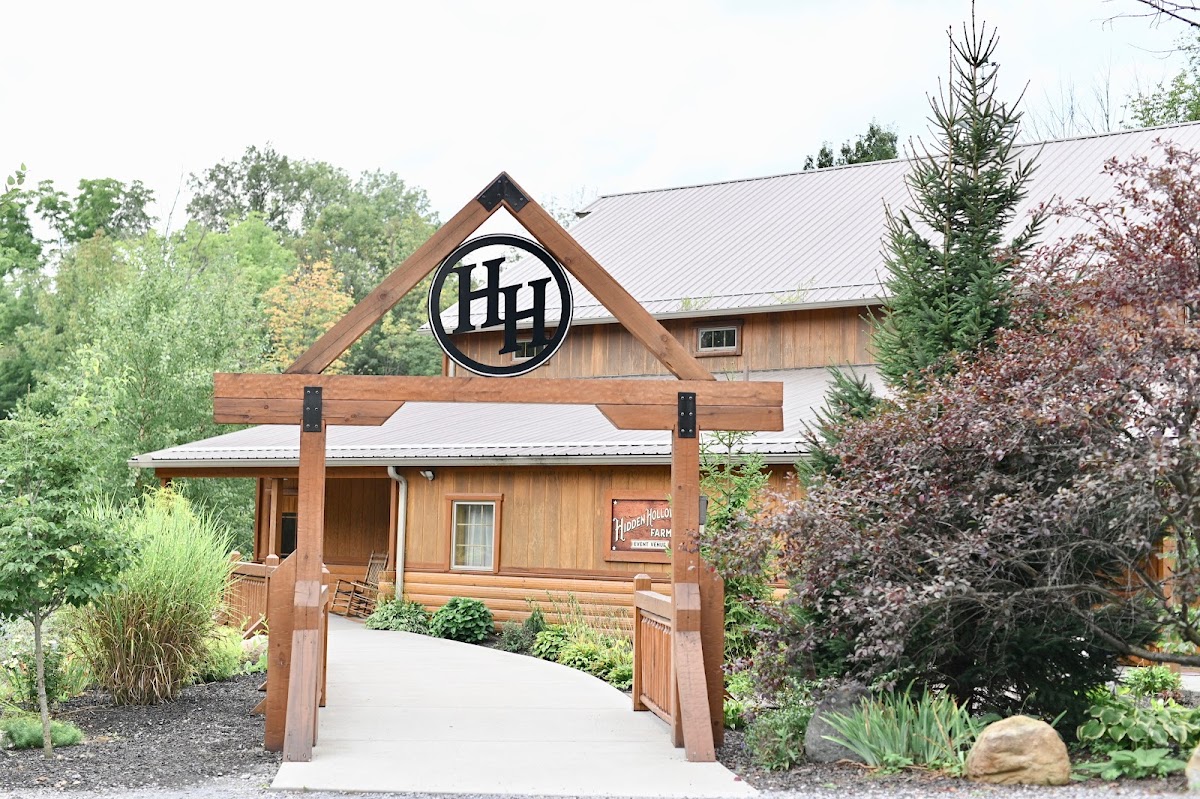
The turn off I-74 comes quickly, and then the highway noise fades behind you. County Road 300 North ribbons through farmland — soybean fields on one side, corn on the other, the occasional red barn set back from the road. You might wonder if you’ve missed the turn. Then the trees thicken, the road dips, and a hand-carved wooden sign announces Hidden Hollow Farm. The driveway curves through a tunnel of maples and oaks, and suddenly the landscape opens: 150 acres of rolling woodland and pasture, a spring-fed pond catching the light, and at the center of it all, the barn. Not a weathered relic patched together for weddings, but a purpose-built structure of honey-toned wood, its 60-by-88-foot frame standing solid and new against the old-growth forest. The sliding doors are thrown wide, revealing Edison bulbs strung across the ceiling and long farmhouse tables waiting to be dressed. This is the kind of place that exhales quiet — no event barns visible on the neighboring properties, no road noise, just birdsong and the rustle of leaves. Hidden Hollow Farm sits 45 minutes northwest of Indianapolis in Crawfordsville, Indiana, and while Poppy hasn’t yet had the pleasure of installing flowers for a wedding here, we’ve received 4 inquiries from couples who found this tucked-away gem and understood immediately what it offers: a private, wooded sanctuary where a celebration can unfold without interruption.
About Hidden Hollow Farm
Hidden Hollow Farm is a family-owned property that opened to weddings with a clear philosophy: build something beautiful, keep it intimate, and let the land do half the work. The 150-acre property has been in agricultural use for generations, but the event barn is a recent addition — constructed in 2020 with modern amenities wrapped in farmhouse aesthetics. The result is a space that feels like a restored heirloom but functions like a well-oiled event venue. The 5,280-square-foot barn interior is entirely wood-clad, with exposed beams, warm Edison lighting, and climate control that makes it functional year-round. The large windowed sliding doors on multiple sides flood the space with natural light during the day and open fully to connect the indoor reception space to the outdoor patios at dusk.
The ceremony site sits at the edge of the woods, a clearing surrounded by mature hardwoods that create a natural cathedral. There’s no need to haul in privacy fencing or attempt to obscure sightlines — the forest does that work. The ceremony space accommodates up to 250 guests on the provided wooden benches, and the altar area sits slightly elevated, backed by a dense canopy of trees. For cocktail hour, couples have the option of utilizing the covered patio (perfect for unpredictable Indiana weather) or the open-air patio that wraps around the barn’s south side, overlooking the pond and open pasture.
The Townsend Lodge, the venue’s on-site lodging, is a separate structure that sleeps 14 guests comfortably. It’s designed for the wedding party or close family, with a full kitchen, gathering areas, and enough space that it doubles as an ideal rehearsal dinner location or post-wedding brunch spot. The barn itself includes dedicated bridal and groom suites with natural light, full-length mirrors, and enough square footage that getting-ready photos don’t feel cramped or staged.
Hidden Hollow Farm operates on an open-vendor model, meaning couples can bring in their own florist, caterer, photographer, and other professionals without restrictions. The venue provides tables, chairs, and basic linens, and the events team handles setup and breakdown. For Poppy’s logistics, the load-in is straightforward: ample parking near the barn entrance, wide doors, and a prep kitchen with counter space suitable for final floral assembly. The drive from Indianapolis is an easy 45 minutes via I-74, and the Crawfordsville area offers a handful of charming B&Bs and farm-stay accommodations for out-of-town guests who want to extend the weekend.
The venue is pet-friendly, which matters for couples who consider their dog a non-negotiable part of the day. There are no noise restrictions or hard curfews, a rarity for a venue this close to residential areas — but the privacy of the 150-acre property makes that possible. From a floral designer’s perspective, Hidden Hollow Farm is a dream: no restrictive decor policies, no mandate to use in-house styling, and a blank-canvas aesthetic that allows flowers to take center stage without competing with overly themed interiors.
Event Spaces & Floral Opportunities
Main Barn
Capacity: 250 seated
Setting: The Main Barn is the gravitational center of a Hidden Hollow Farm wedding. At 60 by 88 feet, it’s spacious enough to accommodate 250 guests comfortably, with room for a dance floor, bar area, and lounge seating. The interior is entirely wood — walls, ceiling, floors — in a warm, unstained finish that reads more Scandinavian farmhouse than rustic Americana. Edison bulbs hang in long strands across the exposed beams, and the ambient lighting casts everything in a soft, golden glow. The windowed sliding barn doors on the east and south walls can be opened fully, blurring the line between indoors and out. The climate control system is discreet, ensuring comfort in the humid Indiana summers and frigid winters without industrial vents disrupting the aesthetic. Modern restrooms and a full prep kitchen with a bar area are integrated seamlessly, so service flows without guests needing to trek to a separate building.
Floral approach: The all-wood interior is a neutral, warm-toned canvas that works with virtually any floral palette, but it rewards restraint and organic design. Overly formal, tightly structured arrangements can feel incongruous here; instead, let the flowers breathe. For centerpieces, consider low, lush compote arrangements in ceramic or wooden vessels — Cafe au Lait dahlias, Quicksand and Juliet roses, white lisianthus, and scabiosa, loosened with trailing jasmine vine and Italian ruscus. Alternatively, go taller with elevated arrangements on slim brass or black iron stands that lift blooms above eye level without blocking the sightlines created by those beautiful windowed doors. The exposed beams are ideal for suspended installations: imagine a 20-foot garland of seeded eucalyptus, olive branches, and smilax, punctuated with clusters of garden roses and hellebores, running the length of the head table. For the bar area, a large urn arrangement with seasonal branches (curly willow in spring, oak leaves in fall) mixed with hydrangea, stock, and spirea creates an impressive focal point. Avoid overly tropical or overly manicured blooms — the space asks for something that feels gathered from a garden or meadow, even if it’s technically cultivated. Hidden Hollow Farm wedding flowers in this barn should feel abundant but never stiff.
Outdoor Ceremony Site
Capacity: 250 seated
Setting: The ceremony site at Hidden Hollow Farm is a woodland clearing surrounded by towering oaks, maples, and hickories. It’s located a short walk from the barn, connected by a stone pathway that winds through the trees. The altar area sits on a slight rise, naturally elevated so every guest has a clear view. The tree canopy overhead is dense enough to provide dappled shade in summer but open enough that the space doesn’t feel dark or enclosed. The venue provides wooden benches for seating, and the forest floor is maintained but natural — no manicured lawn, just native groundcover and leaf litter that gives the space an authentic, unbothered quality. Depending on the season, the surrounding woods shift dramatically: dogwoods bloom white in spring, the canopy glows green in summer, the leaves turn fire-red and gold in fall, and the bare branches create stark, sculptural silhouettes in winter.
Floral approach: The woodland setting is so inherently beautiful that the best floral strategy is often subtraction, not addition. A ceremony arch here doesn’t need to be a floral explosion; it needs to frame the couple without competing with the cathedral of trees behind them. Consider a deconstructed arch using locally sourced branches (ask the venue if you can harvest from the property) or a simple wooden structure dressed asymmetrically with clusters of blooms on one side — garden roses, ranunculus, and sweet peas in spring; zinnias, dahlias, and Queen Anne’s lace in summer; chrysanthemums, marigolds, and oak branches in fall. For the aisle, skip the traditional floral markers every other row; instead, place larger arrangements in wooden crates or galvanized buckets at the entrance and perhaps one or two focal installations midway down the aisle. If the couple wants a more ethereal look, hanging installations work beautifully here: glass orbs or woven grapevine spheres filled with loose blooms and greenery, suspended from low tree branches flanking the aisle. The key is to let the forest remain the star. Hidden Hollow Farm wedding flowers for the ceremony site should feel like they grew there.
Outdoor Patios
Capacity: Flexible, typically 100-150 for cocktail hour
Setting: The outdoor patios wrap around the barn’s south and east sides, offering both covered and open-air options. The covered patio is directly adjacent to the barn’s main entrance, with a solid roof structure and ample space for high-top cocktail tables, lounge seating, and a secondary bar setup. It’s an ideal rain backup for cocktail hour or a shaded retreat during hot summer days. The open-air patio extends beyond the covered area, with views of the spring-fed pond and the open pasture beyond. String lights are pre-installed overhead, and the stone pavers underfoot are level and well-maintained. The patios connect seamlessly to the barn interior when the sliding doors are open, creating one continuous flow from indoor reception space to outdoor lounge areas.
Floral approach: Cocktail hour is where you can afford to have fun with smaller-scale, high-impact installations. For the covered patio, consider hanging arrangements — either individual blooms in glass bud vases suspended at varying heights or fuller installations in hanging baskets filled with trailing ivy, ferns, and seasonal blooms. On the high-top cocktail tables, go for petite arrangements in vintage glass bottles or small ceramic vessels — a single stem of garden rose, a sprig of lavender, a cluster of spray roses and astilbe. These don’t need to be conversation-stopping; they just need to feel intentional and cohesive with the larger floral story. On the open-air patio, larger potted arrangements in rustic containers — galvanized tubs, weathered terracotta, or wooden crates — can anchor lounge seating areas and the secondary bar. If the wedding is in late summer or fall, consider incorporating ornamental grasses (fountain grass, feather reed grass) mixed with zinnias, cosmos, and black-eyed Susans for a meadow-inspired look. The bar itself deserves a statement arrangement: think an oversized urn or wooden box filled with a wild, organic mix of blooms and foliage that spills generously. The patio florals should feel like a transition from the ceremony’s woodland restraint to the barn reception’s full abundance.
The Townsend Lodge
Capacity: Sleeps 14
Setting: The Townsend Lodge is a separate structure on the property, designed for the wedding party or close family to stay overnight. It features a full kitchen, multiple bedrooms, gathering areas with comfortable seating, and large windows that overlook the wooded property. Many couples use it for rehearsal dinners the night before or post-wedding brunches the morning after, in addition to its primary function as lodging. The interior is warm and inviting, with wood finishes, farmhouse-style furniture, and plenty of natural light. It’s about a two-minute walk from the main barn, close enough to be convenient but separate enough to feel like a private retreat.
Floral approach: The Lodge is an opportunity to extend the wedding’s floral narrative into the weekend experience. For a rehearsal dinner held here, use scaled-down versions of the reception centerpieces on the dining table — perhaps smaller compotes or bud vases with a similar palette but a more casual, gathered-from-the-garden feel. A large welcome arrangement in the main gathering area signals arrival and sets the tone: think a rustic wooden box or ceramic urn filled with a loose, organic mix of seasonal blooms and foliage. If the Lodge is used for getting-ready space (though the barn has dedicated suites, some couples prefer the Lodge for its homier vibe), add small personal touches: a petite arrangement on the bathroom vanity, a small bud vase on the bedside table, loose stems for styling shots. For a post-wedding brunch, consider repurposing ceremony or reception flowers — the bridesmaid bouquets in mason jars down the center of the table, leftover centerpiece blooms in a mix of mismatched vintage vessels. The Lodge florals should feel intimate and personal, less formal than the main event but still cohesive in palette and style.
Bridal and Groom Suites
Capacity: 10-12 people comfortably
Setting: Both the bridal and groom suites are located inside the main barn, offering private, well-lit spaces for getting-ready activities. The bridal suite features full-length mirrors, natural light from large windows, seating areas, and enough square footage that a photographer can work without everyone feeling crammed. The groom suite is similarly appointed with comfortable seating, good lighting, and space to hang suits and store personal items. Both suites have direct access to the barn’s modern restrooms, so the wedding party doesn’t need to navigate the main event space in various states of dress.
Floral approach: Getting-ready spaces benefit from small, elegant floral touches that elevate the experience and photograph beautifully without taking up precious counter or table space. In the bridal suite, place a low arrangement on the main table — perhaps a shallow compote filled with garden roses, ranunculus, and trailing jasmine vine in the wedding palette. Loose stems can be scattered artfully on countertops, windowsills, or near the mirror for styling shots. A single stem in a bud vase by the makeup station is a small detail that reads as intentional in photos. For the groom suite, keep it simple: a small arrangement in a masculine vessel (ceramic, dark wood, or metal) with textural greenery, a few roses, and perhaps a succulent or two. If you’re providing boutonnieres, consider delivering them in a wooden box lined with moss, with the stems wrapped in linen ribbon — it’s a beautiful presentation that doubles as decor. The suite florals should feel personal and intimate, designed to enhance the pre-ceremony experience and provide beautiful moments for the photographer to capture.
Wedding Flower Ideas for Hidden Hollow Farm
Indiana Meadow
This concept draws directly from the native wildflowers and grasses of the Indiana countryside, creating a floral story that feels utterly at home in Hidden Hollow’s wooded landscape. The palette is soft and sun-washed: butter yellow, peachy coral, soft lavender, and creamy white, grounded by meadow greens. Specific blooms include black-eyed Susans, cosmos (in white, pink, and coral), zinnias (Queen Lime, Benary’s Giant Coral), Queen Anne’s lace, yarrow, and white lisianthus, mixed with textural grasses like fountain grass and bunny tail. Vessels should be humble and rustic: galvanized buckets, ceramic crocks, wooden crates, and vintage mason jars. For the ceremony arch, weave the blooms asymmetrically into a simple wooden structure, letting some stems extend loosely as if wind-blown. Reception centerpieces can vary in height and container, creating an organic, collected-over-time look. This design works beautifully for late spring through early fall weddings and feels especially at home on the outdoor patios and at the wooded ceremony site. Indiana meadow Hidden Hollow Farm wedding flowers should look like you wandered the property with clippers and gathered armfuls of what was blooming.
Orchard Harvest
For couples marrying in late summer or fall, this concept leans into the agricultural roots of the property with a harvest-inspired palette of deep rust, burnt orange, golden yellow, plum, and forest green. Think dahlias (Cafe au Lait, Labyrinth, Cornel Bronze), garden roses in autumnal tones (Free Spirit, Julia Child), marigolds, celosia, scabiosa pods, privet berries, and branches of crabapple or bittersweet. Foliage includes oak and maple leaves in their fall glory, seeded eucalyptus, and Italian ruscus. Containers lean rustic and substantial: wooden dough bowls, ceramic crocks in cream or rust tones, copper vessels, and woven baskets. For the barn reception, consider incorporating elements beyond just flowers: small pumpkins, gourds, and apples nestled into centerpieces, or wooden slices as bases for arrangements. The bar arrangement could include a dramatic branch installation with hanging pears or apples wired into the foliage. On the outdoor patio, larger potted mums in rust and gold tones can anchor lounge areas. This palette is rich without being heavy, and it complements the barn’s warm wood tones beautifully. Orchard harvest florals should feel abundant, textural, and unmistakably tied to the season and setting.
Garden Romance
For couples who want something softer and more traditionally romantic, this concept uses a classic palette of blush, ivory, champagne, and soft gray-green, with moments of deeper mauve for contrast. The flower list includes Quicksand, Juliet, and Patience garden roses, white ranunculus, blush astilbe, white sweet peas, hellebores, and spray roses in soft tones, all loosened with jasmine vine, silver dollar eucalyptus, and dusty miller. Vessels should feel refined but not overly formal: ceramic compotes in cream or soft gray, brass bud vases, vintage milk glass, and linen-wrapped pots. For the ceremony, a lush arch that’s fuller and more structured than the meadow concept, with blooms densely clustered and trailing elements creating a romantic, garden-gathered look. Reception centerpieces can mix heights — some low and lush, others elevated on slim brass stands — to create visual variety. This palette works year-round (sourcing adjusts seasonally) but is especially stunning in spring and early summer when garden roses and sweet peas are at their peak. The lighting in the barn at dusk makes these soft tones absolutely glow. Garden romance Hidden Hollow Farm wedding flowers should feel like you raided an English cottage garden at its most abundant moment.
Seasonal Considerations
Hidden Hollow Farm’s location in central Indiana means couples experience four distinct seasons, each with advantages and challenges for wedding flowers. Understanding regional climate patterns and bloom availability helps optimize both budget and design.
Spring (March-May): Indiana springs are unpredictable — March can bring late snows, while May can feel like summer arrived early. Average temperatures range from the 40s to 70s Fahrenheit. The wooded ceremony site comes alive with native dogwoods, redbuds, and wildflowers blooming on the forest floor, providing a naturally stunning backdrop. Locally available blooms include tulips (especially mid-to-late spring), daffodils, hyacinths, and flowering branches (forsythia, quince, cherry). Imported garden roses, ranunculus, anemones, and sweet peas are at their peak quality and often most affordable. The challenge: weather volatility. Be prepared for rain (the covered patio is essential for cocktail hour) and potential temperature swings. Avoid overly delicate blooms that wilt in heat if you’re marrying late May. Best months: Late April and May, when the forest is fully green and temperatures stabilize.
Summer (June-August): Indiana summers are warm and humid, with temperatures regularly reaching the 80s and 90s Fahrenheit, plus afternoon thunderstorms. The tree canopy at the ceremony site provides welcome shade, and the barn’s climate control is essential. Locally available blooms include sunflowers, zinnias, dahlias (starting mid-July), cosmos, celosia, and Queen Anne’s lace. Many garden roses struggle in extreme heat, so focus on heat-tolerant varieties or source from cooler regions. Hydrangeas (both locally grown and imported) are abundant. The advantage: long daylight hours mean golden hour light stretches well into the evening, perfect for outdoor patio use. The challenge: heat and humidity can stress blooms quickly, so arrangements need to be installed as close to event start as possible. Avoid delicate flowers like sweet peas and anemones. Best months: June and September (technically early fall but often summer-like), when temperatures are warm but not oppressive.
Fall (September-November): Fall is peak wedding season at Hidden Hollow Farm, and for good reason. The surrounding forest becomes a kaleidoscope of reds, oranges, and golds, creating a backdrop that no florist can compete with. Temperatures range from the 70s in September to the 40s by November. Locally available blooms include dahlias (at their absolute peak), sunflowers, zinnias, marigolds, asters, and chrysanthemums. Branches with fall foliage (oak, maple) and berries (bittersweet, privet) add texture and seasonal character. Imported garden roses, ranunculus, and lisianthus are readily available. The challenge: November weddings risk bare trees and cold temperatures, so plan accordingly. The advantage: the natural beauty of the setting requires less floral supplementation, allowing budget to be concentrated on ceremony and reception focal points. Best months: Late September and October, when foliage peaks and temperatures are ideal.
Winter (December-February): Indiana winters are cold, with temperatures often below freezing and occasional snow. The wooded ceremony site loses its leaves, creating a stark, sculptural backdrop that some couples find beautifully minimalist. The barn’s climate control is essential. Locally available blooms are limited, but imported options include amaryllis, anemones, ranunculus, tulips, and hellebores. Evergreen branches (pine, cedar, fir), pinecones, and berries (holly, winterberry) add seasonal texture. The challenge: outdoor elements are largely unusable unless heated, so plan for indoor ceremony and cocktail hour. The advantage: winter florals often feel more luxurious and dramatic, and the barn’s Edison lighting creates an especially cozy, romantic atmosphere. Best months: December (for holiday-adjacent celebrations with festive greenery) and February (when couples are eager for any escape from winter).
Poppy’s Expert Take
The ceremony arch doesn’t need to be a floral wall. Hidden Hollow’s wooded ceremony site is so naturally beautiful that a massive floral installation can actually detract from the setting. Instead, consider a simple wooden or metal arch dressed asymmetrically with clusters of blooms on one side and trailing greenery on the other. This approach feels organic, costs significantly less, and lets the forest remain the hero. If you want more floral impact, invest instead in aisle markers or a lush arrangement at the altar base.
The barn’s warm lighting is your friend — use it. The Edison bulbs and natural wood create a golden-hour glow even at midnight. Choose floral palettes that work with this warm light rather than against it. Soft blush, peach, champagne, rust, and mauve tones will absolutely glow. Cool-toned palettes (icy blues, pure whites, silvers) can read flat or even slightly dingy under warm lighting. If you love cooler tones, add warm accents (champagne, gold, or peach) to balance.
Plan for the patio, even if weather is uncertain. The covered patio provides insurance against rain, but couples often underestimate how much time guests will spend outdoors, especially during cocktail hour. Invest in at least a few high-impact elements here — a bar arrangement, a few potted plants, or hanging installations. This area is highly photographed and sets the tone for the evening, so don’t treat it as an afterthought.
Repurposing ceremony flowers saves money and makes logistical sense. The ceremony site is a short walk from the barn, but it’s close enough that moving arrangements is feasible during cocktail hour. Ceremony arch flowers can be repositioned as a backdrop for the sweetheart table or cake table. Aisle arrangements can move to the patio or bar. Discuss this plan with your florist early so vessels and mechanics are designed for easy transport.
Communicate with your photographer about floral priorities. The natural light at Hidden Hollow is incredible, especially during golden hour on the patios and at the ceremony site. Work with your photographer to identify which floral elements matter most for their shot list (usually the ceremony arch, bridal bouquet, and a few key reception details), and concentrate your budget there. Flowers that won’t be photographed closely (like far corners of the barn or guest table arrangements in low-light areas) can be simplified without impacting the overall aesthetic.
The Townsend Lodge is an underutilized opportunity. If your wedding party is staying at the Lodge, consider using it for a rehearsal dinner or morning-after brunch and investing in florals for those moments. These tend to be smaller, more intimate gatherings where florals have significant impact, and you can often repurpose leftover blooms from the wedding day. A large welcome arrangement and a few simple centerpieces transform the space at a fraction of the cost of the main event florals.
Ask about harvesting branches from the property. The 150 acres include plenty of natural material that, with permission from the venue, can be incorporated into your floral designs for free. Seasonal branches (dogwood and redbud in spring, oak and maple in fall, evergreen in winter) add volume and texture to arrangements without added cost. This also deepens the connection between the flowers and the land, making the design feel truly site-specific.
What Poppy Couples Spend on Flowers Here
While we haven’t yet had the pleasure of designing for a Hidden Hollow Farm wedding, our experience with similar barn venues in the Indianapolis market gives us a clear sense of how to approach floral budgets here. Most Poppy couples investing in weddings at venues of this style and capacity fall into three general ranges, each offering a distinct level of coverage and impact.
$2,800 - $4,500 | The Essentials This range covers the foundational elements: personal flowers (bridal bouquet, bridesmaid bouquets, boutonnieres, corsages), a modest ceremony installation (either a dressed arch or a pair of substantial arrangements flanking the altar), simple aisle markers at the entrance, and reception centerpieces for all guest tables in a single style. At Hidden Hollow, this budget works especially well if you lean into the natural beauty of the wooded ceremony site and concentrate your investment in the barn reception space. Think low, lush centerpieces in ceramic compotes or wooden boxes for all guest tables, a statement bar arrangement, and perhaps a small installation for the sweetheart table or cake area. Personal flowers can be garden-style with a good mix of focal blooms (garden roses, dahlias) and textural elements (greenery, spray roses, scabiosa). Repurposing ceremony flowers to the barn during cocktail hour stretches this budget further. This tier works beautifully for couples who trust the venue to carry much of the aesthetic weight.
$4,500 - $7,000 | The Full Picture This range allows for more variety and visual interest across all spaces. In addition to the essentials, you can add a fuller ceremony arch installation, more elaborate aisle treatments (arrangements every few rows rather than just at the entrance), upgraded personal flowers (larger bridal bouquet, more premium blooms like peonies or specialty roses), and varied centerpiece styles at the reception (a mix of low, medium, and tall arrangements to create dynamic tablescapes). The outdoor patios get dedicated attention — cocktail table arrangements, a substantial bar installation, perhaps potted plants or hanging elements on the covered patio. You might also add floral touches to the bridal and groom suites, a welcome arrangement for the Townsend Lodge if you’re using it for rehearsal activities, and smaller details like restroom florals or arrangements for the gift and escort card tables. This budget allows for a cohesive floral story across the entire property without the need for constant repurposing and moving arrangements.
$7,000+ | The Full Experience At this level, Hidden Hollow Farm becomes a fully immersive floral environment. The ceremony arch is lush and abundant, aisle markers are frequent and substantial, and you might add hanging installations from the tree branches flanking the aisle. Personal flowers are elevated — cascading bridal bouquet, premium blooms throughout, perhaps floral crowns or more elaborate boutonnieres. The barn reception features varied centerpiece styles, a dramatic suspended installation over the head table or dance floor, large-scale arrangements at the bar and entrance, and layered styling on the sweetheart table or stage. The patios are treated as full event spaces with significant floral investments: multiple bar arrangements, numerous cocktail table florals, large potted installations, and potentially hanging elements throughout the covered patio. The Townsend Lodge receives full floral treatment if it’s in use for rehearsal or brunch, the suites have multiple arrangements, and no detail is overlooked — even small touches like floral napkin rings or individual bud vases at each place setting. This tier is for couples who want flowers to be a defining element of their celebration, where every space guests encounter is thoughtfully designed and abundant with blooms. Hidden Hollow Farm’s neutral, organic aesthetic provides the perfect canvas for this level of floral artistry.