
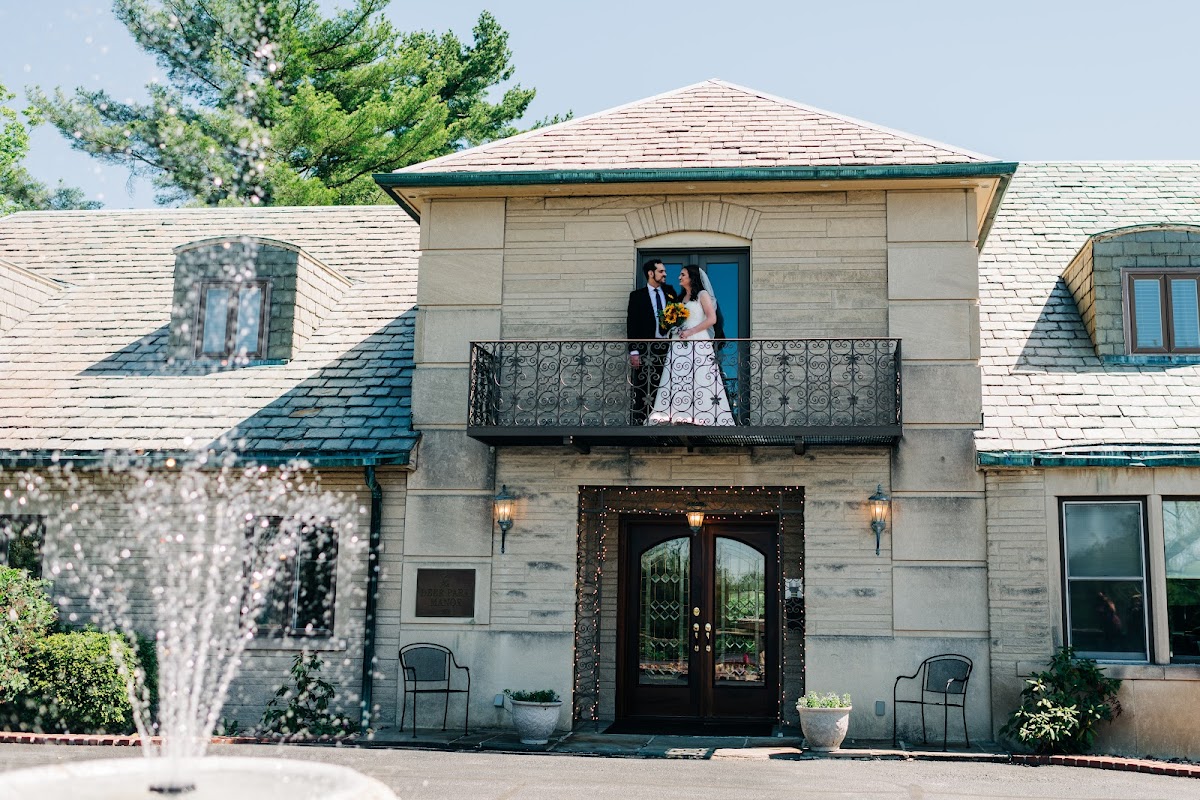
The gated entrance to Deer Park Manor sits on East Hillside Drive, just minutes from Indiana University’s campus but feeling entirely removed from collegiate bustle. You pass through that gate, and the world shifts. The road curves into what the venue calls an “enchanted nature preserve,” which sounds like marketing language until you see it for yourself — and then the phrase makes perfect sense. Historic limestone quarry remnants rise from the ground like ancient ruins, softened by decades of moss and lichen. Deer emerge from the tree line, unbothered by your arrival, their white tails flicking as they browse the wildflower meadows. Red foxes have been spotted here at dusk. The grounds unfold in terraces — manicured gardens transitioning to wilder spaces, ponds reflecting the canopy above, waterfalls trickling over limestone ledges, and finally the Manor itself, set among mature hardwoods and flowering understory. The central courtyard fountain sounds like something from a European villa, water splashing over stone while goldfinches dart between the surrounding plantings. This is not a venue trying to manufacture enchantment. The land itself does the work. Poppy has designed Deer Park Manor wedding flowers for 1 celebration here so far, and the experience left us eager to return — this property rewards a florist who knows how to let nature lead.
About Deer Park Manor
Deer Park Manor occupies land that has held multiple lives. The limestone quarries that once operated here have been reclaimed by the forest, leaving behind dramatic stone formations that now serve as ceremony backdrops and photo locations. The property spans enough acreage to create genuine seclusion — you can hold a 175-person celebration here and still feel like you have discovered a private paradise. The terraced gardens cascade down the hillside in deliberate levels, each tier offering a different microclimate and aesthetic. The upper terrace features formal plantings around the central fountain, with boxwood hedges, perennial beds that bloom in waves from April through October, and mature specimen trees that provide dappled shade. The middle terrace incorporates water features — naturalistic ponds edged with native grasses, small waterfalls that flow between the levels, and enough aquatic plantings to attract dragonflies and butterflies throughout the warm months. The lower terrace transitions to the wilder preserve where the deer roam, meadows full of black-eyed Susans, purple coneflowers, Queen Anne’s lace, and goldenrod depending on the season.
The Manor building itself houses the Grand Hall, a generous indoor space that accommodates up to 120 guests for seated dining. The room features a built-in dance floor, a professional lighting system that allows for customized ambiance, and full kitchen access for caterers — a significant advantage for Bloomington wedding florists like Poppy, as it means we can coordinate with catering teams for smooth setup and timeline management. The aesthetic inside is refined-rustic: hardwood floors, neutral walls that serve as a blank canvas for décor, and architectural details that feel substantial without being fussy. Above the Grand Hall sits The Penthouse, a 3,000-square-foot luxury condo that functions as both bridal suite and overnight accommodation. Three bedrooms, a gourmet kitchen, a living room with comfortable seating, and a balcony overlooking the property make this an exceptional getting-ready space — one where the bridal party can truly settle in rather than feeling squeezed into a glorified closet.
Logistically, Deer Park Manor sits in Bloomington’s East Hillside neighborhood, near Bryan Park and roughly one mile from Indiana University’s campus. The drive from Indianapolis takes about an hour, making this a feasible option for couples with guest lists drawn from both the Bloomington and Indianapolis areas. The surrounding neighborhood is quiet and residential, with the kind of tree-canopy streets that feel quintessentially Midwestern. Downtown Bloomington’s restaurants, breweries, and accommodations are just minutes away, which helps when planning a wedding weekend with out-of-town guests. For Poppy’s delivery logistics, the venue offers ample on-site parking with space for vendor load-in near the event areas. The events team at Deer Park Manor is responsive and organized, and critically, they allow outside vendors — including florists — without restriction, though they do maintain a preferred vendor list and require all vendors to carry liability insurance. The venue encourages couples to use their preferred professionals but does not mandate it, which gives us the creative freedom to design without navigating exclusivity politics.
One detail worth noting: the property allows tent rentals up to 40’x80’ on the designated lawn area, which means couples can scale up to 175 guests for outdoor receptions even if weather or preference makes the indoor Grand Hall less suitable. The natural setting, the flexible indoor-outdoor options, and the genuine wildlife presence make Deer Park Manor a standout in the Bloomington wedding venue landscape — a property that lets you throw a sophisticated celebration without sacrificing the feeling of having escaped into the woods.
Event Spaces & Floral Opportunities
Ceremony Court Yard
Capacity: 175 seated
Setting: The Ceremony Court Yard is the primary outdoor ceremony location, positioned to take advantage of the property’s mature tree canopy and natural landscaping. The space is terraced, with subtle elevation changes that create built-in stadium seating options for guests — no one struggles to see over the person in front of them. The backdrop is pure preserved woodland: towering oaks and maples, native understory plantings, and filtered sunlight that shifts throughout the day. The ground is covered with astroturf in the main seating area, which sounds artificial until you realize it solves the logistical nightmare of guests sinking into soft earth or navigating uneven terrain in heels. Beyond the seating area, the landscape transitions to wildflower meadow and preserve, where deer genuinely do appear during setup hours (and occasionally during ceremonies, which guests find charming rather than disruptive).
Floral approach: The cardinal rule here is restraint. This is not a space that needs correction or enhancement — it needs punctuation. We favor a single, sculptural ceremony structure rather than competing with the natural surroundings. A hexagonal arbor constructed from reclaimed wood or copper tubing, positioned off-center rather than dead-center in the ceremony space, allows the woodland backdrop to remain visible while still providing a clear focal point. Dress the arbor asymmetrically with one dramatic floral cluster — think Café au Lait dahlias, Quicksand and Toffee roses, white lisianthus, and trails of jasmine vine, anchored with eucalyptus and olive branches that echo the silvery undertones of the limestone outcroppings visible throughout the grounds. Aisle markers should be minimal: either simple posies tied to every third chair with silk ribbon, or low shepherd’s hooks holding small arrangements that read more like wildflower pickings than formal florals. If the couple wants more presence, consider a floral-draped welcome table at the entrance to the ceremony space, or a pair of large-scale urns flanking the aisle entrance, overflowing with garden roses, hydrangeas, and textured greenery. For May through September ceremonies, incorporating native Indiana wildflowers — black-eyed Susans, purple coneflowers, Queen Anne’s lace — alongside cultivated blooms creates continuity with the surrounding meadows. The astroturf area can accommodate a tent for tented receptions, in which case the ceremony florals should anticipate how they will translate (or be repurposed) into the tented space.
Grand Hall / Banquet Hall
Capacity: 120 seated
Setting: The Grand Hall serves as the primary indoor reception venue, offering climate-controlled comfort year-round and a professional infrastructure that outdoor spaces cannot match. The room is generously proportioned with a ceiling height that allows for suspended installations, hardwood floors that provide warmth underfoot, and a built-in dance floor that saves couples the rental expense. The lighting system is more sophisticated than typical for a venue at this price point — dimmable overhead fixtures, uplighting capability, and enough control to shift the room’s mood from dinner ambiance to dance party without anyone noticing the transition. The walls are painted in soft cream, the trim is classic white, and the overall aesthetic leans neutral-traditional, which means the space adapts to virtually any design direction. Large windows on one wall provide natural light during daytime events and views of the gardens and grounds. The kitchen access is direct, which keeps catering service smooth and minimizes the awkward parade of staff weaving through guests.
Floral approach: This room demands substantial centerpieces — the scale and formality of the space call for arrangements with real presence. We typically recommend a mix of heights to create visual rhythm across the room: tall arrangements on clear glass or lucite risers for half the tables, low and lush compote-style arrangements for the other half. For tall centerpieces, consider 30-inch glass cylinders filled with submerged Italian ruscus and topped with clusters of hydrangeas (white, blush, or soft blue depending on palette), Quicksand roses, white lisianthus, and trailing amaranthus that drapes over the rim. For low centerpieces, use aged brass or ceramic compotes filled with garden-style arrangements — Juliet and Patience roses, ranunculus, hellebores in season, scabiosa, astilbe, and plenty of textured greenery like eucalyptus and maidenhair fern. The head table benefits from a continuous garland installation: a 20-foot runner of smilax, Italian ruscus, and olive branch woven with clusters of blooms and trailing ribbons. The lighting system allows for dramatic uplighting behind large arrangements placed on pedestals in the room’s corners, creating focal points that anchor the space. If budget allows, a suspended installation above the dance floor — either a circular chandelier constructed from grapevine, greenery, and florals, or a series of hanging glass terrariums filled with votives and small floral clusters — adds a layer of sophistication that photographs beautifully and makes the room feel custom-designed rather than generic banquet hall.
The Penthouse
Capacity: Not applicable (bridal suite and overnight accommodation)
Setting: The Penthouse occupies the upper level of the Manor, offering 3,000 square feet of luxuriously appointed space that serves triple duty as bridal suite, accommodation for the wedding couple or family, and occasionally as a groom’s quarters or family gathering space. Three separate bedrooms mean the bridal party can spread out, the gourmet kitchen allows for coffee service and light breakfast without leaving the suite, and the living room provides comfortable seating for the inevitable pre-ceremony waiting period when everyone is dressed and ready but has ninety minutes to kill. The balcony overlooks the gardens and grounds, offering sweeping views that make for stunning getting-ready photos — bride in robe with coffee cup, bridesmaids leaning on the railing, that sort of thing. The décor is contemporary-neutral with high-end finishes, which means it photographs clean without competing for attention.
Floral approach: The Penthouse is not a primary floral focus space, but small, considered touches make a significant difference in getting-ready photos and in how the bridal party experiences the morning. We recommend a single statement arrangement for the living room — something large and romantic in a textured ceramic vessel, perhaps blush and cream garden roses (Keira, Quicksand, Patience), white ranunculus, hellebores if in season, and plenty of movement from jasmine vine or scented geranium foliage. This arrangement should be delivered the morning of the wedding and positioned where it will appear in candid photos — on the coffee table, on the kitchen island, or near the seating area. For the bedrooms, consider small bud vases or posies, one per room, using a few blooms pulled from the bridal bouquet palette so there is visual continuity. If the bride is having her bouquet delivered to The Penthouse for getting-ready photos (which we recommend), a simple presentation box lined with tissue adds a moment of ceremony to the reveal. The balcony railing can be dressed with a short garland or a few clusters of florals if the couple wants balcony photos to feel elevated, though this is optional — the view itself does most of the work. What matters more than volume here is intentionality: these florals are about creating moments of beauty in the margins of the day, not about filling space.
Lawn / Tented Reception Area
Capacity: 175 seated
Setting: The lawn is the venue’s largest outdoor space, a broad expanse of maintained grass that can accommodate tents up to 40’x80’ — large enough for a 175-guest seated reception with room for a dance floor, bar setup, and lounge areas. The lawn sits adjacent to the Ceremony Court Yard, which makes for easy guest flow if the ceremony is held outdoors and the reception moves under the tent. The perimeter is defined by the property’s mature tree line, which provides natural screening and a sense of enclosure without feeling claustrophobic. The venue allows couples to work with their preferred tent rental company, which means you have control over tent style — clear-top for stargazing, sailcloth for soft light, traditional pole tent for classic elegance. The astroturf and open layout also mean this space can accommodate outdoor grills, carving stations, food trucks, or other non-traditional catering setups that couples sometimes prefer for more casual receptions.
Floral approach: Tented weddings present both challenges and opportunities for floral design. The tent structure itself becomes part of the architecture, and florals need to work with — not against — the lines and style of the tent. For clear-top or sailcloth tents, we favor suspended installations that take advantage of the height: floral chandeliers constructed from grapevine hoops or wooden frames, wrapped with smilax and accented with clusters of garden roses, hydrangeas, and trailing amaranthus. These can be positioned above the dance floor or along the tent’s centerline to draw the eye upward. For traditional pole tents, consider wrapping the poles themselves with garlands of greenery and florals — Italian ruscus, eucalyptus, and clusters of blooms at intervals create a cohesive look that softens the industrial elements. The tent entrance deserves significant floral attention, as it is the threshold between outdoor and indoor: large urns or wooden boxes overflowing with seasonal florals and branches frame the entry and signal the transition. Inside the tent, centerpieces can follow the same tall/low pattern recommended for the Grand Hall, though tent weddings sometimes benefit from more greenery and fewer structured arrangements — the outdoor setting invites a looser, more organic aesthetic. Lounge areas within the tent (if included) should have their own floral moments: arrangements on cocktail tables, garlands along the bar front, and florals integrated into any photo backdrop or installation the couple has planned. One often-overlooked opportunity: the tent perimeter where it meets the tree line can be dressed with potted plants, lanterns, and small floral clusters to create a seamless transition between the constructed and natural environments.
Garden Areas
Capacity: Varies (primarily used for intimate ceremonies and photo locations)
Setting: The terraced gardens are the jewel of the property — multiple levels connected by stone pathways, each terrace offering a different character and photo opportunity. The upper terrace centers on the courtyard fountain, a substantial stone feature with water spilling over multiple tiers, surrounded by formal plantings and framed by mature boxwoods and specimen trees. The middle terrace incorporates naturalistic ponds with stone edges, small waterfalls flowing between levels, and aquatic plantings like water lilies, irises, and ornamental grasses. The lower terrace transitions to the wildflower meadow and preserve, where the landscape becomes less manicured and more ecological — native perennials, volunteer seedlings, and the occasional deer path winding through. The entire garden area is designed for wandering, with benches positioned at scenic overlooks and enough variety to keep guests engaged during cocktail hour or photo time.
Floral approach: The gardens require the lightest floral touch of any space on the property — they are already complete. For intimate ceremonies held in the garden (which work beautifully for guest counts under 50), we recommend a minimalist approach: a simple ceremony backdrop using the fountain or a stone wall as the architectural element, dressed with a single floral swag or a pair of lush arrangements flanking the officiant’s position. The fountain itself can be enhanced with floating florals — garden rose blooms, dahlias, or lotus flowers depending on season and palette — which photograph gorgeously and add a layer of romance without requiring structural installation. For photo purposes, we sometimes position a small floral installation at one of the scenic overlooks — a chair draped with silk ribbon and dressed with a floral cascade, or a styled vignette with vintage furniture and abundant florals — to give the photographer a curated backdrop option. The garden pathways can be marked with lanterns or small floral posies at intervals if the gardens will be used for guest circulation during cocktail hour, though this is more about wayfinding than decoration. What we do not recommend: trying to “improve” the gardens with large floral installations or structured arrangements that compete with the existing plantings. The gardens are already designed by professionals (nature and the venue’s landscaping team), and our job as florists is to offer small moments of accent, not to redesign what already works. This is a space where a Bloomington wedding florist earns their fee by knowing when to pull back.
Wedding Flower Ideas for Deer Park Manor
Limestone & Wildflower
This concept takes direct inspiration from the property’s most distinctive features — the historic limestone quarry remnants and the wildflower meadows where deer browse. The palette is warm and earthy: ivory, buff, soft coral, and touches of rust and marigold, anchored by silvery foliage that echoes the lichen-covered stone throughout the grounds. Flowers include Café au Lait and Breakout dahlias, Juliet and Patience garden roses, peach ranunculus, rust-colored carnations (yes, carnations — the ruffled, textured varieties that read sophisticated rather than dated), Queen Anne’s lace, yarrow, and black-eyed Susans for late summer weddings. Foliage includes eucalyptus (both seeded and silver dollar), olive branches, dusty miller, and trails of jasmine vine. Arrangements sit in vessels that reference the limestone: rough ceramic in sand and cream tones, concrete planters for larger installations, and weathered stone urns for the ceremony arch or entrance pieces. This concept works beautifully in the Ceremony Court Yard where the natural limestone outcroppings are visible, and translates seamlessly into the Grand Hall with its neutral palette. The look is organic and unstructured — no tight, symmetrical arrangements here — with blooms appearing to have been gathered from the meadow and arranged with an artist’s eye. For the fountain area, we float dahlias and garden roses in the water and surround the base with low, mounded arrangements that mimic wildflower clusters. This is Deer Park Manor wedding flowers at their most site-specific: deeply rooted in the landscape, impossible to imagine anywhere else.
English Garden Romance
For couples drawn to the terraced gardens and the European feel of the fountain courtyard, this concept channels the lush romanticism of an English country garden. The palette is soft and layered: blush, ivory, pale lavender, soft peach, and the occasional pop of deeper rose, all grounded in abundant greenery. Flowers include garden roses in every variety Poppy can source (Keira, Quicksand, Patience, Romantic Antike, Mayra’s Rose), ranunculus, anemones, hellebores in spring, sweet peas when available, delphinium, larkspur, astilbe, and plenty of textured foliage like maidenhair fern, Italian ruscus, and trails of ivy. Arrangements are lush and overflowing, designed to look like they have been growing in the garden for years and were simply cut and arranged an hour before the ceremony. Vessels include aged brass compotes, mercury glass, vintage silver, and ceramic urns in soft white or celadon green. This concept shines in the Grand Hall with its formal architecture and generous proportions — the tall centerpieces here can be genuinely dramatic, with blooms spilling over the edges and trailing down toward the table. For garden ceremonies, we position large urns at the ceremony entrance overflowing with roses and trailing foliage, and create a ceremony backdrop that looks like a living garden wall. The fountain becomes a focal point with arrangements encircling the base and floating blooms on the water’s surface. This is a high-bloom-count concept — one that requires budget to execute properly — but when done right, it transforms the venue into something out of a period film. Guests will ask if the gardens always look like this, and the answer is: only on your wedding day.
Modern Meadow
This concept offers a contemporary take on the property’s natural beauty, pairing organic materials with clean lines and unexpected color. The palette is cooler and more graphic: white, soft gray-blue, lavender, and deep plum, accented with silver foliage and the occasional pop of warm gold. Flowers include white anemones with black centers, privet berries, white scabiosa, lavender, blue thistle, plum-toned hellebores, café au lait dahlias, and silvery eryngium. Foliage includes seeded eucalyptus, dusty miller, senecio, and olive branches. Arrangements sit in modern vessels: clear glass cylinders, lucite risers, concrete geometric planters, and matte black ceramic. The style is more structured than the previous concepts but still maintains organic movement — think architectural rather than tight and formal. This concept works exceptionally well for tent weddings where the clean lines of the tent structure call for equally clean floral design. Suspended installations can incorporate geometric frames (hexagons, rectangles) wrapped with greenery and accented with clustered blooms. Centerpieces alternate between tall and low, but all maintain visual clarity — no blowsy, overstuffed arrangements here. For the ceremony, we favor a single statement installation rather than multiple smaller pieces: perhaps a modern hexagonal arbor dressed with an asymmetrical floral cluster in the concept’s cool palette, positioned to frame the woodland backdrop without competing with it. This concept appeals to couples who love the venue’s natural setting but want their wedding design to feel current and curated rather than rustic-romantic. It is proof that you can honor the landscape without defaulting to expected wildflower-and-burlap territory.
Seasonal Considerations
Bloomington’s climate brings four distinct seasons, each offering different opportunities and considerations for wedding florals at Deer Park Manor. The property sits in USDA hardiness zone 6a, which means winters can be genuinely cold (lows to -10°F) and summers hot and humid (highs pushing 90°F). Understanding how the seasons affect both the venue’s landscape and your floral options is essential for successful design.
Spring (April–May) arrives slowly in southern Indiana, with April temperatures still unpredictable (could be 45°F and rainy, could be 70°F and perfect) and May offering more reliable warmth. The property’s gardens come alive during these months: daffodils and tulips in April, followed by azaleas, dogwoods, redbuds, and flowering crabapples in May. The tree canopy leafs out, transforming the woodland backdrop from bare branches to full green cover. For florals, spring offers exceptional availability of bulb flowers (tulips, hyacinths, ranunculus, anemones), early garden roses, and the first peonies by late May. Hellebores, sweet peas, and lilac are also in play. The challenge is weather unpredictability: spring weddings need backup plans for rain, and cool temperatures mean heat-sensitive flowers like tulips will last beautifully in arrangements. The terraced gardens are at their most photogenic in May, which makes garden ceremonies especially appealing. Deer Park Manor wedding flowers in spring should lean into the bulbs and celebrate the property’s natural spring display without trying to compete.
Summer (June–August) brings heat, humidity, and the fullness of the growing season. The meadows bloom with native perennials — black-eyed Susans, coneflowers, Queen Anne’s lace — and the tree canopy provides crucial shade for outdoor events. Temperatures regularly reach the upper 80s and low 90s, with high humidity that challenges delicate flowers. For florals, summer means focusing on heat-tolerant varieties: zinnias, dahlias, sunflowers, celosia, hydrangeas, and the sturdier roses. Peonies are mostly finished by July, though occasional late varieties appear. Ranunculus and anemones are off the table — they do not ship well in heat and wilt quickly. Outdoor arrangements require extra hydration and should avoid the most fragile varieties. The advantage: summer offers the longest daylight hours for outdoor ceremonies, the warmest weather for tented receptions, and the meadow’s natural wildflower display at peak. For ceremony florals, we favor architectural installations that use fewer but larger blooms, supplemented with abundant greenery that holds up better in heat. Late June and September offer the sweet spots — warm but not oppressive, with good flower availability and lower risk of extreme heat.
Fall (September–November) is peak wedding season in Bloomington for good reason. September still feels like summer but with lower humidity and cooler evenings. October brings the foliage show: maples turning scarlet and gold, oaks shifting to bronze, and the understory plants adding layers of amber and rust. November can be stunning (warm Indian summer days) or challenging (cold rain, early snow). For florals, fall offers the best of both worlds: late summer flowers (dahlias at their peak, zinnias, sunflowers) overlapping with early fall varieties (mums, asters, marigolds) and the year’s best garden roses. Texture becomes easier to source: seed pods, berries, fall foliage branches, ornamental grasses, and persimmon branches. The property’s natural color palette shifts toward warm tones, which makes fall the ideal time for rich, saturated floral palettes — burgundy, rust, marigold, deep coral — that would feel heavy in spring but perfect against October’s backdrop. The cooler temperatures mean flowers last longer, outdoor ceremonies are comfortable, and the risk of heat-wilting arrangements is gone. This is the season when Deer Park Manor’s natural beauty peaks, and florals should enhance rather than overshadow that display.
Winter (December–February) is the quietest wedding season here, but couples who choose winter often have the most memorable celebrations. The property takes on a stark beauty: bare tree branches creating graphic silhouettes, the possibility of snow transforming the landscape into something ethereal, and the limestone outcroppings becoming more visible without foliage to obscure them. Winter weddings almost always happen in the Grand Hall rather than outdoors, which shifts the floral focus entirely to the indoor space. For florals, winter requires relying on greenhouse-grown or imported varieties: roses, carnations, mums, and evergreen branches are the workhorses. Amaryllis, paperwhites, and hellebores appear in limited quantities. The advantage: winter allows for dramatic color choices without worrying about how they will photograph against the landscape, since most of the landscape is dormant. Deep jewel tones (emerald, burgundy, navy accents with florals), winter whites and silvers, or even unexpected brights can work beautifully. Evergreen garlands, pinecones, and branches add texture and a seasonal feel without reading as overtly Christmas unless that is the goal. If snow falls, the property becomes a winter wonderland, and ceremony photos taken on the terraced gardens or near the fountain are unforgettable. Logistically, winter requires contingency plans for icy roads and ensuring vendor access is clear, but the couples who embrace the season often get the most unique and intimate celebrations.
Poppy’s Expert Take
The fountain is your secret weapon for cocktail hour. Most couples focus floral budget on the ceremony and reception, overlooking cocktail hour entirely. At Deer Park Manor, the central courtyard fountain provides a ready-made focal point that guests will naturally gravitate toward during cocktails. We position arrangements around the fountain’s base — lush, low clusters that appear to be growing there — and float blooms on the water’s surface. The effect is romantic and photogenic, and it takes advantage of a feature the venue already offers. Budget-conscious couples can invest minimally here (a few dozen floating blooms and two medium arrangements flanking the fountain) and still create significant impact. The sound of the water, the movement of the floating flowers, and the garden setting do most of the work.
Timing deliveries for The Penthouse requires coordination. If you are having your bouquet and any getting-ready arrangements delivered to The Penthouse, communicate clearly with your florist about timing. We typically deliver these pieces 2-3 hours before the ceremony, but that requires knowing when the bridal party will be in place and dressed enough for bouquet photos without being so early that the flowers sit in a hot room for hours. The Penthouse has climate control, but we still prefer to deliver closer to when the flowers will be used. If hair and makeup run long (which they often do), having your maid of honor or wedding planner designated to receive the floral delivery ensures we are not waiting outside with armloads of bouquets while the bride is mid-updo.
The natural lighting in the Ceremony Court Yard shifts dramatically throughout the day. The mature tree canopy creates dappled light, which is beautiful but also means your ceremony florals will photograph differently depending on the hour. Mid-afternoon ceremonies (2-3pm) have the most challenging light: bright sun creates harsh shadows and blown-out highlights in photos. If you are committed to an outdoor ceremony at this hour, work with your photographer on positioning — sometimes moving the ceremony location slightly to take advantage of shade makes a significant difference. Late afternoon and early evening (4pm onward) offer the softest light, with that golden-hour glow filtering through the trees. For floral design, this means pale and pastel flowers can sometimes wash out in bright midday sun,