
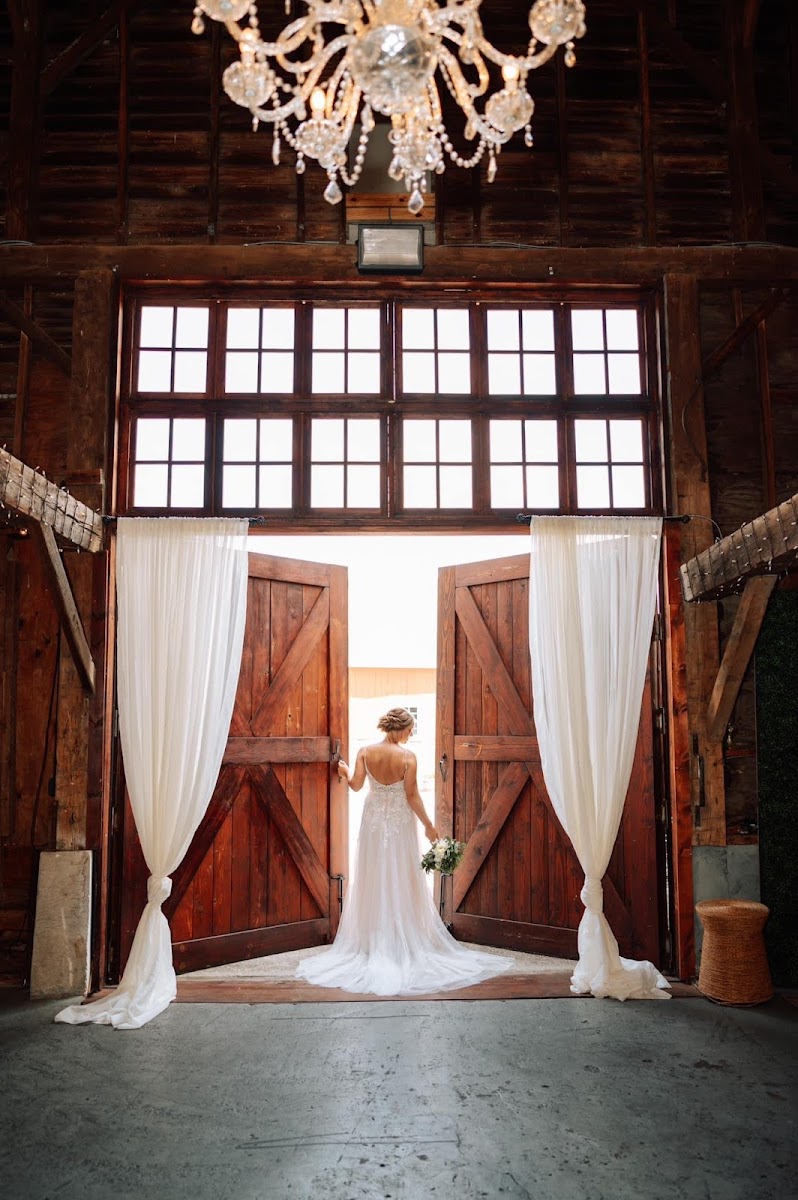
The turn onto County Road 100 North feels like permission to exhale. Indianapolis fades quickly behind you — the strip malls, the highway noise, the relentless sameness of suburban sprawl — and within minutes you’re surrounded by farmland. Corn in summer, soybean fields stretching flat to the horizon, the occasional red barn punctuating the landscape. Then, about six miles west of the city, Ash & Oak Weddings reveals itself: a cluster of restored buildings, a towering silo, and that magnificent Amish barn with its honest wood siding and white-trimmed windows glowing warm in the afternoon light. You park near the shuttle pickup point (because yes, they thought of that), and as you walk the grounds for the first time, you notice the details that separate a working venue from a dressed-up barn. The ancient catalpa tree with limbs thick as torsos spreading over the ceremony lawn. The wooden bridge crossing an actual brook, not a decorative water feature. The meadow spaces mowed in patterns that frame, rather than flatten, the natural landscape. This is a venue that knows what it is: a countryside celebration space that doesn’t apologize for its rural roots or try too hard to be something slicker. Poppy has designed Ash & Oak Weddings wedding flowers for one celebration here so far, and the thing that struck us most was how the venue’s 2,000-piece decor library lets couples focus their floral budget where it matters most — the living, fresh, irreplaceable beauty that only flowers can provide.
About Ash & Oak Weddings
Ash & Oak Weddings sits on 35 acres of Hendricks County farmland in Avon, Indiana, with six acres developed for events and the rest left to do what farmland does best: provide horizon. The property’s centerpiece is an authentic Amish barn built in the 1940s, handcrafted using traditional methods that have kept the structure sound for over a century. This isn’t a barn built to look old; it is old, and the restoration work honored that age rather than erasing it. The original hand-hewn beams remain exposed across the ceiling. The wide-plank flooring has been refinished but not replaced. The bones of the building tell the truth about its origins, and the contemporary updates — climate control, elegant chandeliers, bathrooms that don’t require a trek across the property — feel like respectful additions rather than intrusions.
The venue operates as a family-owned business, which shows in the details. The property includes not just the main barn but also The Cottage (a 2,000-square-foot bridal suite with five mirrors, YouTube TV, and a Bose sound system that actually works) and the Bachelor Pad (an equally spacious groom suite with a pool table, shuffleboard, and comfortable seating that won’t wrinkle a suit). There are seven different outdoor ceremony locations across the property, each offering a distinct aesthetic: the catalpa tree site for classic countryside elegance, meadow spaces for wildflower romance, the silo area for rustic Instagram moments, and the wooden bridge over the brook for timeless portrait opportunities.
What sets Ash & Oak apart in the central Indiana wedding venue landscape is the turnkey approach. The rental includes 225 white chairs (both indoor and outdoor sets), 25 round tables that seat ten each, linens, an extensive decor library with over 2,000 pieces (ceremony arches, centerpieces, table decor, food displays, a hedge wall, lounge furniture), and day-of coordination. Setup, teardown, and cleanup are handled by the venue team. For florists, this means we’re layering fresh flowers into an already-styled environment rather than building from scratch, which changes both the design approach and the budget allocation. Couples can focus their floral investment on statement pieces and living beauty rather than covering basics.
Logistically, Ash & Oak is located about 20 minutes from Indianapolis International Airport and six miles west of Indianapolis proper via US 36, making it accessible for both local and traveling guests. For Poppy’s delivery team, the drive from our studio is straightforward, and the venue provides clear load-in instructions with designated parking near the barn. The family-run operation means communication is direct and responsive. The venue maintains a preferred vendor list for catering but allows outside florists, which we appreciate as an Avon wedding florist building relationships throughout Hendricks County.
The venue holds a liquor license and provides bar service (either hosted by the couple or pay-as-you-go), with bartenders included. They work with an array of local vendors and allow outside professionals with advance approval and required liability insurance. The property’s shuttle service from the parking area to the barn is a thoughtful touch that keeps guests comfortable and prevents that awkward trek across gravel in heels that plagues so many rustic venues.
Event Spaces & Floral Opportunities
Main Barn (Indoor Reception)
Capacity: 225 seated
Setting: Step inside and the transformation is immediate. This is the handcrafted Amish barn in its best form: soaring ceiling with exposed beams, multiple crystal chandeliers casting warm light across the space, strings of twinkle lights woven through the rafters like constellations, and sheer white curtains softening the walls. The venue’s included decor creates a base layer of elegance — tables dressed in linens, chairs with cushions, centerpiece elements already in place from their extensive collection. The floor is polished wood, the walls retain their original board-and-batten character, and the overall palette is cream, honey-toned wood, and soft white. It’s climate-controlled, which matters deeply in Indiana where June can be sweltering and October unpredictable.
Floral approach: Because Ash & Oak includes table centerpieces in their decor library, the floral strategy here is about elevation and distinction. Many couples choose to enhance or replace the venue’s standard centerpieces with fresh floral designs that reflect their specific palette. We recommend a mix of heights across the 25 tables: low, lush arrangements in aged brass compotes (mounded Quicksand and Sahara roses, white ranunculus, cafe au lait dahlias, and trailing jasmine vine) alternating with tall, dramatic designs on clear risers that lift blooms above conversation level. The key is contrast — low arrangements should be genuinely low (under 10 inches) to keep sightlines open, while tall pieces should be substantially tall (24-30 inches to the bloom line) to create visual drama without obstruction. The chandeliers offer opportunities for greenery swags or floral collar installations, though we generally recommend a light touch here — a simple garland of Italian ruscus and smilax with clusters of spray roses at connection points is often more effective than heavy floral chandeliers that compete with the existing lighting. The sheer curtains can be enhanced with floral tiebacks at several key points: behind the sweetheart table, flanking the barn doors, or framing lounge areas. Consider using the venue’s included hedge wall as a backdrop for the cake or dessert display, then adding fresh floral installations at the top corners or as a cascading arrangement to one side. The entrance to the barn is your moment for impact — large-scale urns flanking the doorway, overflowing with seasonal branches (curly willow in spring, dogwood in summer, oak leaves in fall, evergreen in winter), hydrangea, and garden roses signal the transition from cocktail hour to reception.
Outdoor Ceremony Under Catalpa Tree
Capacity: 225 seated
Setting: The catalpa tree is not decorative. It’s a giant — trunk easily four feet in diameter, limbs spreading thirty feet in every direction, creating a natural canopy that provides both shade and architectural drama. The ceremony site sits on manicured lawn with the tree as the focal point and open farmland stretching behind it. In late spring and early summer, the catalpa blooms in clusters of white tubular flowers with purple and yellow markings, filling the air with subtle sweetness. By late summer, the characteristic long seed pods dangle like green beans from the branches. The venue provides 225 white outdoor chairs, and the tree’s natural shape creates an intimate amphitheater effect even for large guest counts.
Floral approach: The catalpa tree does most of the work here, which means restraint is your friend. Rather than building a large, symmetrical arch that competes with the tree’s organic form, we favor an asymmetrical ground installation at the tree’s base. Picture a crescent-shaped arrangement that flows from one side of the trunk: climbing New Dawn roses, white and blush garden roses (Patience, Quicksand, Keira), scabiosa, delphinium in soft blue, and lots of textured greenery including olive branches, eucalyptus, and actual grapevine (which echoes the tree’s own twisting limbs). The arrangement should appear to grow from the base of the tree rather than being placed in front of it. For the aisle, we recommend subtle markers rather than large arrangements on every row — perhaps every third row receives a simple bundle of flowers tied to the chair with flowing ribbon, or low shepherd’s hooks with floral pomanders that don’t obstruct guest views. If the couple wants something overhead, consider a single floral installation hanging from one of the lower catalpa limbs above the ceremony spot: a circular hoop wrapped in vines with clusters of flowers at four points creates a “floral halo” effect without building a freestanding structure. The tree trunk itself can be wrapped with a loose garland at ground level, but keep it subtle — this isn’t a Christmas tree, and over-decorating feels wrong.
Seven Outdoor Ceremony Options
Capacity: 225 seated
Setting: Beyond the catalpa tree site, Ash & Oak offers six additional outdoor ceremony locations, each with distinct character. The meadow spaces feature native grasses and wildflowers left to grow naturally in designated areas. The manicured lawn areas provide classic, formal settings with clean sightlines. The silo area offers that quintessential rustic Indiana farm aesthetic with the tall cylindrical structure as a dramatic backdrop. The wooden bridge site places ceremonies near (or on) the bridge crossing the property’s brook, with water sounds and natural riparian vegetation creating an intimate, romantic setting.
Floral approach: Each site demands a different strategy. For meadow ceremonies, lean into the wildflower aesthetic with ceremony arches or altars that feel like they sprouted from the field: loose, organic installations using cosmos, Queen Anne’s lace, feverfew, snapdragons in mixed colors, sweet peas, and lots of wispy grasses and herbs. Use wooden tripod structures or asymmetrical frameworks rather than formal arches. Aisle markers can be wildflower bundles tied directly to chairs or scattered petals in the grass. For manicured lawn ceremonies, embrace more formal geometry with classic floral arches using roses, hydrangea, delphinium, and elegant greenery like Italian ruscus and silver dollar eucalyptus. Pedestal arrangements flanking the aisle or altar create grandeur. Consider using the venue’s included decorative elements (vintage doors, fabric draping) as a base, then layering florals over that structure for budget efficiency. For silo ceremonies, the scale of the structure demands either very large floral installations at the base (think four-foot-tall arrangements in large urns or barrels) or numerous smaller installations clustered at various heights up the silo foundation. Sunflowers, zinnias, rudbeckia, and other prairie-inspired blooms in warm yellows, oranges, and deep reds complement the silo’s rust-colored metal. For wooden bridge ceremonies, the approach depends on whether the ceremony happens on the bridge or near it. Bridge garlands work beautifully here: a loose, trailing garland of ivy, smilax, and jasmine vine with clusters of roses, spray roses, and clematis woven through at intervals. If the ceremony is on solid ground near the bridge, use the bridge as a backdrop and place large floral installations at each end plus along the railing.
The Cottage - Bridal Suite
Capacity: Bridal party getting-ready space
Setting: This is not a repurposed barn corner or a room with folding chairs. The Cottage is a dedicated 2,000-square-foot bridal suite with proper infrastructure: five full-length mirrors with good lighting, a private bathroom, refrigeration for champagne and bouquets, comfortable seating, and a Bose Bluetooth sound system for getting-ready playlists. YouTube TV provides entertainment options. The space is styled with neutral tones and has ample flat surfaces for makeup, hair tools, and that chaotic spread of getting-ready essentials.
Floral approach: The bridal suite is where detail shots happen, which means floral styling here directly impacts your wedding album. Create a dedicated bouquet and boutonniere display area: a vintage silver tray or wooden cutting board where all the personal flowers are arranged artfully with loose stems, ribbon spools, and perhaps a few pieces of jewelry or the invitation suite. A small arrangement on the main vanity or coffee table adds polish to wide shots — we favor low, romantic designs in soft palettes that won’t compete with the bride’s dress or details. Think blush and cream garden roses (Keira, Patience), white ranunculus, burgundy hellebores, and eucalyptus in a small brass bowl or ceramic vessel. Consider the refrigeration as an asset: we can deliver all personal flowers here early in the day, and they’ll stay fresh until they’re needed. A small “extra blooms” arrangement in a bud vase near the mirror station can provide flowers for hair pieces or last-minute additions. For photos of the bride’s dress hanging in the space, a small floral garland draped over the hanger or a single perfect bloom pinned to the fabric creates that editorial touch.
Bachelor Pad - Groom Suite
Capacity: Groom’s party getting-ready space
Setting: Equal square footage to the bridal suite but with a decidedly different vibe: pool table, shuffleboard, large comfortable sofas, TV with YouTube Premium, and a general “hang out before we have to wear these suits all day” atmosphere. The decor is masculine without being cartoonish — leather, wood, and neutral tones.
Floral approach: Minimal but intentional. The boutonniere display is the focus: rather than a delicate tray, consider a rustic wooden box lined with moss where each boutonniere stands upright in small individual holders or floral tubes. Alternatively, a cork board with the boutonnieres pinned in a row creates a clean, graphic display that photographs well. The flowers themselves should lean textured and structural: scabiosa pods, thistle, burgundy ranunculus, hellebores in deep tones, with minimal filler and lots of interesting greenery like dusty miller, eucalyptus, or even small succulent accents. A single small arrangement on the bar area or coffee table adds finish without feeling precious — maybe a low cluster of garden roses, scabiosa, and olive branches in a simple ceramic vessel or brass cup. This is not the room for orchids or cascading designs; keep it architectural and grounded.
Covered Outdoor Space
Capacity: Flexible space for cocktail hour or additional gathering
Setting: A covered structure on the property that provides weather protection without losing the outdoor atmosphere. This space typically serves as the cocktail hour location, positioned between ceremony and reception, allowing guests to mingle with drinks and appetizers while the event spaces flip.
Floral approach: Cocktail hour florals should be plentiful but not precious, abundant but not obstructing conversation or traffic flow. We favor a combination of bud vases and small arrangements scattered across cocktail tables — each table gets a cluster of three to five small vessels in varied heights with single stems or small groupings. The variety creates visual interest without committing significant budget to each piece. For a 225-person event, expect 20-30 cocktail table surfaces that need something. Consider a few larger statement arrangements at the bar or on a welcome table: these can be later moved into the reception space to maximize use. If there are posts or columns supporting the covered structure, loose garlands of greenery with floral clusters at connection points can define the space beautifully. The covered area often has bistro lights or other strung lighting — garlands can wrap these at intervals without overwhelming the electrical.
Wedding Flower Ideas for Ash & Oak Weddings
Midwest Meadow
This concept embraces Indiana’s native prairie landscape with a palette pulled from roadside wildflowers and working farmland. Start with a base of warm, saturated colors: golden yellow sunflowers (Teddy Bear and Moulin Rouge varieties), zinnias in coral and hot pink, rudbeckia (black-eyed Susan), purple lisianthus, and deep burgundy dahlias (Black Satin, Chat Noir). Add textural elements that echo the countryside: wheat stalks, wild grasses, bronze fennel, and Queen Anne’s lace. The greenery should feel unstructured — fountain grass, wispy jasmine vine, and Italian ruscus with movement and flow. Arrangements sit in mismatched vessels: galvanized metal buckets, ceramic crocks, vintage glass bottles, and wooden boxes. The overall effect is joyful, abundant, and deeply connected to the agricultural landscape surrounding the venue. This palette is spectacular under the catalpa tree for outdoor ceremonies, where the natural meadow aesthetic feels like an extension of the tree’s wild beauty. In the barn, these warm tones glow against the honey-colored wood and create a sunset effect as evening light comes through the windows. The design works especially well for summer and early fall weddings when these blooms are at peak season and locally available.
Blush & Berry Garden
For couples seeking romance without excessive sweetness, this palette balances soft blush tones with deeper berry accents. The foundation includes garden roses in sophisticated neutrals: Quicksand (peachy-blush), Sahara (cream-nude), Cappuccino (dusty mauve), and Keira (ivory with blush edges). Layer in ranunculus in ivory and soft pink, white anemones with dark centers, and pale pink astilbe for texture. The “berry” comes from burgundy accents: deep wine-colored dahlias, burgundy hellebores, chocolate cosmos (which add subtle fragrance), and scabiosa in dark purple. Greenery includes eucalyptus in multiple varieties (seeded, silver dollar, and baby blue), olive branches, and trailing jasmine vine. Vessels are aged brass compotes, mercury glass, and weathered concrete or stone urns that echo the venue’s rustic elements while maintaining elegance. This palette translates beautifully across seasons — in spring, emphasize the blush tones with tulips and cherry blossoms; in fall, deepen the berry shades with dahlias and cosmos; in winter, add evergreen elements and burgundy amaryllis. The barn’s cream walls and soft lighting make these tones appear even more romantic, and the palette photographs gorgeously in both natural outdoor light and the warm indoor illumination.
White & Green Elegance
Sometimes the smartest approach is the simplest. This concept strips away color to focus on form, texture, and the natural beauty of white blooms and varied greenery. Use white flowers exclusively: garden roses (Patience, Alabaster), ranunculus, anemones, tulips (spring), peonies (early summer), hydrangea, and delphinium for height. The interest comes from the extraordinary variety of greenery: Italian ruscus, smilax, eucalyptus, olive branches, dusty miller (for silver-gray tones), ferns, and jasmine vine with its small white blossoms. Add textural elements like white scabiosa (with its unique pincushion centers), white astilbe, and pods from scabiosa or poppy for organic detail. Vessels should be elegant and understated: white ceramic, clear glass, or simple concrete planters that disappear into the design. This palette works year-round and never competes with the venue’s architecture or the natural landscape. It’s sophisticated without being sterile, abundant without being loud. In the barn, white and green arrangements feel clean and timeless against the warm wood tones. Under the catalpa tree, they enhance rather than compete with the natural environment. For the covered outdoor space, white arrangements remain visible even in low light, and they photograph beautifully in both color and black-and-white images.
Seasonal Considerations
Central Indiana experiences four distinct seasons with significant temperature swings and weather variability. Avon, located in Hendricks County just west of Indianapolis, shares the region’s continental climate with hot, humid summers and cold winters. Understanding these patterns is essential for both flower selection and logistical planning.
Spring (March - May) arrives tentatively in Indiana. Early March can still see snow, but by late April, the landscape transforms with redbuds and dogwoods blooming throughout the countryside. Average temperatures range from the 40s in March to the 70s by late May, with frequent rain showers and occasional severe weather. This is the season for tulips (French, parrot, and fringed varieties in every color), daffodils, hyacinth, cherry blossoms, ranunculus, anemones, and later in the season, the first peonies. Locally, bleeding heart, lilac, and viburnum branches add romantic texture. Ash & Oak’s outdoor ceremony spaces are stunning in spring when everything is greening up, though couples should have a weather contingency plan — the barn serves as an excellent backup for outdoor ceremonies interrupted by rain. Spring flowers are generally hardy, but protect early-season blooms like tulips from cold snaps, and be aware that rain can damage delicate petals. The covered outdoor space becomes crucial during unpredictable spring weather for cocktail hours.
Summer (June - August) in Indiana means heat and humidity. Temperatures regularly reach the 80s and 90s with high humidity, and afternoon thunderstorms are common. This is peak wedding season, and Ash & Oak’s climate-controlled barn is a significant comfort factor. Summer brings the widest variety of blooms: garden roses, hydrangea, delphinium, dahlias (starting mid-summer), sunflowers, zinnias, lisianthus, Queen Anne’s lace, cosmos, and locally-grown peonies in June. The challenge is heat management — choose flowers that tolerate warmth (zinnias, sunflowers, dahlias, celosia) and avoid those that wilt quickly (sweet peas, tulips, ranunculus). Outdoor ceremony flowers need to be set up as close to ceremony time as possible, and anything in direct sun should be misted. The covered outdoor space is essential for cocktail hours, providing shade and air circulation. Hydration stations for flowers are critical — we use floral tubes for ceremony arrangements and keep backup blooms refrigerated at the venue. The lush summer landscape surrounding Ash & Oak provides a gorgeous green backdrop that requires less floral volume to create impact.
Fall (September - November) is Indiana’s glory season. Temperatures moderate into the 60s and 70s in September and October, dropping to the 50s in November. The humidity breaks, skies turn crystalline blue, and the deciduous trees across the property transform into gold, orange, and red. This is dahlia season — the blooms are largest and most prolific from September through first frost. Add chrysanthemums, dahlias in every color, chocolate cosmos, marigolds, celosia, roses (which experience a second flush in cooler weather), and sunflowers. For textural elements, incorporate actual autumn leaves, wheat stalks, dried grasses, berries, and branches with fall color. The silo ceremony location is particularly stunning in fall when the foliage provides a painted backdrop. October is the busiest wedding month at Ash & Oak for good reason — the weather is reliable, the landscape is peak beautiful, and flowers are abundant. Be aware that November can be unpredictable with occasional early freezes, so have the barn ready as a ceremony backup.
Winter (December - February) is quiet season at the venue, but winter weddings here have unique charm. Temperatures range from the 20s to 40s, with snow possible throughout. The barn’s climate control makes winter weddings completely comfortable, and the twinkle lights and chandeliers create a warm, romantic atmosphere against dark winter evenings. Winter flowers include amaryllis, paperwhites, tulips (imported), ranunculus (imported), anemones, hellebores, and evergreens in numerous varieties. Consider adding seasonal elements like pinecones, evergreen branches (cedar, pine, fir), holly berries, and even frosted or snow-covered branches for texture. The white and green palette is particularly striking in winter, as are deep jewel tones — burgundy, evergreen, and cream. Winter also allows for dried element integration: pampas grass, lunaria (silver dollar), preserved leaves, and wheat. The venue’s included decor library becomes especially valuable in winter when you’re building warmth and coziness entirely indoors. For outdoor portraits, the winter landscape can be beautiful but brief — plan for golden hour shots and have the warm barn as a comfortable base.
Poppy’s Expert Take
The decor library is your budget ally, not your competition. Ash & Oak includes over 2,000 pieces of decor, and many couples worry this means adding fresh flowers will look redundant or unnecessary. The opposite is true. The venue’s included elements — arches, vessels, table numbers, linens — provide an excellent base that allows you to focus your floral budget exclusively on living blooms and greenery rather than infrastructure. Work with your florist to identify which venue pieces you’ll use (perhaps the ceremony arch structure, which can be enhanced with fresh garlands) and where you’ll introduce entirely custom floral designs (like centerpieces or a ceremony ground installation). The venue’s hedge wall, for instance, makes an excellent backdrop for dessert displays or photo moments — you don’t need to replicate that with florals, but you can enhance it with a cascading fresh arrangement at one corner. This collaborative approach maximizes both the venue’s investment and your own.
The catalpa tree ceremony needs less than you think. First-time visitors to the catalpa tree site often panic that the large natural canopy isn’t “decorated” enough. Resist the urge to over-design this space. The tree itself is architecturally stunning, and heavy floral installations can actually diminish its impact by competing for attention. A single asymmetrical ground arrangement at the tree’s base, subtle aisle markers, and perhaps one floral installation hanging from a lower branch is often more effective than a full arch, extensive aisle flowers, and multiple installations. Discuss with your florist what the tree provides naturally versus what florals need to add. In late spring when the catalpa is blooming, you need even less — the tree’s own white flowers create a natural decoration. Save your floral budget for reception spaces where the impact will be greater.
Plan for the shuttle timing when scheduling delivery. The venue provides shuttle service from the parking area to the barn, which is wonderful for guests but can affect vendor access. Coordinate with both your florist and the venue coordinator about load-in timing and whether vendors can drive directly to the barn for setup or need to shuttle materials. For Poppy deliveries, we typically arrive during early setup windows when direct access is available, complete our installation work, and exit before guest shuttles begin running. If your ceremony is earlier in the day, confirm that your florist has adequate time to set outdoor ceremony flowers before guests arrive and shuttles start running. The venue team is accommodating about vendor logistics, but communication beforehand prevents day-of delays.
The seven ceremony locations are not equally floral-intensive. If you’re budget-conscious, the ceremony location you choose significantly impacts floral costs. The catalpa tree requires minimal floral work because the tree itself provides drama. The meadow spaces can be styled with wildflower-inspired designs that use more affordable seasonal blooms. The manicured lawn areas, however, typically demand more formal, structured floral installations because the clean, simple backdrop provides no natural decoration. The silo location needs large-scale installations to match the structure’s height. Discuss with your florist which ceremony site aligns with your design vision and budget — choosing the right location can save (or add) $500-1000 in floral costs.
Indoor-outdoor flow matters for cocktail hour florals. Most Ash & Oak weddings move from outdoor ceremony to covered space for cocktails to barn for reception. Think about the visual journey guests experience through these transitions. If your ceremony flowers are wildflower-inspired and colorful, carry that through to cocktail hour with similar blooms in smaller arrangements. If you’re doing a formal ceremony with classic white and green florals, maintain that aesthetic in the cocktail space. The floral story should feel cohesive rather than like three separate events. Additionally, consider which arrangements can move between spaces: large ceremony installations can often be relocated to flank the barn entrance or placed near the barn’s dessert display during cocktail hour, maximizing your investment.
Seasonal bloom availability dramatically affects budget here. Because Ash & Oak is in the Midwest, far from major flower-growing regions, seasonality impacts both pricing and availability. Spring peonies, summer dahlias, and fall chrysanthemums sourced locally or regionally are significantly more affordable than imported blooms. Winter weddings or designs requiring out-of-season flowers (peonies in November, dahlias in March) involve premium pricing for imports, often doubling the cost of those specific blooms. If you’re working within a tight budget, design with the season. A September wedding can feature enormous dahlia arrangements for the same cost as modest winter rose designs. Ask your florist what’s in season and abundant for your wedding date — you’ll get more flowers for your budget, and they’ll likely arrive in better condition.
The barn’s existing lighting is a floral asset. The combination of chandeliers, twinkle lights on rafters, and natural wood tones creates warm, romantic illumination that makes flowers glow. This means you can often use slightly less saturated or fewer flowers than you’d need in a stark white ballroom because the lighting does enhancing work. Blush tones appear more vibrant, whites seem to