
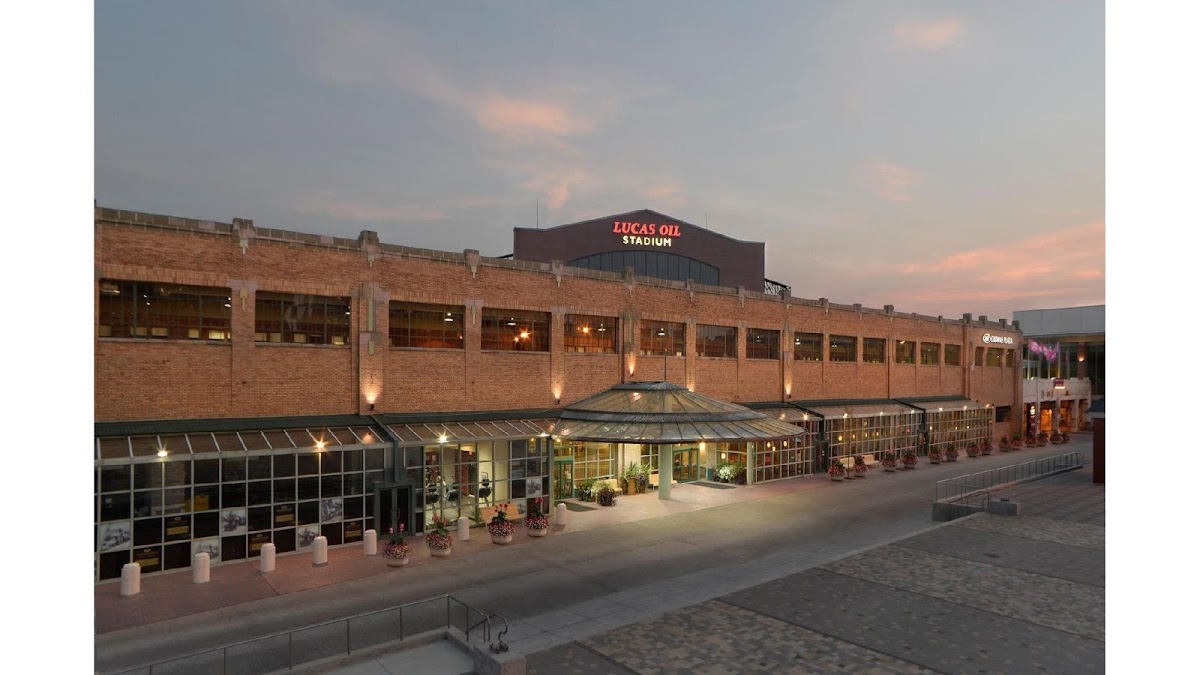
You approach from West Louisiana Street, and for a block or two downtown Indianapolis looks like every other American downtown — glass towers, parking garages, the efficient geometry of a city rebuilt for conventions and commerce. Then the skyline breaks, and there it is: a low-slung Romanesque Revival structure with arched windows, warm honey-colored stone, and the unmistakable profile of a building that predates everything around it. This is the Crowne Plaza Indianapolis Downtown Union Station, but that name undersells what you’re walking into. Built in 1888, this is America’s first union station — the place where seven railways converged, where travelers from Chicago and Cincinnati and St. Louis once passed through vaulted halls on their way to somewhere else. Now those halls host a different kind of passage: couples walking down the aisle beneath a soaring barreled glass ceiling, surrounded by 20-foot stained glass wagon wheel windows that cast jewel-toned light across terrazzo floors worn smooth by more than a century of footsteps. Poppy has received 405 inquiries for weddings at the Grand Hall, and each time we walk through those arched doorways to consult on a couple’s Crowne Plaza Indianapolis Downtown Union Station wedding flowers, we feel the weight of that history — and the thrill of designing blooms that hold their own against it.
About Crowne Plaza Indianapolis Downtown Union Station
The Grand Hall at Historic Union Station isn’t trying to be a wedding venue. It simply is one, almost by accident of its own magnificence. When the station opened in September 1888, it was the largest union station in the world — a feat of engineering and architectural ambition designed by Pittsburgh architect Thomas Rodd in the Romanesque Revival style popularized by H.H. Richardson. The headhouse, where the Grand Hall resides, features load-bearing stone walls nearly three feet thick, rounded Romanesque arches supported by clustered columns, and those signature wagon wheel windows — massive 20-foot circles of leaded stained glass that were custom-fabricated for the space. The ceiling is the true showpiece: a barrel vault constructed of glass panes set into an iron framework, rising 40 feet above the floor and flooding the hall with natural light. For decades, this was one of the busiest train stations in America. By the 1970s, as rail travel declined, the building faced demolition. A preservation effort saved it, converting the station into a hotel and event space while maintaining its National Register of Historic Places designation. Today, the bones of the building remain virtually untouched — the same terrazzo floors laid in geometric patterns, the same stone columns, the same antique wooden bar that once served travelers waiting for the next departure to Louisville or Detroit.
The hotel portion now includes the original station spaces plus converted Pullman train cars — yes, actual sleeping cars from the golden age of rail travel, retrofitted as hotel rooms and permanently stationed on the tracks behind the main building. For wedding parties, these train car suites are both novelty and nostalgia, offering a genuinely unique getting-ready experience. The Grand Hall itself can accommodate up to 700 guests for a seated dinner and reception, while the Illinois Street Ballroom — a more contemporary space within the hotel with floor-to-ceiling windows overlooking downtown Indianapolis — seats up to 175 and serves as an ideal ceremony or smaller reception option. Both spaces are connected via interior corridors, allowing for smooth transitions and guest flow.
Logistically, the venue sits in the heart of downtown Indianapolis at 123 West Louisiana Street, directly connected to the Indiana Convention Center via skywalk and within a few blocks of Lucas Oil Stadium, Gainbridge Fieldhouse, and the city’s theatre and restaurant districts. Parking is valet-only through the hotel ($38 daily, $45-$65 overnight), though there are several public parking garages within a block. For Poppy’s delivery teams — when we expand to Indianapolis — load-in access is straightforward through the hotel’s loading dock, and the events team is accustomed to coordinating multiple vendors on large-scale weddings. The venue requires in-house catering (starting at $54 per person) and bar service, with a minimum of 75 guests. Florists are not restricted to a preferred vendor list, and setup/breakdown is included in the site fee. Storage is available several days in advance, a crucial detail for complex installations. The venue strongly recommends hiring a day-of coordinator, and given the scale and historical significance of the space, we’d echo that advice.
Event Spaces & Floral Opportunities
Grand Hall Ballroom
Capacity: 700 seated, 600 mix-and-mingle reception
Setting: This is the room that stops conversations. The Grand Hall is a 40-foot-tall barrel-vaulted cathedral to the age of rail travel, anchored by those extraordinary wagon wheel windows that glow like kaleidoscopes when the late afternoon sun hits them just right. The architecture is unapologetically grand: rounded Romanesque arches supported by clustered stone columns, walls of warm buff-colored limestone, and a terrazzo floor in muted earth tones that somehow manages to feel both formal and lived-in. The antique wooden bar runs along one wall — dark, polished, and original to the station. Modern amenities (lighting, AV, climate control) have been integrated seamlessly, but this room’s identity is rooted in 1888. It feels like a European train station, a basilica, and a ballroom all at once. There are no windows at eye level — just those towering stained glass wheels overhead — so the space turns inward on itself, insulated from the bustle of downtown outside.
Floral approach: The Grand Hall demands restraint and spectacle in equal measure. The architecture is so powerful that any floral work must either defer to it or match its scale entirely — there is no middle ground. Our approach begins with the ceiling. The barrel vault is supported by an iron framework that can accommodate suspended installations, and this is where drama lives: think 15-foot garlands of smilax, Italian ruscus, and silver dollar eucalyptus suspended in gentle swags above the dance floor or head table, punctuated every six feet with clusters of Quicksand roses, Sahara sensation roses, white lisianthus, and trailing amaranthus. The effect should be lush but airy, adding softness to the industrial ironwork without obscuring the glass. For centerpieces, we favor low and opulent — garden-style arrangements in antique brass compotes or weathered stone urns that echo the building’s materiality. Cafe au Lait dahlias, Juliet garden roses, white ranunculus, blush astilbe, and seeded eucalyptus create texture and movement without rising above 12 inches, preserving sightlines across the room. Tall centerpieces can work here, but they must be tall — 36 inches minimum on clear glass risers — so they lift above the crowd entirely. The columns are natural anchors for ceremony florals: consider flanking the officiant with a pair of large-scale arrangements in bronze urns (4 feet tall, overflowing with white hydrangea, ivory roses, and trailing jasmine vine) or wrapping the columns nearest the ceremony site with garlands of olive branches and white spray roses. The antique bar begs for a 20-foot garland of greenery studded with blooms, or at minimum a substantial arrangement at each end. One critical note: the wagon wheel windows are backlit by daylight and colored glass — do not attempt to compete with them. Position ceremony arches and focal arrangements beside or beneath the windows, not in front of them. Let the glass do what it does best.
Illinois Street Ballroom
Capacity: 175 seated
Setting: If the Grand Hall is drama and history, the Illinois Street Ballroom is elegance and light. This is a contemporary event space on an upper floor of the hotel, defined by floor-to-ceiling windows that overlook Illinois Street and the Indianapolis skyline. The palette is neutral — soft grays, warm whites, blonde wood accents — with modern lighting and a clean, uncluttered aesthetic. The ceilings are standard height (10-12 feet), the windows generous, and the overall feeling is that of a sophisticated urban ballroom. It lacks the architectural grandeur of the Grand Hall, but that’s precisely its strength: this is a blank canvas, a room that adapts to any vision without imposing its own identity. It’s ideal for couples seeking intimacy, for ceremonies that need natural light, or for a rehearsal dinner that feels upscale and modern rather than historical.
Floral approach: The Illinois Street Ballroom invites experimentation. Without the weight of Romanesque arches or stained glass overhead, florals can take the lead in defining the room’s character. For a romantic, garden-inspired wedding, consider lush low centerpieces in a soft blush-and-ivory palette: Patience garden roses, quicksand roses, white ranunculus, blush spray roses, and trailing jasmine vine in matte ceramic vessels or mercury glass compotes. For a modern minimalist approach, go monochromatic and architectural: all-white arrangements of phalaenopsis orchids, calla lilies, and white anthurium in sleek white ceramic cubes, paired with votives in geometric brass holders. The windows are the room’s best feature, so don’t block them — instead, use them. A ceremony arch positioned in front of the windows (backlit by the Indianapolis skyline) creates a stunning focal point; consider a circular wreath-style arch covered in smilax and white blooms, or a geometric copper arch with asymmetrical floral clusters at the corners. The head table or sweetheart table benefits from a low, sprawling garland that spills over the edge — lush and abundant, with garden roses, ranunculus, and eucalyptus woven together with silk ribbon trailing onto the floor. Aisle arrangements can be elevated here: tall arrangements on acrylic pedestals flanking every third row, or low arrangements in simple glass cylinders lining the aisle with petals scattered between them. This room rewards thoughtful curation over sheer volume.
Historic Train Car Rooms
Setting: These are not traditional event spaces, but they are an integral part of the Union Station wedding experience. The Pullman train cars — authentic sleeping cars from the 1920s, retrofitted as hotel suites — provide getting-ready quarters for wedding parties. The interiors are compact and charming, with dark wood paneling, brass fixtures, and period details that feel like a time capsule. Narrow hallways, small windows, and cozy sleeping berths make these rooms ideal for intimate pre-ceremony moments.
Floral approach: Small, thoughtful, and photogenic. A single arrangement in the bride’s train car suite — a low compote of blush roses, white ranunculus, and eucalyptus on the dressing table — adds polish to getting-ready photos without crowding the limited space. Bud vases with single stems (white anemones, blush roses, or even a sprig of lavender) on windowsills or side tables create visual interest in tight quarters. If bouquets and boutonnieres are being delivered here, we recommend simple bud vases or clear glass cylinders to display them before the ceremony. These rooms are about texture and intimacy, not volume — think delicate, vintage, and personal.
Wedding Flower Ideas for Crowne Plaza Indianapolis Downtown Union Station
Romanesque Revival
This concept honors the building’s architectural roots with a palette and style drawn from late 19th-century European design. Imagine deep, saturated jewel tones inspired by the stained glass windows: burgundy dahlias (Karma Choc, Nuit d’Été), wine-toned garden roses (Tess, Darcey), plum scabiosa, and deep red hypericum berries, balanced by ivory spray roses, champagne lisianthus, and soft greenery like seeded eucalyptus and olive branches. Arrangements sit in aged brass urns, dark bronze compotes, and weathered stone vessels that echo the building’s materials. For the ceremony, a reclaimed wooden arch draped with garlands of olive branches and burgundy blooms, flanked by tall arrangements in bronze urns. For centerpieces, low and lush in dark brass vessels, with votives in amber glass. This palette is especially striking under the warm glow of the Grand Hall’s lighting, when the deep burgundy blooms echo the tones in the stained glass above.
Modern Luxe
For couples drawn to the Grand Hall’s grandeur but seeking a contemporary aesthetic, this concept pairs sleek modern design with opulent blooms. The palette is monochromatic ivory and white with touches of gold: white phalaenopsis orchids, ivory Patience roses, white majolica spray roses, white ranunculus, and white tulips (in season), accented with gold-dipped eucalyptus leaves and gold-painted magnolia branches. Arrangements sit in geometric gold stands, clear acrylic pedestals, and matte white ceramic vessels. The ceremony features a circular wreath-style arch covered in white blooms and greenery, suspended above the couple on clear wires so it appears to float. Centerpieces alternate between tall (36-inch arrangements on acrylic risers) and low (mounded arrangements in gold compotes), creating visual rhythm across the ballroom. The bar receives a 20-foot garland of white blooms and gold-dipped foliage. This design feels current, expensive, and unfussy — modern elegance that holds its own in a historic space.
Indianapolis Harvest
This concept celebrates the agricultural richness of Indiana with a palette inspired by autumn harvest and prairie landscapes. Think warm amber, rust, golden yellow, and deep green: golden yellow dahlias (Kelvin Floodlight), peach Juliet roses, rust-colored chrysanthemums, burgundy scabiosa, and burnt orange ranunculus, grounded by textural greenery like seeded eucalyptus, olive branches, and even wheat stalks or dried grasses. Arrangements sit in rustic wooden boxes, copper vessels, and ceramic crocks that feel farmhouse-elegant. For the ceremony, a wooden arch wrapped in eucalyptus garland with clusters of rust and amber blooms. For the reception, low arrangements in copper compotes with wheat and dried grasses extending upward. This palette works beautifully in both the Grand Hall (where the warm tones complement the stone and wood) and the Illinois Street Ballroom (where the harvest colors contrast beautifully with the neutral modern palette). It’s especially stunning for September and October weddings when the Indiana countryside outside the city is turning gold.
Seasonal Considerations
Indianapolis sits in USDA Zone 6a, with a continental climate that delivers four distinct seasons and significant temperature swings. These seasonal shifts directly impact bloom availability, palette choices, and logistical planning for Grand Hall at Historic Union Station wedding flowers.
Spring (March-May): Spring arrives late in Indianapolis, with the last frost typically occurring in mid-to-late April. Early spring weddings (March, early April) require careful planning — many spring blooms are greenhouse-grown rather than locally available, and weather can be unpredictable. By late April and into May, the city blooms: tulips, daffodils, hyacinth, and ranunculus are abundant and affordable. Peonies — the darling of late spring weddings — typically arrive in early May and remain available through mid-June. Spring palettes tend toward soft pastels (blush, lavender, soft yellow, ivory) that complement the Grand Hall’s warm stonework beautifully. Logistically, spring weather can be rainy and cool; ensure your delivery and setup windows account for potential delays. Best months: late April through May, when blooms are plentiful and the weather has stabilized.
Summer (June-August): Summer in Indianapolis is warm and humid, with temperatures regularly reaching the upper 80s and low 90s. This climate is excellent for locally grown flowers — dahlias, zinnias, sunflowers, cosmos, and lisianthus are at their peak, and garden roses perform well. Summer palettes can be bold and vibrant (coral, fuchsia, sunny yellow, bright orange) or soft and romantic (blush, peach, cream, soft pink). The Grand Hall’s climate control is robust, so heat wilting is rarely an issue indoors, but outdoor load-in and photography sessions require hydration vigilance. We recommend avoiding arrangements with delicate blooms like sweet peas or anemones in July and August; they simply don’t tolerate the heat. Instead, opt for hardy summer blooms like hydrangea, roses, and dahlias. Best months: June and September (early fall), when temperatures are warm but not oppressive and bloom variety is at its peak.
Fall (September-November): Fall is the crown jewel of wedding season in Indianapolis. September and October deliver warm days and crisp nights, spectacular foliage in surrounding rural areas, and peak availability of autumn blooms. Dahlias are at their finest, with dozens of varieties in rich jewel tones. Garden roses, chrysanthemums, chocolate cosmos, and hypericum berries are abundant. Fall palettes lean toward warm, saturated tones (burgundy, rust, burnt orange, deep plum, golden yellow) that echo the season and complement the Grand Hall’s stonework. By November, frost becomes a concern, and outdoor load-in can be chilly; plan accordingly. Locally grown flowers wind down by mid-November, so late-fall weddings may require more imported blooms. Best months: September and October, when weather is ideal and bloom selection is extraordinary.
Winter (December-February): Winter weddings in Indianapolis require strategic planning. Temperatures regularly drop below freezing, and snow and ice are common from December through February. Local flowers are unavailable, so all blooms are imported — often from California, Ecuador, or the Netherlands, which increases costs slightly. Winter palettes tend toward elegant whites, deep reds, and rich greens, with accents of silver or gold. Amaryllis, white roses, white orchids, white tulips (from Holland), evergreens (pine, fir, cedar), and seasonal berries (holly, hypericum) are staples. The Grand Hall is especially magical in winter, with the stained glass windows and warm interior lighting creating a cozy contrast to the cold outside. Logistically, winter deliveries require careful timing to avoid extended exposure to freezing temperatures, which can damage blooms. We recommend load-in as close to setup as possible and using insulated transport. Best month: December, for the holiday magic, though January and February can be equally stunning with the right design approach.
Poppy’s Expert Take
The ceiling is your canvas, but treat it with respect. The Grand Hall’s barrel-vaulted glass ceiling is 40 feet high and structurally equipped for suspended installations, but the ironwork framework is historic and must be accessed carefully. Work with the venue’s engineering team to identify approved anchor points, and use professional rigging techniques. Suspended garlands and floral chandeliers are breathtaking here, but they require advance planning, proper equipment, and a florist experienced with large-scale installations. This is not a DIY project. When executed well, a 20-foot garland of greenery and blooms suspended above the dance floor becomes the defining visual of the entire reception.
Don’t fight the wagon wheel windows — frame them. Those 20-foot stained glass circles are the Grand Hall’s most iconic feature, and they’re backlit by natural daylight that shifts throughout the day. Attempting to place a ceremony arch or large floral installation in front of the windows is a losing battle — the backlight will silhouette your florals and wash out their color in photos. Instead, position your ceremony setup beneath or beside the windows, using them as a colorful backdrop rather than competing with them. A low, wide arrangement on a stone pedestal positioned just below a window, allowing the stained glass to glow above it, creates a far more striking composition.
The terrazzo floor is slippery — choose vessels accordingly. The original terrazzo flooring in the Grand Hall is beautiful, smooth, and notoriously slick, especially when polished for events. Avoid tall, top-heavy arrangements on narrow bases — they’re a tipping hazard. Opt instead for low, wide vessels with stable bases, or use weighted urns and compotes that won’t shift if nudged by a guest. For tall arrangements, ensure they’re placed on sturdy pedestals or risers with non-slip bases. The venue staff is vigilant about safety, and they’ll flag unstable installations during setup.
Plan for the acoustics — this is a stone hall, not a carpeted ballroom. The Grand Hall’s stone walls, terrazzo floor, and glass ceiling create lively acoustics — which is a polite way of saying sound bounces everywhere. This doesn’t directly impact floral design, but it does affect the overall guest experience. Large floral installations don’t absorb sound the way fabric drapery or carpeting does, so work closely with the couple’s band, DJ, and sound engineer to manage volume levels. Lush, dense arrangements (especially those with fabric ribbon or thick greenery) provide marginally more sound absorption than sparse designs, but don’t overestimate their impact.
The train car suites are tight — deliver early and minimize packaging. If you’re providing florals for the getting-ready suites in the historic Pullman cars, coordinate delivery at least two hours before hair and makeup teams arrive. The cars are narrow, and space fills quickly with people, dresses, and equipment. Deliver arrangements already in their final vessels, not in transport boxes that require unpacking on-site. A single low arrangement and a few bud vases are ideal; anything more clutters the limited surfaces. Coordinate with the couple’s planner or the hotel’s events team to identify exactly which train car suite is assigned to the bride, as there are multiple cars and they’re not always clearly labeled from the exterior.
Load-in through the hotel loading dock — not the front entrance. The Grand Hall is accessed via interior corridors through the Crowne Plaza hotel. The primary load-in point is the hotel’s loading dock on the south side of the building, accessible from South Meridian Street. Do not attempt to carry large floral installations through the hotel’s main lobby or front entrance — the events team will redirect you to the loading dock, and you’ll waste time backtracking. Coordinate your arrival time with the venue’s events manager, as the loading dock is shared with catering, AV, and other vendors. Plan for at least 30 minutes to transport materials from the loading dock to the Grand Hall via service elevators and corridors.
Budget for scale — the Grand Hall rewards it. A 700-person ballroom with 40-foot ceilings requires florals that match its proportions. Arrangements that would feel generous in a 150-person venue can appear sparse and underwhelming in the Grand Hall. If budget is a concern, prioritize a few large-scale statements (ceremony arch, head table garland, bar arrangement) over spreading resources too thin across dozens of small centerpieces. A single dramatic installation will leave a stronger impression than 60 modest arrangements that disappear in the room’s vastness.
What Poppy Couples Spend on Flowers Here
While we don’t yet have booking data specific to the Grand Hall at Historic Union Station, 405 couples have reached out to Poppy with interest in this venue, which tells us it’s a sought-after Indianapolis landmark. Based on comparable historic ballroom venues in Midwestern markets and the scale and grandeur of this space, here’s what couples typically invest in Grand Hall at Historic Union Station wedding flowers.
$4,500 - $7,500 | The Essentials
This tier covers the foundational floral elements for a Grand Hall wedding: a ceremony arrangement (either a pair of large urns flanking the officiant or a medium-sized arch with greenery and blooms), low centerpieces for 50-70 guests (mounded garden-style arrangements in brass or ceramic vessels with garden roses, spray roses, and seasonal greenery), and personal flowers (bridal bouquet, three bridesmaid bouquets, four boutonnieres, and two corsages). The color palette typically focuses on one or two tones with complementary greenery — think all-white with eucalyptus, or blush-and-ivory with olive branches. This budget works well for ceremonies in the Illinois Street Ballroom followed by a smaller reception in the same space, where the room’s more intimate scale requires less floral volume. For Grand Hall receptions at this tier, we recommend concentrating florals on high-impact areas like the ceremony focal point, head table, and bar, with simpler bud vase clusters or greenery garlands on guest tables.
$7,500 - $12,500 | The Full Picture
This is the tier where the Grand Hall’s architecture begins to shine with florals that match its scale. The budget accommodates a substantial ceremony installation (a large floral arch or a pair of 4-foot urns overflowing with blooms and greenery), low lush centerpieces for 100-150 guests (in varied vessel styles to create visual interest), a 15-foot garland for the head table or bar (smilax, Italian ruscus, and roses woven together), and a simple suspended installation (perhaps a 10-foot garland above the dance floor or head table). Personal flowers expand to include a statement bridal bouquet, five bridesmaid bouquets, six boutonnieres, four corsages, and perhaps flower girl petals or a small basket arrangement. This tier allows for a richer, more textured palette — think burgundy and blush with gold accents, or ivory and champagne with greenery and metallic touches. For Illinois Street Ballroom ceremonies followed by Grand Hall receptions, this budget provides cohesive design across both spaces with enough volume to make an impact in the larger ballroom.
$12,500+ | The Full Experience
At this level, we’re designing florals that command attention in a 40-foot-tall historic train station ballroom, and the results are unforgettable. The budget supports a large-scale ceremony installation (an 8-foot floral arch densely covered in blooms, or a pair of towering 5-foot urns with cascading arrangements), elevated centerpieces for 150+ guests (alternating between low lush arrangements and tall 36-inch arrangements on clear risers, or all low but extraordinarily dense and textured), a 20-foot suspended garland installation above the dance floor (smilax, roses, amaranthus, and trailing jasmine), a dramatic 20-foot bar garland studded with blooms, column wraps or garlands for at least four Romanesque columns, floral accents for the antique wooden bar, a statement arrangement for the escort card table or welcome area, and expanded personal flowers (including a cascading bridal bouquet, bridesmaid bouquets with trailing elements, and boutonniere upgrades with textured accents). We also incorporate specialty blooms that elevate the overall design — garden roses like Juliet and Patience, imported ranunculus, phalaenopsis orchids, or seasonal show-stoppers like tree peonies or parrot tulips. This tier often includes a visit to the getting-ready train car suite with a welcome arrangement and bud vases. For couples hosting both ceremony and reception in the Grand Hall, this budget creates a fully immersive floral experience that transforms the entire 700-person space into a lush, romantic, historically resonant celebration.