
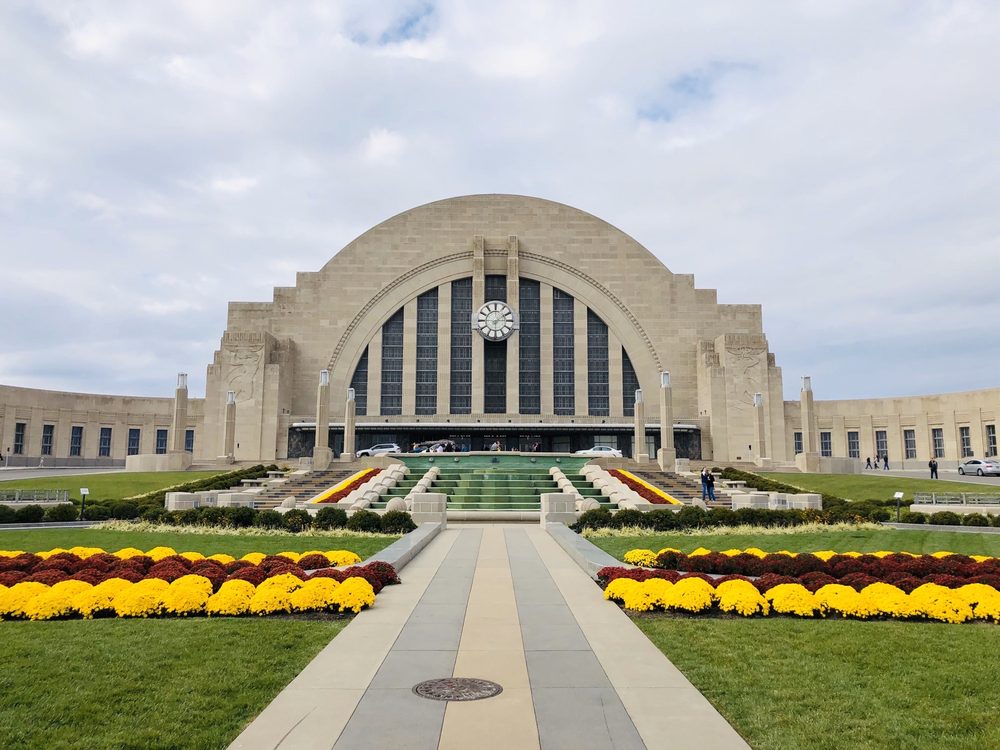
You turn off Western Avenue in the Queensgate neighborhood and there it is: Union Terminal rising before you like something transported from another era entirely. The approach is sudden, cinematic. One moment you’re navigating the industrial streets west of downtown Cincinnati, and the next you’re face to face with one of the most spectacular examples of Art Deco architecture in America — a massive limestone structure with a soaring half-dome and a facade that curves like a ship’s prow. The building announces itself without apology. This was, after all, designed to be one of the last great American train stations, built in 1933 when rail travel still meant romance and glamour. You park in the garage beneath, ascend the escalators, and step into the Grand Rotunda. That first glimpse stops everyone. The dome arcs 106 feet overhead, spanning 180 feet across — the second largest half-dome in the world. And then there are the murals: massive glass mosaics by Winold Reiss, vivid even after ninety years, depicting Cincinnati’s industrial history in bold reds, golds, cerulean blues, and burnt oranges. The scale is overwhelming in the best possible way. This is not a venue where florals need to work hard to create drama. The drama is already here, built into the bones of the building. Your job — our job — is to honor it. Poppy hasn’t designed flowers for a wedding at Union Terminal yet, but we’ve studied this space the way you study a masterpiece, and we understand what Cincinnati Museum Center at Union Terminal wedding flowers need to be: bold enough to hold their own in a room this grand, restrained enough not to compete with Reiss’s mosaics, and architecturally precise enough to echo the Art Deco language written into every archway and balustrade.
About Cincinnati Museum Center at Union Terminal
Cincinnati Museum Center at Union Terminal is a National Historic Landmark, and that designation is not handed out lightly. Completed in 1933, Union Terminal was designed by the firm Fellheimer & Wagner in collaboration with architect Paul Philippe Cret, and it remains one of the finest intact examples of Art Deco design in the United States. The building cost $41.5 million to construct during the Depression — an almost unimaginable sum for the era — and it shows. Every detail, from the geometric terrazzo floors to the aluminum grillwork to the streamlined benches, speaks to an era when public architecture aspired to be monumental. For twenty years, Union Terminal served as Cincinnati’s primary rail hub, welcoming thousands of travelers daily beneath that soaring dome. By the 1970s, rail travel had declined and the building faced demolition. Instead, the city rallied. In 1980, it reopened as the Cincinnati Museum Center, now housing the Cincinnati History Museum, the Museum of Natural History & Science, the Robert D. Lindner Family OMNIMAX Theater, and the Cincinnati Children’s Museum. A $228 million restoration completed in 2018 brought the building back to its original glory, repairing the dome, restoring the mosaics, and updating infrastructure while preserving every historic detail.
The building sits just west of downtown Cincinnati in the Queensgate neighborhood, an industrial area undergoing gradual transformation. Union Terminal anchors this district, visible from I-75 and serving as a cultural hub for the entire region. For couples planning a wedding here, the location offers easy highway access and a 900-space parking garage on-site — logistics matter when you’re hosting a celebration for hundreds. The venue is about a ten-minute drive from downtown Cincinnati and the trendy Over-the-Rhine neighborhood, where many guests might be staying or dining before or after your event. Amtrak still serves Union Terminal, which means out-of-town guests arriving by rail can literally step off the train and into your wedding venue, a romantic detail that feels lifted from another century.
As a wedding venue, Union Terminal is managed by an experienced events team accustomed to orchestrating large-scale celebrations within a historic, museum setting. All catering is handled in-house, and the venue maintains an approved vendor list for certain services, though florists are not restricted — which means Poppy, as a Cincinnati wedding florist, can work here freely. Load-in logistics require coordination, as setup windows are typically limited to a few hours before your event begins. The venue’s sheer scale means that floral installations need to be planned meticulously and executed efficiently. The museum setting also comes with the usual restrictions: no nails, no adhesives on historic surfaces, and careful handling of any exhibits used as part of your event design. But these constraints are easily managed with the right team. The payoff is a venue that requires almost no additional decoration because the architecture itself is the spectacle.
Event Spaces & Floral Opportunities
Grand Rotunda
Capacity: 1,000 seated for dinner; 1,500 for reception
Setting: The Grand Rotunda is the heart of Union Terminal and the most breathtaking event space in Cincinnati. The half-dome rises 106 feet above the floor, and the space spans 24,000 square feet, making it one of the largest single-room venues in the region. The walls curve gently, lined with Winold Reiss’s monumental glass mosaic murals — each mural is 22 feet tall and stretches 110 feet in length, depicting scenes of Cincinnati’s industries, workers, and history in vivid tesserae that catch and refract light throughout the day. The murals are not merely decorative; they are storytelling on an epic scale, rendered in bold colors that remain unfaded after nine decades. The floors are geometric terrazzo in cream, rust, and black. Modern chandeliers hang from the dome’s apex, and the overall effect is simultaneously grand and intimate, a room that feels designed for ceremony in the most literal sense.
Floral approach: Designing flowers for the Grand Rotunda requires a clear understanding of scale and restraint. This is not a space where you scatter bud vases and call it finished. Everything must be larger, taller, more architecturally considered. For guest tables, we recommend either very low arrangements — no taller than ten inches, so sightlines remain clear and the murals stay visible — or dramatically elevated designs on 36- to 48-inch tall risers that lift blooms well above head height. Low arrangements might feature mounded garden roses (Mayra’s Rose, Keira, or Romantic Antike in blush and peach tones that echo the mural’s warm palette), ranunculus in burnt orange and gold, chocolate cosmos for depth, and trailing jasmine vine or Italian ruscus spilling over the edges of wide, shallow stone or bronze vessels. Elevated arrangements can include statement blooms like dinner-plate dahlias (Café au Lait, Penhill Dark Monarch), tall gladiolus in jewel tones, delphinium in cobalt or burgundy, and long trails of amaranthus that cascade downward, creating movement and drama without obstructing views. Vessels should be substantial — hammered bronze urns, geometric Art Deco vases in gold or black lacquer, or clear glass cylinders filled with submerged branches and floating candles. For the ceremony, a large-scale installation is essential to hold the space. Consider a 12-foot-wide freestanding arch constructed from dark metal framework (echoing the geometric ironwork throughout the building) and densely covered with smilax, eucalyptus, and clusters of roses, peonies, and dahlias in shades that harmonize with the mural colors — think rust, gold, deep crimson, and slate blue. Position the arch so it doesn’t compete with the murals but rather frames the couple against the architectural backdrop. Aisle arrangements can be minimal — perhaps clusters of tall pillar candles in hurricane glass or simple stone urns filled with blooms positioned every third or fourth row. The goal is to enhance the grandeur without cluttering the sightlines or distracting from the mosaics, which are, after all, irreplaceable works of art.
Cincinnati Dining Room
Capacity: 100 seated; 200 for theater-style ceremony
Setting: The Cincinnati Dining Room is a 2,000-square-foot private event space with original Art Deco architectural details intact. The room features geometric wood paneling, period light fixtures, and a warm, intimate atmosphere that contrasts beautifully with the vast openness of the Rotunda. The space includes its own restrooms and coat racks, making it self-contained and ideal for smaller celebrations or as a ceremony space followed by a reception in the Rotunda. The ceilings are lower here — still tall by modern standards but human-scaled — and the overall vibe is elegant, refined, and slightly more residential in feel.
Floral approach: In this more intimate setting, florals can be more detailed and conversational. Centerpieces should be lower — eight to twelve inches tall — allowing guests to easily see and speak to one another across the table. Consider lush, tightly clustered arrangements featuring garden roses (Juliet, Patience, or Keira), spray roses, ranunculus, scabiosa, lisianthus, and astilbe in soft, romantic tones: blush, champagne, mauve, with touches of burgundy or rust for depth. Vessels might be vintage-inspired: mercury glass compotes, geometric brass containers, or matte black ceramic bowls that nod to the Art Deco era without feeling costume-y. Foliage should be refined — maidenhair fern, eucalyptus (silver dollar or seeded), and perhaps a few strands of trailing ivy for movement. For a ceremony in this room, a simple floral chuppah or arch placed near the windows provides a focal point without overwhelming the space. Alternatively, large floral urns flanking the ceremony area and a lush aisle runner of loose petals create an elegant processional. Consider adding greenery garlands along the wood paneling or draping smilax above doorways for a soft, garden-inspired touch that enhances the room’s warmth.
Losantiville Cafe Dining Room
Capacity: 250 seated
Setting: The Losantiville Cafe Dining Room is a 4,000-square-foot space that offers more room than the Cincinnati Dining Room while still maintaining an intimate, enclosed feel. The aesthetic is similar — Art Deco details, period lighting, warm tones — but the larger footprint allows for more guests and more flexibility in table configurations. This room works well for both ceremonies and receptions, and it can accommodate a small dance floor.
Floral approach: With 250 guests, you’ll want a mix of high and low centerpieces to create visual variety and rhythm throughout the room. Alternate between low, lush arrangements (as described for the Cincinnati Dining Room) and taller designs on risers or elevated stands. Tall arrangements might feature branches (curly willow, manzanita, or birch) as structural elements, with blooms — orchids (phalaenopsis or cymbidium), calla lilies, delphinium, lisianthus — clustered at the base or wired along the branches. The verticality draws the eye upward and fills the room’s volume without crowding the tables. For a ceremony in this space, consider a substantial floral backdrop rather than a traditional arch: a 10-foot-wide by 8-foot-tall installation of greenery (smilax, Italian ruscus, ferns) with florals clustered asymmetrically — large groups of blooms in jewel tones or warm neutrals, with negative space left visible to keep the design feeling modern and intentional. The backdrop can later be repurposed as a focal point behind the head table or dessert display. Entrance arrangements — large urns or pedestals flanking the doorways — help define transitions between spaces and make a strong first impression as guests arrive.
Public Landing (Cincinnati History Museum)
Capacity: Ceremony space within museum
Setting: The Public Landing is one of the most unique ceremony locations in the entire venue. Located within the Cincinnati History Museum, this area recreates a 19th-century riverfront scene, complete with cobblestone streets, historic storefronts, and immersive exhibits. The space feels like stepping back in time, offering a theatrical, storytelling backdrop for vows. The setting is quirky, memorable, and very Cincinnati — it’s hard to imagine another venue where you could get married in front of a recreated steamboat landing.
Floral approach: The key here is to complement the historical theming without feeling like a costume. Vintage-inspired arrangements work beautifully: think wildflower-style bouquets with dahlias, zinnias, black-eyed Susans, cosmos, Queen Anne’s lace, and herbs like rosemary and lavender, arranged loosely in tin buckets, enamelware pitchers, or rustic wooden boxes. These containers feel period-appropriate without being overly literal. For the ceremony, consider lining the cobblestone aisle with lanterns and small posies of seasonal blooms in glass bottles or mason jars. A simple floral garland draped along a historic storefront or fence creates a focal point without overwhelming the exhibit details. This is also a space where less is more — the environment provides so much visual interest that florals should enhance the mood rather than compete for attention. If you’re leaning into the historical vibe, consider asking your florist to source heritage rose varieties or blooms that would have been available in the 1800s, like peonies, hydrangeas, and sweet peas.
Natural History Museum Exhibits
Capacity: Cocktail hour space
Setting: Hosting cocktail hour among dinosaur fossils is exactly as extraordinary as it sounds. The Natural History Museum includes towering skeletal reconstructions, dioramas of prehistoric scenes, and interactive exhibits that provide a built-in conversation starter for your guests. The lighting is dramatic, designed to spotlight the exhibits, and the overall effect is both playful and awe-inspiring.
Floral approach: In this setting, florals should feel organic, slightly wild, and connected to the natural world. Think terrariums, moss-covered vessels, arrangements featuring succulents, air plants, and botanical elements like ferns, fiddlehead ferns, and lichen-covered branches. Small bud vases or test tubes filled with single blooms — perhaps protea, thistle, or unusual foliage — can be scattered on cocktail tables alongside votives. For bar displays, consider larger installations that incorporate natural textures: a runner of moss and ferns along the bar top, accented with clusters of orchids, hellebores, or miniature calla lilies. Glass cloches or bell jars filled with floating blooms or botanical specimens create a cabinet-of-curiosities vibe that feels perfectly at home in a museum. This is also a space where you can have fun with unexpected elements: perhaps incorporating feathers, stones, or even faux fossil elements into floral displays for a whimsical nod to the surroundings. The goal is to let the exhibits do the heavy lifting while florals add pops of color, texture, and life.
OMNIMAX Theater
Capacity: 245 seated
Setting: The OMNIMAX Theater is a unique space for special screenings, presentations, or even a ceremony for film-loving couples. The massive domed screen and tiered seating create a dramatic, immersive environment.
Floral approach: Floral needs in the theater are minimal, given the focus on the screen and seating layout. If using the space for a ceremony, consider a large floral installation at the base of the screen or on the stage area — this becomes the visual focal point for guests as they enter. Otherwise, entrance arrangements and a few floral accents near the lobby or concessions area are sufficient. This isn’t a space where table florals make sense, so invest in one or two statement pieces that frame the experience.
Outdoor Fountains
Capacity: Outdoor ceremony space
Setting: Union Terminal’s exterior grounds feature historic fountains with the building’s magnificent Art Deco facade as a backdrop. The fountains are elegant, the stonework is pristine, and the setting offers a rare opportunity for an outdoor ceremony within a largely indoor venue.
Floral approach: Outdoor floral designs here must account for wind and water. Use sturdy stems — hydrangeas, roses with thick stems, gladiolus, and woody branches — and avoid delicate blooms that will wilt or shred in a breeze. Arrangements should be weighted heavily and positioned in stable, low-profile containers (stone urns, wide ceramic pots). A floral arch or chuppah should be anchored securely, ideally with sandbags or stakes concealed beneath draping fabric. For aisle arrangements, consider substantial pedestals or urns placed every few rows rather than delicate shepherd’s hooks or glass vases that could topple. If the fountains are running during your ceremony, position arrangements so water spray doesn’t reach the florals — or choose water-tolerant foliage like ferns, eucalyptus, and ivy that can handle a bit of mist. The building itself is such a stunning backdrop that florals can be relatively simple: the architecture does most of the work. A runner of loose petals along the aisle and a lush floral installation framing the couple is often all you need.
Wedding Flower Ideas for Cincinnati Museum Center at Union Terminal
Deco Royale
This palette draws directly from the Winold Reiss mosaics, using the same rich jewel tones that define the artwork. Deep burgundy dahlias (Jowey Winnie, Spartacus), crimson garden roses (Tess, Piano), burnt orange ranunculus, and golden yellow roses (Catalina, Free Spirit) form the foundation. Add depth with chocolate cosmos, burgundy calla lilies, and touches of cobalt blue delphinium or tweedia. Foliage includes bronze-toned leucadendron, burgundy-edged eucalyptus, and dark magnolia leaves. Vessels are strictly geometric: black lacquered Art Deco vases, hammered bronze urns, gold pedestals with clean lines. This is a bold, saturated palette that holds its own in the Grand Rotunda without competing with the mosaics — instead, it echoes them, creating a sense of visual harmony between florals and architecture. Use this concept for dramatic Rotunda receptions where you want maximum impact and unapologetic color.
Union Terminal Moderne
For couples seeking a more restrained, modernist approach, this concept strips back to a monochromatic palette of white, cream, and green. White phalaenopsis orchids, white calla lilies (Crystal Blush for a hint of blush at the throat), white garden roses (Patience, Vitality), and pale green hydrangeas. Foliage is all texture: silver dollar eucalyptus, seeded eucalyptus, maidenhair fern, and flat Italian ruscus. Structural elements include bleached birch branches or white-painted manzanita, creating height and architectural interest without color distraction. Vessels are minimal: clear glass cylinders, white ceramic cubes, or simple brushed nickel stands. The effect is clean, elegant, and timeless, allowing the venue’s architecture to shine while florals add softness and organic shape. This palette works beautifully in the Cincinnati Dining Room or Losantiville Cafe, where the more intimate scale lets you appreciate the subtlety of tone-on-tone design. It’s also stunning in the Rotunda if you want a sophisticated, modern celebration that doesn’t lean into the mosaics’ bold color.
Cincinnati Heritage
This concept leans into the city’s history and the era of Union Terminal’s construction. The palette is vintage-inspired: soft blush roses (Quicksand, Romantic Antike, Café Latte), peach garden roses (Juliet, Edith), mauve lisianthus, pale pink astilbe, and peachy-coral ranunculus. Add depth with dusty plum accents — scabiosa, hellebores, or smoke bush foliage. Textural elements include hops, privet berries, and trailing jasmine vine. Vessels are vintage finds: mercury glass compotes, aged brass bowls, enamelware pitchers, and etched glass vases. The overall vibe is romantic, nostalgic, and soft, evoking the glamour of 1930s Cincinnati without being literal or costumey. This palette is perfect for the Public Landing ceremony, where the historical exhibits call for a softer, more intimate floral approach, or in the Cincinnati Dining Room for a celebration that feels warm and personal.
Seasonal Considerations
Cincinnati’s location in southwestern Ohio means four distinct seasons, each with unique advantages and challenges for wedding florals.
Spring (March–May): Spring in Cincinnati can be unpredictable — warm one day, snowy the next, especially in March and early April. By May, the weather stabilizes, with temperatures in the 60s and 70s and frequent rain showers. Locally available blooms include tulips, daffodils, hyacinths, ranunculus, and anemones, along with flowering branches like cherry, dogwood, and crabapple. Spring is peak wedding season, and flower availability is excellent, though prices for certain stems (peonies, especially) can be high due to demand. For outdoor fountain ceremonies, have a backup plan in case of rain or wind — Union Terminal’s indoor spaces provide seamless alternatives. Spring’s soft light is beautiful for photography, and the city’s parks and neighborhoods are blooming, making it a lovely time for a wedding weekend in Cincinnati.
Summer (June–August): Cincinnati summers are hot and humid, with temperatures regularly reaching the 80s and 90s and occasional thunderstorms. Heat is the primary concern for florals, especially if you’re using outdoor spaces. Hydrangeas, roses, zinnias, dahlias, lisianthus, and sunflowers are all in season and hold up relatively well in heat, but delicate blooms like sweet peas or lily of the valley should be avoided. Load-in and setup should happen as close to your event as possible to minimize heat exposure, and arrangements should be kept hydrated and out of direct sun. The good news: Union Terminal is climate-controlled, so once florals are inside, they’re protected. Summer also offers the most daylight for photography and the lushest outdoor landscapes, making it a popular choice despite the heat.
Fall (September–November): Fall is Cincinnati’s most popular wedding season, and for good reason. The weather is mild and pleasant, with crisp mornings and warm afternoons. By October, the trees surrounding Union Terminal and throughout the city turn brilliant shades of red, orange, and gold, providing a natural color palette that’s hard to beat. Locally available blooms include dahlias, chrysanthemums, asters, and the last of the summer roses. Fall is also harvest season, so incorporating seasonal elements like pumpkins, gourds, apples, and grain into floral designs adds a festive, regional touch. The outdoor fountains are ideal for October ceremonies, when the weather is reliably pleasant and the light is golden and soft. Fall’s only downside is its popularity — book your florist early.
Winter (December–February): Winter weddings at Union Terminal are magical, especially around the holidays when the city is decorated and the building feels even more grand and festive. However, winter in Cincinnati means cold, with temperatures often below freezing and occasional snow. Outdoor ceremonies are rarely practical, but the indoor spaces are cozy and elegant. Winter florals include amaryllis, paperwhites, ranunculus, anemones, hellebores, and evergreens like pine, fir, cedar, and eucalyptus. Berries (ilex, hypericum, privet) add pops of color, and branches (birch, curly willow, red twig dogwood) provide structure. Winter is also the season for rich, moody palettes — deep reds, burgundies, evergreen, and ivory — that feel perfectly suited to Union Terminal’s dramatic interiors. Consider adding candles, lanterns, and warm lighting to enhance the cozy, romantic atmosphere.
Poppy’s Expert Take
Respect the murals. The Winold Reiss mosaics are priceless works of art and the main attraction in the Grand Rotunda. Your floral designs should complement them, not compete. Avoid placing tall arrangements directly in front of the murals, and choose color palettes that harmonize with the mosaics’ jewel tones. When in doubt, step back and ask: are the florals enhancing the space or distracting from it? If guests are looking at your centerpieces instead of the art, you’ve gone too far.
Scale up or sit down. The Rotunda’s 24,000 square feet and 110-foot ceilings mean that small, dainty arrangements will simply disappear. Either commit to low, lush designs that create intimacy at table level, or go tall with elevated arrangements that fill vertical space. Mid-height arrangements — the standard 18-to-24-inch centerpieces that work in most venues — are the wrong choice here. They’ll look lost.
Plan for limited setup time. Union Terminal typically allows only 2–3 hours of vendor setup before your event begins. For a large Rotunda wedding with complex floral installations, that window can feel tight. Work with a florist (like Poppy) experienced in museum venues who can prep arrangements off-site, stage them efficiently, and execute setup with precision. Communicate with the venue’s events team about load-in logistics, freight elevator access, and where arrangements can be staged before placement.
Use the museum exhibits wisely. If you’re incorporating the Natural History or Cincinnati History museums into your event — for cocktail hour, a ceremony, or photos — coordinate with the venue about which exhibits will be accessible and whether any displays will be off-limits. Some areas may have restrictions on where florals can be placed due to artifact preservation. Embrace the quirky, unexpected nature of these spaces rather than trying to make them look like a traditional ballroom.
Consider floral repurposing. Because setup time is limited and the spaces are vast, some couples choose to design ceremony florals that can be repurposed for the reception. A large ceremony arch or backdrop can be moved to behind the head table or used as a focal point in the Rotunda. Aisle arrangements in urns can be repositioned at the venue entrances or flanking the dance floor. Discuss this with your florist during planning to maximize your budget.
Lighting is everything. The Grand Rotunda’s dome and murals are best appreciated with thoughtful lighting. Work with your venue and lighting designer to ensure that uplighting on the murals doesn’t wash out your floral colors, and that centerpieces are illuminated without harsh spotlighting. Soft, ambient lighting enhances the Art Deco atmosphere and makes florals glow.
Budget for the scale. Union Terminal’s grandeur requires florals that match its ambition. Couples often underestimate the quantities and sizes needed to make an impact in a room this large. Be realistic about your budget, and trust your florist to guide you toward designs that will work in the space. A few large, dramatic installations often make a stronger impression than many smaller arrangements scattered throughout.
What Poppy Couples Spend on Flowers Here
$5,000–$7,500 | The Essentials
This budget covers the basics for a mid-sized celebration in the Cincinnati Dining Room or Losantiville Cafe (100–150 guests). You’ll have centerpieces for all guest tables — either low, lush arrangements in vintage-inspired vessels or a mix of high and low designs to create interest. Add a ceremony arrangement (a floral arch or backdrop, plus aisle markers), personal flowers (bridal bouquet, bridesmaid bouquets, boutonnieres), and a few accent pieces (entrance arrangements or a small installation behind the head table). Blooms at this level are seasonal and accessible — garden roses, ranunculus, lisianthus, spray roses, and plenty of lush greenery. This budget creates a beautiful, cohesive look without large-scale installations.
$8,000–$12,000 | The Full Picture
This range is ideal for a larger celebration in the Rotunda (200–300 guests) or for couples using multiple spaces (ceremony in the Public Landing, cocktails in the Natural History Museum, reception in the Rotunda). You’ll have elevated centerpiece designs — a mix of low, lush arrangements and tall, dramatic pieces on risers — plus a substantial ceremony installation (a large arch, backdrop, or paired urns with abundant blooms). Add personal flowers, entrance arrangements, bar florals, cocktail table accents, and possibly a floral installation for the head table or a statement piece in the Rotunda. At this level, you can incorporate more premium blooms like dahlias, peonies (in season), orchids, and specialty foliage. The overall effect is polished, abundant, and impactful.
$12,000+ | The Full Experience
For couples seeking a showstopping floral presence in the Grand Rotunda, this investment allows for large-scale installations that match the venue’s grandeur. Think suspended greenery garlands with clustered blooms running the length of the room, a 12-foot ceremony arch densely covered in florals, tall elevated centerpieces for every table, lush arrangements flanking