
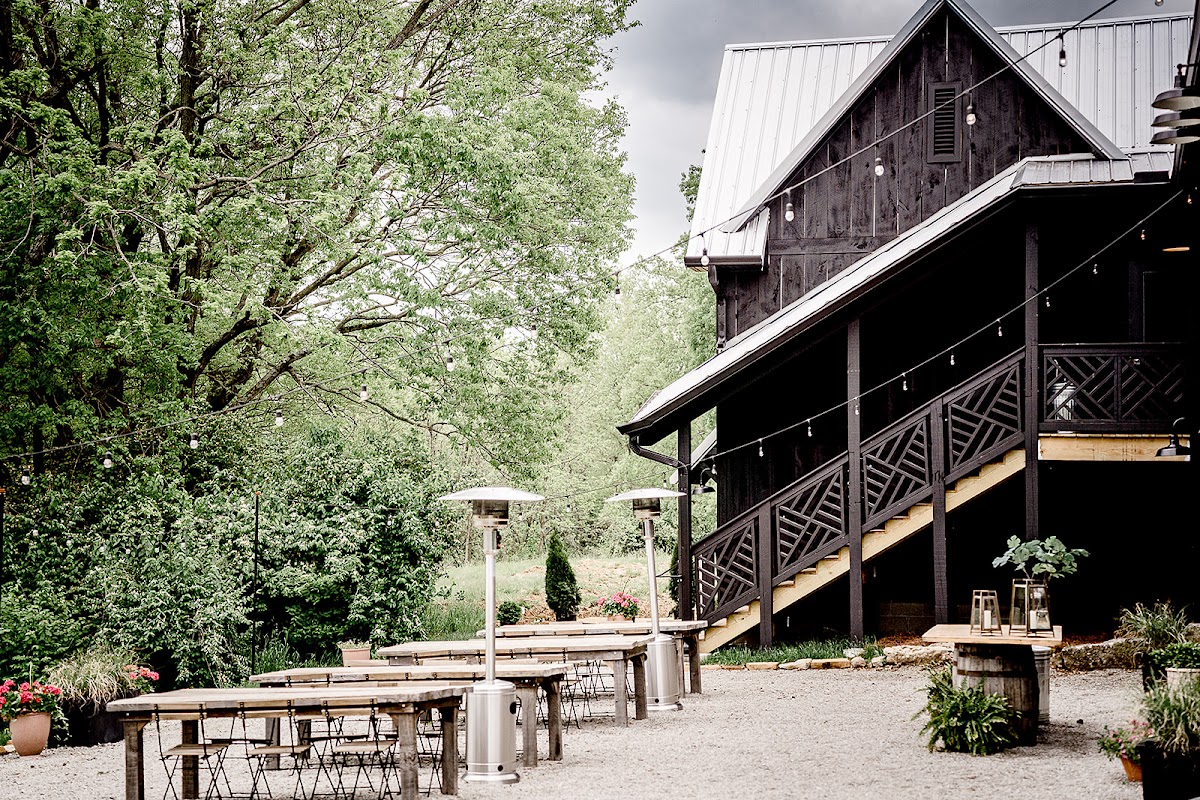
You turn off Drake Road and the city noise falls away. The drive into Cedar Bay Farm is a deliberate transition — pavement becomes gravel, and the Warren County countryside unfolds around you in soft waves of green. First you notice the open fields, then the pond catching the afternoon light, and finally the barn itself: a long, dark silhouette against the sky, dignified and plainspoken in the way that 170-year-old structures tend to be. This is not a barn that has been dressed up to play a part. It was built in 1855 by hands that knew timber and stone, and it has been working ever since. The original beams still span the ceiling. The modern black siding and glass doors are recent additions, but they defer to the architecture rather than compete with it. Inside, thousands of tiny lights thread through the rafters like stars brought down to earth. Outside, a creek meanders through the property, spanned by a wooden bridge that leads to the ceremony site. Ten acres of rolling hills, open sky, and the kind of quiet that makes you realize how much noise you carry with you from the city. Cedar Bay Farm sits thirty minutes from Cincinnati, thirty minutes from Dayton, and a world away from both.
About Cedar Bay Farm
Cedar Bay Farm is a family-owned wedding venue in Lebanon, Ohio, occupying ten private acres in Warren County’s gently rolling farmland. The property centers on a restored 1855 barn — one of the oldest wedding venues in southwestern Ohio still standing in its original form. The barn’s bones are all original: hand-hewn timber beams, mortise-and-tenon joinery, and the kind of thick wooden posts that were cut from trees that were already old when Lincoln was president. The restoration, completed in recent years, modernized the structure with climate control, large glass doors that slide open to the courtyard, and a sophisticated lighting system that preserves the barn’s rustic character while making it comfortable for year-round celebrations.
The property was never a decorative farm. It was a working homestead, and that utilitarian honesty remains in the architecture. The stone courtyard connects the barn to the outdoor ceremony site via a five-minute walk through the grounds. The creekside ceremony location is shaded by mature trees, with a custom-built wooden arbor positioned so guests look out over the water and the fields beyond. A charming bridge — sturdy enough for a processional, photogenic enough for every wedding album — provides the entrance to the ceremony site. The entire estate is exclusively yours for the day, which means no overlapping events, no time pressure, and no strangers wandering through your family photos.
Beyond the barn and ceremony site, the property includes a historic farmhouse that serves as the bridal suite, a separate groom’s lounge called the Fox’s Den, a pond, a fire pit area (the only place on the property where smoking is permitted), and enough open field to accommodate golden-hour portraits, lawn games, or simply wandering. The venue is positioned between I-71 and I-75, making it equally accessible from Cincinnati’s east side suburbs, Dayton’s southern neighborhoods, and towns like Mason and Kettering. For florists, the load-in is straightforward: the barn has wide doorways, level access, and the staff provides golf cart assistance for transporting materials from parking to the various ceremony and reception locations. The venue requires standard certificates of insurance but does not restrict florist choice, which is increasingly rare in the Cincinnati market.
Cedar Bay Farm operates with an open-vendor policy for all licensed professionals — caterers, photographers, florists, DJs — though they maintain a preferred vendor list for couples who want guidance. The venue provides tables, linens, wooden cross-back chairs, bar service, parking attendants, and those remarkable twinkle lights that have become the barn’s signature. Couples have access from 10 a.m. to 11 p.m. on their wedding day, which allows time for both ceremony and reception setup without the rushed flips that plague many barn venues.
Event Spaces & Floral Opportunities
Historic Barn - Main Reception Hall
Capacity: 126 seated
Setting: The barn measures 2,000 square feet under a cathedral ceiling supported by the original 1855 timber beams. The walls are finished in a neutral cream and soft gray palette that reads as almost white in the twinkle light glow. Large glass doors on the south wall slide open to the stone courtyard, blurring the line between inside and outside during cocktail hour. The ceiling is strung with thousands of tiny lights — not the harsh, overly bright kind, but a warm amber glow that makes everything look like it’s been dipped in honey. Wooden cross-back chairs (included with the venue) line long farmhouse tables or cluster around rounds, depending on your preference. The space is climate-controlled, with large fans for summer weddings and heating for cooler months, but the barn still feels like a barn — you can see the joinery in the beams, the natural imperfections in the wood, the history in the rafters.
Floral approach: The twinkle lights are your greatest ally and your biggest design consideration. In evening receptions, anything you place on the tables will be illuminated by that soft, warm glow, which means certain colors will sing and others will disappear. Whites, creams, blushes, soft peaches, and muted lavenders come alive under warm lighting. Deep burgundies and navy blues can read as almost black unless you use them sparingly as accents. We favor low, lush centerpieces in this space — think garden roses (Patience, Juliet, Keira), ranunculus, anemones, and hellebores in aged brass compotes or wooden boxes that echo the barn’s rustic warmth. Keep arrangements under twelve inches so guests can see across the table, and let the texture do the talking: trailing jasmine vine, scented geranium foliage, chocolate cosmos for their almost-black centers, and plenty of movement. The barn beams are a dream for suspended installations. We’ve draped 30-foot garlands of smilax, Italian ruscus, and seeded eucalyptus along the central beam, punctuated every six feet with clusters of quicksand roses and white lisianthus. The key is to use the vertical space without blocking the twinkle lights — you want the garland to weave between the lights, not cover them. For the entrance to the barn, a pair of large-scale arrangements in weathered urns (café au lait dahlias, white hydrangea, lunaria, and curly willow) announces the transition from cocktails to dinner. Real candles are permitted here, which is rare and wonderful — low taper candles in brass holders scattered down the length of a long table create an intimacy that battery-operated versions simply can’t match.
Creekside Ceremony Site
Capacity: 126 seated
Setting: A five-minute walk from the barn, accessible via a picturesque wooden bridge that spans a small creek. The ceremony site sits in a naturally shaded clearing surrounded by mature trees, with the water murmuring in the background and open fields visible beyond. The custom wooden arbor is positioned at the end of a grass aisle, with the creek and countryside as the backdrop. Chairs are provided by the venue and arranged in neat rows on either side of the aisle. The shade is a practical gift — it keeps guests comfortable and prevents flowers from wilting during the ceremony — but it also lends a certain dappled, fairy-tale quality to the light. This is not a place that needs much help looking romantic.
Floral approach: The wooden arbor is your primary canvas, and the approach depends entirely on your vision. For couples who want drama, we recommend a full asymmetrical installation: start with a structural base of curly willow or flowering branches (dogwood in spring, cherry blossom in late April, blooming quince in early summer), then layer in focal flowers on one side — garden roses, peonies (in May and early June), lisianthus, and spray roses in soft, romantic tones. Let the arrangement cascade down one side of the arbor and trail into the grass, as though the flowers are growing there. For a more minimal approach, we’ve done simple garlands of Italian ruscus and eucalyptus along the top beam of the arbor, with two large clusters of blooms at the corners — this keeps the creek and countryside visible behind the couple while still framing the moment. Aisle markers can be as simple as shepherd’s hooks with small posies of seasonal blooms (tulips and daffodils in spring, zinnias and black-eyed Susans in summer, chrysanthemums and marigolds in fall), or you can line the aisle with lanterns surrounded by loose petals. The creek itself is an opportunity: we’ve floated arrangements in shallow bowls on the water near the arbor — a loose gathering of roses, floating candles, and floating greenery that catches the light and creates a dreamy, almost otherworldly effect. Because the ceremony site is shaded, your florals will hold beautifully even on a warm day, which is a luxury not every outdoor space offers.
Stone Courtyard & Custom Bar
Capacity: 200 standing
Setting: The stone courtyard is the connective tissue between the barn and the ceremony site, and it functions as cocktail hour central for most weddings. The floor is paved in neutral stone that complements the barn’s exterior. A custom-built wooden bar anchors one side of the courtyard, with enough space for multiple bartenders and room for decorative displays. Cocktail tables (also provided by the venue) are scattered throughout, and the space opens onto the surrounding fields, so guests can wander with their drinks and take in the scenery. The courtyard gets full sun in the late afternoon, so shade sails or the barn’s overhang provide relief on hot days.
Floral approach: The custom bar is prime real estate for a statement arrangement. We favor something abundant and slightly wild here — a large, overflowing installation in a wooden trough or galvanized tub that sits atop the bar: sunflowers (Vincent’s Choice, Teddy Bear), zinnias (Queen Red Lime, Benary’s Giant), dahlias (Café au Lait, Blushing Bride), black-eyed Susans, and plenty of textural foliage like fountain grass, amaranthus, and bear grass. This is the space to embrace color — the stone and wood are neutral enough to handle it, and the outdoor setting calls for something cheerful and abundant. For the cocktail tables, we recommend either small bud vases with single statement blooms (one perfect dahlia, one stem of larkspur, one ranunculus) or small clustered arrangements in mason jars or vintage bottles — nothing tall, nothing that blocks conversation. If you want to elevate the space further, consider potted herbs like lavender or rosemary in terracotta pots stationed around the perimeter — they add fragrance, texture, and a garden-party vibe that feels right at home on a farm. The courtyard’s connection to the open fields also makes it ideal for a signature floral moment that guests can photograph: a freestanding floral backdrop (a frame covered in greenery and blooms), a vintage truck or wheelbarrow overflowing with flowers, or even a simple market-style display with buckets of seasonal stems arranged as though you’ve just cut them from the garden.
Open Fields & Grounds
Capacity: Variable
Setting: Ten acres of rolling hills, open fields, a pond, walking paths, and a fire pit area. The fields are mowed and maintained but retain a natural, organic feel — this is not a manicured golf-course lawn, and that’s part of the charm. The property offers multiple photo locations: the pond at sunset, the open fields with long grass swaying, the fire pit surrounded by Adirondack chairs, and various tree groves that provide dappled shade. The grounds are yours exclusively for the day, which means you can stage additional floral moments anywhere that makes sense for your celebration.
Floral approach: The grounds are an opportunity for unexpected floral installations that don’t fit neatly into “ceremony” or “reception” categories. We’ve created welcome moments near the parking area — a vintage wooden ladder leaning against a tree with small arrangements on each rung, or a simple sign surrounded by potted flowers that greets guests as they arrive. The pond is ideal for floating arrangements if the water is calm — large blooms like peonies, dahlias, or lotus flowers (if sourced in season) in shallow bowls or floating directly on the surface. For golden-hour portraits, consider a setup near the open fields: a vintage rug, a small settee, and a freestanding arrangement in an urn that creates a styled vignette for photos. The fire pit area, if used during the reception, can be softened with simple greenery garlands draped over the Adirondack chairs or small arrangements in lanterns placed on the ground. The key with the grounds is restraint — the landscape is already doing most of the work, so your florals should feel like natural extensions of what’s already there rather than additions imposed on the space. Think installation art rather than decoration: subtle, considered, and surprising when guests stumble upon them.
Wedding Flower Ideas for Cedar Bay Farm
Heirloom Harvest
This design concept leans into the farm’s agricultural history with a palette pulled from a late-summer vegetable garden: deep burgundy (like heirloom tomatoes), burnt orange (like winter squash), mustard yellow (like sunflowers), and soft sage green. The centerpieces are built in wooden crates or galvanized buckets and feature a mix of dahlias (Cornel, Labyrinth, Café au Lait), zinnias (Queen Red Lime, Benary’s Giant Salmon Rose), sunflowers (Teddy Bear, Autumn Beauty), celosia (Bombay Fire, Kurume Scarlet), and textured foliage including amaranthus (Coral Fountain, Green Tassels), fountain grass, and bear grass. The ceremony arbor is dressed with a full installation that includes flowering branches (viburnum, blooming raspberry canes), the same dahlias and sunflowers, and trailing hops vine or jasmine. Bouquets are hand-tied with natural jute twine and feature the same rich, saturated tones. This palette is especially stunning in the barn under the twinkle lights — the warm amber glow brings out the gold and orange tones — and it photographs beautifully against the neutral stone courtyard. Best seasons: late summer through early fall (July through October).
Meadow Lark
Inspired by the wildflower meadows that bloom in Ohio’s countryside, this concept embraces an organic, just-picked-from-the-field aesthetic. The palette is soft and romantic: blush, cream, lavender, butter yellow, and plenty of green. Centerpieces are arranged in mismatched vintage bottles and mason jars clustered in groups of three or five on each table, featuring a mix of garden roses (Patience, Keira, Juliet), astilbe (Bridal Veil, Peach Blossom), scabiosa (Fama White, Blue Note), Queen Anne’s lace, nigella, ranunculus, sweet peas (when in season, April through June), and lots of textured greenery like Italian ruscus, seeded eucalyptus, and maidenhair fern. The ceremony arbor is dressed minimally — a loose garland of greenery along the top with two asymmetrical clusters of blooms at the corners. Aisle markers are shepherd’s hooks with small posies tied with trailing silk ribbon. Bouquets are loose, unstructured, and slightly overgrown, as though the bride just wandered through a meadow and gathered what she found. This style works beautifully year-round but is especially magical in spring (April through June) when many of these blooms are at their peak and most affordable.
Modern Farmhouse
For couples who want a cleaner, more minimal aesthetic, this concept pairs the barn’s rustic architecture with a refined, almost Scandinavian simplicity. The palette is restrained: white, soft green, and natural wood tones, with texture doing most of the design work. Centerpieces are low and sculptural, arranged in bleached wooden bowls or simple ceramic vessels, and feature a tight edit of blooms: white ranunculus, white anemones, white lisianthus, and lots of structural greenery like eucalyptus (silver dollar, seeded, baby blue), Italian ruscus, and maidenhair fern. On some tables, we skip flowers entirely in favor of potted succulents, herbs, or ferns in terracotta pots — guests can take them home as favors. The ceremony arbor is dressed with a simple garland of smilax and eucalyptus, no blooms, allowing the wooden structure and the natural backdrop to be the focus. The bar arrangement is the one place we introduce volume: a large, loose installation in a wooden trough featuring white hydrangea, white garden roses, lots of greenery, and branches (curly willow, dogwood, blooming apple in spring). Bouquets are tightly clustered and collar-wrapped in white or natural linen ribbon. This style works in any season and is particularly appealing to couples who want their floral budget to stretch further — the emphasis on greenery and minimal blooms keeps costs down without sacrificing impact.
Seasonal Considerations
Cedar Bay Farm sits in USDA Hardiness Zone 6a, which means four true seasons with cold winters, warm summers, and distinct spring and fall transitions. Each season brings different opportunities and challenges for wedding florals, and understanding what’s locally available — versus what needs to be imported — can significantly impact both your budget and the freshness of your flowers.
Spring (March - May): Ohio spring is unpredictable. March can still see snow, while May can feel like summer. Average temperatures range from the low 40s to the high 70s, and rain is common. But spring is also when the local landscape comes alive: dogwood and redbud trees bloom, daffodils and tulips push through the ground, and the surrounding countryside turns impossibly green. Locally available flowers include tulips (late March through May), daffodils (March and early April), hyacinth, ranunculus, anemones, and flowering branches (dogwood, cherry blossom, viburnum). Peonies are available in late May and early June, but the season is short — two to three weeks at most — and they sell out quickly. Spring weddings at Cedar Bay benefit from the natural beauty of the landscape; you need less floral decor because the property itself is blooming. The shaded ceremony site is ideal in spring when temperatures can still be cool. Practical tip: Order spring bulbs early, especially if you want specific tulip varieties, as growers allocate their inventory months in advance. And have a rain plan — the creekside ceremony is stunning, but it’s fully outdoors with no covered backup.
Fall (September - November): Fall is peak wedding season in Ohio, and for good reason. The temperatures are comfortable (mid-60s to mid-70s in September, dropping to the 50s and 60s in October, and cooler in November), the humidity breaks, and the surrounding countryside explodes in color. The open fields at Cedar Bay turn golden, and the tree line shifts from green to amber, rust, and crimson. Locally available flowers include dahlias (at their absolute peak in September and October), chrysanthemums, marigolds, asters, and late-season zinnias and sunflowers. This is also the season for textured foliage: red and gold leaves, bittersweet vine, oak branches, and ornamental grasses. Fall weddings here practically design themselves — the landscape does half the work. Practical tip: Dahlias are the star of fall weddings, but they’re sensitive to cold. If your wedding is in late October or November and temperatures drop unexpectedly, blooms can be damaged. Work with your florist to source from multiple growers or have backup varieties ready. The fire pit area is perfect for fall weddings — guests naturally gravitate there as the evening cools.
Winter (December - February): Winter weddings at Cedar Bay are rare but enchanting. The barn becomes a warm, glowing refuge against the cold, and the twinkle lights feel especially magical when darkness falls early. Average temperatures range from the high 20s to low 40s, and snow is possible, particularly in January and February. Floral availability shifts almost entirely to imported blooms: roses, carnations (which get an unfair reputation but are actually stunning in winter when properly designed), ranunculus, anemones, amaryllis, and evergreen foliage (pine, cedar, fir, eucalyptus). Winter is also an opportunity to incorporate non-floral elements: pinecones, birch branches, candles, and dried materials like lunaria, eucalyptus, and lotus pods. The ceremony site is less practical in winter — most couples opt for an indoor ceremony in the barn or a tented setup — but the barn’s large glass doors can be opened briefly for a dramatic entrance. Winter florals are often the least expensive of the year (with the exception of December, when holiday demand drives up prices), so couples can get more bloom volume for their budget. Practical tip: Avoid flowers that freeze easily (tulips, calla lilies, orchids) if there’s any chance they’ll be exposed to below-freezing temperatures during transport or setup.
Poppy’s Expert Take
The bridge is your secret ceremony photo opportunity. Every couple photographs on the wooden bridge leading to the ceremony site, and for good reason — it’s charming, it’s structural, and it frames beautifully. But very few couples think to add florals here. A simple garland of greenery along the bridge railing, or small arrangements on either end, creates a gorgeous moment for both the processional and portraits. It’s also visible from the ceremony site, which means it shows up in wide shots of the ceremony itself. Budget a small amount for bridge florals — it’s one of those details that photographs far more expensively than it costs.
Embrace the barn’s twinkle lights rather than fighting them. We’ve worked with couples who want to add string lights, uplighting, or additional lighting to the barn, and it almost always ends up competing with the existing twinkle lights rather than complementing them. The barn’s lighting is already dialed in — warm, romantic, and flattering to both people and flowers. Design your florals to work with that lighting rather than against it. Soft, warm tones (blush, peach, cream, soft yellow) will glow. Cool tones (blues, purples, silvers) can look muddy unless you use them very intentionally. Trust the lights. They’ve been making couples look good for years.
Plan for the five-minute walk between ceremony and reception. Guests walk from the creekside ceremony site back to the barn, and while it’s a lovely stroll, it’s also five minutes during which nothing is happening. Consider how you’ll guide guests along the path — simple floral markers, lanterns, or even a welcome table with drinks stationed halfway creates a sense of journey rather than just a walk. This is also when cocktail hour begins in the courtyard, so make sure your timeline accounts for that transition. Golf carts are available for guests who need assistance, but most guests will walk.
Logistics matter: load-in happens during daylight, but most receptions don’t start until evening. Cedar Bay gives you access from 10 a.m. to 11 p.m., which is generous, but it also means your floral installations are sitting in place for hours before guests arrive. In summer, this can be challenging — arrangements in the courtyard or ceremony site are exposed to sun and heat for the entire afternoon. Hydrate everything heavily, use water tubes for any installations that aren’t in foam or water sources, and communicate with your florist about timing. Ideally, ceremony site installations happen as late as possible (early afternoon for an evening ceremony), and anything in the barn or courtyard can be set up earlier since those spaces are climate-controlled or shaded.
The venue’s vendor-friendly policy is a gift — use it. Cedar Bay doesn’t restrict florists, which means you’re not limited to a preferred list. But it also means the venue staff may not be as familiar with your florist’s setup needs, timing, or style. Encourage your florist to communicate directly with the venue coordinator in the weeks leading up to the wedding. Details like where to park for load-in, whether golf carts are available for transporting materials, and where to access water for filling vases can make or break a smooth setup. The venue is accommodating, but they need to know what you need.
Don’t overlook the groom’s lounge and bridal suite for floral moments. Most couples focus their floral budget on the ceremony and reception, but the Fox’s Den and Bridal Farmhouse Suite are where you and your wedding party will spend the morning and early afternoon. A small arrangement in the bridal suite (somewhere the photographer can style with your dress, shoes, and details) and a simple greenery-and-succulent arrangement in the groom’s lounge add to the story of the day without adding much to the budget. These are also the spaces where you’ll take getting-ready photos, and florals in the background elevate those images significantly.
What Poppy Couples Spend on Flowers Here
While Poppy doesn’t yet have completed bookings at Cedar Bay Farm, our experience with similar barn venues in the Cincinnati and Dayton markets — combined with conversations with couples who have inquired about this property — gives us a clear picture of typical floral investments. Ohio barn weddings generally see floral budgets ranging from $2,500 to $7,000+, depending on guest count, design complexity, and the number of floral moments couples prioritize.
$2,500 - $4,000 | The Essentials
This budget covers the core floral moments: a ceremony arbor installation (garland-style with clusters of blooms at the corners), bridal bouquet, three to four bridesmaid bouquets, boutonnieres for the groom and groomsmen, corsages for mothers, and centerpieces for up to 15 guest tables in the barn. At this level, we recommend focusing your floral investment where it matters most: the ceremony arbor (which is visible in nearly every ceremony photo) and the reception centerpieces (which guests interact with all evening). For the arbor, a full greenery garland (smilax, Italian ruscus, seeded eucalyptus) with two large floral clusters (garden roses, lisianthus, spray roses) creates impact without requiring every inch to be covered in blooms. Centerpieces are low and lush — mounded garden roses, ranunculus, and greenery in brass compotes or wooden boxes — alternating between full arrangements on some tables and simple greenery-and-candle setups on others to stretch the budget. You’ll have enough for a small bar arrangement in the stone courtyard (a single large installation in a wooden trough) and perhaps a welcome sign arrangement near the entrance. Bouquets are moderately sized and feature a focused palette (three to four flower varieties) to keep costs manageable. This budget works beautifully at Cedar Bay if you’re willing to let the venue’s existing charm (the twinkle lights, the architecture, the natural landscape) do much of the design work.
**$4,000