
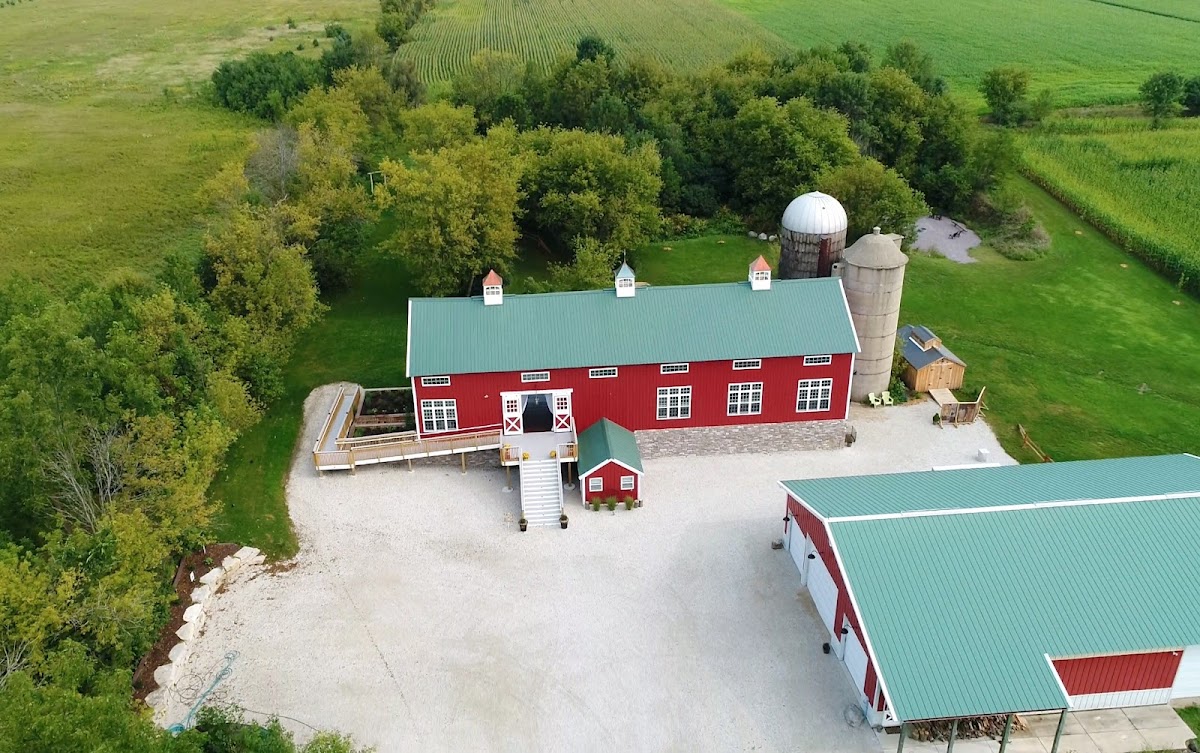
You leave the last subdivision behind on Mapleton Road, and the landscape shifts from suburban Milwaukee sprawl to something older and quieter — five-acre parcels with split-rail fences, the occasional horse grazing in a paddock, silos standing sentinel against Wisconsin’s enormous sky. Then the Cupola Barn appears on your left, its namesake cupola rising above the roofline like a punctuation mark on the horizon. This is not a barn that has been gutted and sanitized into generic event space. This is the real thing: hand-hewn beams from 1840, wood walls that still carry the scent of old timber, floorboards worn smooth by a century and a half of use. But walk through the front doors and you realize someone understood the assignment — the barn has been restored with a reverence for its bones and an eye for what makes a modern celebration work. Dimmable chandeliers hang where oil lamps once swung. A birch focal wall anchors one end of the room, its pale bark glowing like paper lanterns. The tin-lined bar gleams under string lights. And through the back doors, past the cobblestone pathway, five acres of farmland roll out under that relentless Wisconsin sky. Poppy has designed The Cupola Barn wedding flowers for 2 celebrations here, and each time we pull up that gravel drive, we feel the same thing: this barn has stories, and your wedding gets to be one of them.
About The Cupola Barn
The Cupola Barn sits on five acres of working farmland in Oconomowoc, Wisconsin, in the heart of what locals call Lake Country — a constellation of small towns, glacial lakes, and preserved agricultural land an hour west of Milwaukee. The barn itself was built in 1840, which makes it one of the oldest surviving timber-frame barns in Waukesha County. The original structure was a working dairy barn, built by settlers who came west after the Erie Canal opened and found land here that reminded them of upstate New York — rolling, fertile, forgiving. The barn changed hands several times over the decades, fell into disrepair in the mid-20th century, and was nearly lost to demolition before the current owners bought the property in the 2010s and began a painstaking restoration. What they preserved is remarkable: the original hand-crafted wood walls, still bearing the marks of adze and drawknife; the massive beams hewn from old-growth Wisconsin timber; the cathedral-height ceilings that once stored hay bales and now hold chandeliers and the laughter of two hundred wedding guests.
The restoration was not about turning the barn into something it never was. The owners kept the weathered wood, the uneven floors, the exposed beams — all the evidence of the barn’s working life — and then layered in the infrastructure a modern wedding demands. They added bathrooms, a professional catering prep area (technically a tent, since the barn itself has no state-inspected kitchen), climate control that works year-round, and lighting that can shift from bright and festive during dinner to low and romantic for dancing. The result is a space that photographs like a historic barn and functions like a professionally managed event venue. The aesthetic leans rustic-elegant: the birch focal wall was installed to create a photo-worthy backdrop for cocktail hour, the tin-lined bar adds an industrial edge, and the custom head table — built from beams salvaged from the barn’s original loft — seats up to twenty people and serves as the visual anchor for the entire reception.
Outside, the property includes a dedicated outdoor ceremony site surrounded by open fields, a charming cobblestone pathway that leads from the barn to the ceremony area, a private firepit zone for late-night s’mores and cigars, and two separate getting-ready spaces: the She-Shed for the bridal party (Pinterest-ready with mirrors, outlets, and hooks for dresses) and the Tool Shed for the groomsmen (less photogenic, equally functional). The outdoor ceremony site features an 8-foot-tall wooden arch that can be left natural or dressed with florals, and rows of white-washed benches and chairs already set for guests. If weather turns, the ceremony can be moved indoors without much disruption — the barn’s open floor plan accommodates both ceremony and reception configurations.
Logistically, The Cupola Barn is easy to work with. The venue provides 10 AM to 11 PM access on event days (plus an extra hour for vendor cleanup), which gives Poppy’s design team ample time for setup and breakdown. Load-in is straightforward with direct access to the barn interior, and the venue coordinators are experienced and communicative. The property requires that outside caterers be pre-approved and complete a site visit, but florists face no such restrictions — which means we can bring in exactly the flowers and design approach each couple needs. Parking is on-site and ample, and the rural location means no noise ordinances to worry about (though the venue does prohibit fireworks, sparklers, and open flames anywhere on the property due to local regulations and fire safety).
For couples coming from Milwaukee, Madison, or Chicago, The Cupola Barn offers a genuine countryside escape without requiring a full destination wedding. The surrounding Lake Country area has a robust hospitality infrastructure — boutique inns, farm-to-table restaurants, and enough weekend activity (wineries, hiking trails, antique shops) to keep out-of-town guests happily occupied. It is the kind of place where your wedding can anchor a true weekend gathering, not just a single-night event.
Event Spaces & Floral Opportunities
Main Barn Interior
Capacity: 200 seated
Setting: The heart of The Cupola Barn is this soaring single-room space, its original 1840s hand-crafted wood walls rising to cathedral ceilings crossed with massive timber beams. The floor plan is open and flexible, furnished with a mix of 72-inch round tables (seating ten each) and 8-foot rectangular tables (also seating ten) plus 200 silver-wood Chiavari chairs that photograph beautifully against the aged wood. The birch focal wall — a floor-to-ceiling installation of pale birch logs — anchors one end of the room and serves as the primary backdrop for cocktail hour and photos. The tin-lined bar occupies another corner, its industrial metallic finish a deliberate counterpoint to all the warm wood. Overhead, dimmable chandeliers and permanent string lights provide ambient glow that shifts in intensity from dinner through dancing. The custom head table, built from beams salvaged from the barn’s original loft, stretches 20 feet long and seats 14 to 20 people, positioned against a built-in greenery frame that serves as a ready-made backdrop. The overall palette is warm neutrals — honey-toned wood, cream walls, soft Edison-bulb lighting — which means florals can go in almost any direction without clashing.
Floral approach: The main barn interior rewards a layered approach to florals, with multiple focal points working in concert rather than one single statement piece. Start with the head table, which is large enough to support either a full-length garland runner or a series of elevated centerpieces. For a garland treatment, we favor a lush, asymmetric design: Italian ruscus and seeded eucalyptus as the base, woven through with garden roses (Juliet, Patience, Keira in soft peach and blush tones), quicksand roses for dusty mauve depth, white ranunculus, ivory spray roses, and accents of jasmine vine trailing off the table’s edge. The greenery frame behind the head table is already installed, which means you can either leave it as-is or enhance the central opening with a floral focal piece — a circular wreath of greenery and blooms, for example, or a small hanging installation of amaranthus and trailing smilax. The birch focal wall begs for a standing arrangement nearby: a large urn (aged concrete or matte black ceramic) filled with tall branches (curly willow or birch), white hydrangea, cream lisianthus, and textured foliage that echoes the woodland vibe. This becomes the cocktail hour photo backdrop. For guest tables, consider either low, lush compote arrangements (6 to 8 inches tall) in terracotta or wooden vessels, or elevated designs on clear glass risers that lift florals above sightlines and allow guests to converse easily. The tin-lined bar is perfect for a simple garland or a few clustered bud vases with single-stem blooms. The permanent chandeliers and string lights mean you do not need to add overhead floral installations — the ceiling is already doing its job. The key here is restraint and cohesion: let each floral element complement the barn’s architecture rather than compete with it.
Outdoor Ceremony Site
Capacity: 200 seated
Setting: The outdoor ceremony site sits in a private clearing surrounded by acres of open farmland — no houses, no roads, just fields and sky. The venue provides an 8-foot-tall wooden arch (8 feet wide on the outside posts, 6 feet wide inside, offering plenty of space for floral installations), along with rows of white-washed benches and pre-set chairs arranged in a gentle semicircle. The approach to the ceremony site is via a charming cobblestone pathway that winds from the barn’s back doors through a section of lawn — this pathway becomes the processional aisle. The backdrop is pure Wisconsin countryside: fields of prairie grass or corn depending on the season, distant tree lines, and that enormous Midwest sky that seems to go on forever. There is a weather backup plan (the ceremony can move indoors), but on a clear day, this outdoor site is hard to beat for its simplicity and scale.
Floral approach: The ceremony arch is the obvious hero piece here, and an 8-foot structure can support substantial floral work. For couples who want lush, garden-style coverage, we recommend a full asymmetric installation: one side of the arch densely packed with blooms and foliage (garden roses, hydrangea, stock, lisianthus, eucalyptus, Italian ruscus), the other side lighter and more vine-forward (smilax, jasmine, trailing amaranthus), creating visual movement and organic flow. For a more modern or minimal aesthetic, consider clustered corners — florals concentrated at the two bottom corners of the arch with trailing elements that drape down and pool slightly on the ground. The cobblestone pathway is subject to venue restrictions: only fresh flower petals are allowed (no dried petals, which can stain), and light colors are strongly recommended to avoid discoloration of the stone. We typically scatter petals lightly rather than densely — a soft drift of cream and blush rose petals down the center of the aisle, leaving the cobblestone edges visible. For additional aisle decor, consider urns or baskets placed every few rows on alternating sides — these can hold arrangements that mirror the ceremony arch florals in a smaller scale. The white-washed benches and chairs already have a clean, neutral look, so aisle markers should enhance rather than distract. Small clusters of greenery tied with silk ribbon to the end chairs, or single-stem blooms in glass bottles hung from shepherd’s hooks, work beautifully without overwhelming the natural landscape. The fields beyond provide all the backdrop you need — resist the urge to add too much, and let the setting speak.
Bridal She-Shed
Setting: The She-Shed is a separate structure on the property, designed specifically as a bridal suite for getting-ready photos. It is outfitted with plenty of mirrors, outlets for hair tools and phone chargers, hooks for hanging dresses, and decor that leans feminine and photo-friendly — soft textiles, good natural light, and enough space for the bridal party to spread out without tripping over each other. Access is from 10 AM to 8:30 PM, with a firm cutoff for removing all personal items by 8:15 PM (the venue is serious about this timeline, so plan accordingly). This is not a space where guests will see your florals, but it is a space where your photographer will spend an hour or two capturing detail shots and getting-ready moments.
Floral approach: The She-Shed florals are all about the small, personal touches that make for beautiful photos. The bridal bouquet should be on display here — set it in a simple glass vase or ceramic pitcher on a side table near a mirror, where it can be photographed in soft window light. If you are doing bridesmaid bouquets, have them arranged in a row or casually clustered together on a dresser or bench for a group shot. Consider a small loose arrangement (6 to 10 stems in a low vessel) that coordinates with your wedding palette — this can sit on the vanity or side table and appear in background shots while hair and makeup are underway. Think soft, romantic, unfussy: garden roses, ranunculus, spray roses, a bit of eucalyptus, nothing too structured or formal. This is also the spot for any floral hair pieces, corsages for mothers, or boutonnieres for the groomsmen — lay them out on a tray or in a shallow box lined with ribbon for a styled detail shot. The key is creating small vignettes that your photographer can capture quickly without disrupting the flow of getting ready.
Tool Shed (Groom’s Suite)
Setting: The Tool Shed is the groom’s counterpart to the She-Shed — a private space where the groomsmen can get dressed, store their belongings, and avoid being underfoot before the ceremony. It is more utilitarian than the bridal suite (this is still a barn property, after all), but it is functional and offers enough room for the guys to hang suits, tie ties, and perhaps crack a beer before showtime. Like the She-Shed, access is 10 AM to 8:30 PM.
Floral approach: Florals in the groom’s suite are minimal and optional, but a small arrangement can add a touch of polish to getting-ready photos. Consider a simple, masculine design: a small wooden box or matte black vessel filled with greenery (eucalyptus, ruscus), white or cream blooms (spray roses, stock, lisianthus), and perhaps a textural accent like scabiosa pods or privet berries. Place it on a table where the boutonnieres and ties are laid out — it adds visual interest to detail shots without reading as overly fussy. The boutonnieres themselves should be pinned to a display board or fabric-covered piece of foam core so the photographer can capture them before they are pinned on. If the groom is wearing a floral pocket square or lapel piece, include it in this setup. Keep it clean, simple, and out of the way.
Wedding Flower Ideas for The Cupola Barn
Wisconsin Meadow
This concept draws directly from the surrounding Lake Country landscape — the wildflower-dotted fields, the prairie grasses, the soft, hazy light of a Wisconsin summer afternoon. The palette is warm and organic: ivory, butter yellow, peach, soft lavender, and plenty of green. Think loose, unstructured arrangements that look like they were gathered from a meadow walk and placed in whatever vessel was handy. Flowers include garden roses (Patience, Juliet, and Bombastic for their soft, ruffled petals), ranunculus in peach and yellow, white lisianthus, lavender stock, Queen Anne’s lace, yarrow, solidago, and plenty of textured foliage — seeded eucalyptus, Israeli ruscus, and wispy grasses like setaria or bunny tail. Vessels are deliberately rustic: weathered wood boxes, galvanized metal buckets, terracotta pots, and ceramic crocks in muted earth tones. For the ceremony arch, an asymmetric installation with one side full and lush (mimicking the dense hedgerows of the countryside) and the other side trailing and vine-like. Guest table centerpieces are low and wild-looking, arranged in wooden boxes or ceramic bowls with blooms spilling over the edges in an organic, just-picked way. The head table gets a full-length garland treatment with the same meadow flowers woven through a base of greenery and grasses. This design works beautifully in late spring through early fall when local blooms are at their peak, and it feels utterly at home in the barn’s rustic-elegant setting.
Refined Farmhouse
For couples who love the barn aesthetic but want a more polished, elevated look, this concept bridges rustic and refined. The palette is soft and neutral: ivory, champagne, blush, dusty mauve, and muted sage green, with accents of antique gold. Flowers include premium garden roses (Patience, Keira, Quicksand, and Café Latte), white hydrangea, blush ranunculus, cream lisianthus, white spray roses, café au lait dahlias (in season), and foliage like Italian ruscus, olive branches, and eucalyptus in silver-green tones. Vessels are elegant but not fussy: matte white ceramic compotes, aged brass urns, concrete pedestals, and mercury glass votives. The overall feel is curated and intentional, with clean lines and symmetrical compositions that still nod to the barn’s character. For the ceremony arch, a balanced design with floral clusters at the base corners and a lighter garland swag across the top, allowing the wooden structure to remain visible. Guest tables feature either elevated arrangements on clear glass risers (lifting florals 12 to 18 inches above the table) or low, lush compote designs in white ceramic vessels, all in the same soft palette. The head table is dressed with a runner of smilax and Italian ruscus, punctuated at intervals with tight clusters of roses and hydrangea, creating a sophisticated garland that feels tailored rather than wild. This palette photographs beautifully against the barn’s honey-toned wood and works year-round, making it a solid choice for fall and winter weddings when you want warmth without leaning too heavily into autumn clichés.
Birchwood & Botanicals
This concept takes direct inspiration from the barn’s birch focal wall and the surrounding woodland landscape, creating a design that feels like the interior forest brought indoors. The palette is cool and natural: white, cream, soft green, and gray-green, with accents of taupe and pale blush. Flowers are deliberately minimal, allowing foliage and branches to take center stage: white garden roses (Patience, Avalanche), cream lisianthus, white ranunculus, white anemones with their dark centers, hellebores in pale green, and scabiosa for texture. The real stars are the foliage and branches: actual birch branches (either white paper birch or the darker river birch), ferns (maidenhair, leather leaf), eucalyptus in silver and seeded varieties, Italian ruscus, olive branches, and willow. Vessels are organic and textural: birch bark-wrapped cylinders, raw wood slices as bases, matte gray ceramic, and concrete urns. For the ceremony arch, a full installation of branches and greenery with clusters of white blooms concentrated at the base, creating the impression of a woodland bower. Guest table arrangements are a mix of tall branch-heavy designs in cylindrical vases and low, moss-covered mounds with white blooms nestled into greenery. The birch focal wall gets a large standing arrangement nearby — a tall urn filled with birch branches, ferns, and white hydrangea, creating a visual echo of the wall itself. This design is particularly stunning for winter weddings, when the bare branches and white palette feel seasonally appropriate, or for spring weddings when the ferns and hellebores are at their freshest. It is a quieter, more understated approach to florals, perfect for couples who appreciate negative space and want the barn’s architecture to remain the focus.
Seasonal Considerations
Wisconsin’s four-season climate means The Cupola Barn looks and feels dramatically different depending on when you get married, and your floral choices should take those seasonal shifts into account.
Spring (April – May): Spring in southeastern Wisconsin is unpredictable and often muddy. Temperatures can range from the 40s to the 70s, and rain is common — which is why the venue’s weather backup plan for moving the ceremony indoors is essential. The surrounding farmland is just waking up in spring, with fields greening and wildflowers beginning to emerge by late May. This is the season for soft, romantic florals: tulips (available early spring), ranunculus, anemones, hellebores, and early garden roses (Patience and Garden Rose varieties start appearing by mid-May). Locally, you will see flowering branches (dogwood, cherry, magnolia) and ferns emerging in wooded areas. The barn’s interior feels particularly cozy in spring, when you may still want a bit of warmth from the dimmable lighting and the rustic wood. For outdoor ceremonies, keep arrangements elevated off the ground to avoid mud splatter, and consider using urns or tall pedestals rather than low ground pieces. Spring is also when Wisconsin’s legendary mosquitoes start to appear, so if you are planning an outdoor evening event, advise guests to dress accordingly.
Summer (June – August): Summer is peak wedding season in Wisconsin, and for good reason: warm temperatures (70s to 80s, occasionally 90s), long daylight hours, and the farmland in full lush glory. The fields around The Cupola Barn are green and alive, often planted with corn or soybeans that grow taller as the season progresses. This is the season for abundant, garden-style florals: hydrangea (both local and imported), dahlias (starting mid-July), garden roses, lisianthus, zinnias, sunflowers, Queen Anne’s lace, and all the textured greenery you could want. Local flower farms in the Lake Country area are producing at full capacity, which means you can source Wisconsin-grown blooms if local sourcing is important to you. The downside of summer is heat — the barn has climate control, but outdoor ceremonies in July and August can be warm, and delicate blooms like sweet peas and anemones will wilt quickly in direct sun. For summer weddings, we recommend hardier flowers (roses, hydrangea, stock, lisianthus) and plenty of water sources for arrangements. The long summer sunlight also means your outdoor ceremony can happen later in the evening without losing natural light, which is a gift for photographers.
Fall (September – October): Fall is many florists’ favorite season at The Cupola Barn, and many couples’ too. September is still warm (60s to 70s), but by October you are looking at cooler temperatures (50s to 60s) and the risk of an early frost. The surrounding fields are often harvested by late September, leaving golden stubble and wide-open views, and the tree lines turn brilliant shades of red, orange, and gold. This is the season to lean into autumn’s natural palette: burgundy, rust, burnt orange, gold, and deep plum, with plenty of warm neutrals. Flowers include dahlias (café au lait, burgundy varieties), garden roses in deeper tones (Toffee, Cappuccino, Black Baccara), ranunculus, marigolds, celosia, amaranthus, and seasonal accents like hypericum berries, privet berries, and wheat stalks. The barn’s warm wood tones are especially photogenic in fall, when the light takes on a golden quality that makes everything glow. For outdoor ceremonies, the cooler temperatures mean flowers will last longer, which is a relief after the heat of summer. Fall is also harvest season in Wisconsin, so if you want to incorporate seasonal elements like pumpkins, gourds, or apple accents, they are readily available and fit the barn aesthetic perfectly.
Winter (November – March): Winter weddings at The Cupola Barn are less common but utterly magical. Temperatures range from below freezing to the 40s, and snow is likely (Wisconsin winters are serious business), but the barn’s climate control means the interior is cozy and comfortable. The surrounding farmland is blanketed in snow, creating a stark, minimalist landscape that photographs beautifully in black and white. This is the season for rich, moody florals: deep burgundy and plum (Black Baccara roses, burgundy ranunculus, plum calla lilies), creamy whites and ivories (Patience roses, white ranunculus, white anemones), and plenty of evergreen foliage (pine, cedar, fir, eucalyptus). Seasonal accents like pine cones, birch branches, and berries (hypericum, ilex, privet) add texture and winter character. The barn’s dimmable lighting and chandeliers make the space feel warm and intimate, which is exactly what you want when it is snowing outside. For winter weddings, we recommend skipping the outdoor ceremony entirely unless you have truly adventurous guests — the indoor space is plenty beautiful on its own. Winter is also the season for budget-conscious couples: flower availability is more limited, but roses, carnations, and evergreens are plentiful and affordable, and the barn’s architecture does so much of the decorative work that you can scale back on florals and still have a stunning event.
Poppy’s Expert Take
Mind the head table greenery frame. The Cupola Barn’s built-in greenery frame behind the head table is a double-edged sword. On one hand, it is a ready-made backdrop that requires zero additional decor. On the other hand, it is permanently installed, which means you cannot remove it or significantly alter it. The frame’s opening (22.25 inches high by 48 inches wide) can accommodate a floral wreath, a hanging installation, or even a neon sign if that is your style, but the greenery border itself is staying put. Our recommendation: lean into it. The greenery is artificial and maintenance-free, so you do not need to worry about it wilting or browning, and its neutral green tone complements almost any floral palette. If you want to enhance it, add a simple floral wreath in the center opening or a trailing installation of smilax and blooms that echoes the frame’s shape. If you want to minimize it, keep your head table florals low and centered on the table itself, drawing the eye down rather than up toward the frame. What does not work: trying to compete with the frame by placing tall, vertical arrangements directly in front of it. You will end up with visual clutter and a confused focal point.
Respect the cobblestone petal policy. The venue is strict about what you can place on the cobblestone pathway: fresh flower petals only, no dried petals, and light colors strongly recommended. This is not arbitrary fussiness — dark or dried petals can stain the cobblestone, and the venue has had to professionally clean the pathway multiple times after weddings ignored this rule. We have tested this firsthand, and red or deep burgundy petals do indeed leave a faint stain that takes weeks to fade. Stick with white, cream, blush, or pale peach petals, and scatter them lightly rather than densely. If you want a more defined aisle look, use floral arrangements in urns or baskets every few rows instead of relying on petals to do all the work. And absolutely do not use dried lavender, confetti, or any other non-fresh-petal material on the cobblestones — the venue will charge a cleanup fee, and it is not a small one.
Leverage the birch focal wall. The birch focal wall is one of the barn’s most Instagram-friendly features, and nearly every couple uses it as a backdrop for cocktail hour photos. This means you should plan a floral installation nearby that enhances the wall without blocking it. A large standing arrangement on the floor or on a low pedestal works beautifully — think a tall urn filled with birch or willow branches, white hydrangea, cream lisianthus, and textured greenery. The arrangement should be substantial enough to register in photos but not so wide that it crowds the wall or makes it difficult for guests to stand nearby for pictures. We typically position the arrangement slightly to one side of the wall rather than dead center, creating a natural framing effect. If your budget allows, consider a pair of matching arrangements flanking the wall on either side. This creates symmetry and makes the wall feel even more intentional as a photo moment.
Plan for limited floral refrigeration on-site. The Cupola Barn has multiple refrigerators available for catering use, but floral-specific refrigeration is limited. This means that if you are doing a summer wedding with delicate blooms that need to stay cool before the ceremony, you will need to coordinate timing carefully with your florist. Poppy’s approach is to deliver ceremony florals as close to the start time as possible and to use hardy, heat-tolerant flowers (roses, hydrangea, stock, lisianthus) that can handle a few hours at room temperature without wilting. If you are set on using more delicate blooms like sweet peas, anemones, or tulips, be prepared for your florist to arrive later in the setup window to keep those flowers fresh. The venue’s climate-controlled interior helps, but on a hot July day, even the barn’s air conditioning has limits.
Work with the barn’s natural palette. The Cupola Barn’s interior is all warm neutrals — honey-toned wood, cream walls, soft Edison-bulb lighting. This is a gift for florists, because it means nearly any color palette will work without clashing. That said, some palettes are more harmonious than others. Warm tones (peach, coral, rust, burgundy, gold) play beautifully with the wood and create a cohesive, glowing effect. Cool tones (lavender, dusty blue, slate gray) provide a nice contrast and keep the space from feeling too monochromatic. Pure white and cream arrangements can look stunning but risk disappearing against the light-colored walls, so if you go this route, make sure you are incorporating plenty of texture and greenery to add depth. What to avoid: overly bright, saturated colors (hot pink, electric blue, neon yellow) that feel jarring against the barn’s rustic aesthetic. If you love bold color, use it as an accent rather than the dominant note.
**Coordinate floral removal timing carefully