
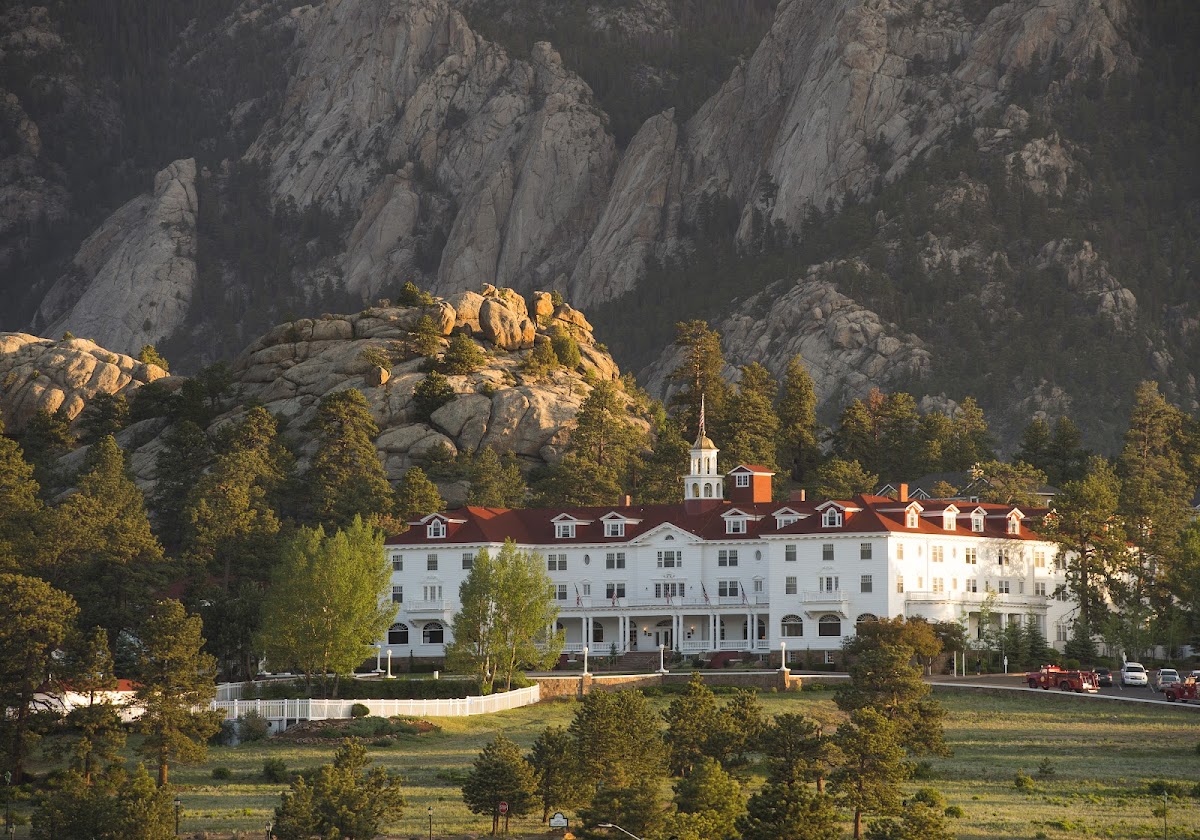
The approach to The Stanley Hotel is not subtle. You follow Highway 36 as it climbs through the canyon, Big Thompson River churning alongside, until Estes Park opens before you — all log-cabin storefronts and outfitters selling bear spray and hiking boots. The town sits in a natural amphitheater, ringed by mountains, and above it all, commanding Wonderview Avenue like a grande dame at a ball, stands The Stanley. The white Georgian Colonial Revival façade gleams against the pine-covered slopes, and beyond it, Longs Peak rises 14,259 feet into the Colorado sky, its diamond face catching the afternoon sun. This is not a hotel that blends in. Built in 1909 by inventor F.O. Stanley (of Stanley Steamer fame), it was designed to be seen, to be talked about, to be remembered. And it has succeeded spectacularly. Stephen King stayed here in 1974 and the result was The Shining. But long before Hollywood made it famous, The Stanley was already a destination — for tuberculosis patients seeking mountain air, for society families escaping East Coast summers, and now, for couples who want a wedding venue with genuine history, jaw-dropping views, and the kind of character you cannot manufacture. Poppy has designed The Stanley Hotel wedding flowers for 4 celebrations here, and every single time, we’re struck by the way this place manages to feel both grand and welcoming, historic and alive, impossibly romantic and utterly, unmistakably itself.
About The Stanley Hotel
The Stanley Hotel perches at 7,522 feet elevation on a hillside above Estes Park, Colorado, in the neighborhood known as Stanley Heights. From its portico, you can see thirteen mountain peaks — not distant suggestions on the horizon, but towering presences that dominate the landscape and change hourly as weather and light shift. The hotel was the vision of Freelan Oscar Stanley, who arrived in Estes Park in 1903 seeking treatment for tuberculosis and left cured, energized, and determined to build a world-class resort. Construction began in 1907, and when The Stanley opened two years later, it was the most technologically advanced hotel west of the Mississippi — every room had electricity, telephone service, and en suite bathrooms, luxuries that were rare in the Rockies at the time. Stanley built a hydroelectric plant to power it, constructed roads to reach it, and even ran his own transportation service using his Stanley Steamer automobiles to ferry guests from the train station.
Architecturally, The Stanley is pure Georgian Colonial Revival, which is an unexpected choice for the Colorado mountains but makes perfect sense once you understand Stanley’s New England roots. The main hotel building is painted brilliant white with black shutters, features symmetrical wings flanking a central entrance with prominent columns, and feels more at home on a Massachusetts hilltop than at the gateway to Rocky Mountain National Park. But that’s precisely what makes it memorable. The interiors have been lovingly restored and updated over the decades — the Music Room retains its historic Steinway piano and arched Palladian windows, the MacGregor Ballroom still has its original hardwood floors, and the newer Pavilion building, completed in 2015, combines F.O. Stanley’s architectural heritage with contemporary design and floor-to-ceiling windows that frame those omnipresent mountain views.
The location is both accessible and legitimately remote. Denver International Airport is 90 minutes away via a scenic drive through canyons and foothills. Rocky Mountain National Park entrance is less than ten minutes from the hotel, making it easy for guests to explore Trail Ridge Road, hike to alpine lakes, or simply drive through meadows where elk graze in herds of fifty or more. Downtown Estes Park, with its breweries, restaurants, and rock shops catering to tourists, is a five-minute walk down the hill. For Poppy’s team, the drive from Fort Collins is straightforward, and The Stanley’s events staff is exceptionally organized — they provide detailed load-in instructions, ample space for vendor setup, and respect the timeline, which matters immensely when we’re installing florals at altitude where everything takes just a bit longer.
The Stanley operates as a full-service resort with 160 guest rooms, multiple dining venues, a spa, and a robust events program. Weddings here are managed by a dedicated sales and events team, and couples work with approved caterers (Occasions Catering and Biscuits & Berries are favorites) for food service. The hotel’s private property designation means all vendor visits and wedding-related activities must be scheduled in advance — you cannot simply show up with your florist for a casual walk-through. This is a venue that takes its history seriously, that protects its spaces, and that expects a level of professionalism from vendors, which suits Poppy just fine.
Event Spaces & Floral Opportunities
The Pavilion
Capacity: 250 seated
Setting: The Pavilion is The Stanley’s crown jewel for large weddings — a modern addition completed in 2015 that manages to honor F.O. Stanley’s architectural legacy while offering state-of-the-art amenities. The main ballroom features over 8,000 square feet of event space with stylish statement chandeliers, a soaring ceiling, and a wall of retractable glass doors that open directly onto a terrace overlooking a private waterfall and pond. Beyond that, Longs Peak rises in the distance, providing a backdrop that needs no introduction. The 250-seat auditorium portion has theater-style seating with glass doors at the rear that frame mountain views, making it ideal for ceremonies where you want guests focused forward. Separate cocktail terraces, a dedicated bridal suite, and flexible ballroom configurations (the space can be divided) make this the most versatile option on property.
Floral approach: The Pavilion’s design language is modern and clean, which gives florals room to make a statement without competing with ornate architectural details. For ceremonies in the auditorium, the theater seating arrangement means floral opportunities are concentrated at the stage entrance and along the aisle. We favor a dramatic ceremony arch or asymmetrical backdrop positioned to frame the glass doors and mountain view beyond — imagine a seven-foot structure of contorted willow branches anchored with clusters of white peonies, blush Juliet garden roses, and trailing jasmine vine, grounded with lush mounds of variegated pittosporum and seeded eucalyptus. Aisle markers should be substantial enough to register in that large space: small metal stands holding bouquets of delphinium, stock, and roses in tones that echo the ceremony palette, tied with silk ribbon that moves slightly in the breeze when those glass doors are open.
In the ballroom, those modern chandeliers are begging for greenery installations. We love suspended garlands of Italian ruscus, smilax, and plumosa fern running the length of the head table or sweeping across the ceiling in graceful arcs, with clusters of Quicksand roses, white lisianthus, and scabiosa woven in at intervals. Centerpieces need to account for the ballroom’s scale — this is not a space for timid arrangements. Either go low and lush (compote vessels overflowing with garden roses, ranunculus, anemones, and spirea in creams and soft pinks) or dramatically tall with arrangements on 30-inch gold stands that elevate blooms above conversation height. The retractable glass wall situation is key: when those doors are open and the terrace becomes part of your reception space, your florals need to create a visual bridge. We’ll place large urns flanking the doorway filled with hydrangea, delphinium, larkspur, and trailing amaranthus, then echo those same blooms in lower arrangements on the terrace cocktail tables. The pond and waterfall area offers an unexpected opportunity: floating floral installations (consider water lily pads with pillar candles, or small floral rafts of moss, succulents, and spray roses) that catch the light and create a magical moment during cocktail hour when guests wander outside with their wine.
Library
Capacity: 40 seated
Setting: Tucked into The Lodge (the hotel’s original 1909 building), the Library is 1,089 square feet of old-world intimacy. Dark wood paneling covers the walls floor to ceiling, creating that warm, enveloping atmosphere you find in gentlemen’s clubs and historic libraries. There’s a private veranda accessible through French doors, classic furnishings, and a formality that makes this space perfect for small weddings or rehearsal dinners where you want gravitas and coziness in equal measure. The scale is inherently intimate — you’re not accommodating 200 people, you’re hosting 40 who matter most.
Floral approach: Dark wood paneling demands a specific floral response: jewel tones, gold accents, and arrangements that glow against those rich walls. We favor deep burgundy café au lait dahlias, Black Bacarra roses, plum-toned ranunculus, and wine-colored hellebores, lightened with blush Keira garden roses, white anemones, and dusty miller foliage. Vessels matter here — aged brass compotes, dark green ceramic urns, and gold mercury glass votives scattered across tables catch candlelight beautifully. For the mantel (assuming there’s a fireplace, typical in these historic rooms), an asymmetrical arrangement that cascades slightly to one side: start with a base of eucalyptus and olive branches, then layer in roses, lisianthus, scabiosa, and finished with trailing amaranthus that drapes elegantly downward.
Table arrangements should be appropriately scaled for a 40-person dinner — we’re talking centerpieces that are lush but not overwhelming, perhaps low arrangements in gold compotes (8-10 inches tall) that allow conversation to flow easily. The veranda access means you can extend floral moments outside: potted arrangements of seasonal blooms in aged terra cotta containers flanking the French doors, or hanging fern baskets that add greenery without blocking the mountain views. For an autumn wedding, consider incorporating Colorado-native elements — aspen branches with their distinctive white bark, golden leaves, and sprigs of juniper berries that nod to the surrounding landscape. The Library is not a space that wants wild, unstructured arrangements; it wants thoughtful, elegant, quietly luxurious florals that honor the room’s historic character.
Manor Hall
Capacity: 60 seated
Setting: Manor Hall lives in The Lodge and presents a complete contrast to the Library’s dark wood drama. Here you have bright white walls, large windows framing those ever-present mountain views, and a cozy fireplace that serves as a natural focal point. The room reads as elegant but approachable, formal but not stuffy, and the white walls act as a blank canvas that welcomes color. Manor Hall operates from 4:00-10:00 p.m., making it ideal for rehearsal dinners or intimate wedding receptions. There’s outdoor patio access, which extends your usable space during Colorado’s mild summer evenings.
Floral approach: The bright white walls are a gift — they allow for bold color choices that would overwhelm a more decorated space. For a summer wedding, we’d lean into saturated tones: coral charm peonies, orange ranunculus, fuchsia garden roses (Miranda, Lady Arabella), and yellow crespedia, grounded with eucalyptus and ferns. For a winter celebration, the fireplace mantel becomes your hero moment: a lush, asymmetrical arrangement that appears to tumble organically across the mantel — start with a base of Fraser fir, cedar, and magnolia branches, then add white amaryllis, pale pink hellebores, white anemones, and frosted dusty miller, with a few pieces of silver brunia or bleached ruscus for texture. Let some elements cascade down toward the hearth.
The large windows mean you need to think carefully about arrangements near the glass — you don’t want to block views, but you do want florals visible from outside when guests step onto the patio. For guest tables, consider a mix of heights: some tables get low, sprawling arrangements in white ceramic bowls (garden roses, lisianthus, stock, and Queen Anne’s lace in soft tones), while others get single statement stems in bud vases — perhaps dramatic calla lilies, or a trio of white delphiniums grouped together for impact. For a ceremony in Manor Hall, the fireplace becomes your altar backdrop. A simple but elegant frame of blooms and greenery around the mantel, perhaps with two tall arrangements flanking the fireplace in brass stands, creates a focal point that photographs beautifully against those white walls. The patio connection means you should carry your floral palette outside: potted arrangements on the patio railing, or hanging lanterns with small floral collars of greenery and blooms around the top.
Longs Peak Lawn
Capacity: 200 seated
Setting: This is the outdoor ceremony site that makes guests gasp audibly when they round the corner and see it for the first time. Longs Peak Lawn sits on the hillside with panoramic views of thirteen mountain peaks, including the iconic Longs Peak itself — Colorado’s northernmost fourteener and the dominant presence on the horizon. The lawn is naturally terraced, providing stadium-style viewing for guests, and the crisp mountain air carries the scent of pine and that indefinable quality of high altitude. This is not a manicured formal garden; it’s mountain meadow domesticated just enough for chairs, with wild grasses and wildflowers at the edges and nothing between you and those peaks but air and light.
Floral approach: The single most important principle for Longs Peak Lawn florals is restraint. Those mountains are your real decor. Anything we install needs to enhance the ceremony moment without competing with the landscape. We favor a simple ceremony structure — either a low wooden arbor or a geometric metal arch — dressed with blooms that feel native to Colorado even if they’re not technically indigenous. Think white delphiniums, lavender salvia, yellow yarrow, and soft pink spirea, interspersed with grasses like fountain grass or blue oat grass, and anchored with olive branches or aspen branches. The structure should be grounded with lush arrangements at the base: garden roses, lisianthus, scabiosa, and ranunculus in creams, soft yellows, and lavender tones.
For the aisle, resist the urge to line it with arrangements every three feet — at this scale, that reads as cluttered. Instead, we place substantial arrangements (in sturdy vessels weighted with rocks or sand, because wind is a real consideration at 7,500 feet) at the beginning, middle, and end of the aisle. Each arrangement: a meadow-inspired cluster of wildflowers and grasses in a galvanized metal bucket or aged wood container, substantial enough to register from a distance but not so precious that they look out of place on a mountain lawn. For the ceremony chairs, a simple touch: sprigs of lavender or small herb bundles (rosemary, eucalyptus) tied to every third chair with linen ribbon. The effect should be effortless, organic, and entirely appropriate for a ceremony where the real star is that impossible view.
Wind management is critical. Everything needs to be weighted, secured, and designed with movement in mind. Delicate, top-heavy arrangements will topple. Ribbons will tangle. Loose petals will scatter across Montana. Choose sturdy stems — roses, lisianthus, stock — over floppy tulips or precious sweet peas that will wilt in direct sun at altitude. And always, always have a weather backup plan, because mountain weather is notoriously fickle. A ceremony scheduled for 5:00 p.m. under clear skies can be interrupted by a thunderstorm at 4:45 p.m., so know your pivot to an indoor space.
Music Room
Capacity: 70 seated reception / 130 ceremony
Setting: The Music Room is where The Stanley’s historic soul lives most visibly. This space features arched Palladian windows that frame mountain views with theatrical precision, a historic Steinway piano that has been played by luminaries and guests for over a century, a fireplace with a carved mantel, French doors opening to a private veranda, and architectural details — crown molding, wainscoting, period light fixtures — that transport you directly to 1909. The room accommodates 70 for a seated reception or up to 130 for a ceremony, making it remarkably versatile. This is the space for couples who want their wedding to feel like it’s happening inside a piece of history.
Floral approach: The Steinway piano is not just a prop; it’s an opportunity. For a ceremony, the piano can serve as your altar focal point — position it in front of those Palladian windows and surround it with florals that frame without obscuring the instrument’s lines. We’d place a lush, asymmetrical arrangement on the piano top: Romantic Antike garden roses, white lisianthus, blush ranunculus, and trailing jasmine vine cascading down the piano’s curve, with a base of Italian ruscus and variegated pittosporum. Then flank the piano with two tall arrangements in gold stands: garden roses, delphiniums, and amaranthus reaching upward to echo the window arches.
For a reception, the fireplace mantel becomes your design anchor. A generous garland-style arrangement running the entire length of the mantel: smilax and seeded eucalyptus as your base, then clusters of Quicksand roses, white spray roses, lisianthus, and scabiosa woven in, with a few longer pieces of amaranthus or trailing jasmine draping down toward the hearth. Guest table arrangements should respect the room’s formality — low compote arrangements in silver or mercury glass vessels, filled with garden roses, ranunculus, astilbe, and dusty miller in a soft, romantic palette. The Palladian windows provide dramatic backlighting at certain times of day, so consider how your florals will be silhouetted — arrangements near those windows should have interesting shapes and textures that read well even in shadow.
The veranda access means you can extend the celebration outside, and your florals should acknowledge that transition. Potted arrangements flanking the French doors — perhaps boxwood topiaries with floral collars of seasonal blooms around the base — create a visual gateway between inside and outside. For a spring wedding, the veranda could feature clusters of potted tulips, hyacinths, and daffodils. For fall, consider mums in aged copper containers. The Music Room rewards a traditional, elegant approach to florals — this is not the place for ultra-modern installations or minimalist gestures. Give the room arrangements worthy of its history.
Wedding Flower Ideas for The Stanley Hotel
Alpine Meadow
This concept draws directly from the wildflower meadows that carpet the Rockies above treeline in July and August. The palette combines soft lavenders, butter yellows, crisp whites, and touches of coral pink — colors you’d find hiking above 11,000 feet. Key blooms: white delphiniums, lavender salvia, yellow yarrow, coral ranunculus, white scabiosa, and blush lisianthus, textured with fountain grass, oat grass, Queen Anne’s lace, and mountain mint. Vessels should feel organic: galvanized metal buckets, weathered wood boxes, ceramic crocks in muted tones. This approach works beautifully for Longs Peak Lawn ceremonies where you want to extend the natural landscape rather than contrast with it, and translates well into The Pavilion for a reception that maintains that meadow sensibility indoors. For the ceremony arch, we’d use minimal structure — perhaps just three weathered wood posts in an asymmetrical arrangement — densely packed with wildflowers and grasses that appear to grow directly from the posts. Table arrangements: low and wild, with blooms arranged to look just-picked and casually gathered. This is a design that celebrates Colorado’s natural beauty without trying to tame it.
Grand Dame
If The Stanley could choose its own floral identity, it might choose this: a palette drawn from F.O. Stanley’s Edwardian era, when elegance meant restraint, luxury meant quality over quantity, and style meant knowing exactly which rules to follow. We’re talking cream, blush, champagne, and the palest yellow — almost no pure white, because it’s too stark, and absolutely no trendy dusty rose or mauve. Key blooms: Patience garden roses, champagne spray roses, blush ranunculus, cream lisianthus, pale yellow tulips (spring) or pale yellow calla lilies (summer), white sweet peas, and lots of textural foliage like Italian ruscus, seeded eucalyptus, and variegated pittosporum. Vessels must be elegant: silver compotes, mercury glass votives, and for larger arrangements, tall glass cylinders or brass urns with classical lines. This design is perfect for the Music Room, where historic architecture demands a historically appropriate floral response, and translates beautifully to Manor Hall where those white walls allow the subtle color variations to shine. For the piano in the Music Room, we’d create a cascading arrangement that drapes elegantly down one side, using Patience roses as the focal blooms with sweet peas and ranunculus filling in, finished with trailing jasmine vine that moves slightly with air currents. This is wedding flowers for couples who appreciate subtlety, craftsmanship, and designs that will look just as elegant in photographs fifty years from now.
Winter Lodge
For couples marrying at The Stanley between December and March, when snow blankets the property and Longs Peak turns into an Ansel Adams photograph, this concept leans fully into the season. The palette: winter whites, silvery greens, touches of burgundy and deep forest green, with metallic accents in silver and pewter. Key blooms: white amaryllis, white anemones, burgundy ranunculus, white lisianthus, pale pink hellebores, and white tulips (if timing works), textured with Fraser fir branches, cedar, eucalyptus, dusty miller, and silver brunia. For added drama: frosted branches, birch bark pieces, and pine cones (both natural and metallic-painted). Vessels should feel substantial and wintry: pewter compotes, mercury glass hurricanes with pillar candles, dark ceramic vessels, and aged wood boxes. This concept shines in spaces with fireplaces — the Library and Manor Hall — where mantel arrangements become the hero elements. For Manor Hall’s fireplace, we’d create a lush asymmetrical mantel piece that appears to tumble organically across the surface: start with evergreen branches as your base, then add white amaryllis as your focal blooms, burgundy ranunculus and white anemones as supporting players, and finish with silver brunia and frosted dusty miller tucked throughout. Let a few tendrils of greenery cascade down toward the hearth. Table arrangements: low and lush in mercury glass compotes, with lots of candlelight (mercury glass votives, pillar candles in hurricanes) to warm the palette. For The Pavilion in winter, consider suspended installations of evergreen garlands with white blooms and silver accents woven through, creating a forest canopy effect indoors while the snow falls outside those glass walls.
Seasonal Considerations
The Stanley Hotel sits at 7,522 feet elevation, which creates specific challenges and opportunities for wedding flowers. Colorado’s mountain climate is characterized by intense sun, low humidity, dramatic temperature swings, and weather that can change by the hour. Understanding these seasonal realities is essential for successful floral design here.
Spring (April-June): Spring in the Rockies is notoriously unpredictable. April can bring blizzards or sixty-degree sunshine, sometimes on the same day. May and June gradually settle into more reliable patterns, with daytime temperatures in the 60s-70s and nighttime temps dropping into the 40s. Afternoon thunderstorms are common in late spring. Blooms that thrive in these conditions: tulips, daffodils, hyacinths, anemones, ranunculus, and flowering branches (lilac, cherry blossom, forsythia). Local Colorado availability begins to improve in May with peonies typically arriving by late May or early June. The intense Colorado sun and low humidity mean hydration is critical — flowers will dehydrate faster here than at sea level, so proper conditioning and frequent misting during setup is essential. For outdoor ceremonies on Longs Peak Lawn, have a weather backup plan through mid-June. The mountains create their own weather systems, and afternoon storms can roll in with fifteen minutes’ warning. Best timing: Late May through June offers the most reliable spring weather and peak peony season.
Summer (July-September): Summer is peak wedding season at The Stanley, and for good reason — weather is generally cooperative, with warm days (70s-80s), cool nights (40s-50s), and spectacular afternoon light. July and August bring afternoon thunderstorms almost daily, typically between 2:00-5:00 p.m., but they usually pass quickly. September is arguably the best month: fewer storms, stunning light, and the beginning of fall colors as aspen trees turn gold. Summer bloom availability is excellent: garden roses, dahlias, zinnias, sunflowers, delphiniums, lisianthus, scabiosa, and locally-grown wildflowers are all readily available. The altitude means flowers behave differently than at sea level — colors stay more vivid, blooms can last slightly longer indoors due to cooler temperatures, but outdoor installations face challenges from intense UV exposure and rapid dehydration. Hydrangeas, in particular, struggle with Colorado’s low humidity and will wilt quickly outdoors. For Longs Peak Lawn ceremonies, afternoon timing (4:00 p.m. or later) offers the best light for photos and lower risk of thunderstorms. Dahlias are show-stopping in late summer — varieties like Cafe au Lait, Peaches and Cream, and Otto’s Thrill thrive in Colorado’s climate. Best timing: Late August through September offers ideal weather and spectacular bloom availability.
Fall (October-November): Fall at The Stanley is magical but brief. October brings aspen gold, crisp mountain air, and dramatically reduced crowds. Daytime temperatures range from 50s-60s in early October, dropping to 40s-50s by late month. November is unpredictable — you might have a gorgeous 60-degree day, or you might have six inches of snow. First significant snowfall typically arrives in late October or early November. Fall bloom availability remains strong through October: dahlias (until the first hard freeze kills them), garden roses, chrysanthemums, marigolds, sunflowers, and ornamental kale. This is the season to incorporate Colorado’s natural fall palette: aspen branches with golden leaves, oak leaves in burgundy and rust, juniper berries, and branches of mountain ash with their distinctive orange-red berries. For outdoor ceremonies, October is your last reliable month — by November, snow becomes a real possibility and temperatures may be too cold for guest comfort. The Library and Music Room are particularly atmospheric in fall, where fireplace mantels can showcase seasonal arrangements of chrysanthemums, dahlias, and branches. Best timing: Early-to-mid October offers the most reliable fall weather and peak aspen colors.
Winter (December-March): Winter weddings at The Stanley are intimate, dramatic, and decidedly not for everyone. Snow is guaranteed, temperatures regularly drop below freezing, and roads can be treacherous. But for couples who embrace the season, there’s nothing quite like The Stanley draped in snow with mountain peaks crystalline against blue sky. Winter bloom availability shifts toward amaryllis, anemones, hellebores, tulips (imported), ranunculus, and evergreens — we’re relying heavily on shipped-in blooms rather than local availability. Evergreens are your friend: Fraser fir, cedar, pine, and magnolia branches are readily available and hold beautifully in cold temperatures. Outdoor ceremonies are not practical — it’s too cold for guests — so ceremonies move indoors to the Music Room, Pavilion Auditorium, or Manor Hall. The benefit: you can use candlelight lavishly without worrying about wind. Mercury glass votives, pillar candles in hurricanes, and candelabras create warmth and romance that’s especially welcome in winter. For outdoor photos, have blankets available and keep sessions brief. The pond at The Pavilion may be partially frozen, creating interesting visual opportunities. Best timing: February and March offer slightly warmer temperatures and longer daylight hours than December-January, while still maintaining that winter aesthetic.
Poppy’s Expert Take
Altitude affects everything — plan accordingly. At 7,522 feet, you’re working with roughly 25% less oxygen than at sea level, which means our setup team moves a bit slower, we build in extra time for installations, and we pre-hydrate florals more aggressively than we would for a Denver wedding. Altitude also affects how flowers behave: colors stay vivid longer due to lower temperatures, but blooms dehydrate faster due to low humidity and intense sun. We bring extra water sources to every Stanley wedding, mist