
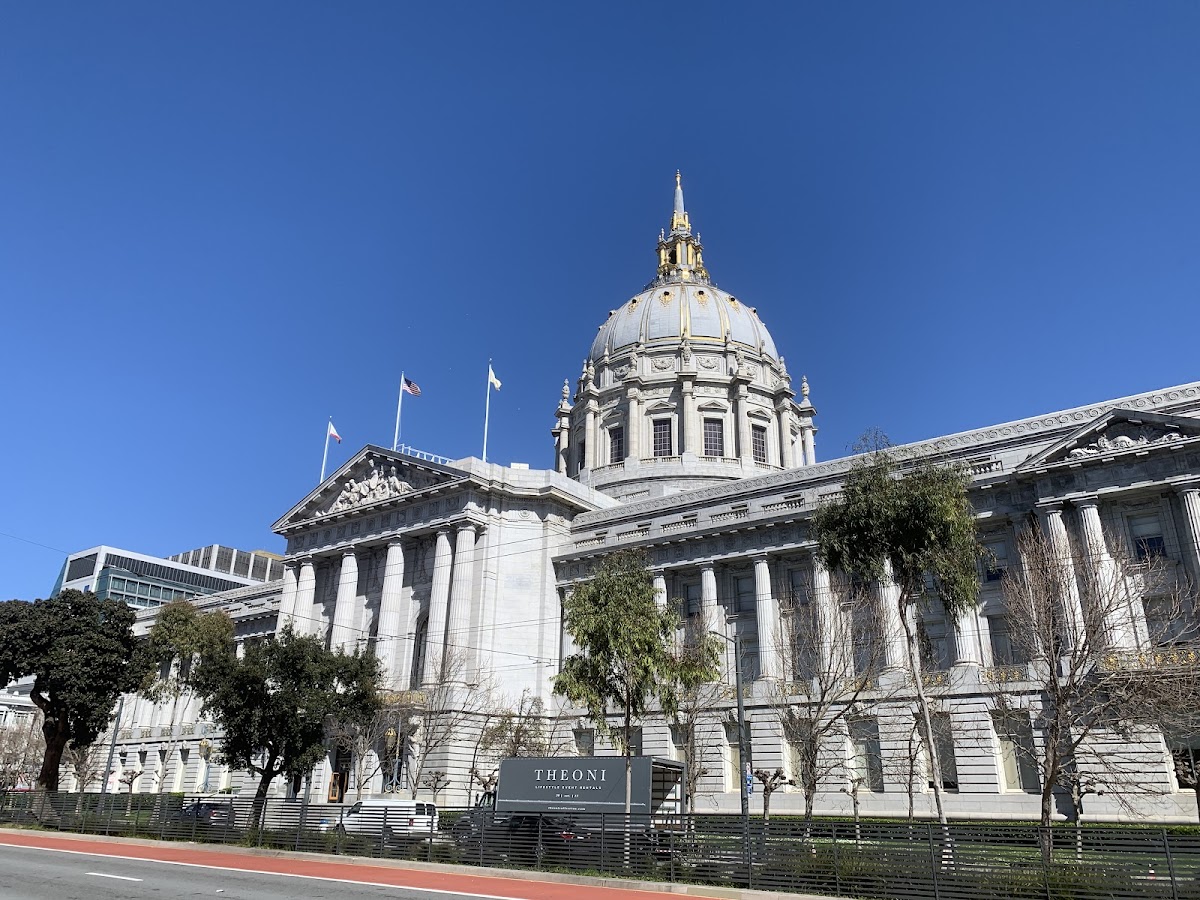
You exit the Civic Center BART station and emerge into the heart of San Francisco’s governmental district. City Hall rises before you like a vision from another century — not merely grand but deliberately, spectacularly so. The Madera County granite exterior glows warm in the California light, every stone placed with Beaux-Arts precision. You climb the exterior steps, pass through the bronze doors (notice the custom doorknobs, each one a small work of art), and then the Rotunda opens before you and upward, upward, impossibly upward to that dome — 307.5 feet of ornate coffers and gilded detail, taller than the Capitol in Washington, lit now with LEDs that can shift from ivory to blush to the palest blue. The Grand Staircase sweeps up in a curve of Indiana sandstone and marble, sixty steps that have been photographed more than perhaps any staircase in America, and the light pours through the tall arched windows in shafts so defined you could almost climb them. This is not a venue that whispers. This is architecture that announces, that celebrates, that gives every couple who marries here the sense that their union is being witnessed by history itself. Poppy has received inquiries from 6 couples planning San Francisco City Hall wedding flowers, and we understand completely why this building — this monument to civic beauty and enduring love — draws people from around the world.
About San Francisco City Hall
San Francisco City Hall stands as one of the finest examples of Beaux-Arts architecture in the United States, a physical manifestation of the City Beautiful movement that swept America in the early 20th century. Designed by Arthur Brown Jr. (who also designed the War Memorial Opera House and Coit Tower), the building was completed in 1915 after the original City Hall was destroyed in the 1906 earthquake and fire. The structure required 7,900 tons of structural steel, and its exterior is clad in Madera County granite that has weathered to a warm honey tone. The interior features Indiana sandstone walls and finish marbles sourced from Alabama, Colorado, Vermont, and Italy — a geology lesson in luxury. Every architectural detail was considered: the custom doorknobs, the hand-forged ironwork, even the building’s signature typeface. The dome, inspired by Jules Hardouin-Mansart’s Baroque masterpieces at the Val-de-Grâce and Les Invalides in Paris, was deliberately constructed to exceed the height of the U.S. Capitol dome. It is, in the most literal sense, a monument to civic pride and the enduring beauty of democratic institutions.
The building occupies two full city blocks in San Francisco’s Civic Center neighborhood, bounded by Van Ness Avenue, McAllister Street, Carlton B. Goodlett Place, and Grove Street. The location is deeply urban — this is the heart of the city’s governmental and cultural district, with the Asian Art Museum, San Francisco Public Library, and War Memorial Opera House all within a few blocks. The Civic Center BART station sits directly across the plaza, making City Hall one of the most transit-accessible wedding venues in the Bay Area. For couples coming from the East Bay, Peninsula, or Marin, access is straightforward via multiple highways and public transit options. Street parking is metered, and several parking garages serve the area, though we generally recommend couples arrange transportation for guests given the urban setting.
For florists, City Hall presents both extraordinary opportunities and specific logistical constraints. The building is a working government facility, and weddings are scheduled around its primary civic functions. Load-in times are strictly regulated: for evening events in the Rotunda or North Light Court, vendor access begins at 4:00 PM (or 2:00 PM for North Light Court specifically). Load-out must be completed by 2:00 AM. One-hour ceremony packages (available Monday through Friday, 9:00 AM to 3:00 PM) allow minimal setup time and no vendor presence during the ceremony itself — couples must work with the building’s guidelines for what can be installed in advance. The building requires certificates of insurance from all vendors, and only approved vendors may work on the property. City Hall does not restrict floral designers to an approved list, which means Poppy (and other qualified florists) can design and install here without venue-imposed limitations. However, certain décor elements require advance approval: chuppahs, for instance, must be hand-supported rather than freestanding due to fire safety regulations. No nails, screws, adhesives, or anything that damages the marble, stone, or woodwork is permitted. Everything must be freestanding or secured with methods that leave no trace.
The venue’s event program accommodates an impressive range of wedding scales. At one end of the spectrum, the Civil Ceremony package allows up to 6 guests for a five-minute ceremony conducted by County Clerk staff in the Rotunda while the building remains open to the public — essentially an elopement with the grandest possible backdrop. At the other end, full Saturday morning buyouts of the Grand Staircase allow up to 200 guests for a two-hour private ceremony and photos. Evening and weekend Rotunda events can accommodate full receptions with dinner, dancing, and bar service for 200+ guests, with the building’s capacity theoretically extending to 2,000 for large-scale events. The Fourth Floor North Gallery and Mayor’s Balcony offer mid-sized options for 40-60 seated guests in more intimate, secluded settings.
Event Spaces & Floral Opportunities
Grand Staircase
Capacity: Up to 200 guests for Saturday morning buyouts
Setting: This is the image that appears in every City Hall wedding search: sixty rectangular marble steps sweeping upward in a graceful curve beneath soaring arched windows, Indiana sandstone walls glowing warm in natural light, the Rotunda dome rising impossibly high above. The staircase begins at the ground floor Rotunda and ascends to the second-floor landing, where marble balustrades frame views back down to the ceremony site. The stone is pale gray-beige with subtle veining, polished to a low sheen that catches light without glaring. Brass railings line both sides, and the proportions are cinematic — this staircase was built for processions, for grand entrances, for moments that demand to be witnessed. On Saturday mornings, couples can reserve the Grand Staircase for two-hour private ceremonies (9:00 AM to 12:00 PM, $5,000 buyout fee), which includes exclusive use of the staircase and surrounding Rotunda area. The light is extraordinary: tall arched windows flood the space with diffused California sunshine that shifts as the morning progresses.
Floral approach: The Grand Staircase is one of the most photographed locations in San Francisco, and every floral choice here will be documented from multiple angles. The key is enhancing rather than obscuring the architecture. We favor aisle markers along the staircase — arrangements placed every 3-4 steps in low, wide vessels (8-10 inches tall maximum) that won’t block guests’ views or create tripping hazards. Think brass or mercury glass compotes filled with garden roses (Patience, Keira, O’Hara), ranunculus, hellebores, and trailing jasmine vine or plumosa fern that softens the arrangement edges without hanging into the walkway. At the landing where the ceremony takes place, a freestanding arch or chuppah becomes the focal point. Given the soaring dome and vertical architecture, we often recommend an asymmetrical arch — 8-10 feet tall on one side, tapering to 6 feet on the other — constructed from natural wood or brushed brass and densely covered with a mix of blooms and textural greenery. For a spring wedding: white peonies, blush Sweet Avalanche spray roses, white lilac, butterfly ranunculus, and silver dollar eucalyptus. For fall: Café au Lait dahlias, Quicksand roses, toffee-toned Japanese sweet peas, amaranthus, and Italian ruscus. The brass railings offer opportunities for garland installations, though these must be secured with non-damaging ties and should be kept to the sections immediately flanking the ceremony landing rather than running the entire staircase length. A 15-20 foot garland of smilax, eucalyptus, and clusters of roses creates a lush frame without overwhelming the space. Personal flowers — bridal bouquet, bridesmaid bouquets, boutonnieres — should be substantial enough to register in photos taken from a distance. This is not the venue for minimalist hand-tied posies; a bride ascending these stairs needs a bouquet that matches the scale of the architecture.
Rotunda
Capacity: 200+ for evening receptions; up to 2,000 for full buyout events
Setting: Stand at ground level in the Rotunda and look up: the dome rises 307.5 feet above you, its interior surface a symphony of coffers, arches, moldings, and gilded details that seem to multiply the higher your eye travels. The dome’s base features a ring of arched openings that allow natural light to filter through, and at night, color-changeable LED lighting can transform the dome from warm ivory to soft pink to celestial blue. The ground floor features pale marble flooring with geometric inlays, and the space opens to all four sides — north, south, east, and west galleries that create a symmetrical, balanced volume. For evening receptions, the Rotunda becomes a ballroom unlike any other: dinner tables arranged in concentric circles or linear rows, a dance floor beneath the dome’s apex, perhaps a band or DJ setup against one of the perimeter walls. The room’s acoustics are live — sound travels and amplifies — which creates wonderful energy for toasts and dancing but also requires strategic planning for amplified music. The sheer scale of the volume means that even 200 guests feel comfortably distributed rather than crowded, and the architectural details provide visual interest from every angle.
Floral approach: The Rotunda’s dome is the star, and floral design must respect that hierarchy. Tall centerpieces that rise above 14-16 inches risk blocking guests’ views of the dome and each other, which is why we almost always recommend low, lush arrangements for guest tables here. Picture compotes (8-10 inches tall including vessel) overflowing with garden roses (Mayra’s Rose, Juliet, Koko Loco), ranunculus, anemones, hellebores, and seasonal foliage like eucalyptus, Italian ruscus, or maidenhair fern. The color palette should complement rather than compete with the dome’s lighting: soft whites, creams, blush pinks, and muted greens work universally, while deeper tones (burgundy, plum, charcoal) create dramatic contrast if the couple plans evening lighting in jewel tones. For the head table or sweetheart table, we can afford more drama: a 20-30 foot garland runner massed with blooms and foliage, punctuated every few feet with clusters of larger focal flowers, creates a lush focal point that registers from across the Rotunda. The bar area (typically set up along one of the perimeter walls) benefits from elevated arrangements — tall vessels (24-30 inches) with dramatic branches (curly willow, manzanita, or flowering cherry in season) and blooms at varying heights create visual interest without obstructing bar service. If the couple is doing a dance floor installation, consider a floral chandelier suspended above the floor — a 4-6 foot ring densely covered with greenery and flowers that appears to float beneath the dome. This requires advance structural approval from the venue, but when executed properly, it becomes one of the most memorable design elements in the space. Statement arrangements at the Rotunda’s four main entrances (north, south, east, west galleries) help define the space and create Instagram-worthy moments: think 4-5 foot tall arrangements in substantial urns, asymmetrically designed with flowering branches, large blooms, and cascading greenery.
North Light Court
Capacity: Varies; ideal for cocktail receptions and as transitional space
Setting: The North Light Court occupies the first floor on the building’s northern side, and its name tells you the defining characteristic: natural light pours through tall windows that face the Civic Center Plaza. The room features high ceilings, pale stone walls, and a more intimate scale than the soaring Rotunda. For evening events, this space serves as the cocktail hour location before guests transition to the Rotunda for dinner and dancing. The atmosphere is bright, airy, and elegant without being overwhelming — a palate cleanser between the grandeur of the ceremony spaces and the drama of the Rotunda reception. Load-in for North Light Court begins at 2:00 PM (two hours earlier than other spaces), which allows vendors more time for setup and creates a less rushed installation process.
Floral approach: Cocktail spaces call for different floral strategies than seated dinners. Guests will be standing, mingling, moving through the space with drinks in hand, which means high-low arrangements work beautifully: cocktail tables get low arrangements (6-8 inches tall) that won’t tip or obstruct conversation, while perimeter spaces and the bar can accommodate tall statement pieces. For cocktail tables, we favor clusters of bud vases — three to five small vessels (varying heights from 4-8 inches) grouped together and filled with a mix of blooms and textured foliage. This creates visual interest and sophistication without requiring massive floral volume. One stunning option for North Light Court: a living wall installation or large-scale floral backdrop near the entrance, positioned to catch the natural light and create a photo opportunity for guests as they arrive. This could be a 6-8 foot panel covered in greenery (plumosa fern, maidenhair fern, Italian ruscus) with blooms inserted throughout, or a more sculptural installation using branches, suspended flowers, and dramatic foliage. The bar deserves its own moment: elevated arrangements in tall clear glass cylinders (24-30 inches) with submerged stems and floating candles create elegance and allow the bartender to work without obstruction. Given the earlier load-in time, this space is also ideal for more complex installations that require assembly time.
Fourth Floor North Gallery
Capacity: 60 seated, 100 standing (with 40 additional standing guests possible)
Setting: Take the elevator or climb the stairs to the fourth floor, and you’ll find the North Gallery — a secluded, light-filled space that feels worlds away from the Rotunda’s grandeur but no less beautiful. The gallery features high ceilings, large windows overlooking the city, and a more intimate architectural scale that creates immediate warmth. The walls are pale, the floors are polished marble, and the overall feeling is elegant and refined without being imposing. This space is available for one-hour ceremony packages (Monday through Friday, 9:00 AM to 3:00 PM) and works beautifully for couples who want the prestige of a City Hall wedding without the scale and publicity of the Grand Staircase. With seating for 60 and standing room for up to 100, it accommodates small to mid-sized weddings comfortably. The natural light makes this space particularly lovely for daytime ceremonies, and the secluded location offers more privacy than the main floor public areas.
Floral approach: Intimate spaces allow for more detailed, personal floral work. Here, we can create ceremony installations that guests will experience up close — every petal, every texture, every color variation becomes visible. For the ceremony backdrop, consider a floral arch scaled appropriately for the space: 6-7 feet tall and 4-5 feet wide, designed asymmetrically with one side fuller than the other to create movement. Fill it with garden roses (Patience, Garden Rose, Mayra’s Rose), ranunculus, hellebores, sweet peas (when in season), and textured foliage like jasmine vine, passion vine, or Italian ruscus. The color palette can be more adventurous in this space — the neutral walls and natural light flatter both soft pastels and richer jewel tones. Aisle arrangements should be spaced every other row (rather than every row) to avoid overcrowding the sightlines; we favor arrangements in brass or mercury glass compotes (10-12 inches tall) filled with lush garden-style clusters. For the windows, consider hanging installations — glass terrariums suspended at varying heights and filled with air plants, blooms, and trailing greenery create a romantic, organic moment that capitalizes on the natural light. If the couple is hosting a small reception in this space after the ceremony, centerpieces should be low (8-10 inches maximum) to facilitate conversation, with rich, detailed compositions that reward close examination.
Mayor’s Balcony
Capacity: 40 seated, 100 standing (60 additional standing guests)
Setting: The Mayor’s Balcony is City Hall’s secret treasure — a private second-floor balcony overlooking the Grand Staircase and facing directly toward the Rotunda dome. It’s tucked away, accessed through interior corridors, and when you step onto it, you feel like you’ve discovered San Francisco’s most romantic Juliet balcony. The balcony features ornate iron railings, marble flooring, and views that span the entire Rotunda interior. Natural light floods the space from the surrounding windows, creating beautiful diffused illumination throughout the day. This space is available for one-hour ceremony packages (Monday through Friday, 9:00 AM to 3:00 PM) and is ideal for intimate weddings where couples want privacy, architectural beauty, and that elevated perspective that makes the ceremony feel both grand and personal.
Floral approach: The balcony’s railing presents a unique opportunity for garland installations — a lush, organic garland of greenery (smilax, eucalyptus, plumosa fern) punctuated with clusters of garden roses, ranunculus, and trailing jasmine vine creates a romantic frame for the ceremony without obstructing the views. Keep the garland to 8-10 feet in length, positioned along the section of railing where the ceremony will take place, and secure it with soft floral ties that won’t damage the ironwork. For the ceremony backdrop, work with the balcony’s architecture rather than against it: a low pedestal arrangement (18-24 inches tall) positioned behind where the couple will stand creates a floral moment without competing with the Rotunda views. Fill it with a lush, asymmetrical composition — garden roses (O’Hara, Keira, Juliet), seasonal blooms (peonies in spring, dahlias in fall), hellebores, and textured foliage that spills over the pedestal’s edges. Personal flowers should be substantial here: the balcony’s intimate scale means guests will see every detail of the bridal bouquet and boutonnieres. We favor hand-tied bouquets with 30-40 stems, combining focal flowers (garden roses, peonies, ranunculus) with textural accents (scabiosa, astilbe, tweedia) and trailing ribbon in silk or velvet. If the couple wants additional floral presence, consider small arrangements (bud vases or low compotes) positioned along the balcony’s perimeter, creating a garden-like environment that enhances the romance without overwhelming the intimate space.
Civil Ceremony Space (Rotunda - Public)
Capacity: Up to 6 guests (couple plus 4 additional guests)
Setting: The Civil Ceremony package is City Hall’s most accessible wedding option: a five-minute ceremony conducted by County Clerk staff in the Rotunda, Monday through Friday, 9:00 AM to 3:30 PM, scheduled every half hour. The ceremony takes place on the Rotunda’s ground floor while the building remains open to the public — this is a working government facility, so tourists and staff will be moving through the space during your vows. The cost is $103 (marriage license separate at $120), and the ceremony includes no private space, no officiant beyond the County Clerk, and minimal setup or personalization. For many couples, this is exactly what they want: a legal marriage in one of the world’s most beautiful buildings, with no fuss and no lengthy planning process.
Floral approach: Given the public nature, tight timeline (five minutes), and no-frills structure of the Civil Ceremony package, elaborate florals are neither practical nor appropriate. What we recommend: a beautiful bridal bouquet (12-20 stems) and a boutonniere for the partner. The bouquet should feel special and photo-worthy without being so large it becomes cumbersome during the brief ceremony. A hand-tied garden bouquet of garden roses (Patience, Koko Loco, Mayra’s Rose), ranunculus, hellebores, and jasmine vine or eucalyptus, wrapped in silk ribbon, is perfect. Keep the palette romantic and classic — whites, creams, blush, soft greenery — to complement the Rotunda’s architecture in photos. No ceremony arch, no aisle arrangements, no centerpieces. Just beautiful personal flowers that the couple can carry away and cherish after their five minutes beneath the dome.
Wedding Flower Ideas for San Francisco City Hall
Gilded Age Romance
This design concept embraces City Hall’s Beaux-Arts grandeur with a palette inspired by turn-of-the-century opulence: champagne, ivory, blush, and touches of antique gold. Floral varieties include Patience garden roses (ivory with blush centers), champagne-toned Quicksand roses, white ranunculus, blush sweet peas (in season March-June), white hellebores, champagne lisianthus, and ivory stock. Textural elements include Italian ruscus, silver dollar eucalyptus, and trails of jasmine vine. Vessels are chosen to evoke the era: antique brass compotes, mercury glass cylinders, and gilded ceramic urns. For the Grand Staircase, aisle markers in brass compotes filled with lush, organic clusters create a romantic procession, while the ceremony arch features asymmetrically massed florals on a natural wood structure with brass accents. In the Rotunda, low centerpieces in mercury glass allow guests to appreciate the dome while maintaining the romantic palette. This concept works beautifully year-round but is especially stunning during the golden hour light of spring and fall, when the natural illumination enhances the warm metallic tones.
Modern San Francisco Garden
This concept brings the city’s urban garden culture indoors with a palette inspired by San Francisco’s microclimates and botanical diversity: soft whites, dusty lavenders, pale yellows, sage greens, and pops of deeper plum. Floral varieties include garden roses (Keira, Mayra’s Rose, Juliet), lavender (when available June-September), white lisianthus, pale yellow butterfly ranunculus, scabiosa in both white and deep purple, white anemones, purple stock, and hellebores. Foliage includes eucalyptus (silver dollar and seeded), plumosa fern, maidenhair fern, and passion vine tendrils. Arrangements are designed to feel organic and just-gathered, with blooms at varying heights and textures that create movement. For the Fourth Floor North Gallery or Mayor’s Balcony, a ceremony arch covered in this garden mix creates an intimate, enchanted feeling. In the Rotunda, low centerpieces mounded with blooms and trailing foliage evoke the lushness of Golden Gate Park’s botanical gardens. This palette photographs beautifully in City Hall’s natural light and works particularly well for spring (March-May) and summer (June-August) weddings when garden flowers are at their peak.
Metropolitan Elegance
This concept leans into City Hall’s urban sophistication with a refined, architectural approach to floral design: a palette of pure white, charcoal, and touches of deep burgundy. Floral varieties include white phalaenopsis orchids, white calla lilies, white garden roses (Patience, Polar Star), deep burgundy dahlias (in season August-October), burgundy ranunculus, white hellebores, and white lisianthus. Foliage is minimal and structural: lily grass formed into loops and spirals, aspidistra leaves, and minimal eucalyptus. Arrangements are designed with clean lines and geometric precision — tall centerpieces in clear glass cylinders with submerged stems and floating orchid blooms create modern elegance in the Rotunda, while the Grand Staircase features aisle markers in sleek black or charcoal vessels filled with architectural compositions of calla lilies and looped lily grass. This concept works especially well for evening receptions when the Rotunda’s LED lighting can be programmed to complement the palette, and it photographs dramatically against the pale marble and stone. Best seasons are fall and winter (September-February) when the deeper burgundy tones feel seasonally appropriate and dahlias are available.
Seasonal Considerations
San Francisco’s climate is famously mild and Mediterranean, but the city’s microclimates create surprising variation neighborhood to neighborhood. City Hall, located in the Civic Center, experiences the patterns typical of the city’s eastern neighborhoods: cool, foggy summers (“June Gloom” is real), mild winters with occasional rain, and warm, clear autumns that many consider the city’s finest season.
Spring (March-May): Spring in San Francisco arrives gradually, with March often still cool and damp but April and May bringing increasing warmth and sunshine. This is one of the most beautiful seasons for flowers, with abundant availability of tulips, daffodils, hyacinths, ranunculus, anemones, sweet peas, hellebores, and the first peonies arriving by late April. The natural light inside City Hall is particularly beautiful in spring, when the sun angle creates soft, diffused illumination through the tall windows. Practical considerations: San Francisco’s spring can still include rainy days, but since City Hall is entirely indoor, weather is less of a concern than at outdoor venues. Do note that spring is also peak tourist season, which means the building and surrounding Civic Center area will be busy even on weekdays. For one-hour ceremony packages, this means more public foot traffic during your vows.
Summer (June-August): San Francisco summers famously defy expectations: while the rest of California bakes, the city stays cool and often foggy, particularly in the mornings. Mark Twain (apocryphally) said “The coldest winter I ever spent was a summer in San Francisco,” and while he probably didn’t say it, the sentiment holds. For City Hall weddings, this means beautiful, consistent indoor temperatures and no concerns about wilting flowers in extreme heat. Summer flower availability is excellent: garden roses peak, dahlias begin their long season in late July, hydrangeas are lush, and herbs like lavender and rosemary are abundant. Zinnias, lisianthus, and scabiosa thrive. The main consideration is that summer weekends in San Francisco are busy with tourists and conventions, which can affect hotel availability and rates for out-of-town guests. The earlier load-in times (2:00 PM for North Light Court, 4:00 PM for Rotunda) work well in summer when daylight extends late into the evening.
Fall (September-November): Fall is San Francisco’s secret best season. September and October bring “Indian Summer” — warm, clear days with temperatures often reaching the 70s and 80s, low humidity, and brilliant sunshine. The city’s fog retreats, the light turns golden, and the weather is reliably beautiful. For City Hall weddings, this means spectacular natural light through the windows and comfortable temperatures for guests moving between spaces. Fall flower availability is extraordinary: dahlias are at their absolute peak (Café au Lait, Bliss, Penhill Watermelon, and hundreds of other varieties), garden roses continue strong, cosmos and zinnias flourish, and rich seasonal foliage (copper beech, oak leaves) becomes available. November can bring the first winter rains, but San Francisco’s wet season is mild compared to most of the country. Fall is the most popular season for City Hall weddings, which means competition for Saturday morning Grand Staircase buyouts — book early.
Winter (December-February): Winter in San Francisco means rain, but temperatures rarely drop below the 40s, and snow is essentially unheard of. The city takes on a quieter, more intimate atmosphere,