
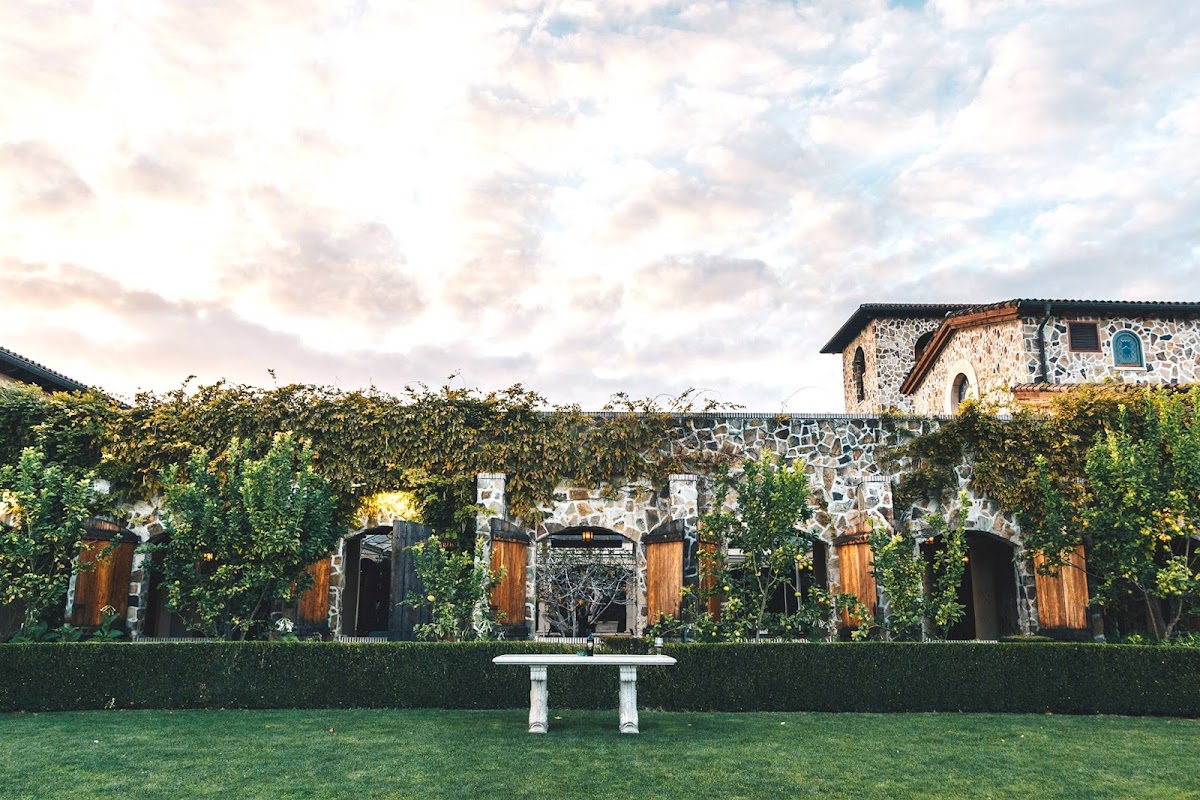
You know you have arrived somewhere singular when the driveway feels less like an approach and more like a passage through time. Arnold Drive winds through Carneros wine country, where Sonoma bleeds into Napa and the fog from San Pablo Bay settles over the vines each morning. And then, just past the low-slung ranches and the working vineyards, Jacuzzi Family Vineyards reveals itself — not as a California winery styled with Italian flourishes, but as an actual reconstruction of the Jacuzzi family’s ancestral home from the Friuli region of northern Italy. This is not theme-park Tuscany. The 18,000-square-foot structure was built with Italian art, handmade furnishings shipped from the old country, and an architectural commitment to authenticity that extends to every arched window, every hand-laid stone, every wrought-iron detail. Walk through the entrance and you could be standing in a villa outside Udine, except for the fact that beyond the terrace, rows of Chardonnay and Pinot Noir stretch toward the Wetland Preserve, unmistakably Californian in their golden-hour beauty. Poppy has designed Jacuzzi Family Vineyards wedding flowers for 2 celebrations here, and each time, the design challenge is the same: how do you honor this extraordinary Old World craftsmanship while celebrating the fact that you are standing in one of the most beautiful wine regions on earth?
About Jacuzzi Family Vineyards
The Jacuzzi name carries weight in Northern California — not just for the family’s contributions to winemaking, but for their broader legacy in innovation and craftsmanship. The family emigrated from Italy in the early 20th century, and while they became famous for inventing the whirlpool bath, their roots in viticulture run deep. Jacuzzi Family Vineyards, founded in 2007, represents a return to those roots. The property sits in the Carneros appellation, the cool-climate region straddling the southern edges of Napa and Sonoma counties. The estate vineyards produce Italian varietals — Barbera, Sangiovese, Pinot Grigio, and Aglianico — alongside classic Carneros Chardonnay and Pinot Noir. This is a working winery where the connection to Italian winemaking traditions is not decorative, it is operational.
The architecture is the story here. The main building is a meticulous recreation of the Jacuzzi family’s home in the Friuli-Venezia Giulia region of northeastern Italy, constructed with materials and design principles imported directly from Italian craftsmen. Inside the Barrel Room, you will find Romanesque statues, baroque paintings, and a working pipe organ installed in an apse that could belong to a 16th-century chapel. Venetian-style glass chandeliers cast warm light across exposed wood beams and stained glass windows. Outside, the Grand Piazza features stone pillars, arched colonnades, and a sense of proportion that feels lifted from a Tuscan courtyard. The Vineyard Vista overlooks the eastern vineyards and an imported Italian marble fountain that serves as the ceremony site focal point. The attention to detail extends to the landscaping — olive trees, lavender hedges, and Mediterranean plantings that reinforce the Italianate aesthetic.
Logistically, Jacuzzi Family Vineyards is located about 45 minutes north of San Francisco, making it an accessible wine country destination for Bay Area couples and their guests. The venue operates as a raw space, meaning couples have flexibility with their vendor selections (outside caterers are required, drawn from a preferred list), but they also must bring in all elements of their event. The venue provides tables, chairs, setup, and lighting, but everything else — linens, catering, florals, rentals — is managed by the couple’s team. For Poppy, this means we coordinate closely with planners and caterers to ensure seamless setup. Load-in is straightforward with ample parking on-site, and the venue’s event team is organized and communicative about vendor timelines. Free self-parking is available for guests, and the property accommodates shuttles, which many couples opt for given the wine-tasting opportunities.
The venue’s event program is curated and limited, which preserves the sense of exclusivity. Jacuzzi Family Vineyards does not feel like a wedding factory. It feels like you have been invited to celebrate in someone’s extraordinary private estate — which, in a sense, you have.
Event Spaces & Floral Opportunities
Vineyard Vista
Capacity: 50–150 seated / 50–200 standing
Setting: The Vineyard Vista is the estate’s outdoor ceremony site, and it delivers on every promise the name suggests. Positioned to overlook the eastern vineyards, the space offers sweeping views of the vines, the Wetland Preserve beyond, and the rolling Carneros landscape that stretches toward the Bay. The centerpiece is an imported Italian marble fountain — weathered, elegant, and framed by olive trees and lavender plantings. Rows of vineyard march up the hillside behind the fountain, creating a layered, textural backdrop. The ceremony site is naturally terraced, so guests have excellent sightlines, and the surrounding landscape provides wind protection without feeling enclosed. During golden hour, the light here is luminous, soft and warm in that particular Northern California way that photographers chase.
Floral approach: The Vineyard Vista is already so visually complete that the florist’s task is to accent, not overwhelm. The marble fountain is your natural altar backdrop, and we recommend flanking it with a pair of large-scale urn arrangements rather than obscuring it with an arch. Think terracotta or aged concrete vessels filled with a lush, loose mix of garden roses (Juliet, Patience, Constance), late-summer dahlias (Café au Lait, Peaches and Cream), olive branches, jasmine vine, and Italian ruscus trailing to the ground. For the aisle, consider low stone vessels or terracotta pots with similar arrangements placed every third row — enough to frame the processional without creating a floral runway that competes with the vineyard views. If you do want an arch, keep it architectural and restrained: a simple wooden or metal frame softened with asymmetric greenery (smilax, Italian ruscus, seeded eucalyptus) and a few statement blooms clustered at one corner. The wind in Carneros can be a factor, so any aisle markers should be weighted or staked, and delicate blooms like sweet peas should be avoided in favor of hardier varieties. The color palette here should echo the landscape — warm terracotta, dusty lavender, soft peach, buttery yellow, with plenty of silvery olive foliage to tie into the surrounding plantings.
Grand Piazza
Capacity: 50–150 seated / 50–150 standing
Setting: The Grand Piazza is where Jacuzzi Family Vineyards makes its strongest architectural statement. This is a reception space designed to feel like an Italian courtyard transplanted to Sonoma — all honey-toned stone pillars, arched colonnades, and old-world proportions. From May through October, the space is open-air, with long farm tables or rounds set under the California sky. Come November, a clear tent encloses the Piazza, transforming it into a pavilion with views of the surrounding vineyards and protection from the elements. The stonework is the hero here: hand-laid, textured, and warm, especially in the late afternoon when the setting sun hits the western façade. Arched windows punctuate the walls, and stone pillars create natural divisions within the space. There is an adjoining covered deck that flows seamlessly from the Piazza, perfect for a lounge area or band setup.
Floral approach: In this space, florals should enhance the Italian architecture without competing with it. The stone pillars are natural anchors for large-scale arrangements — consider placing elevated designs on pedestals at the base of each pillar, spilling with garden roses, hydrangea, jasmine, and trailing amaranthus or Italian ruscus. These create vertical moments that draw the eye upward and emphasize the height of the space. For guest tables, we favor low, lush centerpieces in aged terracotta, ceramic, or stone vessels that echo the Piazza’s materiality. Think textured, garden-style arrangements with a Mediterranean palette: dusty pink Quicksand roses, ivory Ohara garden roses, soft peach Juliet roses, white lisianthus, scabiosa, astilbe, olive branches, rosemary, and lavender sprigs for that herbal, sun-drenched Italian feel. If the space is tented in cooler months, you have the opportunity to add floral chandeliers or suspended installations that fill the overhead volume. A long garland of smilax, olive, and eucalyptus running the length of the tent’s center beam, punctuated with clusters of blooms, creates a romantic canopy effect. The arched windows can be framed with greenery garlands or small floral clusters at each corner, softening the architecture without blocking the views. In the open-air months, string lighting overhead is common, and we often weave greenery through the light strands to integrate the florals into the existing ambiance.
Barrel Room
Capacity: Up to 150 guests seated / 50–200 standing
Setting: The Barrel Room is not what you expect when you hear “winery barrel room.” This is not a rustic cellar with oak barrels and concrete floors. This is a cathedral. Literally. The space features a soaring, cathedral-like ceiling with exposed wood beams, stained glass windows that cast jewel-toned light across the room, Venetian-style glass chandeliers that could have been pulled from a Murano workshop, Romanesque statues positioned in alcoves, baroque oil paintings on the walls, and — most dramatically — a working pipe organ installed in an apse at one end of the room. There is a full kitchen for caterers, a polished dance floor, and a level of European grandeur that reads more “Milanese palazzo” than “California wine country.” The color palette is rich and warm: dark wood, gilded accents, deep burgundy and gold tones in the art and stained glass.
Floral approach: This room demands formality and elegance. We are not talking about loose, organic, just-picked-from-the-garden arrangements here. The Barrel Room calls for structured, refined floral designs that honor the baroque aesthetic. For guest tables, consider elevated arrangements on tall gold or bronze candelabras or compotes — think classic blooms like Patience garden roses, white Polo roses, blush Ohara roses, white hydrangea, white phalaenopsis orchids, and touches of burgundy hypericum berries or privet berries for depth. Incorporate trailing amaranthus and smilax to add movement and soften the formality. The apse is your statement moment. This is where the pipe organ sits, and it functions as a natural focal point for the room. Consider a large, symmetrical altar-style arrangement placed in front of the organ — a lush, formal installation with height and presence, using blooms like white and blush roses, white hydrangea, delphinium, and plenty of greenery. If you are doing a sweetheart table or head table in front of the apse, a low, luxurious runner arrangement — something that feels like an Italian garland — works beautifully. The chandeliers are already dramatic, so resist the urge to add too much overhead floral unless you are going for full opulence. If budget allows, small greenery clusters attached to the chandeliers with floral wire can add a subtle organic touch without overwhelming the existing fixtures. The stained glass windows and statues should be left to speak for themselves — no need to place florals in front of them. This is a space where restraint and refinement win over abundance.
Wedding Flower Ideas for Jacuzzi Family Vineyards
Tuscan Terracotta
This palette takes its cues directly from the sun-baked landscapes of Tuscany and the warm stonework of the villa itself. We are working with terracotta, burnt sienna, dusty peach, warm ivory, and soft lavender, grounded by silvery olive foliage and the gray-green of Italian ruscus. Specific blooms include Juliet garden roses (that perfect peachy-apricot), Patience garden roses (blush with a hint of peach), Café au Lait dahlias (creamy beige with blush undertones), peach stock, soft orange ranunculus, lavender, scabiosa, and astilbe in muted tones. Textural elements like olive branches, rosemary sprigs, jasmine vine, and seeded eucalyptus reinforce the Mediterranean feel. Arrangements sit in terracotta pots, aged concrete vessels, or ceramic urns that echo the earthy palette. This concept works beautifully across all three spaces — soft and romantic in the Vineyard Vista, warm and inviting in the Grand Piazza, and elegantly restrained in the Barrel Room when executed with a more refined hand. It is a palette that feels both timeless and completely appropriate to the setting, honoring the Italian heritage without veering into cliché.
Golden Hour Romance
Inspired by the luminous light that bathes Carneros in late afternoon, this palette captures the glow of golden hour with buttery yellows, soft golds, warm ivories, champagne tones, and touches of apricot and blush. Specific blooms include garden roses in Golden Mustard, Juliet, and Patience, cream Polo roses, yellow and apricot ranunculus, champagne spray roses, golden yarrow, café-toned dahlias, and white lisianthus. Foliage includes Italian ruscus, olive branches, and jasmine vine, with accents of seeded eucalyptus for texture. Vessels are kept neutral — aged brass compotes, gold-rimmed ceramic urns, or natural wood boxes. This palette is particularly stunning in the Vineyard Vista at sunset, where the floral tones mirror the light on the vines and the golden hills beyond. In the Grand Piazza, it creates a warm, celebratory atmosphere that feels sun-soaked and joyful. In the Barrel Room, executed with champagne and ivory tones and touches of gold, it reads as elegant and refined without feeling overly formal.
Venetian Elegance
This concept leans into the baroque opulence of the Barrel Room and the Italian craftsmanship throughout the venue. The palette is rich and dramatic: deep burgundy, wine red, dusty mauve, blush, ivory, and soft gray-green foliage. Specific blooms include Black Baccara roses (nearly black-red), Burgundy Iceberg roses, deep red ranunculus, burgundy dahlias (Chat Noir, Black Jack), dusty mauve Quicksand roses, blush Keira garden roses, white phalaenopsis orchids, burgundy carnations, privet berries, hypericum berries, and hellebores when in season. Foliage includes dark Italian ruscus, olive branches, and trailing amaranthus in burgundy tones. Vessels are elevated — aged bronze urns, gold compotes, dark ceramic pedestals. This palette is bold and unapologetically formal, perfect for couples who want to embrace the grandeur of the Barrel Room. It also works beautifully in the Grand Piazza for an evening reception, where candlelight plays off the deep tones and creates a moody, romantic atmosphere. In the Vineyard Vista, this palette can be softened with more mauve and blush tones to avoid feeling too heavy against the outdoor light.
Seasonal Considerations
Sonoma’s Carneros region enjoys a Mediterranean climate with cool, fog-influenced mornings and warm afternoons from spring through fall, and mild, wet winters. Understanding the seasonal shifts is essential for planning your Jacuzzi Family Vineyards wedding flowers.
Spring (March–May): Spring in Carneros is lush and green, with wildflowers dotting the hillsides and the vines beginning to leaf out. Temperatures range from the mid-50s to low 70s, with occasional rain showers, especially in March and early April. Mornings can be cool and foggy, burning off by midday. Locally available blooms include ranunculus, anemones, tulips, sweet peas, hellebores, and early garden roses. This is an ideal time for soft, romantic palettes in blush, lavender, peach, and ivory. The vineyard landscape is vibrant green, so florals can echo that freshness. Be prepared for wind, especially in the Vineyard Vista, and choose sturdy blooms and weighted vessels. April and May are peak spring wedding months in Sonoma, so book your florist early.
Fall (September–November): Fall is harvest season in Carneros and arguably the most beautiful time of year. The vines turn shades of gold, crimson, and amber, and the air is crisp and clear. Temperatures range from the 60s to mid-70s, with cooler evenings. September and October are ideal wedding months with reliable weather, though November can bring the first rains. Locally available blooms include dahlias (in their absolute prime), garden roses, ranunculus, café-toned blooms, marigolds, amaranthus, and late-season hydrangea. This is the perfect season to embrace rich, warm palettes — burnt orange, rust, burgundy, goldenrod, and deep plum. Incorporate seasonal elements like pomegranates, figs, or grape clusters into arrangements. The vineyard backdrop is at its peak, so florals should complement rather than compete with the landscape. Note that the Grand Piazza transitions to a tented space in November, so design plans may shift accordingly.
Winter (December–February): Winter in Carneros is mild but wet, with daytime temperatures in the 50s and 60s and frequent rain. The Grand Piazza is enclosed with a clear tent during these months, creating a cozy, intimate atmosphere. The vineyard landscape is dormant and spare, with bare vines and golden grasses, which provides a neutral backdrop for bold floral statements. Locally available blooms are more limited, with many flowers imported from warmer regions or hothouses. Options include garden roses, ranunculus, anemones, hellebores, amaryllis, tulips (imported), and evergreen foliage. Winter is an excellent time for dramatic, romantic palettes — deep reds, burgundy, blush, ivory, and plenty of greenery. Candlelight becomes essential in the shorter days, and florals can be paired with abundant votives and taper candles for warmth. While winter is the off-season for Sonoma weddings, couples who embrace the season can create an incredibly intimate, elegant celebration with lower venue and vendor costs.
Poppy’s Expert Take
Understand the Italian aesthetic. Jacuzzi Family Vineyards is not generically Mediterranean — it is specifically Italian, modeled after the Jacuzzi family’s ancestral home in Friuli. That means your floral designs should nod to Italian garden traditions: olive branches, rosemary and lavender, jasmine, romantic garden roses, and warm, earthy color palettes. Avoid overly tropical blooms (protea, bird of paradise, anthurium) or ultra-modern minimalist designs that clash with the baroque and Tuscan architecture. When in doubt, ask yourself: could I see this arrangement in a Tuscan villa or a Venetian palazzo? If not, rethink it.
The Barrel Room is not rustic. Do not let the name fool you. This is not a casual barn space. It is a formal, cathedral-like ballroom with baroque art, stained glass, and a pipe organ. Your floral designs should match that level of elegance. This is not the venue for mason jars, wildflower bunches, or loose, unstructured arrangements. Go for refined, elevated designs with classic blooms and formal vessels. Think Italian chapel, not California barn.
Wind management in the Vineyard Vista. Carneros is known for its afternoon winds, which blow in from San Pablo Bay and keep the climate cool. In the Vineyard Vista, this can wreak havoc on ceremony florals if you are not prepared. Use heavy vessels (stone, concrete, or terracotta) for any freestanding arrangements, and stake or weight aisle markers. Avoid tall, top-heavy arrangements that will tip, and skip delicate blooms like sweet peas or cosmos that shred in the wind. Opt for sturdier varieties like garden roses, spray roses, and foliage-heavy designs. If you are doing an arch, make sure it is properly weighted or staked — we have seen arches tip mid-ceremony when the wind picks up.
Leverage the fountain as your ceremony focal point. The imported Italian marble fountain in the Vineyard Vista is stunning and provides a natural backdrop for your ceremony. Rather than building a large floral arch that competes with it, flank the fountain with a pair of statement urns or place a low, lush arrangement at its base. This highlights the fountain rather than hiding it and creates a more sophisticated, integrated look. Bonus: it is often more budget-friendly than constructing a full arch.
Coordinate with the tent timeline for the Grand Piazza. The Grand Piazza transitions from open-air to tented around November, depending on weather. If your wedding falls in late October or early November, confirm with the venue whether the tent will be up. This affects your floral design significantly — open-air allows for more natural, loose arrangements that play off the vineyard views, while the tented version allows for overhead installations like chandeliers or garlands. Make sure your florist knows the configuration in advance.
The venue is a raw space — plan accordingly. Jacuzzi Family Vineyards provides tables, chairs, setup, and lighting, but everything else is on you. That includes linens, tableware, catering, florals, and rentals. Work with a planner or coordinator who understands raw space logistics, and make sure your floral designer is coordinating closely with your rental company on vessel and linen selections. There is no in-house coordination team managing vendor schedules, so clear communication is essential. For Poppy, this means we build extra time into our setup schedule and confirm load-in logistics directly with the venue and planner well in advance.
Use the architecture, not just the tables. The stonework in the Grand Piazza, the stained glass and apse in the Barrel Room, the arched windows throughout — these architectural features are opportunities for floral installations beyond just centerpieces. Consider greenery garlands framing arched windows, elevated arrangements on pedestals at the base of stone pillars, or a dramatic installation in the Barrel Room apse. These large-scale moments create visual impact and make the space feel fully designed, rather than just decorated.
What Poppy Couples Spend on Flowers Here
Based on Poppy’s experience designing for Jacuzzi Family Vineyards weddings, couples typically invest an average of $3,172 in their floral designs. This positions Jacuzzi slightly below the San Francisco market average of $4,000–$6,000, likely because the venue’s inherent beauty and architectural drama mean you need fewer florals to create impact. That said, floral budgets can vary widely depending on the scale of your celebration and the design approach. Here is how spending typically breaks down across three tiers.
$2,500–$3,500 | The Essentials At this level, you are covering the core floral elements for a wedding at Jacuzzi Family Vineyards: bridal bouquet, bridesmaid bouquets, boutonnieres, ceremony arrangements, and guest table centerpieces. For the Vineyard Vista ceremony, this might include a pair of medium-scale urn arrangements flanking the marble fountain and simple aisle markers every third row. Reception centerpieces for 15–20 tables in the Grand Piazza would be low, lush arrangements in textured vessels — nothing overly complex, but cohesive and beautiful. Personal flowers would include a full bridal bouquet, three to five bridesmaid bouquets, and six to eight boutonnieres. You are not adding large-scale installations, bar arrangements, or lounge florals, but you are creating a warm, designed look that complements the venue without feeling sparse. This budget works well for couples who trust the venue’s architecture to do much of the aesthetic heavy lifting.
$3,500–$5,500 | The Full Picture This mid-tier budget allows for more layered, detailed floral designs across all three event spaces. In the Vineyard Vista, you might add a ceremony arch (or a more elaborate pair of statement urns) along with upgraded aisle markers and a welcome arrangement at the entrance. In the Grand Piazza, you can include elevated centerpieces, greenery garlands along the stone pillars or arched windows, and florals for the bar and any lounge areas. If you are using the Barrel Room for cocktails or as a secondary space, you can add arrangements for the organ apse, entry florals, and cocktail table clusters. Personal flowers expand to include more elaborate bouquets, additional boutonnieres, corsages, and flower crowns or hairpieces. At this level, you are creating a fully designed floral experience that feels intentional and abundant, with thoughtful touches in every space. This is the sweet spot for most Jacuzzi Family Vineyards weddings — enough to make a statement without overdesigning a venue that already delivers so much architectural beauty.
$5,500+ | The Full Experience For couples who want florals to be a defining feature of their celebration, this upper tier allows for dramatic, large-scale installations and abundance across all spaces. In the Vineyard Vista, think an oversized ceremony arch or multiple statement urns, lush aisle arrangements at every row, and a welcome installation at the entrance. In the Grand Piazza, you can add overhead floral chandeliers or a long suspended garland, elevated and low centerpieces in a mixed-height approach, extensive greenery installations framing all architectural features, and full floral coverage for bars, lounges, and the band or DJ area. The Barrel Room might include a large-scale altar arrangement in the apse, greenery woven into the chandeliers, and arrangements on every surface. You can also budget for luxury blooms like phalaenopsis orchids, peonies, and out-of-season imports. Personal flowers can include statement bridal bouquets with trailing elements, elaborate bridesmaid bouquets, additional floral installations like a flower wall or photo backdrop, and even floral petals for the aisle or toss. This tier is for couples who see flowers as art and want every corner of the venue to feel lush, designed, and unforgettable.