
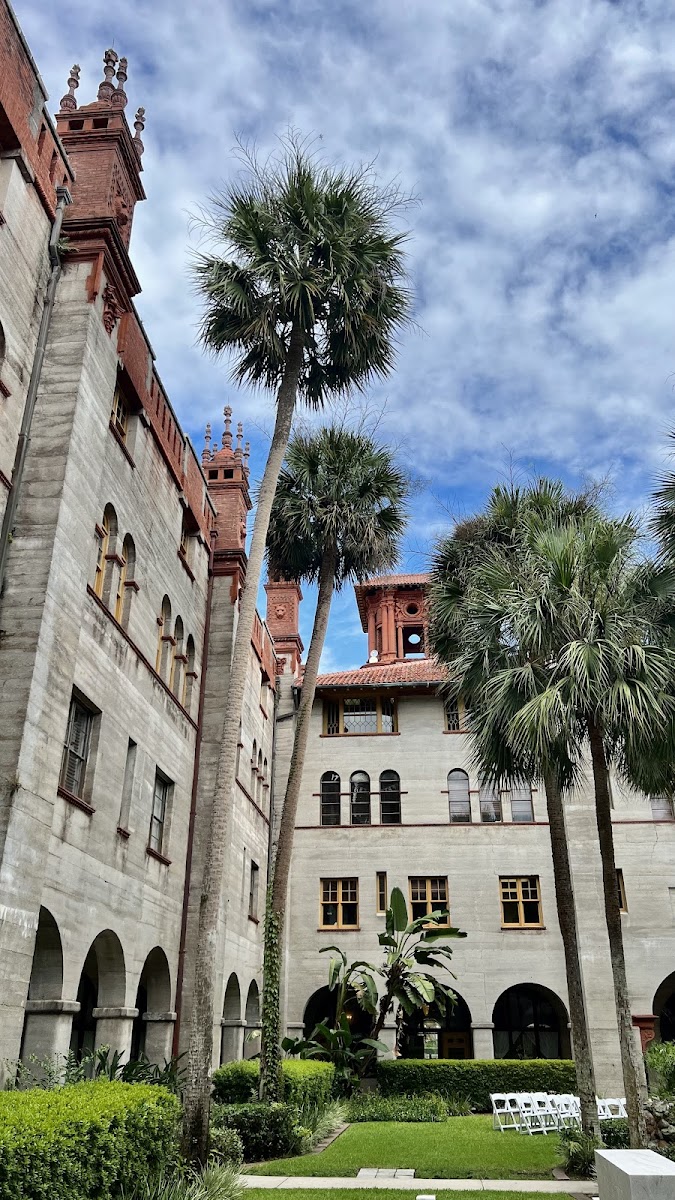
The Lightner Museum is not a blank canvas. It is a historic monument of the Gilded Age, and your floral design must acknowledge that weight. Designing for this venue requires a shift in perspective—you aren’t just decorating tables; you are competing with three stories of Spanish Renaissance Revival architecture. If your arrangements are too small, the room will swallow them.
Success at the Lightner depends on scale and architectural integration. The venue’s neutral stone and ornate plasterwork provide a sophisticated backdrop that rewards high-contrast color palettes or lush, monochromatic white-and-greenery schemes. We know this venue intimately and understand that the most successful designs here are those that feel like they are growing out of the museum’s very foundations.
The Spaces
Historic Pool (Main Ballroom)
This is the heart of the Lightner. Once the world’s largest indoor swimming pool, it is now a sunken ballroom surrounded by towering mezzanines. The sheer verticality of this space is its defining feature.
- What works: Tall, trumpet-style centerpieces or elevated stands. You need to draw the eye upward toward the ornate ceilings. Cascading greenery on the railings of the first-level mezzanine can help connect the two levels visually.
- Skip: Short, tight pavé arrangements. They will look like coasters on the tables when viewed from the mezzanine above.
- Watch out: The “pool” floor is lower than the entrance. Guests look down into the space before entering, so the “top-down” view of your centerpieces matters immensely.
- Budget hero move: Focus your investment on a massive floral installation for the grand staircase leading down into the pool. This is where every guest looks, and it serves as the primary backdrop for the evening.
The Grand Lobby
The lobby is a masterclass in detail, from the mosaic floors to the crystal chandeliers. It is often used for cocktail hours or intimate ceremonies.
- What works: Ground-level “growing” meadows that frame the arched windows. These installations feel organic and contrast beautifully with the rigid geometry of the mosaic tiles.
- Skip: Heavy pedestals or bulky rental structures that block the view of the courtyards.
- Watch out: The lighting in the lobby can be dim during evening events. Use flowers with high luminosity—whites, creams, and pale yellows—to ensure they pop in photographs.
Outdoor Terrace & Gardens
The terrace offers a view of St. Augustine’s skyline and the museum’s twin towers. It is a classic Florida setting that requires a light touch.
- What works: Asymmetrical floral pillars for the ceremony. These provide a frame for the couple without obstructing the historic facade of the museum.
- Skip: Potted plants that look like they belong in a home garden. The museum’s scale demands something more intentional and curated.
- Watch out: Wind exposure on the terrace can be significant. All floral structures must be weighted heavily to prevent tipping on the stone floor.
Side Courtyards & Loggia
These spaces are characterized by stone walkways and vibrant bougainvillea. They are the most “Mediterranean” feeling parts of the property.
- What works: Smilax or jasmine vines wrapped around the stone columns to enhance the “secret garden” aesthetic.
- Skip: Modern, geometric structures. They clash with the old-world charm of the stone arches.
- Budget hero move: Use simple, lush garlands on the loggia railings. It’s a cost-effective way to define the space while leaning into the existing greenery.
What Works at Lightner Museum
Embrace the verticality. With ceilings this high, you have permission to go big. Statement trees, 36-inch elevated stands, and hanging installations are not just options; they are the best way to fill the visual void.
Soften the stone. The museum is a world of hard surfaces—marble, tile, and stone. Use “floppy” florals like sweet peas, ranunculus, and trailing eucalyptus to provide a necessary organic contrast to the rigid architecture.
Design for the mezzanine view. This is one of the few venues where guests spend significant time looking down at the reception from a higher floor. Ensure your centerpieces have interest from the top—avoid exposed floral foam or unfinished mechanics at all costs.
Utilize the built-in stages. The Lightner is full of ledges, built-in seating, and wide staircases. Instead of bringing in more furniture, “grow” your flowers directly off these architectural features. It makes the floral design feel like a permanent part of the museum.
High-contrast palettes. Pale stone and neutral plaster can wash out muted colors. Deep burgundies, vibrant ochres, or crisp, bright whites stand out best against the museum’s interior.
Budget Guide
| Tier | Investment | Floral Strategy |
|---|---|---|
| Essentials | $1,750 - $4,000 | Focus exclusively on personal flowers and two high-impact focal points for the ceremony that can be moved to the reception. |
| Sweet Spot | $4,000 - $8,000 | Includes personals, a full ceremony arch or pillar set, and a mix of low and medium-height centerpieces to create visual variety in the ballroom. |
| Full Experience | $8,000 - $15,000 | Allows for a significant staircase installation (the Lightner’s signature move) and tall, lush centerpieces on every table. |
| Statement | $15,000+ | Full-scale architectural integration: hanging installations from the ballroom rigging points, floral wraps for columns, and immersive “meadow” designs. |
The Lightner Museum is a venue that rewards those who respect its history; your floral budget should be spent on fewer, larger moments rather than many small ones.
Tips
Repurpose the staircase florals. If you install a lush runner on the outdoor terrace stairs for the ceremony, have your team move it to the indoor ballroom stairs for the reception.
No floor candles. The venue has strict rules against open flames or floating candles on the floor; stick to LED or elevated glass chimneys to stay compliant.
Check the rigging points. The ballroom has specific points where hanging installations can be safely secured; confirm these with the venue manager before finalizing a ceiling design.
Coordinate with the lighting team. The museum’s architecture is often uplit in colors; ensure your floral palette doesn’t clash with the planned house lighting.
Plan for the flip. If your ceremony and reception are both in the Historic Pool, the “flip” happens quickly; design your ceremony pieces to be easily mobile.