
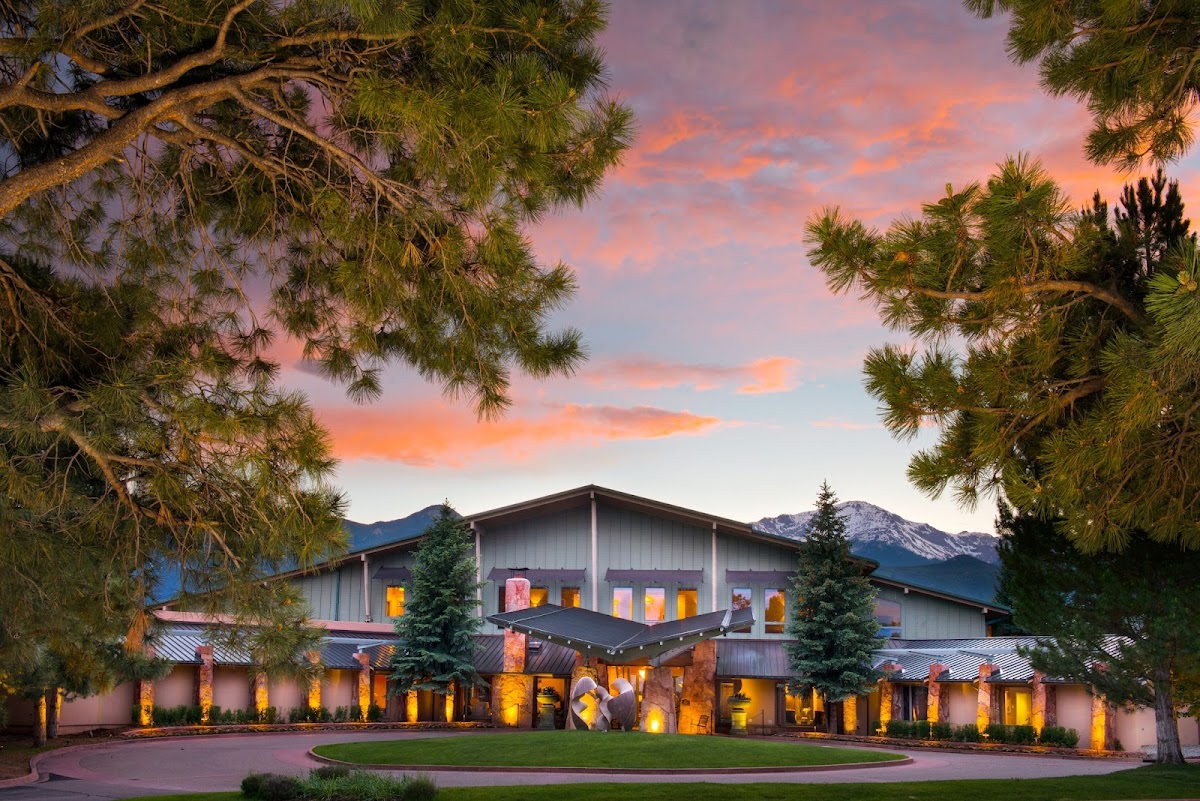
The drive up Mesa Road narrows as it climbs, and then there’s a moment — the one where Garden of the Gods Resort and Club reveals itself against the backdrop of something much older and much grander. Behind the resort’s stone-and-timber architecture, Pikes Peak rises 14,115 feet into the Colorado sky, its granite face catching the late afternoon sun. To the east, the rust-red towers of Garden of the Gods National Landmark jut out of the earth like cathedral spires, ancient sandstone sculpted by wind and time into formations that geologists call “kissing camels” and “balanced rock” and that everyone else simply calls breathtaking. This is not a venue trying to be beautiful. This is a venue positioned at the gateway to one of the most photographed landscapes in America, smart enough to get out of the way and let the scenery do what it does best. Poppy has designed Garden of the Gods Resort and Club wedding flowers for 3 celebrations here, and every time we pull up with our delivery van filled with dahlias and garden roses, we’re reminded that our job is not to compete with those red rocks — it’s to echo them, complement them, and occasionally reflect them in a tranquil pool of water.
About Garden of the Gods Resort and Club
Garden of the Gods Resort and Club occupies 55 acres at the western edge of Colorado Springs, perched on a natural plateau that provides unobstructed views of both Pikes Peak to the west and the Garden of the Gods formations to the east. The resort was established in 1907 as a destination for travelers seeking the healing properties of Colorado’s high-altitude climate, and while the accommodations have been updated considerably since then — the property now includes 142 guest rooms, a championship golf course designed by the Hurdzan-Fry team, and multiple fine-dining restaurants — the fundamental appeal remains unchanged. This is a place where the landscape is the luxury. The architecture reflects this philosophy: natural stone walls, exposed timber beams, floor-to-ceiling windows in every direction. The design language borrows from both Arts and Crafts tradition and contemporary mountain modernism, creating spaces that feel simultaneously rustic and refined. What this means for wedding flowers is that the venue provides a beautifully neutral canvas — warm wood tones, cream-colored linens, stone accents — that allows florals to either harmonize quietly or make a bold chromatic statement, depending on your inclination.
The resort sits just minutes from the actual Garden of the Gods park, a 1,300-acre registered National Natural Landmark where the red sandstone formations rise as high as 300 feet above the valley floor. The park’s geology is spectacular — these rocks were part of an ancient seabed that was thrust upward 300 million years ago during the formation of the Rocky Mountains — and the colors shift throughout the day as the sun moves across the sky. At sunrise, the formations glow soft pink. By midday, they’re a vibrant terracotta. At sunset, they deepen into rust and burgundy. For a Colorado Springs wedding florist, this color story provides an extraordinarily rich palette to work with: all the warm earth tones, from pale peach to deep sienna, look like they belong here. Cooler tones — dusty blues, soft lavenders, silvery greens — create a striking contrast against the red rock backdrop.
Logistically, the resort is about 70 miles south of Denver (roughly a 90-minute drive from Denver International Airport) and about 20 minutes west of downtown Colorado Springs. For out-of-town guests, this is a true destination wedding venue with on-site accommodations, multiple dining options, and enough activities — golf, hiking, spa treatments, wine tastings — to fill an entire weekend. For Poppy’s delivery teams, access is straightforward with dedicated loading areas for each event space, though the altitude (Colorado Springs sits at 6,035 feet above sea level) does require some hydration-related adjustments for flowers. The resort’s events team is professional and well-coordinated, providing detailed load-in instructions and timelines for each wedding. The venue requires all couples to use their in-house catering team, which is headed by an award-winning culinary program, but outside florists are welcome — a policy we deeply appreciate.
Event Spaces & Floral Opportunities
Reflection Pool
Capacity: 220 seated
Setting: The Reflection Pool is the resort’s most iconic wedding venue, and for good reason: it is a 60-foot rectangular pool of perfectly still water positioned on an elevated terrace with panoramic views of Pikes Peak and the Garden of the Gods formations. The pool itself is surrounded by stone pavers and low native grasses, intentionally minimal landscaping that keeps the focus on the water and the mountains beyond. The ceremony site is typically set at one end of the pool, with guest seating arranged on either side so that the aisle runs parallel to the water. What makes this space extraordinary from a floral perspective is the mirror effect — anything placed near the pool’s edge will be reflected in that glassy surface, effectively doubling its visual impact. The terrace is completely open to the sky, which means you’re at the mercy of Colorado weather (more on that below), but when conditions are right, this is one of the most photographed ceremony sites in the American West.
Floral approach: The temptation with the Reflection Pool is to go big — massive ceremony arch, elaborate aisle arrangements, the works. Resist that temptation. The natural backdrop here is so visually powerful that excessive florals risk looking fussy or competitive. Instead, we favor a restrained approach that uses the water’s reflective properties to maximum effect. A low, horizontal ceremony installation works beautifully: imagine a 12-foot-long ground piece composed of cafe au lait dahlias, Quicksand and Sahara roses, trailing jasmine vine, and silvery dusty miller, positioned right at the pool’s edge so that it creates a perfect mirror image in the water. For the aisle, we recommend simple markers — either low stone urns filled with seasonal blooms positioned every third row, or loose petals scattered directly on the pavers in a way that feels organic rather than precious. If you do want a vertical element, consider a single sculptural piece rather than a traditional arch: a asymmetric installation of manzanita branches with blooms clustered at varying heights, positioned to one side of the ceremony space rather than directly behind the couple. The altitude and sun exposure mean that hardier blooms perform best here — garden roses over standard roses, dahlias over ranunculus, succulents and air plants as textural accents.
The View at Kissing Camels
Capacity: 130 seated
Setting: The View at Kissing Camels is a newer event space that lives up to its name with floor-to-ceiling windows that frame the titular rock formation — two vertical sandstone towers that, from a certain angle, appear to be leaning toward each other in eternal embrace. The space itself is a study in contemporary mountain design: polished concrete floors, exposed steel beams, neutral palette of grays and creams, and a series of glass doors that open onto a terrace overlooking the golf course. There’s a separate suite for getting ready with its own mountain views, plus a wet bar area for cocktails. The room can be configured multiple ways depending on guest count, but the constant is those windows, which flood the space with natural light during the day and transform into dramatic black mirrors at night, reflecting candlelight and string lights back into the room.
Floral approach: This space calls for a design strategy that acknowledges the indoor-outdoor flow and the commanding views. During cocktail hour on the terrace, we like to create a series of elevated arrangements on modern stands — think café au lait dahlias, peach garden roses (Juliet, Patience), white lisianthus, and feathery grasses in matte black or brushed brass vessels that echo the room’s industrial-chic aesthetic. These arrangements should be tall enough (30-36 inches) to be visible across the terrace but narrow enough not to obstruct sightlines to the Kissing Camels formation. Inside, the long dining tables benefit from either low, lush runners composed entirely of flowers and foliage (no visible mechanics, just blooms) or a series of varied-height arrangements that create visual rhythm down the table’s length. The concrete floors and steel beams give you permission to go bold with color here — this is one space where a vibrant palette of hot pink, coral, and orange wouldn’t feel out of place. For couples seeking something softer, a monochromatic cream-and-ivory scheme with lots of textural variation (ruffly ranunculus, smooth orchids, fuzzy lamb’s ear, spiky eryngium) creates sophisticated elegance. The getting-ready suite is an often-overlooked opportunity: a small hand-tied bouquet in a simple glass vase on the vanity provides a beautiful, intimate moment for detail photos.
Three Graces Ballroom & Terrace
Capacity: 220 seated (up to 250 maximum)
Setting: The Three Graces Ballroom is the resort’s largest indoor event space, designed to handle the big celebrations with style and flexibility. The ballroom itself is a generous rectangle with neutral carpet, cream-colored walls, and modern chandeliers providing ambient light. What elevates this space from standard hotel ballroom to something more distinctive is the foyer — a glass-walled atrium filled with natural light and furnished with contemporary lounge seating — and the adjoining terrace, a covered outdoor area that’s perfect for cocktails or late-night dancing under the stars. The terrace features string lights overhead and views across the valley toward Garden of the Gods. The ballroom’s neutrality is both its strength and its challenge: there’s nothing offensive here, but there’s also nothing particularly memorable until you layer in the décor.
Floral approach: The Three Graces Ballroom is a space that rewards investment in statement installations because you’re essentially creating the room’s personality from scratch. The glass-walled foyer is your first opportunity: a dramatic suspended installation here — perhaps a cloud-like composition of quicksand roses, white hydrangea, trailing jasmine vine, and Italian ruscus — becomes the visual anchor that guests see immediately upon arrival and remember long after. Inside the ballroom, the sheer size of the room means that low centerpieces, no matter how lovely, tend to disappear. We recommend a mixed-height approach: alternating tables with low, lush arrangements (mounded garden roses, dahlias, and lisianthus in aged stone compotes) and elevated designs on clear acrylic or gold metal stands that lift the blooms to 24-30 inches above the table. This creates visual interest and allows the eye to travel across the room rather than getting stuck at table level. For color, consider the time of day: if your reception runs into evening, warmer tones (peach, coral, apricot, blush) photograph beautifully under the ballroom’s ambient lighting. The adjoining terrace is ideal for a dramatic bar arrangement — an asymmetric installation of seasonal branches, garden roses, and cascading greenery that creates a focal point for the cocktail area and looks stunning when backlit by the terrace’s string lights.
Garden Room & Terrace
Capacity: 100 seated (up to 150 maximum)
Setting: The Garden Room strikes a lovely balance between intimacy and elegance, with large picture windows that bring the outdoors in and a terrace that extends the usable space during warmer months. The room features warm wood floors, cream walls, and the kind of classic proportions that make it easy to decorate. The picture windows look out onto manicured lawns and, in the distance, mountain views. The terrace can be set for an alfresco ceremony or used for cocktail hour before guests move inside for dinner. The room can also be divided for smaller gatherings, which makes it versatile for rehearsal dinners or more intimate wedding receptions. There’s an understated sophistication to this space — it doesn’t try to be dramatic, which means you can let the flowers create the drama.
Floral approach: The Garden Room’s name is a hint: this space loves garden-style florals. We favor abundant, overflowing arrangements that look like they were gathered from an English cutting garden — roses in various stages of bloom (tight buds and fully open), sweet peas, ranunculus, anemones, tweedia, lisianthus, and plenty of textured foliage (dusty miller, eucalyptus, ferns, Italian ruscus). Vessels should feel natural rather than formal: ceramic urns, stone compotes, even weathered wooden boxes for the terrace. The picture windows provide a beautiful backdrop, so avoid placing tall arrangements directly in front of them; instead, frame the windows with a pair of larger installations on either side, and keep the table arrangements low enough (8-10 inches) that guests can see the views beyond. For a ceremony on the terrace, a simple floral arch works beautifully — a structure wrapped in jasmine vine and garden roses with clusters of blooms at varying heights creates a romantic focal point without blocking the mountain views. If you’re using the space for cocktail hour before moving to another room for dinner, consider potted arrangements (rosemary topiaries, lavender plants, ornamental grasses) that can be repurposed as guest favors or décor for the dinner space.
Hill Room & Terrace
Capacity: 40 seated
Setting: The Hill Room is a hidden gem, and its unique circular design sets it apart from every other space on the property. The room is essentially round, with floor-to-ceiling windows wrapping around nearly the entire perimeter, creating a 270-degree view of Garden of the Gods’ red rock formations. The architecture is modern — clean lines, neutral palette, contemporary lighting — but the circular footprint gives it a surprisingly intimate, almost cave-like quality despite all that glass. There’s an attached terrace that’s perfect for cocktails or a small outdoor ceremony. This space is ideal for couples hosting a smaller, more intentional wedding where every guest matters and the focus is on connection rather than spectacle.
Floral approach: The circular room demands circular thinking when it comes to centerpieces. A single, large round arrangement in the center of each table — designed to be beautiful from every angle — is the natural choice here. Think lush, garden-style compositions with blooms facing outward in all directions: Juliet garden roses, café au lait dahlias, white ranunculus, blush astilbe, and trailing jasmine vine in round ceramic or stone vessels. The goal is to create a 360-degree arrangement that looks just as beautiful from the bride’s seat as from the groom’s, and just as lovely from across the room. The windows are the room’s main architectural feature, so resist the urge to place tall arrangements along the perimeter — doing so would block those extraordinary red rock views. Instead, consider a single statement installation near the entrance: an organic, asymmetric piece on a modern stand that welcomes guests into the space without competing with the windows. On the terrace, low arrangements on cocktail tables — simple clusters of roses and succulents in small vessels — provide floral moments without overwhelming the small space. The Hill Room’s intimacy means you can invest in higher-end blooms or more labor-intensive designs, since you’re working with fewer arrangements overall.
Hill Terrace
Capacity: Standing cocktail reception or dancing
Setting: The Hill Terrace is a covered outdoor space adjacent to the Hill Room, featuring a solid roof overhead and open sides that frame views of Garden of the Gods and Pikes Peak. It’s primarily used for cocktail hour or as an outdoor dance floor, with room for high-top tables, lounge seating, or a band/DJ setup. The space has a relaxed, resort-casual vibe that lends itself to creative use — some couples use it for welcome drinks the night before the wedding, others for a late-night after-party with s’mores and hot chocolate. The covered roof is key at this altitude, where afternoon thunderstorms are common in summer months.
Floral approach: Because the Hill Terrace is a covered outdoor space, you can use slightly more delicate blooms here than at the fully exposed Reflection Pool, but you still need to account for temperature fluctuations and potential wind. For cocktail hour, we recommend small arrangements on high-top tables — tight clusters of garden roses, spray roses, and succulents in low vessels that won’t topple in a breeze. Consider adding potted plants or small topiaries around the perimeter to define the space and add greenery without requiring water sources. If the terrace is being used for dancing later in the evening, a dramatic bar installation becomes your focal point: an abundant arrangement of seasonal branches (aspen, manzanita, or curly willow depending on the season), garden roses, and cascading greenery that serves as both décor and a photo backdrop. String lights overhead can be softened with minimal greenery garland — just enough to add organic texture without obscuring the lights themselves. The key with the Hill Terrace is portability: anything placed here should be easy to move if weather turns or the space needs to transition from cocktails to dancing.
Grand View Room
Capacity: 92 seated
Setting: The Grand View Room is the most atmospherically distinctive space on the property, featuring exposed stone walls, lower ceilings, and a moodier, more intimate ambiance than the light-filled ballrooms. The natural rock walls are the room’s defining feature — rough-hewn Colorado stone that provides incredible texture and a sense of being inside the landscape rather than just viewing it. The room has partial mountain views through a series of smaller windows, and the lighting tends toward dim and romantic rather than bright and airy. This is a space that embraces shadow and candlelight, that feels more like a wine cave or a mountain lodge than a hotel ballroom. It’s ideal for couples who want their reception to feel cozy, warm, and distinctly Colorado.
Floral approach: The Grand View Room’s stone walls are a textural gift that should inform your entire floral approach. This is not the place for formal, symmetrical arrangements in shiny silver vessels. Instead, lean into organic, asymmetric designs that echo the irregular beauty of the stone itself. We favor abundant garden-style compositions with lots of movement: garden roses (Keira, Juliet, Patience), dahlias, ranunculus, scabiosa, astilbe, and textured foliage (jasmine vine, Italian ruscus, eucalyptus) arranged in aged ceramic, weathered wood, or stone vessels. The color palette should be warm — think terracotta, rust, peach, cream, burgundy — colors that glow under candlelight and complement the stone rather than competing with it. Because the room has lower ceilings and a more intimate scale, centerpieces should be proportionally sized: low to medium height (10-14 inches), but lush and overflowing rather than tight and contained. Candlelight is essential here — we recommend clustering votive candles of varying heights around each centerpiece to create that warm, flickering glow that makes stone walls come alive. For texture, consider incorporating unexpected elements: dried grasses, seed pods, berries, even small branches of aspen or willow. The goal is to make the arrangements feel like they grew out of the Colorado landscape, as natural and inevitable as the stone walls themselves.
Mesa
Capacity: Ceremony site (capacity varies based on setup)
Setting: The Mesa is the outdoor ceremony space that utilizes the Reflection Pool, essentially offering the same stunning views and reflective water feature as the Reflection Pool reception setup, but configured specifically for ceremonies with stadium-style or traditional row seating arrangements. The space is positioned to maximize the Pikes Peak and red rock views, with the ceremony typically held at sunset to capture that extraordinary Colorado light.
Floral approach: See Reflection Pool section above for floral approach, as the design considerations are nearly identical. The main difference is that ceremony-specific installations (arch, chuppah, aisle markers) take priority over reception décor. For sunset ceremonies, consider how your florals will photograph in that warm golden light — peachy tones will glow, while cooler colors may appear muted. White and cream blooms become luminous at golden hour and photograph beautifully against the red rocks.
Wedding Flower Ideas for Garden of the Gods Resort and Club
Red Rock Romance
This palette is a love letter to the landscape, pulling directly from the rust-red sandstone formations that define Garden of the Gods. Start with terracotta as your base: orange-toned dahlias (Labyrinth, Cornel Bronze), peach garden roses (Juliet, Free Spirit), apricot ranunculus, and burnt orange spray roses. Lighten the palette with cream lisianthus, ivory garden roses (Patience, Ivory Tower), and blush astilma. Add depth with burgundy scabiosa, dark coral celosia, and maroon hypericum berries. For texture, incorporate silvery dusty miller, sage-colored eucalyptus, and trails of jasmine vine. Vessels should echo the natural stone: think aged terracotta urns, ceramic compotes in matte rust glaze, or natural stone vessels. This palette is particularly stunning at the Reflection Pool, where the warm tones glow at sunset, and in the Grand View Room, where the terracotta hues complement the natural stone walls beautifully. The key is to use variation within the warm color family — not every bloom should be the exact same shade of rust, but rather a gradient that moves from pale peach through true terracotta to deep burgundy, mimicking the way sunlight shifts across the red rocks throughout the day.
Alpine Meadow
Inspired by the wildflowers that bloom in Colorado’s high country each summer, this concept embraces a loose, organic aesthetic with a cooler, more varied palette. Think delphinium in shades of purple and blue, white and lavender sweet peas, dusty blue tweedia, violet lisianthus, and soft pink astilbe, combined with plenty of textured greenery: ferns, eucalyptus, jasmine vine, and Italian ruscus. Add unexpected elements like nigella (love-in-a-mist), scabiosa pods, wild grasses, and perhaps even a few stems of Colorado’s state flower, the columbine, if seasonally available. Arrangements should feel unstructured and gathered, as if you walked through a mountain meadow with garden shears and returned with armfuls of blooms. Vessels can be more varied here: vintage brass, weathered ceramic, even simple glass cylinder vases wrapped with burlap or twine. This palette is ideal for The View at Kissing Camels, where the meadow-like aesthetic echoes the golf course views, and for the Garden Room, where the indoor-outdoor flow calls for something that feels naturally gathered. The cooler tones provide a striking contrast against the warm red rocks visible through the windows, and the loose, organic style photographs beautifully in natural light.
Mountain Twilight
This dramatic, moody palette is inspired by the moment when the sun drops behind Pikes Peak and the sky turns deep purple and indigo, with the last rays of light painting the red rocks in shades of plum and wine. Start with deep tones: burgundy dahlias (Black Satin, Spartacus), plum calla lilies, deep purple anemones, and wine-colored ranunculus. Lighten slightly with dusty mauve roses (Quicksand, Amnesia), lavender lisianthus, and blush spray roses. Add near-black accents with chocolate cosmos, privet berries, and dark scabiosa pods. For contrast and to prevent the palette from becoming too heavy, incorporate silvery elements: dusty miller, eucalyptus, air plants, and perhaps even touches of metallic silver brunia. Vessels should have presence: aged brass urns, deep plum ceramic compotes, or matte black stands for elevated arrangements. This palette absolutely shines in the Three Graces Ballroom under evening lighting, where the deep tones create an intimate, sophisticated atmosphere, and in the Grand View Room, where the moody colors complement the stone walls and candlelight beautifully. It’s a bold choice that photographs dramatically and creates an unforgettable visual impact, particularly for couples marrying in fall or winter when the earlier sunset times mean reception lighting becomes crucial.
Seasonal Considerations
Colorado Springs sits at an elevation of over 6,000 feet in the Front Range of the Rocky Mountains, which creates a unique climate pattern that every couple planning Garden of the Gods Resort wedding flowers should understand. The region experiences what’s called a semi-arid continental climate: four distinct seasons, low humidity year-round, intense sunshine due to the high altitude (which means stronger UV rays and faster flower dehydration), and the potential for dramatic weather shifts, particularly in summer when afternoon thunderstorms are common.
Spring (April-May) at this elevation is temperamental and glorious in equal measure. Temperatures can range from the 40s to the 70s, and it’s not unusual to see sunshine and snow in the same week. Late spring snowstorms are possible through May, though they typically melt quickly. For florals, this is a transitional season where you’ll rely on a mix of greenhouse-grown blooms (tulips, ranunculus, anemones, sweet peas) and early garden roses. Peonies arrive late May if you’re lucky, but their season is brief at this altitude. The advantage of spring weddings is the moderate temperatures, which are ideal for outdoor ceremonies — neither too hot nor too cold. The disadvantage is weather unpredictability; always have a backup indoor plan for outdoor ceremonies. Locally available blooms: tulips, daffodils (for early spring events), sweet peas, and ranunculus from Colorado greenhouses. Aspens are beginning to leaf out, providing fresh green foliage options.
Summer (June-August) brings Colorado’s most reliable weather — warm days (typically 75-85°F), cool nights (dropping to the 50s), intense sunshine, and those famous afternoon thunderstorms that roll across the mountains like clockwork. Humidity is low, which is wonderful for guests but challenging for flowers, particularly at outdoor venues like the Reflection Pool where blooms are exposed to direct sun for hours. Certain flowers simply don’t tolerate this: standard roses will wilt, delicate sweet peas will shred, and ranunculus will look sad within hours. Hardy blooms are essential: garden roses (particularly Patience, Juliet, and Quicksand varieties, which have thicker petals), dahlias, lisianthus, hydrangea (kept well-hydrated), and succulents as textural accents. The afternoon thunderstorm pattern is predictable enough that most couples plan ceremonies for late afternoon or early evening after the storms have passed, though you should always have a weather contingency plan. Locally available: Colorado-grown dahlias, sunflowers, zinnias, and an abundance of wildflowers in the surrounding mountains (though harvesting wildflowers from national forests and parks is illegal).
Fall (September-October) is arguably the most spectacular season for weddings at Garden of the Gods Resort. The weather is stable and moderate — daytime temperatures in the 60s and 70s, crisp nights, brilliant sunshine, and far fewer thunderstorms than summer. The aspen trees in the nearby mountains turn gold, the scrub oak turns rust-red, and the air has that crystalline clarity that makes the mountains look close enough to touch. This is peak wedding season in Colorado, and for good reason. For flowers, fall brings the best of both worlds: summer blooms (dahlias, garden roses, lisianthus) are still available through early October, while autumn-specific flowers (chrysanthemums, marigolds, celosia) add seasonal texture. The color palette of the landscape shifts toward warm tones, which means terracotta, rust, burgundy, and gold florals feel particularly cohesive with the environment. Locally available: dahlias (through first frost, typically mid-October), sunflowers, zinnias, ornamental grasses, and aspen branches with golden leaves (sourced responsibly, not from protected areas).
Winter (November-March) at 6,000 feet is cold — there’s no way around it. Temperatures range from the 20s to the 40s, with snow possible any month (though accumulation is often less than you’d expect due to Colorado’s dry climate and intense sunshine, which melts snow quickly). Despite the cold, winter weddings at the resort can be magical, particularly if you embrace the season rather than fighting it. Indoor venues like the Three Graces Ballroom and Grand View Room are cozy and atmospheric, and the mountain