
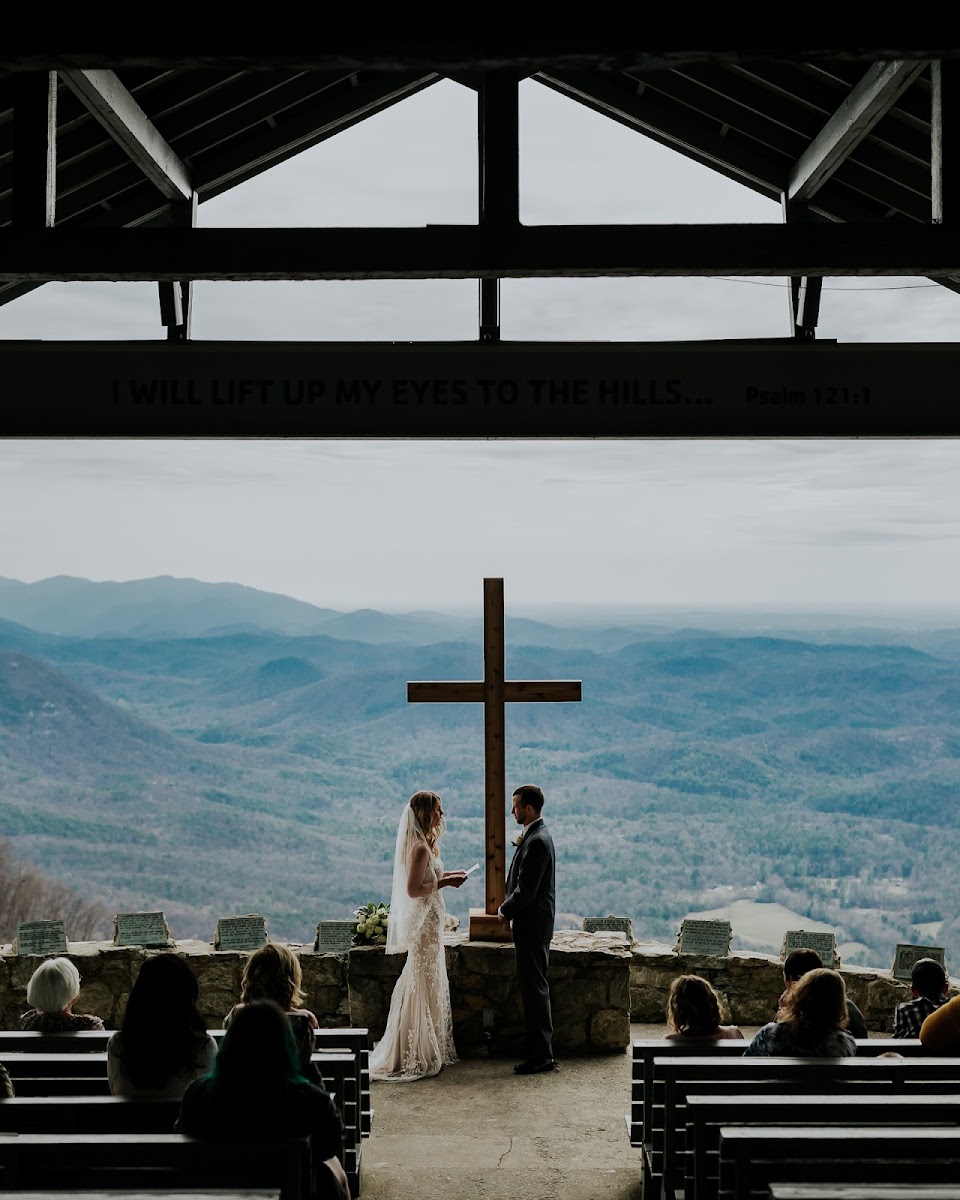
The ascent up Highway 267 tells you this wedding will be different. You leave the last stoplight in Cleveland behind and the road begins to climb — first through hardwood forest, then into the Blue Ridge proper, switchbacks tightening as you gain elevation. Five miles into YMCA Camp Greenville’s property, past rustic cabins and pine groves, the pavement ends at a small parking area. From there, it’s a short walk up a wooded path, and then the trees open and you see it: Fred W. Symmes Chapel, known to everyone who’s ever been here as Pretty Place. There are no walls. Just sixteen wooden pews descending toward an eight-foot cross, and beyond that cross — nothing but air and mountains. Layers upon layers of Blue Ridge peaks stretching into Tennessee, the Piedmont valleys rolling out below in a patchwork of green and gold, and a sky so expansive it makes you understand why people use the word “cathedral” for wild places. At 3,200 feet, perched on the edge of Standing Stone Mountain, this is not a chapel that protects you from the elements. It delivers you directly into them. Wind, light, the scent of pine and distant rain — everything is present, immediate, unmediated. Poppy has received 19 inquiries for Pretty Place Chapel wedding flowers, and every single one begins with the same challenge: how do you bring flowers to a place that is already overflowing with beauty?
About Fred W. Symmes Chapel (Pretty Place Chapel)
Fred W. Symmes Chapel was built in 1941 as a place of worship for YMCA Camp Greenville, a Christian summer camp that has operated on this mountainside since 1916. The chapel was named for Fred W. Symmes, a Greenville civic leader and camp supporter who envisioned a sacred space where campers could gather with nothing between them and creation. The original structure was simple: a wooden cross, some benches, and an unobstructed view. Over the decades, the chapel has been renovated and expanded — in 2012, 2018, and most recently in 2025 after Hurricane Helene caused significant damage to the surrounding forest and access roads. The current iteration seats up to 350 guests on two rows of sixteen wooden pews, with a 66-foot center aisle that descends in sixteen distinct steps (each with a six-inch drop and thirty inches of depth) from the back of the chapel down to the cross. The cross itself — eight feet of weathered timber mounted on a rock base that measures five feet wide and thirty inches deep — stands at the very edge of the cliff, framed by nothing but sky and the rolling silhouette of the southern Appalachians.
What makes Pretty Place unique is what it lacks. There are no walls, no roof, no side aisles, no bridal suite attached to the sanctuary. The chapel is completely open to the elements — which means open to wind, rain, afternoon thunderstorms, the bite of January cold, and the golden wash of October light. This is not a backup-plan kind of venue. If it rains on your wedding day at Pretty Place, everyone gets wet, and that’s part of the deal. The openness is the point. The view is the architecture.
The chapel sits within the 1,400-acre YMCA Camp Greenville property on Cleveland Ridge, a long spine of mountain that forms the border between South Carolina and North Carolina. The surrounding landscape is classic southern Appalachian mixed hardwood forest — oak, hickory, poplar, rhododendron thickets, and mountain laurel. In spring, the understory erupts with wildflowers. In summer, the canopy is dense and green. In fall, the hillsides blaze with color — scarlet maples, golden hickories, and the deep burgundy of sourwood. Winter strips the trees bare and reveals the bone structure of the mountains themselves, ridge after ridge fading into blue distance.
Logistically, Pretty Place is about an hour and ten minutes from downtown Greenville, South Carolina, and roughly an hour and fifteen minutes from Asheville, North Carolina. The drive up Highway 267 is winding and remote — this is genuine backcountry, and cell service is spotty. The camp road from the highway to the parking area is five miles of gravel and dirt, steep in places, narrow in others. Vendors need to coordinate arrival times carefully, as parking is limited to about 100 vehicles. For weddings with more than 150 guests, the camp strongly recommends carpooling or arranging shuttle service. There is no loading dock, no covered drop-off area, no elevator. Everything comes up the wooded path on foot or via utility vehicle if arranged in advance with camp staff.
For florists, this means planning. Poppy’s delivery logistics for Pretty Place begin days before the wedding, with detailed weather monitoring (wind speed matters as much as rain), careful stem selection (only the sturdiest varieties survive mountain wind), and backup plans for every arrangement. We work closely with couples to set realistic expectations about what’s possible at 3,200 feet in an open-air setting. The camp staff are helpful but not involved in setup — this is a DIY venue in many respects, and couples are responsible for coordinating all vendors, decorations, and cleanup. The permanently mounted sound system is a bonus (wireless microphone, instrument hookup, AUX cord), but there’s no climate control, no power beyond the dressing rooms, and no second chances if something blows away.
Pretty Place is a ceremony-only venue. There are no reception facilities on the property, no catering kitchen, no bar. The chapel is alcohol-, tobacco-, and pet-free, and no food or drink is allowed at the site itself. Most couples hold their receptions at a separate location — often a barn venue, winery, or restaurant in Greenville or the surrounding Upstate region. This means Pretty Place Chapel wedding flowers are almost always ceremony-focused, with personal florals (bouquets, boutonnieres, corsages) taking center stage alongside altar arrangements and aisle installations.
Event Spaces & Floral Opportunities
Pretty Place Chapel - Main Ceremony Space
Capacity: 350 seated
Setting: This is not a chapel in the traditional sense. There is no building to enter, no threshold to cross, no interior to prepare. You walk up the wooded path and emerge directly into the ceremony space: sixteen rows of wooden pews arranged on a gently sloping hillside, facing west toward the cross and the mountains beyond. The pews are simple, handcrafted, weathered to a soft gray. The center aisle is wide — five and a half feet — and descends in sixteen distinct steps, each one a small stage for the bridal procession. At the front, the wooden cross stands on its rock base at the cliff’s edge, and beyond it, the land falls away into nothing. The view is the sanctuary. On a clear day, you can see forty miles into North Carolina, the Blue Ridge peaks stacked like watercolor washes, each ridge a lighter shade of blue than the last. In late afternoon, when the sun hangs low over the Piedmont, the light turns everything amber and rose. This is when Pretty Place earns its name.
The stepped aisle is the second major opportunity. With sixteen steps descending sixty-six feet, you have natural platforms for small arrangements at intervals — we recommend every other step or every third step, not every single one (which would read as overly formal and cluttered). These aisle markers can be simple posies in mason jars weighted with river stones, or clusters of three pillar candles in hurricane lanterns surrounded by loose stems of Queen Anne’s lace, goldenrod, and spray roses. The aisle is wide enough to accommodate substantial installations without obstructing the processional, but remember: wind. Everything must be secured. We use sandbags, stakes, or heavy ceramic vessels that won’t topple in a gust. Lightweight glass vases are a liability here.
Pew markers are optional and often unnecessary — the view does the decorating. If couples want them, we suggest simple bundles of lavender, eucalyptus, and wax flower tied with linen ribbon, attached to the pew ends with floral wire. Nothing that will blow away, nothing that requires water.
The dressing rooms offer a minor floral opportunity — a small arrangement for the bride’s bouquet to rest in during getting-ready photos, perhaps a few stems in bud vases on the mirrored vanity. But the real floral investment here is in what the bride carries and what waits for her at the cross.
Bride’s Dressing Room
Capacity: Bridal party
Setting: A modest 10’ x 15’ room adjacent to the chapel, with one wall fully mirrored and another half-mirrored — ideal for final dress adjustments and bridal party photos. Five electrical outlets mean hair tools and phone chargers are covered, but this is a functional prep space, not a glamorous suite. The room opens directly to the wooded path leading to the chapel, so there’s no grand reveal moment, no long hallway entrance. You prepare here, and then you walk outside into the forest and toward the cross.
Floral approach: This space benefits from one beautiful arrangement — something the bride can admire while she’s getting ready, something that anchors the pre-ceremony photos. We typically design a loose, romantic bouquet in a vintage brass urn or ceramic pitcher, placed on a small table near the mirror. The palette should echo the bride’s personal flowers: if she’s carrying blush and cream, the dressing room arrangement should feature those same tones (Quicksand and Patience roses, white ranunculus, blush astilbe, seeded eucalyptus). This is also where we stage the bridal bouquet, bridesmaids’ bouquets, and any floral hairpieces or boutonnieres before the ceremony. A simple floral crown of delicate blooms — tiny spray roses, wax flower, baby’s breath — can hang on the mirror as a beautiful detail shot. Keep it simple, keep it meaningful, and remember that this room is temporary. The real moment happens outside.
Groom’s Dressing Room
Capacity: Groomsmen
Setting: A smaller 10’ x 12’ space, functional and straightforward. This is where the groom and his attendants get dressed, pin on boutonnieres, and take a few final deep breaths before walking to the chapel. No frills, no mirror wall, just a place to prepare.
Floral approach: One small arrangement is plenty here — something masculine and understated. We often use a low wooden box filled with succulents, white roses, dusty miller, and eucalyptus, or a simple gathering of sunflowers and goldenrod in a pewter pitcher. This is also where we set up the boutonniere station: all the boutonnieres lined up on a tray with a few extra stems and pins in case of last-minute adjustments. The groom’s boutonniere should be slightly larger and more distinctive than the groomsmen’s — perhaps a single Juliet rose with a sprig of rosemary and a small pheasant feather, while the groomsmen wear simpler clusters of spray roses and greenery.
Wedding Flower Ideas for Fred W. Symmes Chapel (Pretty Place Chapel)
Blue Ridge Wildflower Ceremony
This concept is rooted in the native flora of the southern Appalachians, with a palette drawn from the roadside meadows and forest clearings surrounding Pretty Place. Imagine soft yellows, warm whites, and touches of lavender and sky blue — the colors of Black-eyed Susans, Queen Anne’s lace, wild asters, and mountain goldenrod. We combine these wildflower varieties (or their cultivated cousins) with garden roses in buttery yellow (Julia Child), cream lisianthus, lavender stock, and pale blue delphinium. Foliage is abundant and textural: sword fern, leatherleaf, wild grasses, and trailing smilax. The cross installation is designed as a wild meadow cluster, spilling asymmetrically from the rock base as if the flowers seeded themselves there. Aisle markers are small posies in amber glass bottles, each one slightly different, arranged every third step. The bridal bouquet is hand-tied and loose, with stems visible, ribbon trailing — it looks like she walked through a field and gathered what she found. This style works beautifully in spring and summer when local wildflowers are at their peak, and it honors the landscape without trying to tame it.
Sunset Over the Piedmont
Pretty Place faces west, and anyone who has attended a late afternoon ceremony here knows what happens when the sun drops toward the Piedmont. The light turns molten — gold, amber, rose, and deepening lavender. This palette captures that magic hour. We work with peach and coral garden roses (Juliet, Princess Charlene), burnt orange ranunculus, coral charm peonies (in season), golden yellow dahlias, and dusty lavender lisianthus. The effect is warm, glowing, romantic. Foliage includes dusty miller for its silvery softness, Italian ruscus for structure, and trails of jasmine vine for movement. The cross installation is lush and abundant, almost baroque in its fullness, with the warmest tones concentrated at the center and the cooler lavenders and silvers radiating outward. We use aged brass urns or copper vessels that catch the light. Aisle arrangements are small clusters of peach roses and lavender in copper julep cups, placed every other step. This palette is particularly stunning in the fall, when the surrounding forest echoes the same warm tones, but it works year-round as long as you’re working with a florist who can source premium roses and seasonal blooms. The bridal bouquet is a romantic cascade with trailing amaranthus and jasmine vine, designed to move as she walks.
Winter on Standing Stone
For couples marrying in the colder months — December through February, when the trees are bare and the view stretches even farther — we recommend a palette that embraces the season rather than fighting it. Think deep evergreen, ivory, touches of burgundy, and plenty of texture. We use white roses (Polo, Akito), ivory ranunculus, white hellebores (if available), burgundy hypericum berries, deep red carnations (Burgundy, Black Baccara for a near-black tone), and abundant evergreen foliage: noble fir, cedar, magnolia leaves, and eucalyptus. The cross installation incorporates natural elements gathered from the forest floor — pine cones, lichen-covered branches, birch bark — wired into the design for an organic, foraged feel. We add tall white taper candles in iron holders flanking the cross, which photograph beautifully against the winter sky and provide a sense of warmth. Aisle markers are simple bundles of evergreen and white roses tied to the pews with burlap ribbon. The bridal bouquet is structured and elegant, with white roses, evergreens, and a single trailing ribbon in deep burgundy. This palette works in any season at Pretty Place, but it’s especially powerful in winter when the surrounding landscape is quiet and the colors are muted.
Seasonal Considerations
Pretty Place sits in the Blue Ridge foothills of South Carolina, where the seasons are distinct and the weather is famously unpredictable. Floral planning must account for temperature swings, afternoon storms, and the open-air reality of the venue.
Spring (March - May): Spring arrives slowly at 3,200 feet. While the valleys below may be blooming in March, the mountain is often still cool and windy. By April, the forest floor erupts with wildflowers — trillium, bloodroot, wild geranium — and the mountain laurel and rhododendron begin their show. Spring weather is volatile: warm mornings can turn into cold, rainy afternoons, and wind is constant. Floral choices should favor hardy blooms that can handle temperature fluctuations: roses, stock, lisianthus, and tulips (which are surprisingly sturdy). Avoid delicate blooms like sweet peas and anemones, which wilt quickly in wind. This is an excellent season for incorporating foraged elements — dogwood branches, redbud branches, ferns — that connect the ceremony florals to the surrounding landscape. Late May is peak rhododendron season, and if you’re marrying then, consider adding a few branches of wild rhododendron to your cross installation as a nod to the forest.
Summer (June - August): Summer at Pretty Place is warm but rarely oppressive — the elevation keeps temperatures moderate, usually in the 70s and 80s. Afternoon thunderstorms are common, rolling up from the valleys with little warning. Lightning is a serious concern, and the camp staff will delay or relocate ceremonies if storms threaten. Floral choices should favor heat-tolerant varieties: roses (always a safe bet), sunflowers, zinnias, dahlias, celosia, and solidago. Hydrangeas, while beautiful, can wilt quickly in the afternoon heat unless kept in water until the last possible moment. We recommend delivering all florals as late as possible on summer wedding days and keeping a spray bottle on hand for last-minute hydration. This is the season for bold, saturated color — jewel-tone dahlias, hot pink zinnias, deep purple lisianthus — because the light is strong and bright colors read beautifully against the green forest backdrop. Local growers in the Upstate are at their peak in summer, so take advantage of locally sourced blooms to reduce costs and environmental impact.
Fall (September - November): This is Pretty Place’s glory season. The mountains explode in color — scarlet, gold, burgundy, rust — and the light is impossibly clear. September is still warm, but by October, temperatures drop, and by November, you may need blankets for evening ceremonies. The fall palette is obvious and irresistible: dahlias in every shade of rust and burgundy, chrysanthemums, sunflowers, marigolds, celosia, and all the warm-toned roses (Juliet, Free Spirit, Princess Charlene). Foliage is abundant: sourwood branches with their crimson leaves, oak leaves in gold and rust, bittersweet vines with orange berries. This is the season to go big with texture and color because the surrounding forest is doing the same. Floral designs can be exuberant and romantic without feeling overdone. The only caution: by late November, the weather can turn cold and wet, and some blooms (dahlias especially) don’t tolerate frost. Check the forecast and have a backup plan for delicate varieties.
Winter (December - February): Winter weddings at Pretty Place are rare but breathtaking. The view is unobstructed, the air is sharp and clear, and on a sunny day, the light is crystalline. Temperatures can drop below freezing, especially in January and February, and snow is possible (though not common at this elevation). Ice on the roads is a bigger concern than snow, and the camp will close the access road if conditions are unsafe. Floral choices must be cold-hardy: roses, carnations, evergreens, and berries. Avoid anything tropical (orchids, anthuriums) or delicate (ranunculus can freeze). This is the season for incorporating non-floral elements: branches, pine cones, candles, and foraged greenery. A winter bouquet might be mostly evergreen and white roses with a few stems of red hypericum berries and trailing ribbon. The cross installation can include magnolia branches, noble fir, and clusters of white roses, all anchored with heavy mechanics that won’t shift in the wind. Winter ceremonies are often shorter (cold guests don’t linger), so the florals need to make an immediate impact. Think high contrast — white against dark evergreen, burgundy against icy blue sky — and embrace the season’s stark beauty.
Poppy’s Expert Take
The view is your primary design element. We cannot stress this enough: Pretty Place does not need decoration. The mountains are the decoration. Floral designs should enhance the ceremony space without distracting from the vista. This means avoiding overly vibrant colors that clash with the landscape (hot pink and lime green might be your brand colors, but they’ll fight the forest) and keeping arrangements proportional. A massive floral arch at the cross will block the view your guests came to see. Instead, frame the cross with something low and organic that draws the eye toward the mountains, not away from them. When in doubt, go smaller and more textural rather than larger and showier.
Foraged elements are your best friend here. Pretty Place sits in the middle of a forest. Use that. We often incorporate branches, ferns, moss, lichen-covered twigs, and other foraged materials into our designs because they connect the florals to the surrounding landscape and add volume without cost. (Note: always get permission from the camp before foraging on their property, and never take from protected or sensitive areas.) A cross installation that includes wild ferns, rhododendron branches, and dogwood alongside garden roses will feel much more site-specific than one that relies solely on purchased blooms. Foraged materials also photograph beautifully — they add an organic, imperfect quality that suits the wildness of the location.
Timing matters more here than anywhere. Because Pretty Place is ceremony-only and has no climate control, florals must be delivered and installed as close to ceremony time as possible. We typically arrive two to three hours before the ceremony, set up the cross installation and aisle arrangements, and keep personal florals (bouquets, boutonnieres) in water until the last possible moment. In summer, we sometimes mist arrangements with water right before the ceremony starts. In winter, we keep delicate blooms in a warm vehicle until setup. Coordinate closely with your florist and the camp staff to ensure load-in access and timing are aligned. There’s no Plan B if flowers wilt an hour before the ceremony because they were set up too early.
Photography coordination is essential. Pretty Place is one of the most photographed wedding venues in the Southeast. Every photographer wants the shot of the couple at the cross with the mountains behind them. Make sure your florist and photographer are aligned on the floral design so the arrangements enhance rather than obstruct those key images. The cross installation should be designed to look beautiful from multiple angles — front, sides, and importantly, from the back, where the photographer will stand to capture the couple with the mountain vista behind them. Low, asymmetrical arrangements work best because they don’t block faces or views. Communicate with your photographer about when they’ll shoot detail images of the florals so your florist can style those shots during setup.
Budget for delivery logistics. Pretty Place is remote. The drive from Greenville takes over an hour, and the last five miles are on unpaved camp roads. Florists factor this into delivery fees, and it’s not uncommon to pay a premium for mountain delivery compared to in-town venues. Additionally, setup takes longer here because everything is carried up a wooded path on foot (or via utility cart if arranged with camp management). Budget realistically for these logistics, and choose a florist who has experience with mountain venues and understands the challenges of open-air installations. This is not the place for a budget DIY floral approach unless you have significant experience working with wind, elevation, and remote locations.
Always have a weather contingency. Pretty Place does not have an indoor backup. If it rains, the ceremony happens in the rain, or it’s postponed. The camp staff monitor weather closely and will make the call if conditions are unsafe (lightning, high winds, ice). As a florist, we always have a weather contingency plan: waterproof mechanics for rain, extra stakes for wind, and a quick-strike setup plan if storms are forecast. Couples should have weather contingencies too: clear umbrellas for guests, blankets for cold days, and emotional readiness for the possibility that nature will do what it wants. The most beautiful Pretty Place weddings we’ve designed were the ones where couples embraced the weather — rain, wind, or shine — and trusted that the mountains would deliver something unforgettable.
What Poppy Couples Spend on Flowers Here
Pretty Place is a ceremony-only venue, which means floral budgets are almost entirely focused on the ceremony space and personal florals. Without a reception to decorate, couples can invest more deeply in the ceremony experience — or keep it simple and let the mountains do the work. Based on our experience with Greenville-area weddings and the specific challenges of Pretty Place, here’s what couples typically spend:
$1,800 - $3,500 | The Mountain Essentials
This budget covers a focused, beautiful ceremony with personal florals and one statement installation. You’ll have a bridal bouquet (hand-tied, garden-style, with 30-40 stems of seasonal blooms like garden roses, ranunculus, and greenery), bridesmaids’ bouquets (smaller versions of the bridal bouquet, 20-25 stems each), boutonnieres for the groom and groomsmen (single focal bloom with greenery and texture), and corsages for mothers and grandmothers (wrist or pin-on, with roses or orchids). The floral focal point is a low, lush installation at the cross base — designed asymmetrically to wrap around the rock, featuring a mix of focal blooms (Juliet roses, white lisianthus, seasonal dahlias) and abundant texture (ferns, ruscus, trailing smilax). This range includes delivery, setup, and breakdown, plus logistics fees for the mountain location. It’s a classic, elegant approach that honors the landscape without overwhelming it. Most couples in this range skip aisle florals entirely or use simple foraged elements like bundles of eucalyptus and lavender tied to every third or fourth pew.
$3,500 - $6,000 | The Full Ceremony Experience
This budget allows for a more immersive floral presence throughout the chapel. In addition to all personal florals (upgraded bridal bouquet with premium blooms like peonies or cafe au lait dahlias, larger bridesmaids’ bouquets, elevated boutonnieres with textural accents like feathers or berries), you’ll have a substantial cross installation that feels abundant and romantic — think overflowing urns on either side of the cross, filled with garden roses, dahlias, hydrangea, and trailing greenery, plus a low ground arrangement that wraps the rock base. Aisle florals are included: small arrangements or lanterns with florals placed every other step down the sixteen-step aisle, creating a beautiful visual progression for the bride’s walk. We also add floral accents in the dressing rooms — a styled arrangement for the bride’s getting-ready space and a small masculine arrangement for the groom’s room. This budget allows for seasonal flexibility and premium blooms, plus more intricate mechanics to ensure everything is wind-secure. Couples in this range often incorporate foraged branches, local wildflowers, or other site-specific elements to deepen the connection to the landscape.
$6,000+ | The Pretty Place Immersion
For couples who want Pretty Place Chapel wedding flowers to be a defining feature of their ceremony, this budget delivers. Every detail is elevated: a cascading bridal bouquet with rare blooms and trailing elements, oversized bridesmaids’ bouquets that feel like garden gatherings, distinctive boutonnieres and corsages with unique textures and premium mechanics. The cross installation is showstopping — large-scale arrangements on both sides of the cross, possibly incorporating tall branches or structural elements, with an abundant ground installation that feels like a mountain meadow grew up overnight. Aisle florals run the full length of the sixteen steps, with varied arrangements that create visual rhythm and guide guests’ eyes toward the cross and mountains. We often add floral elements to the pew ends — not on every pew, but at key intervals — using bundles of flowers and greenery that echo the cross palette. The dressing rooms are styled with care: a large, romantic arrangement for the bride, a handsome installation for the groom, and small bud vases or loose stems for the bridal party. This budget allows for premium, out-of-season blooms (peonies in October, for example), complex color palettes, and the kind of floral abundance that transforms the ceremony into an immersive experience. We also include extended setup time to ensure every detail is perfect and every arrangement is photographed beautifully before the ceremony begins.