
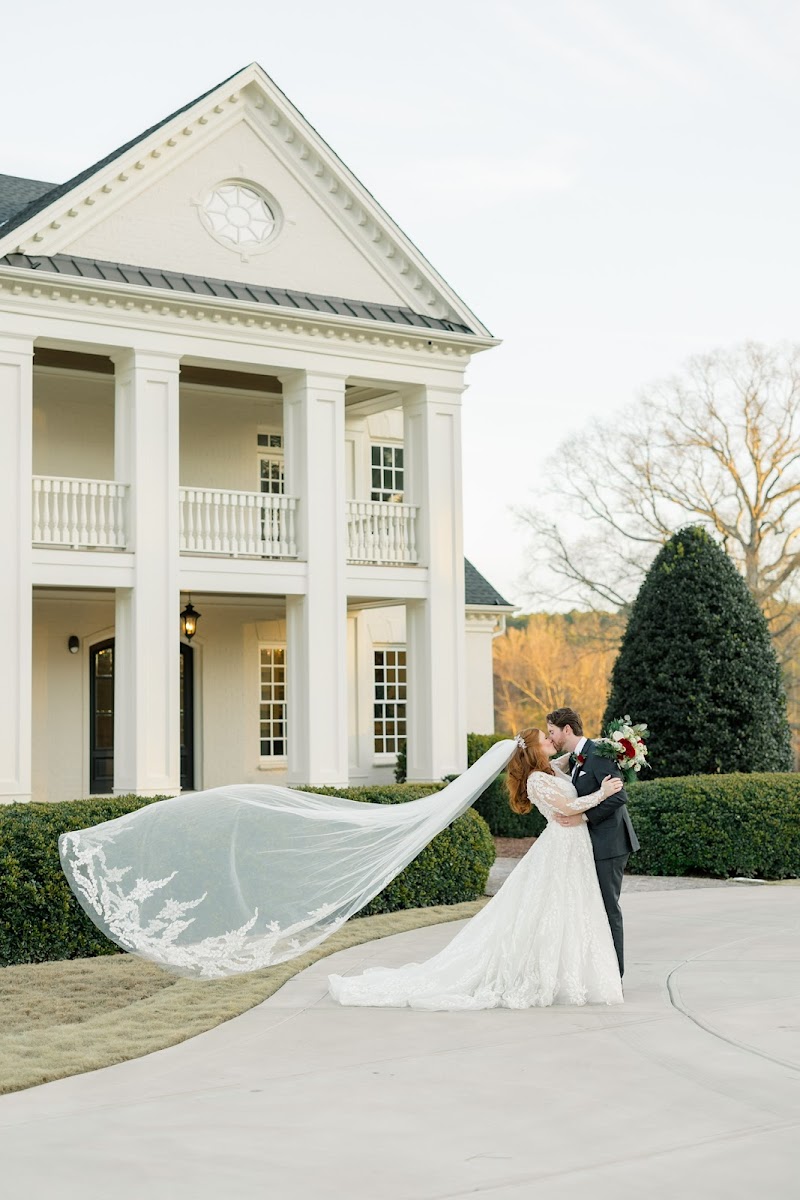
The turn onto Hilltop Road tells you everything. You leave Fuquay-Varina’s main thoroughfare behind, pass a stand of loblolly pines, and suddenly the landscape opens into something that feels transported from another era entirely. Fifteen acres of manicured estate grounds, the kind of Southern property where every detail has been considered, every sightline intentional. The Main House appears first — classic white clapboard with that signature two-story porch wrapping around the front like an embrace. Then Feore Hall, the grand structure housing the ballroom, its architecture both traditional and contemporary in that way only the best new construction manages. And finally, as you round the circular drive, the thing that stops every bride mid-sentence when she steps out of the car: the Infinity Garden, where 125 heritage rose bushes cascade across the hillside in cultivated abundance, framed by hydrangeas the size of dinner plates and trellises that arch overhead like living cathedrals. This is Donovan Manor, twenty minutes south of Raleigh, where Southern estate elegance meets serious horticultural commitment. Poppy has designed Donovan Manor wedding flowers for 1 celebration here so far, and that singular experience taught us everything we needed to know about this venue’s exacting standards and extraordinary beauty.
About Donovan Manor
Donovan Manor is not a historic property — it opened in recent years — but you would never know it from the architecture. The estate was designed to evoke the timeless elegance of Southern plantation homes, the kind of properties where magnolias bloom along gravel drives and cocktails are served on wide verandas as the sun sets over open fields. Everything here is new construction executed with painstaking attention to period detail: heart pine floors reclaimed from tobacco barns, custom millwork throughout the Main House, herringbone brick pavers laid by hand across 5,000 square feet of courtyard. The result is a venue that photographs like a 200-year-old estate but functions with the reliability and modern amenities couples expect from contemporary event spaces.
The property encompasses 15 acres on Hilltop Road in Fuquay-Varina, positioned high enough to catch breezes even on humid July afternoons. The Main House serves as the heart of pre-ceremony activity, with two entire floors devoted to separate wedding party suites — the bridal suite awash in blush tones and natural light, the groom’s suite outfitted with leather wingback chairs and a full bar. Feore Hall, the grand ballroom structure, anchors the southern end of the property and houses both the 299-seat Grand Ballroom and the more intimate Trestle Lounge. Outside, the Infinity Garden (more commonly called the Rose Garden) occupies the prime ceremony location, while the Meadowview Terrace and Courtyard provide versatile outdoor spaces for cocktail hours and receptions under the stars.
The signature element — and the detail that most significantly impacts floral design here — is the Rose Garden itself. This is not decorative landscaping. This is a protected horticultural collection of over 125 heritage rose varieties, cultivated and maintained with the kind of precision you’d find at botanical research facilities. David Austin English roses, Knock Out shrub roses, climbing varieties trained on custom trellises, all selected for disease resistance, repeat blooming, and visual impact. The venue’s management takes the health of this collection seriously enough that they enforce a strict policy: no outside flowers, plants, or greenery may be brought onto the property. The concern is legitimate — introducing even a single stem of conventionally farmed roses could introduce pests like thrips or spider mites, soil-borne diseases like botrytis or powdery mildew, or invasive plant species that could compromise the entire garden. As a result, Donovan Manor maintains an exclusive list of vetted floral partners who meet their horticultural standards. Poppy is one of those partners, and that relationship required documentation of our sourcing practices, farm partnerships, and design protocols.
Logistically, Donovan Manor sits about 20 minutes south of downtown Raleigh via Highway 401, making it easily accessible from the entire Research Triangle region while maintaining that essential sense of countryside escape. The drive from Raleigh-Durham International Airport takes roughly 25 minutes. For Poppy’s delivery teams coming from our Raleigh studio, the route is straightforward, and the venue provides ample load-in access with 90 paved parking spaces plus overflow areas that can accommodate vendor vehicles during setup. Vendor access begins at noon for standard partners, though exclusive preferred vendors (including vetted florists) may begin setup as early as 10 a.m. — a meaningful advantage when installing large-scale designs that require daylight for proper placement.
The venue operates as a full-service estate, requiring couples to use Donovan’s Dish for all catering (with limited exceptions for specific cultural cuisines like traditional Indian or Halal preparations), in-house bar service, and vendors from their curated list for planning, florals, and essential rentals. Tables and chairs for 175 guests are included; couples rent linens, china, glassware, and flatware through approved partners. It’s a model that ensures quality control but requires couples to work within the established framework rather than bringing in entirely independent vendor teams.
Event Spaces & Floral Opportunities
The Main House
Capacity: 50 seated for intimate ceremonies
Setting: The Main House is where Southern architecture becomes theater. That two-story porch wraps the entire front facade, white columns rising from brick foundation to second-floor balcony, the kind of veranda where you expect to see women in white linen dresses holding sweating glasses of sweet tea. Inside, the grand staircase curves upward from the entry hall with carved banisters and a landing positioned perfectly for bridal portraits. The first floor houses a formal parlor and connects to the groom’s suite, while the entire second floor is devoted to the bridal suite — a sprawling space with separate dressing areas, a lounge with velvet settees, and French doors opening onto the upper porch. The color palette throughout is soft and warm: cream walls, blush upholstery, brass fixtures that catch the light streaming through tall windows. For intimate ceremonies, the first-floor parlor can accommodate up to 50 guests, with the staircase providing a dramatic entrance point for the bride.
Floral approach: The Main House presents opportunities for elevated, classic Southern floral design. On the two-story porch, we favor symmetrical urn installations flanking the front door — large arrangements in aged concrete or moss-covered stone vessels, overflowing with Patience garden roses, white hydrangea, magnolia foliage, and trailing Italian ruscus. These should be substantial (think 36 inches tall, 24 inches wide at the base) to hold visual weight against the architectural scale. The interior staircase is the showpiece moment. A garland installation running along the banister, composed of smilax vine as the base with clusters of Polo roses, white lisianthus, Queen Anne’s lace, and seeded eucalyptus woven through at intervals, creates that editorial Southern wedding aesthetic without overwhelming the millwork. At the landing, a larger focal arrangement — perhaps O’Hara garden roses, white majolica spray roses, Quicksand roses for depth, and jasmine vine cascading down — provides the portrait backdrop. For the bridal suite, we recommend a hand-tied bouquet waiting on the vanity (Juliet garden roses, ranunculus, sweet peas in blush and cream) and a smaller arrangement for the lounge. The groom’s suite calls for something more restrained: succulents, air plants, and textural greenery like dusty miller in a wooden box or leather vessel. If hosting a ceremony in the parlor, the staircase itself becomes the altar backdrop, requiring minimal additional florals — perhaps just two large urns at the base and a small arrangement on the newel post.
The Grand Ballroom
Capacity: 299 seated / 440 standing
Setting: Feore Hall’s signature space is a study in how to build a ballroom that feels both grand and warm. The room measures large enough for nearly 300 guests but avoids that echoing warehouse quality through careful design: soaring ceilings with exposed beams, crystal chandeliers that provide ambient glow without harsh overhead lighting, and most importantly, that 26-foot wall of windows overlooking the Rose Garden. The glass is floor-to-ceiling, divided by slim black mullions in a grid pattern that frames the garden view like a living painting. During ceremony season (April through October), those windows showcase the roses in full bloom — a riot of pinks, corals, whites, and reds cascading across the hillside. Glass stacking doors connect the ballroom to the Meadowview Terrace, creating seamless indoor-outdoor flow, and the indoor-outdoor marble bar serves both spaces simultaneously. The room’s palette is sophisticated neutral: cream walls, natural wood beams, polished concrete floors that reflect candlelight beautifully. It’s a space that can absorb nearly any design aesthetic, from black-tie formal to garden party elegance.
Floral approach: The fundamental principle in this ballroom is respecting that window wall. Any centerpiece that rises above 12-14 inches will interrupt guests’ views of the Rose Garden, and those views are half the reason couples book this venue. We favor two approaches: ultra-low compote arrangements or dramatically elevated designs. For low arrangements, we use wide, shallow vessels (14-16 inch diameter footed compotes in gold, marble, or ceramic) mounded with garden roses (Keira, Patience, Juliet), ranunculus, spray roses, hellebores in season, and textural elements like scabiosa, astrantia, and trailing jasmine vine. These sit 6-8 inches tall maximum, creating lush floral moments at each table that never compete with the view. The elevated approach uses 24-30 inch clear glass or acrylic risers to lift arrangements well above sightlines — essentially creating a floating garden of smilax, eucalyptus, roses, and lisianthus suspended in space, with clear stems running down through the riser so the mechanism nearly disappears. For the head table, a long and low garland installation (think 15 feet long, 8 inches tall) running the table length provides impact without blocking conversation or views. The indoor-outdoor bar is the statement moment: a large-scale installation featuring garden roses, hydrangea, orchid sprays, trailing amaranthus, and abundant greenery (Italian ruscus, silver dollar eucalyptus, magnolia) that cascades across the marble countertop and appears to flow through the open doors onto the terrace. We typically use 60-80 stems for this installation. The chandeliers themselves don’t require floral enhancement — they’re beautiful on their own — though for clients with larger budgets, delicate greenery garlands wired to the base can soften the look without obscuring the crystal. Window wall considerations aside, this room loves candlelight: we recommend dozens of votives on every table, creating a warm glow as natural light fades.
The Trestle Lounge
Capacity: 150 seated / 220 standing
Setting: Adjacent to the Grand Ballroom, the Trestle Lounge provides a more intimate alternative for smaller receptions or serves as cocktail space for larger events. The defining feature is the view — large windows frame the Heritage Oak Tree and the historic railroad trestle bridge that gives the space its name. The bridge, a preserved artifact from the property’s previous life, spans a small creek at the back of the estate, surrounded by wetlands and native grasses. Inside, the design is slightly more casual than the ballroom: exposed brick accent wall, warm wood finishes, mixed seating with both traditional tables and lounge furniture. The overall vibe is Southern living room meets modern event space, comfortable and sophisticated without being stuffy.
Floral approach: This room responds beautifully to organic, garden-style designs that echo the natural landscape visible through the windows. We favor a more relaxed floral palette here: café au lait dahlias, chocolate cosmos, quicksand roses, toffee roses, peach ranunculus, and textural elements like astilbe, scabiosa pods, and wild grasses. Vessels should feel collected rather than matched — ceramic crocks, wooden boxes, vintage brass containers. For cocktail-style setups, clusters of bud vases with single stems (one perfect dahlia, three stems of chocolate cosmos, a few branches of seeded eucalyptus) scattered across cocktail tables create visual interest without requiring large arrangements. If the space is being used for a seated dinner, we recommend varied heights — some low compotes, some medium cylinder vases, creating a more dynamic tablescape. The brick accent wall is ideal for a large installation if the event calls for it: a free-standing arrangement on a pedestal or vintage table, featuring branches (curly willow or manzanita), garden roses, orchids, and cascading greenery, provides a focal point for photos. The key is maintaining that connection to the landscape outside — the Heritage Oak is the star, and florals should feel like they could have grown naturally in the same ecosystem.
Infinity Garden (Rose Garden)
Capacity: Flexible, typically 100-200 for ceremonies
Setting: This is the venue’s crown jewel and its most significant design constraint. The Infinity Garden occupies a gentle hillside slope, with 125+ heritage rose bushes planted in sweeping curved beds that create the illusion of endless garden extending into the horizon (hence “infinity”). Grand trellises arch overhead at the primary ceremony site, trained with climbing roses that bloom in massive clusters from April through frost. Hydrangeas — both mophead and lacecap varieties — provide additional color and structure, while evergreen boxwood hedges define the pathways. The roses themselves represent dozens of varieties: David Austin English roses like ‘Generous Gardener’ and ‘Lady of Shalott’, ‘Bonica’ shrub roses in soft pink, deep red ‘Knock Out’ roses, fragrant ‘Belinda’s Dream’ in medium pink. When the garden is in peak bloom (May, June, September, October), it is genuinely breathtaking — the kind of setting that appears on magazine covers and Pinterest boards. The ceremony space typically positions chairs in rows facing the main trellis, with the roses cascading on all sides and providing a living backdrop.
Floral approach: Here is where Donovan Manor’s policies become critical, and where couples sometimes feel frustrated until they understand the reasoning. No outside flowers, plants, or greenery are permitted in the Rose Garden. Not bouquets, not aisle markers, not petals. The restriction exists to protect the health of this heritage collection, and it is non-negotiable. As one of the venue’s vetted floral partners, Poppy can bring flowers into the garden, but only if they meet strict protocols: we source from farms we’ve worked with for years, inspect every stem for pests before loading our vehicle, and package arrangements in clean mechanics free of soil or organic debris. Even with those precautions, we recommend minimal floral additions in this space because the garden itself is the floral design. A ceremony here needs almost nothing: perhaps a small arrangement attached to the trellis (using zip ties, never nails or staples) featuring white O’Hara roses and trailing jasmine vine to enhance the climbing roses already present. Aisle markers, if desired, should be non-floral: brass lanterns, ribbon tied to chair backs, or simple signage. The bridal bouquet and bridesmaid bouquets will obviously enter this space (carried by their respective people), and those are permitted, but we cannot line the aisle with loose petals or install floral arrangements on shepherd’s hooks. Couples booking Donovan Manor need to embrace the garden as-is during bloom season, which means timing matters significantly. A May or June wedding showcases the roses at their absolute peak. A February wedding will feature mostly green bushes with architectural structure but minimal color. We always recommend scheduling a venue visit during your intended wedding month to see exactly what the garden will provide naturally.
Meadowview Terrace
Capacity: Flexible, typically 100-150 for cocktails
Setting: Directly outside the Grand Ballroom, connected by those glass stacking doors, the Meadowview Terrace is exactly what it sounds like: a generous brick paver patio with herringbone pattern and views extending across the estate’s open meadow. The indoor-outdoor marble bar serves this space, creating a natural anchor point. String lights overhead (permanently installed) provide ambient glow as the evening progresses. The terrace is spacious enough to accommodate cocktail tables, lounge furniture, or even a small dance floor if couples choose to hold their entire reception outdoors during perfect weather months (April, May, September, October). The brick pavers ensure solid footing even after rain, and the covered transition area at the ballroom entrance provides shelter.
Floral approach: The terrace should feel like a natural extension of the ballroom’s floral design — same palette, same style, but adapted for outdoor conditions. The marble bar installation we mentioned earlier cascades from interior to exterior, creating visual continuity. For cocktail tables, we favor simple, sturdy arrangements that can withstand breeze: low ceramic vessels filled with garden roses, spray roses, and hearty greenery like eucalyptus or Italian ruscus. Avoid tall, top-heavy designs or anything with delicate petals that shatter in wind (anemones, ranunculus can be fragile). If the couple is using the terrace for a full reception, the same centerpiece principles from the ballroom apply, though we generally recommend slightly smaller arrangements to account for the open-air setting where scale reads differently. The perimeter of the terrace can be enhanced with larger arrangements on pedestals — think magnolia branches, hydrangea, roses, and trailing greenery in substantial urns that won’t tip. Because this space has permanent string lighting, we usually skip additional candles (fire restrictions apply outdoors) and let the existing ambiance do the work. The most important consideration is timing your floral installation for stability: if setting up hours before guests arrive in August heat, ensure arrangements have water sources and aren’t in direct afternoon sun, or they’ll wilt before cocktail hour even begins.
The Courtyard
Capacity: Flexible, typically 75-125 for cocktails
Setting: Nestled between the Main House and Feore Hall, the Courtyard is 5,000 square feet of brick pavers creating an intimate, enclosed feeling despite the open-air setting. The built-in bar on one side provides service capability, while the opposite side opens to views of the wetlands and the historic Trestle Bridge. Trees overhead — mature hardwoods that provide dappled shade — make this space comfortable even during warmer months. The aesthetic is relaxed elegance: brick underfoot, string lights overhead, distant views of water and wildlife. It’s the kind of space that works beautifully for rehearsal dinners, welcome parties, or cocktail hours for couples who want their guests to explore multiple areas of the estate.
Floral approach: The Courtyard calls for a more organic, less formal approach than the ballroom spaces. This is where garden-style design really shines: loose, natural arrangements that feel gathered from a cutting garden rather than precision-engineered. We favor ceramic vessels, terracotta pots, wooden boxes — containers with texture and patina rather than polished metal or glass. Blooms should include things that read as “grown here”: zinnias, dahlias, sunflowers (in season), cosmos, black-eyed Susans, mixed with cultivated garden roses and lisianthus for refinement. Textural elements are key: add seeded eucalyptus, privet berries, grasses, even herbs like rosemary or lavender for scent. The built-in bar offers a natural focal point: a large arrangement featuring branches (dogwood, curly willow, whatever is seasonally appropriate), garden roses, and cascading greenery makes the bar feel like a destination rather than just a service point. For cocktail tables, vary the heights and vessels — some tables get low ceramic bowls with lush arrangements, others get taller arrangements in bottles or vintage crocks, creating a collected, casual vibe. If the couple wants to lean into the wetlands/bridge view, we might incorporate elements that reference that landscape: pussy willow branches, ornamental grasses, even cattails (dried) arranged with roses and hydrangea. The Courtyard tolerates — even welcomes — a bit more whimsy and personality than the formal spaces. This is where you can incorporate wildflowers, unexpected color combinations, or slightly quirky vessels (vintage watering cans, enamelware pitchers) without feeling off-brand for the venue.
Wedding Flower Ideas for Donovan Manor
Rose Garden Romance
This concept works with, rather than against, the venue’s signature feature by echoing the Rose Garden’s palette throughout all interior and exterior spaces. The foundation is garden roses in the exact shades found in the heritage collection: Keira roses (soft blush), Patience (ivory with blush undertones), Juliet (apricot-peach), and Romantic Antike (champagne with touches of pink). Add David Austin Constance roses for deeper peach tones and Mayra’s Rose for dusty pink accents. Supplement with supporting blooms in harmonious shades: white majolica spray roses, blush ranunculus, peach stock, and café au lait dahlias when in season. Greenery should be soft and romantic: seeded eucalyptus, Italian ruscus, dusty miller for silver tones, and trailing jasmine vine. Vessels lean traditional Southern: aged stone urns for large installations, gold or brass compotes for tables, occasional mercury glass for candlelight reflection. The effect is timeless, romantic, and deeply connected to the property’s identity. This palette works beautifully in the Grand Ballroom where the window wall frames the actual Rose Garden, creating a visual echo between the view and the interior design. It’s equally stunning in the Main House, where the soft palette complements the blush-toned bridal suite. For the ceremony in the Rose Garden itself (where floral additions are minimal), this means the bridal party bouquets and groom’s boutonniere blend seamlessly with the surrounding blooms rather than introducing competing colors.
Southern Estate
This concept embraces the full architectural grandeur of Donovan Manor with a more classical, formal approach. The palette is sophisticated and restrained: ivory, white, champagne, with touches of deep green and occasional burgundy for depth. Key blooms include: O’Hara garden roses (classic ivory), Playa Blanca roses (pure white), polo roses (white), white lisianthus, white hydrangea (both French and antique varieties), white phalaenopsis orchids, and in season, white peonies. For texture and depth, add burgundy scabiosa, burgundy hellebores (winter/spring), deep plum calla lilies as accents, and abundant greenery: magnolia leaves (the underside has that beautiful copper tone), Italian ruscus, smilax vine for garlands, and preserved plumosa fern for delicate texture. Vessels skew traditional and substantial: silver julep cups and compotes, white marble urns, tall clear glass cylinders for modern contrast. This is the aesthetic for couples hosting black-tie celebrations, formal seated dinners, and events where the dress code calls for tuxedos and floor-length gowns. The design is elegant, classic, and photograph-worthy in that timeless way that won’t look dated in 20 years. It’s particularly stunning in the Grand Ballroom during evening events, where the white and ivory florals glow under chandelier light and candlelight creates romantic ambiance. The Main House staircase installation becomes truly editorial with this palette — imagine a long smilax garland with clusters of white O’Hara roses and magnolia leaves creating that iconic Southern wedding staircase moment.
Garden Harvest
This concept takes inspiration from the surrounding North Carolina landscape and the agricultural heritage of the region, creating a design that feels both abundant and organic. The palette pulls from late summer and autumn: burnt orange, golden yellow, burgundy, rust, peach, and cream. Key blooms include: café au lait dahlias (those stunning dinner-plate blooms in pale blush-beige), ‘Cinnamon’ dahlias (burnt orange), ‘Café au Lait Royale’ (deeper peachy-cream), Cappuccino roses (taupe-brown with peach undertones), toffee roses (caramel tones), Free Spirit roses (peachy-coral), peach stock, chocolate cosmos (for that almost-black burgundy), peach and coral ranunculus, celosia in rust and orange tones, and sunflowers (the more refined varieties like ‘Vanilla Ice’ or ‘ProCut Orange’). Textural elements are critical: add seeded eucalyptus, olive branches, privet berries, ornamental grasses, wheat stalks, and even herbs like rosemary or sage for scent and texture. Vessels should feel collected and rustic: wooden boxes, ceramic crocks in earth tones, copper vessels (which develop gorgeous patina), terracotta pots, and vintage bottles for single stems. This palette absolutely shines in the Courtyard and Trestle Lounge, where the organic quality complements views of the Trestle Bridge and wetlands. It’s also stunning in the Grand Ballroom during autumn months, particularly late September and October, when that warm light through the windows plays beautifully against the harvest tones. This is the design for couples who want their wedding to feel abundant, warm, and deeply connected to place and season.
Seasonal Considerations
North Carolina’s climate allows for year-round weddings at Donovan Manor, but each season presents distinct advantages and challenges for floral design.
Spring (March-May) arrives early in central North Carolina, with temperatures climbing into the 70s by April and occasional warm spikes into the 80s by late May. This is peak bloom season for the Rose Garden — by mid-April, the heritage roses are beginning their first flush, and by May they’re in full glory. Spring also brings abundant local and regional blooms: tulips and daffodils in early spring, peonies by late April through May (though North Carolina’s heat means peony season is brief), ranunculus, anemones, sweet peas, lilac (short season, early May), and locally grown delphinium. Spring weather can be unpredictable — April can bring afternoon thunderstorms — but generally offers comfortable temperatures for outdoor ceremonies and cocktail hours. The Rose Garden ceremony site is at its most spectacular in May and early June, requiring minimal floral enhancement because nature is doing the work. For spring weddings, we recommend embracing the season’s natural abundance with designs featuring peonies, garden roses, ranunculus, and sweet peas in soft pastels or classic whites. Logistics note: spring is prime wedding season, so Donovan Manor books early for April and May dates.
Summer (June-August) in North Carolina means heat and humidity. Temperatures regularly climb into the 90s with high humidity, creating challenging conditions for both flowers and guests. The Rose Garden typically experiences a slowdown in bloom production during the hottest weeks of July and August (roses conserve energy in extreme heat), then rebounds with a strong second flush in September. Summer does offer abundant availability of certain blooms: hydrangea (both local and imported), garden roses (year-round from farms but at their most affordable in summer), sunflowers, zinnias, dahlias, lisianthus, and gladiolus. Summer weddings at Donovan Manor typically take advantage of the air-conditioned indoor spaces, using the Courtyard or Meadowview Terrace for brief cocktail hours rather than extended outdoor activities. For floral design, durability is paramount: choose blooms that tolerate heat (garden roses, spray roses, hydrangea if kept watered, lisianthus) and avoid fragile flowers like sweet peas, anemones, or tulips (not seasonally available anyway). Install arrangements as close to event time as possible, ensure they have water sources if sitting for hours, and keep arrangements out of direct sun whenever feasible. We also recommend incorporating more greenery and fewer blooms during summer months — greenery tolerates heat better and costs less, allowing budget to stretch further.
Autumn (September-November) is arguably Donovan Manor’s most beautiful season and certainly the most comfortable for outdoor activities. Temperatures cool into the 70s by September and drop to pleasant 60s by October and November. The Rose Garden experiences its second major bloom flush in September and continues producing well into October, often with deeper, more saturated colors as cooler nights intensify pigments. Autumn also brings North Carolina’s most