
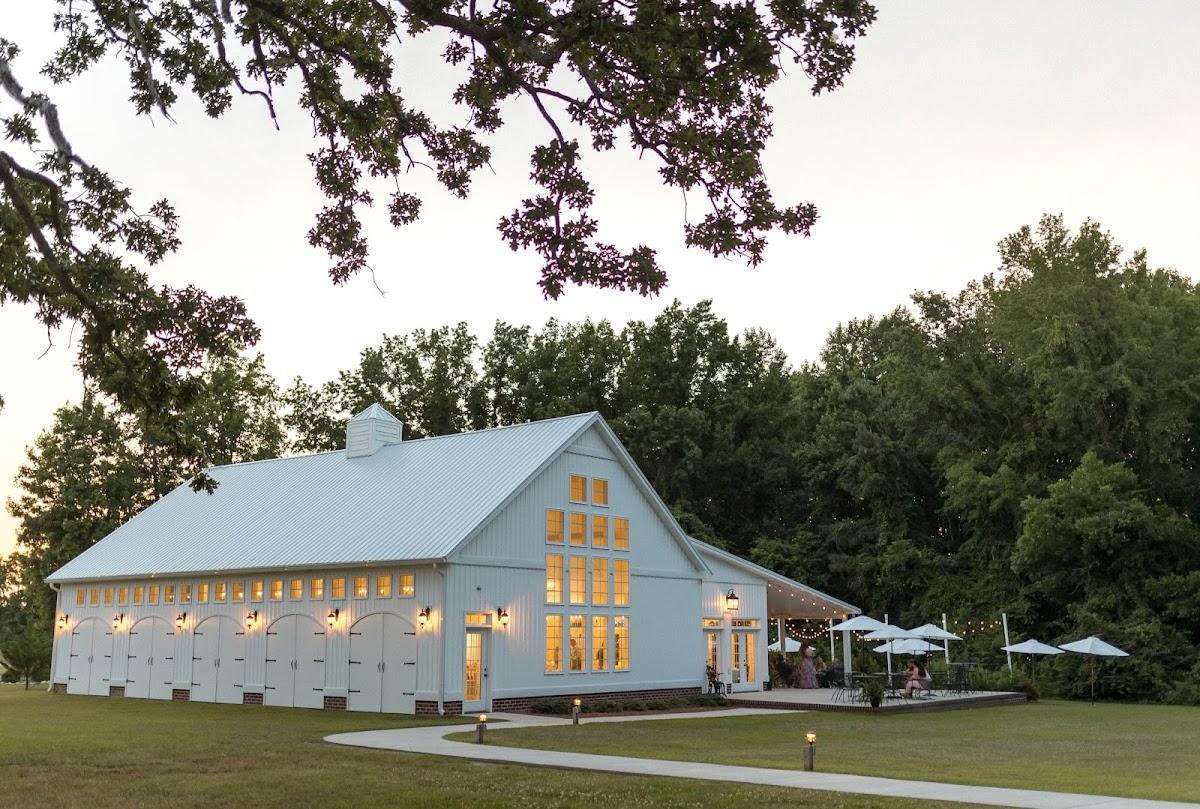
The turn off Highway 70 onto Old Smithfield Road is easy to miss if you’re not looking for it. One moment you’re in the strip-mall sprawl of outer Goldsboro, and the next you’re on a two-lane country road that narrows as it winds through tobacco fields and pecan groves. The land flattens into eastern North Carolina farmland — old growth oaks draped with Spanish moss, red clay driveways, the occasional century-old farmhouse set back from the road. And then, about three miles in, the sign for The Cornealius Properties appears, hand-painted and weathered in that authentic way that can’t be faked. You turn onto the gravel drive and the property unfolds: ninety acres of working farmland, a pond that glints through the trees, pastures dotted with livestock, and eventually, rising like something out of a Southern fairytale, Birdsong Chapel. All white. Open to the air. Cathedral ceilings soaring above antique pews. Chandeliers catching the filtered woodland light. A chapel bell hanging silent until the moment it rings out across the farm. This is not a venue trying to be anything other than what it is — a family farm that happens to have built the most photogenic chapel in eastern North Carolina. Poppy has designed Birdsong Chapel at The Cornealius Properties wedding flowers for 1 celebration here so far, and from the moment we turned onto that gravel drive, we understood why this place has generated 23 leads and counting.
About Birdsong Chapel at The Cornealius Properties
The Cornealius family didn’t set out to build a wedding venue. They were farmers — fourth-generation stewards of this 90-acre property outside Goldsboro — when they started noticing how many people stopped to photograph their land during golden hour, how often friends asked if they could host small gatherings under the old oak tree, how beautiful the light looked filtering through the pecan grove at dusk. So they built Birdsong Chapel in 2018, an open-air structure that feels part cathedral, part garden pavilion, set in a clearing surrounded by native hardwoods. The design is deliberately simple: white clapboard walls on three sides, no wall on the fourth so the woodland becomes your backdrop, a peaked roof to shelter guests from rain but not from birdsong (hence the name), antique pews salvaged from a decommissioned church in Virginia, and those statement chandeliers — crystal and iron, elegant without being fussy — that anchor the space. The chapel seats 200 comfortably, with a center aisle wide enough for a full bridal procession and cathedral ceilings high enough to make every “I do” feel momentous.
But the chapel is just the opening act. The property includes Carriage Hall, a 3,300-square-foot climate-controlled barn that serves as the reception space. Built in the style of a classic carriage house, the hall features five sets of white carriage doors that can be opened to connect the interior to the covered patio and courtyard beyond, creating a seamless indoor-outdoor flow. The ceilings soar to 28 feet, anchored by exposed beams and more of those elegant chandeliers. The all-white interior — white walls, white woodwork, white farmhouse tables and Chiavari chairs included in the rental — functions as a blank canvas, which means your floral palette can go in any direction without clashing. Adjacent to Carriage Hall is a 1,500-square-foot covered patio with a built-in bar area, perfect for cocktail hour, and beyond that, a 2,000-square-foot courtyard strung with café lights and shaded by market umbrellas.
The property also includes two getting-ready suites that deserve mention. The Honeymoon House, a refurbished 1940s farmhouse painted entirely white, serves as the bridal suite. Inside you’ll find gold-framed mirrors, velvet settees, two queen beds for post-hair-and-makeup lounging, a full kitchen, and a dedicated room set up for hair and makeup with proper lighting and counter space. The Camp Cabin, by contrast, is pure man-cave: a rustic log structure with mounted taxidermy, leather furniture, a full kitchen, outdoor grill, and a basketball goal in the yard. Both suites are available for overnight stays if you book the venue for multiple days, which many couples do given the property’s distance from Raleigh.
Speaking of distance: Birdsong Chapel sits about 50 minutes southeast of Raleigh and 45 minutes from the Research Triangle Park area, making it a destination venue for most Raleigh-Durham couples. This is not a quick-jaunt-after-work kind of location. It’s the kind of place you build a weekend around, where your out-of-town guests book the nearby Airbnbs and everyone congregates at the property for rehearsal dinner, ceremony, and Sunday brunch send-off. For Poppy’s design and delivery team, the drive from our Raleigh studio is straightforward via Highway 70, though we do factor drive time into our logistics. Load-in at Birdsong is easy — the gravel drive leads directly to Carriage Hall’s rear entrance, where there’s ample space to unload, and the Cornealius family is hands-on in the best way: helpful, communicative, and genuinely invested in making sure vendor logistics run smoothly.
The property’s farm setting is not decorative. This is a working farm with livestock, vegetable gardens, a stocked pond, pecan and fruit trees, and all the seasonal rhythms that come with agricultural life. In spring, the dogwoods and azaleas bloom in waves. In summer, the fields turn golden and the air smells like cut grass and honeysuckle. In fall, the hardwoods go amber and crimson. In winter, the evergreens hold their color and the bare branches create a spare, elegant backdrop. Every season offers something different, and the family works with that rather than against it, which is exactly the approach we take with Birdsong Chapel at The Cornealius Properties wedding flowers.
Event Spaces & Floral Opportunities
Birdsong Chapel
Capacity: 200 seated
Setting: This is the heart of the property, and the space most couples fall in love with first. The chapel is technically open-air — it has a roof and three walls, but the fourth side opens entirely to the woods, so you’re sheltered from rain but not from the natural world. The structure measures 1,728 square feet, with cathedral ceilings that peak at roughly 20 feet, white-painted tongue-and-groove walls, exposed rafters, and two large crystal chandeliers suspended over the aisle. The antique pews, refinished in white with their original patina showing through in places, seat about 200 guests with a center aisle that’s a generous five feet wide. At the front, there’s a raised platform area for the ceremony, and beyond it, through that open fourth wall, the woodland backdrop — oaks, maples, native understory plants, dappled light. A small chapel bell hangs near the entrance, rung by hand after the recessional. Ceiling fans keep the air moving in summer. The aesthetic is Southern Gothic meets garden party: romantic, airy, and just formal enough.
Floral approach: The all-white backdrop is a florist’s dream because it allows every color to sing. You could do blush and ivory and it would feel soft and timeless, or go full jewel-tone drama — burgundy dahlias, plum scabiosa, navy delphiniums — and the white walls would make the colors pop even harder. The altar area demands a substantial installation. We typically recommend either a large asymmetrical arrangement on a pedestal to one side of the ceremony spot (think three feet tall, two feet wide, spilling with garden roses, trailing jasmine vine, and textural foliage), or a low horizontal arrangement that runs along the front edge of the platform — maybe four feet long, lush and gathered, incorporating local branches and seasonal blooms. The antique pews are ideal for simple pew markers: small clusters of flowers tied with silk ribbon and clipped to the ends of every third or fourth pew along the aisle. We love using flower varieties that nod to Southern gardens — Café au Lait dahlias, Juliet garden roses, white hydrangea, clematis vine, magnolia foliage. The chandeliers are another opportunity: a garland of smilax or Italian ruscus woven with clusters of spray roses and wax flower, wrapped loosely around the chandelier arms, creates a romantic canopy effect without blocking the light. Because the chapel is open to the woods, we always consider what will photograph well against that natural backdrop — avoid anything too matchy or artificial, and lean into organic, slightly wild compositions that feel like they could have grown there.
Carriage Hall
Capacity: 200 seated
Setting: Carriage Hall is where the reception unfolds, and it’s designed to handle everything from intimate 50-person dinners to full 200-guest celebrations with dancing. The space is massive — over 3,000 square feet — with 28-foot cathedral ceilings, exposed white-painted beams, and three large chandeliers running down the center of the room. The walls are white shiplap, the floors are polished concrete (practical for spills, excellent for acoustics), and those five sets of white carriage doors can be fully opened to connect the interior to the covered patio, effectively doubling your square footage on mild-weather days. The venue provides twelve custom-built 4x8-foot farmhouse tables, one 4x6-foot sweetheart table, and 200 white Chiavari chairs, all included in the rental. There’s also a mobile bar and a wooden hexagon backdrop (optional) that can be used for photo ops or dessert displays. A caterer’s kitchen is tucked into the back with full setup and cleanup included, and there are dedicated restrooms off the main hall so guests never have to leave the building. The vibe is clean, airy, and versatile — the kind of space that can skew rustic-elegant with farm tables and greenery runners, or modern-romantic with tall tapers and elevated centerpieces.
Floral approach: The soaring ceilings beg for height. This is not a room where you want everything at table level — you’ll lose visual impact in all that vertical space. We love doing a mix of low and high centerpieces: low, lush garden-style arrangements (think eight inches tall, overflowing with Quicksand roses, white ranunculus, blush astilbe, seeded eucalyptus) on half the tables, and tall, dramatic arrangements on clear glass risers or gold candelabras (think 30 inches tall, with long stems of delphinium, foxglove, or bells of Ireland creating height, and clusters of focal flowers like peonies or garden roses at the base) on the other half. The alternating heights create visual rhythm and ensure that every sightline in the room encounters something beautiful. The farmhouse tables are also ideal for greenery runners — a continuous line of eucalyptus, olive branches, and Italian ruscus running down the center of each 8-foot table, punctuated by clusters of votives and small bud vases with single blooms. The chandeliers can be dressed with garlands, same as the chapel, or left bare if you’re going for a more minimalist look. The carriage doors offer another opportunity: when they’re open, consider flanking each doorway with large potted arrangements or freestanding floral installations that frame the transition between indoors and out. And don’t sleep on the wooden hexagon backdrop — we’ve styled it as a photo wall with trailing greenery, clustered blooms, and vintage ribbons, and it photographs beautifully.
Covered Patio
Capacity: Standing cocktail reception, approximately 100-120 guests comfortably
Setting: The covered patio runs along the entire east side of Carriage Hall, measuring roughly 1,500 square feet and sheltered by a pitched roof that matches the barn’s architecture. It’s connected to the main hall via three of those carriage doors, so the flow between spaces is seamless. The venue provides a built-in bar area on the patio, plus seven cocktail tables (tall, round, bar-height) that are included in the rental. The patio overlooks the courtyard, which is strung with café lights and dotted with market umbrellas, so even in the heat of a July afternoon, there’s shaded space for guests to gather. The floor is stained concrete, same as the barn, and there are ceiling fans overhead to keep air moving. This is typically where cocktail hour happens, with bartenders stationed at the built-in bar and passed hors d’oeuvres circulating among the cocktail tables. The vibe is relaxed, outdoor-adjacent, and conversational.
Floral approach: Cocktail hour florals should be simple, portable, and low enough not to interfere with mingling. For the seven cocktail tables, we recommend small arrangements — six to eight inches tall, gathered and slightly wild, in vessels that won’t tip easily (low ceramic bowls or weighted glass cubes work well). Think seasonal blooms that can handle a bit of heat and humidity: spray roses, wax flower, hypericum berries, dusty miller, and lots of textured foliage. The built-in bar is the star here, and it’s the perfect spot for a statement arrangement: something large and lush, maybe 18 inches tall and equally wide, that sits at one end of the bar and catches every guest’s eye as they order their first drink. We love using the bar arrangement to set the tone for the rest of the florals — if your centerpieces are blush and ivory, echo that palette here; if your ceremony flowers were full of garden roses and jasmine, bring those varieties into the bar piece. If the courtyard is in use (and the café lights are on), consider adding small potted arrangements or lanterns mixed with florals on the ground level to create little vignettes in the corners of the space. The patio-to-courtyard transition is also a nice spot for a freestanding arrangement or a pair of matching urns flanking the steps.
Courtyard
Capacity: Standing cocktail reception or lounge seating, approximately 80-100 guests
Setting: The courtyard is an outdoor extension of the covered patio, a 2,000-square-foot open-air space defined by a canopy of string lights overhead and a perimeter of market umbrellas around the edges. The ground is a mix of gravel and pavers, and there’s flexibility in how you use the space — some couples set up lounge furniture (sofas, chairs, low tables) to create a more relaxed hangout vibe, while others keep it open for lawn games like cornhole or giant Jenga. The string lights are permanent and included in the rental, which means the space glows beautifully at dusk without any additional effort. The courtyard is adjacent to the pond and the old oak tree with the swing, so it’s also a natural gathering spot for guests who want to wander the property before the reception starts. The vibe is casual, festive, and distinctly Southern — like the best kind of backyard party, but elevated.
Floral approach: The courtyard is where you can have fun. This is not a space that demands formal arrangements or precise symmetry. Instead, lean into the casual, garden-party energy with florals that feel abundant and unstructured. If lounge furniture is part of the setup, style the low tables with small bud vases, each holding a single statement bloom — a Café au Lait dahlia, a blush peony, a stem of flowering jasmine. Cluster three or five vases together for visual impact. If the space is more open, consider using large potted plants or arrangements on stands to define different zones within the courtyard — a cluster of pots near the lawn games, a tall arrangement near the entrance to the patio, a small grouping by the steps leading down to the pond. You can also dress the market umbrellas with small floral accents clipped to the poles or tied with ribbon. The string lights overhead are beautiful on their own, but if you want to add a touch of greenery, short garlands of smilax or eucalyptus can be woven through the light strands in a few key spots (just be mindful of weight and make sure any additions are secured properly). The old oak tree with the swing, if it’s visible from the courtyard, is a natural photo backdrop — consider adding a loose garland of greenery and blooms to the swing, or a simple floral accent tied to the ropes, to signal that it’s a designated portrait spot.
The Honeymoon House (Bridal Suite)
Capacity: Bridal party getting-ready space
Setting: The Honeymoon House is a fully refurbished 1940s farmhouse that serves as the bridal suite. The exterior is painted a crisp white with black shutters, and the interior is styled like a Southern bed-and-breakfast: gold-framed mirrors, vintage furniture, velvet settees in dusty rose, white linens on the two queen beds, and a dedicated hair-and-makeup room with a long counter, proper lighting, and high stools. There’s a full kitchen stocked with coffee, a fridge for champagne and snacks, two full bathrooms (one with a clawfoot tub, ideal for detail shots), and plenty of natural light streaming through the windows. The space is large enough for a bridal party of eight to ten to get ready comfortably without tripping over each other, and the vintage aesthetic makes for gorgeous getting-ready photos. Many couples also use the front porch, with its white rocking chairs and view of the farm, for first-look photos or pre-ceremony portraits.
Floral approach: A single statement arrangement is all you need here. Place it on the vintage dresser in the main bedroom or on the counter in the hair-and-makeup room — somewhere it will be visible in the background of getting-ready photos but not in the way of actual getting-ready activities. We typically recommend something soft and romantic: a gathered arrangement of garden roses (Patience, Keira, Juliet), ranunculus, sweet peas, and trailing jasmine vine in a vintage brass or ceramic vessel. Keep it medium-sized (12 to 15 inches tall, 10 inches wide) so it photographs beautifully without overwhelming the space. If the bride is carrying a particularly special bouquet, you can also stage it here for detail photos — laying it across the white linens on the bed, propped in a vase on the vanity, or held by one of the bridesmaids near the window light.
The Camp Cabin (Groom Suite)
Capacity: Groom and groomsmen getting-ready space
Setting: The Camp Cabin is the masculine counterpart to the Honeymoon House: a rustic log cabin with mounted taxidermy, raw wood walls, leather furniture, and a distinctly “man cave” aesthetic. There are two queen beds, two couches, a full bathroom, a kitchen with a full-size grill outside, and recreational amenities like a basketball goal and cornhole boards in the yard. The cabin is set slightly apart from the main venue buildings, giving the groom’s party their own space to hang out, have a beer, and get ready without the chaos of the bridal suite. It’s comfortable, laid-back, and unapologetically rustic, which means any floral touches here should be subtle and in keeping with the cabin’s vibe.
Floral approach: Less is more in the Camp Cabin. A single small arrangement — maybe six to eight inches tall, composed of foliage, berries, and a few understated blooms like scabiosa or hellebores — placed on the kitchen counter or the coffee table is plenty. Use a rustic vessel: a wooden box, a ceramic crock, or even a mason jar. The goal is to add a touch of life and color to the space without clashing with the masculine aesthetic. Alternatively, skip the flowers entirely and use a small potted succulent or a bundle of fresh herbs (rosemary, lavender, sage) tied with twine, which photographs well and smells great. If the groom is wearing a boutonniere, stage it here for detail shots — pinned to a leather jacket draped over a chair, or placed on a wooden tray with his watch and cufflinks.
Wedding Flower Ideas for Birdsong Chapel at The Cornealius Properties
Southern Heirloom
This palette pays homage to the gardens that have bloomed on North Carolina farms for generations: soft, romantic, and unmistakably Southern. The foundation is blush and ivory — Keira garden roses, Quicksand roses, white O’Hara garden roses, ivory spray roses — lightened with touches of pale peach (Juliet roses, peach ranunculus) and cream (Patience garden roses, white lisianthus). Textural accents include white hydrangea, blush astilbe, jasmine vine, and lots of Southern greenery: magnolia leaves (the glossy kind, not the dried), lemon leaf, and seeded eucalyptus. We also love adding a few stems of local flowering branches in spring — dogwood, cherry, or pear blossoms — to root the arrangements in the region. Vessels should feel vintage and collected: tarnished silver compotes, ceramic bowls with a soft glaze, or aged brass urns. This palette works beautifully in every space on the property, but it’s especially stunning in Birdsong Chapel, where the all-white backdrop makes the soft blush tones glow, and in Carriage Hall, where the vintage aesthetic of the farmhouse tables and Chiavari chairs feels like a natural extension of the flowers.
Wildflower Revival
This concept leans into the property’s working-farm identity and the native North Carolina landscape. The palette is organic, unstructured, and full of movement: a mix of wildflower-inspired blooms and foraged elements that feel like they were gathered from the fields and woods surrounding the venue. Start with a base of locally available flowers: Queen Anne’s lace, yarrow, goldenrod (yes, goldenrod — it’s stunning and doesn’t cause allergies despite its reputation), black-eyed Susans, zinnias in coral and peach, and scabiosa in soft mauve. Add in garden roses for a touch of refinement (Café au Lait, Juliet, or Koko Loko), and lots of textured foliage: butterfly weed, ferns, salal, eucalyptus, and olive branches. We also incorporate grasses — fountain grass, feather reed grass, or wheat stalks in fall — to add movement and a touch of the meadow. Arrangements should feel loose and gathered, like armfuls of stems casually placed in vessels. Use containers that reinforce the farm aesthetic: galvanized buckets, ceramic crocks, wooden boxes, or even mason jars clustered in groups of three or five. This palette is ideal for spring and summer weddings, and it works especially well in the Courtyard and on the Covered Patio, where the casual, garden-party vibe of the florals matches the laid-back energy of the spaces.
Moody Harvest
For couples drawn to richer, more dramatic tones, this palette takes its cues from the colors of a North Carolina autumn: deep burgundy, burnt orange, plum, and golden amber, grounded by plenty of dark greenery. The hero blooms are Café au Lait dahlias, burgundy dahlias (Rip City, Karma Choc), Dark Knight scabiosa, chocolate cosmos, and Black Baccara roses, balanced by lighter accents like peach Juliet roses, amber spray roses, and rust-colored ranunculus. Add in seasonal texture: amaranthus (the burgundy or green varieties), privet berries, hypericum berries in burgundy or rust, seeded eucalyptus, and olive foliage. For fall weddings, we love incorporating actual harvest elements: small gourds, heirloom pumpkins, dried corn husks, or even a few stems of cotton (North Carolina is, after all, cotton country). Vessels should have weight and presence: dark wood boxes, aged bronze urns, matte black ceramic bowls, or copper compotes. This palette is incredibly striking against the all-white interiors of both the chapel and Carriage Hall, and it photographs beautifully in the golden afternoon light that filters through the woods. It’s also ideal for October and November weddings, when the natural landscape outside is echoing these same warm, earthy tones.
Seasonal Considerations
North Carolina’s eastern piedmont region experiences four distinct seasons, each with its own weather patterns, available blooms, and logistical considerations for outdoor and open-air venues like Birdsong Chapel.
Spring (March-May): Spring in Goldsboro is glorious but unpredictable. March can still dip into the 40s at night, but by late April and May, you’re looking at highs in the 70s and 80s with moderate humidity. This is peak blooming season for North Carolina natives: dogwood, azalea, redbud, and cherry blossoms are all at their peak in April, and local farms start producing peonies, ranunculus, and sweet peas by late April and early May. Spring rains are common, but the open-air chapel has a roof, so light showers won’t disrupt a ceremony (though we do recommend having a backup plan for processional logistics if it’s pouring). For spring Birdsong Chapel at The Cornealius Properties wedding flowers, lean into the season’s abundant blooms: tulips (locally available in April), peonies (late May), ranunculus, sweet peas, and lots of flowering branches. The best months for spring weddings here are late April and May, when the weather is warm but not yet humid, and the landscape is lush and green.
Summer (June-August): Summer in eastern North Carolina is hot and humid — expect highs in the upper 80s to mid-90s with humidity levels that make it feel even hotter. Afternoon thunderstorms are common, rolling in fast and dramatic and then clearing just as quickly. The good news: Carriage Hall is fully climate-controlled, so your reception will be comfortable regardless of the heat. The Covered Patio also provides shade and ceiling fans for cocktail hour. For ceremony logistics, the open-air chapel benefits from the shade of the surrounding trees, and the venue provides ceiling fans, but guests will appreciate programs-as-fans and cold drinks. Floral-wise, summer is when we steer toward heat-tolerant blooms: zinnias, sunflowers, celosia, dahlias, lisianthus, and hypericum berries. Avoid flowers that wilt quickly in heat (sweet peas, tulips, anemones) and lean heavily on greenery and foliage to fill out arrangements without relying on temperamental blooms. Hydration is key — we always mist summer arrangements before transport and ensure everything is kept cool until the last possible moment. The best summer months are June and early September, when the heat is slightly less intense than July and August.
Fall (September-November): Fall is peak wedding season at Birdsong Chapel, and for good reason. September and October offer warm days (70s and 80s) with cooler evenings and significantly less humidity than summer. By November, you’re looking at daytime highs in the 60s and nighttime lows in the 40s, which is perfect sweater-weather territory. The fall foliage in eastern North Carolina isn’t as dramatic as the mountains, but the hardwoods do turn amber, rust, and gold by late October and November, and the landscape takes on a softer, warmer light. Fall is also dahlia season — North Carolina dahlia farms hit their peak production in September and October, which means you have access to incredible locally grown dahlias in every color. Other fall favorites include marigolds, celosia, chrysanthemums, and the last flush of garden roses before frost. This is also the season for incorporating harvest elements: heirloom pumpkins, gourds, cotton stems, wheat, and ornamental corn. The best months for fall weddings are October and early November, when the weather is reliably beautiful and the landscape is at its most photogenic.
Winter (December-February): Winter at Birdsong Chapel is mild by Northern standards but still requires thoughtful planning. Daytime highs range from the 40s to the 60s depending on the month, and nighttime lows can dip