
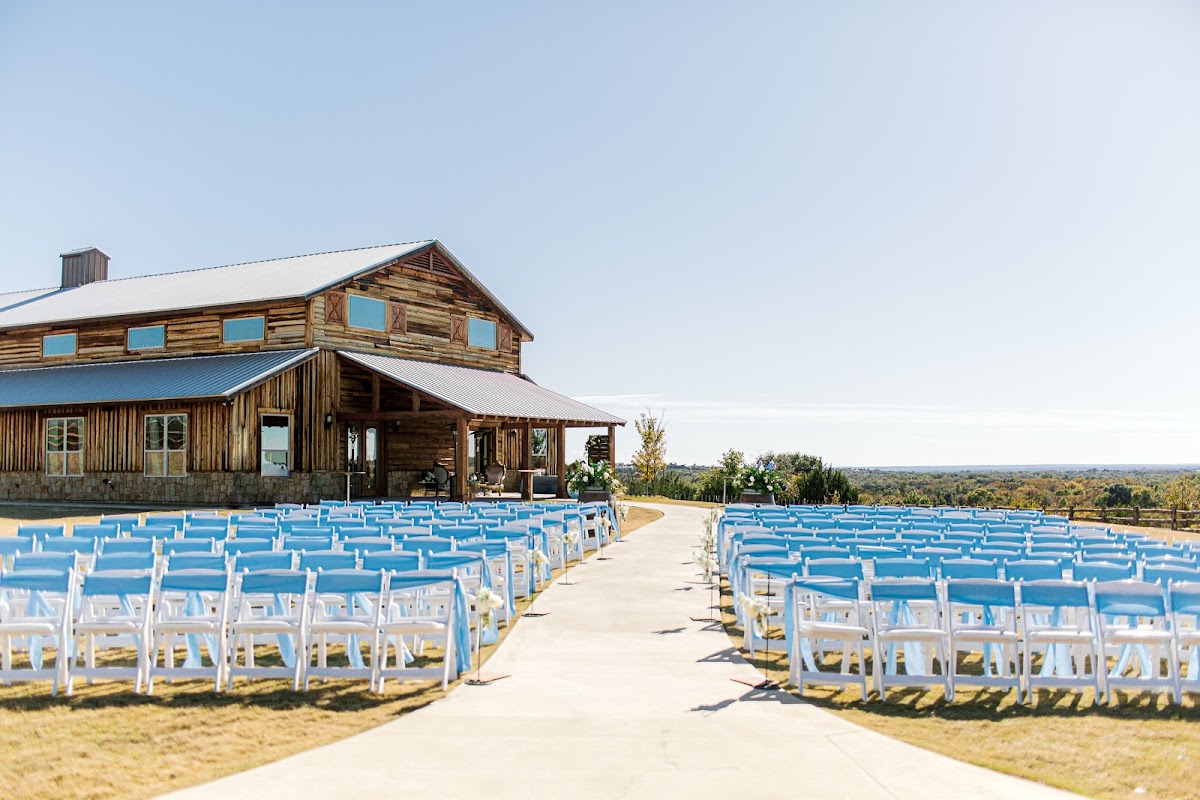
You leave the last gas station behind on Old Brock Road, and the landscape begins to shift in that particular Texas way — fences stretching longer between properties, cattle grazing on hillsides dotted with live oaks, the horizon opening up until it feels like you can see clear to the next county. Then Diamond H3 Ranch appears on your left, one hundred acres of rolling Parker County hills crowned by a structure that stops every arriving guest in their tracks: a stark white open-air chapel perched on the hilltop like something out of a dream, its clean lines and seven-foot oak cross silhouetted against the enormous Texas sky. Pull through the gate, wind up the drive, and the full picture reveals itself — the cedar barn with its windmill fan turning lazily in the breeze, the waterfall cascading alongside the chapel, and that view. Those rolling hills that seem to go on forever, turning gold and pink and purple as the sun sets over Parker County. This is not a venue trying to be something it’s not. It is authentically, unapologetically Texas — cattle ranch turned wedding destination, where the ceremony happens under open sky and the dancing goes late into the night inside a climate-controlled barn with chandeliers. Poppy has received inquiries from 7 couples planning Diamond H3 Ranch weddings, and every time we talk through the floral possibilities here, we find ourselves sketching installations that honor both the rustic landscape and the surprisingly elegant architecture.
About Diamond H3 Ranch
Diamond H3 Ranch sits on one hundred acres of working cattle ranch land in Weatherford, Texas, roughly an hour west of downtown Dallas and twenty-five minutes from Fort Worth via I-20. This is Parker County — known as the Cutting Horse Capital of the World — where the land still looks like the Texas of postcards and Willie Nelson songs. The ranch has been transformed into a wedding venue without losing its agricultural soul. You will still see cattle grazing in the distance. The hills are still dotted with native mesquite and live oak. The sunsets are still the kind that make you pull your car over just to watch.
The signature structure on the property is the open-air chapel, completed in February 2020 and designed to take full advantage of the hilltop location. The building is stark white — bright enough to glow at golden hour — with an open concept that means you are technically outdoors but sheltered under a roof. A seven-foot oak cross anchors the altar end, flanked by lighted sconces on the back wall. Above, a crystal chandelier catches the light. Most remarkably, a cascading waterfall runs alongside the chapel, providing the kind of ambient sound that makes even nervous brides take a deep breath and relax. The chapel sits on the highest point of the property, which means your ceremony guests will be looking out over a hundred acres of hill country while you exchange vows.
The reception barn is classic Texas with modern upgrades. The exterior is cedar — weathered and warm — while the interior is polished and climate-controlled, a critical detail for Texas weddings from May through September. The barn can accommodate up to three hundred guests comfortably, with high ceilings that give the space an airy feel despite the capacity. The signature architectural feature is a curved staircase that serves as the bride’s grand entrance point, sweeping down from the second-floor bridal suite in a way that practically begs for a floral installation. There is also an extraordinary windmill fan — a nod to Texas ranch heritage — multiple crystal chandeliers, polished concrete floors ideal for dancing, a full caterer’s kitchen, a bar area, and a state-of-the-art sound system with DJ hookups. The barn has windows that overlook the Parker County hills, so even inside, you are never fully disconnected from the landscape.
The second-floor bridal suite is accessed via that same curved staircase and features a large lighted vanity with seating for five, making it practical for bridal party preparation and beautiful for getting-ready photos. The natural light up there is excellent for detail shots of bouquets and floral accessories.
For couples who want an entirely outdoor ceremony experience, the ranch offers an alternative hilltop ceremony site with panoramic three-sixty views — no structure at all, just you and the sky and the hills rolling away in every direction. This works beautifully for spring and fall weddings when the weather cooperates, though the chapel serves as the built-in backup plan if skies threaten rain.
Logistically, Diamond H3 Ranch is extremely accessible for a Weatherford wedding florist like Poppy. The drive from the Dallas-Fort Worth metro area is straightforward, load-in access is easy with ample space near both the chapel and barn, and the venue includes a full caterer’s kitchen with refrigeration, which is essential for keeping floral installations fresh during setup on hot Texas days. The property has plenty of parking for guest vehicles and vendor trailers, and the staff is accustomed to working with outside vendors since catering is permitted through outside providers. The venue does not restrict floral designers, giving Poppy full creative freedom to design Diamond H3 Ranch wedding flowers that reflect each couple’s vision.
Event Spaces & Floral Opportunities
Open-Air Chapel
Capacity: Ceremony space for approximately 200+ guests
Setting: This is the crown jewel of Diamond H3 Ranch. Completed in 2020, the chapel is an architectural study in simplicity — pristine white walls, an open-air concept that puts you under a roof but still technically outdoors, and a seven-foot oak cross as the focal point behind the altar. A crystal chandelier hangs above the ceremony space, catching sunlight during daytime ceremonies and glowing softly for evening vows. The back wall features lighted sconces that add warmth without competing with the natural light. Most unusually, a waterfall cascades just outside the chapel’s open sides, providing both visual drama and that soothing water sound that instantly calms pre-ceremony jitters. The chapel sits on the property’s hilltop, which means guests seated in the wooden pews are looking past the couple and out over a hundred acres of rolling Texas hill country. On a clear day, the view stretches for miles.
Floral approach: The white walls and minimalist architecture are a blank canvas, which is both a gift and a responsibility. Diamond H3 Ranch wedding flowers in this space need to add warmth and romance without cluttering the clean lines. The oak cross is the natural focal point, and we typically treat it as such — either a full installation that drapes asymmetrically down one side with smilax, Italian ruscus, and clusters of Quicksand roses, white ranunculus, and caramel antique hydrangea, or a more restrained approach with two large urns flanking the base, overflowing with ivory Patience garden roses, blush Keira roses, white lisianthus, and trailing jasmine vine. The crystal chandelier can be enhanced with a delicate floral crown — a circular garland of seeded eucalyptus, plumosa fern, and small spray roses that adds softness without blocking the light. The waterfall does much of the scenic heavy lifting, so ceremony florals should complement rather than compete. Aisle markers work best when they are simple and organic — small clusters of wildflowers and grasses in glass cylinders, or bundles of lavender tied with natural twine and placed every other row. For couples who want a ceremony arch, we recommend a structure made from natural Texas materials — gnarled mesquite branches or weathered cedar — dressed with organic, slightly wild arrangements that feel foraged rather than formal. Think locally grown zinnias, Texas-grown sunflowers, native grasses, and plenty of textured greenery. Because the chapel is open-air, wind is a consideration. Any tall installations need to be weighted securely, and delicate petals like sweet peas may not hold up in a breeze.
Cedar Barn Reception Hall
Capacity: 300 seated guests
Setting: The reception barn is where Diamond H3 Ranch reveals its dual personality — rustic on the outside, surprisingly refined on the inside. The exterior is weathered cedar that looks like it has been standing on this hilltop for generations. Step inside and you will find polished concrete floors that reflect the chandelier light, high ceilings with exposed beams, climate control that keeps the space comfortable year-round, and that show-stopping curved staircase. The staircase sweeps down from the second-floor bridal suite in a graceful arc, providing a dramatic entrance point for the bride and a focal point that draws every eye in the room. Above the reception space, multiple crystal chandeliers provide ambient lighting — elegant enough for a ballroom, but scaled appropriately for the barn aesthetic. An extraordinary windmill fan — a true Texas touch — adds visual interest near the ceiling. Windows along one wall overlook the Parker County hills, so even at night with uplighting, guests can see the dark silhouette of the landscape beyond. The barn includes a full bar area, a professional caterer’s kitchen, and a built-in sound system, making it as functional as it is beautiful.
Floral approach: That curved staircase is begging for a cascading installation, and it is one of the most dramatic opportunities for Diamond H3 Ranch wedding flowers on the entire property. We design these staircase pieces to flow asymmetrically down the banister, starting lush at the top landing and tapering as it descends, using smilax as the structural base with clusters of focal flowers woven throughout — Café au Lait dahlias, Juliet and Patience garden roses, white or blush peonies (when in season), and accents of jasmine vine, eucalyptus, and trailing amaranthus. The installation should feel abundant but not heavy, romantic but not overly formal. For centerpieces, the cedar tones and high ceilings allow for flexibility. Tall arrangements on gold or wooden risers (twenty-four to thirty inches) create drama and take advantage of the vertical space, filled with a mix of textures — pampas grass, curly willow branches, garden roses in warm tones, café au lait or burgundy dahlias, scabiosa, and trailing greenery. Alternate with low, lush arrangements in aged brass compotes or wooden boxes, overflowing with garden roses, ranunculus, stock, and seasonal blooms. The chandeliers can be enhanced with greenery garlands — roping smilax or eucalyptus between fixtures to create a cohesive overhead design, with the option to add small clusters of florals at intervals. The windmill fan is a unique architectural element, and while we do not typically add florals directly to it, a large arrangement on a pedestal beneath it can draw attention upward. The bar area is prime real estate for a statement installation — an overflowing arrangement with height and movement that becomes a focal point during cocktail hour. The color palette should complement the warm cedar tones — think ivory, blush, peach, rust, burgundy, and plenty of greenery in varied textures.
Outdoor Hilltop Ceremony Site
Capacity: Flexible, 200+ guests depending on setup
Setting: For couples who want an entirely outdoor ceremony experience with nothing between them and the Texas sky, the ranch offers this alternative hilltop location. It is simply a clearing on the highest point of the property with three-hundred-sixty-degree views of the Parker County hills. No structure, no walls, no roof — just grass underfoot, open air above, and that enormous Texas horizon all around. The views are most dramatic at sunset, when the hills turn shades of amber and rose and the light goes soft and golden. This site works beautifully for spring and fall weddings when temperatures are mild, though summer ceremonies are possible if scheduled for late afternoon or early evening. The open-air chapel serves as the built-in backup plan if weather turns.
Floral approach: The landscape here is the star, and Diamond H3 Ranch wedding flowers should enhance the natural beauty without blocking those views. A ceremony arch is almost essential to create a focal point in such an open space, but it should be constructed from natural materials that feel indigenous to Texas — weathered cedar posts, gnarled mesquite branches, or even a simple wooden frame draped in gauzy fabric that moves with the breeze. Florals on the arch should be organic and asymmetrical, clustered on one side or corner rather than evenly distributed, using locally grown or Texas-appropriate flowers — sunflowers, zinnias, celosia, Mexican bush sage, native grasses, and plenty of eucalyptus, olive branches, and Italian ruscus. The effect should feel slightly wild, as if the flowers were gathered from the surrounding hills. Aisle markers need to be minimal and low to the ground so they do not obstruct sightlines — small arrangements in terracotta pots, bundles of dried grasses and wildflowers tied to wooden stakes, or clusters of potted succulents and cacti for a truly Texan touch. If the ceremony is scheduled for sunset, consider the color palette carefully. Warm tones — peach, coral, amber, rust — will glow in the golden hour light, while cooler tones may appear washed out. Wind is a significant consideration in this entirely open location. Every installation must be weighted or staked securely, and delicate flowers will not survive. Choose sturdy blooms with strong stems and thick petals.
Bridal Suite
Capacity: Preparation space for bridal party
Setting: The bridal suite occupies the second floor of the cedar barn, accessed via that dramatic curved staircase. The space features a large lighted vanity with seating for five, providing practical preparation space and excellent lighting for getting-ready photos. Natural light floods in through windows, and the suite offers a quiet retreat from the activity below. This is where the bride and her attendants will spend the morning or afternoon before the ceremony, where hair and makeup happen, where the dress gets zipped, and where those intimate pre-wedding moments unfold.
Floral approach: The bridal suite does not require elaborate floral installations, but thoughtful touches here make a difference in both the experience and the photos. A small, beautifully composed arrangement on the vanity — perhaps a low, lush design in a brass compote or ceramic vessel, filled with soft, romantic blooms like Quicksand and Keira roses, white ranunculus, blush lisianthus, and trailing jasmine — adds elegance to the space and provides a lovely backdrop for detail shots. Loose stems in bud vases scattered around the room create an organic, garden-gathered feel. This is also where we stage the personal flowers — bouquets, boutonnieres, corsages, and any floral accessories like hair combs or flower crowns — before they are distributed. The lighted vanity provides perfect lighting for capturing close-up shots of these elements, so we always arrange them intentionally with photography in mind. If the bride is wearing a floral hair piece, this is where it will be photographed both on its own and being placed in her hair. Small details matter here: ribbons trailing from the bouquet, a vintage brooch on a boutonniere, a handwritten note tucked into the stems.
Wedding Flower Ideas for Diamond H3 Ranch
Texas Sunset
This design concept captures the warmth and drama of a Parker County sunset with a palette drawn directly from those golden hour skies. The foundation is built on warm-toned blooms in shades of amber, rust, peach, and coral — Café au Lait dahlias in their signature blush-peach tone, Free Spirit roses in coral-peach, Juliet garden roses in that perfect apricot-amber, coral charm peonies when in season, and rust-toned celosia for texture. Supporting blooms include peach ranunculus, apricot stock, orange spray roses, and touches of burgundy scabiosa for depth. Textural elements are crucial: pampas grass in both natural cream and dyed rust tones, bunny tail grass, wheat stalks, and wispy fountain grass that catches the light. Greenery includes seeded eucalyptus, dusty miller for its silvery texture, and olive branches. Arrangements sit in vessels that feel authentically Texan — terracotta pots, weathered wooden boxes, copper bowls, and woven baskets. On the ceremony arch, clusters of these warm blooms nestle asymmetrically into gnarled mesquite branches, with trails of pampas grass creating movement. Centerpieces alternate between tall arrangements with height from pampas and branches, and low, lush designs overflowing with garden roses and dahlias. This palette is spectacular in the outdoor hilltop ceremony site at actual sunset, when the natural light amplifies every warm tone, and equally stunning in the cedar barn where the golden tones complement the wood.
Hill Country Garden
This concept embraces the organic, slightly wild beauty of the Texas landscape with a palette that feels foraged from the surrounding countryside. The color story is soft and romantic — ivory, blush, pale peach, and soft lavender, grounded by abundant greenery. Featured blooms include O’Hara and Patience garden roses in ivory and blush, white ranunculus, blush sweet peas (spring only), quicksand roses, white lisianthus, lavender (both fresh stems and dried for texture), purple statice, and pale peach stock. The greenery is the real star here: smilax forming lush, trailing bases for installations, Italian ruscus for movement, eucalyptus in multiple varieties (seeded, silver dollar, and baby blue), jasmine vine cascading from arrangements, plumosa fern for softness, and olive branches for a slightly silvered tone. Wildflower accents include Queen Anne’s lace, nigella, scabiosa pods, and in spring, Texas bluebonnets if available through proper channels. Vessels are organic and understated — stone compotes, weathered wooden boxes, clear glass cylinders that disappear visually. The curved staircase gets a lush, asymmetrical installation heavy on the trailing jasmine and smilax, with clusters of ivory and blush roses woven throughout. Centerpieces are low and romantic, designed to feel like they were gathered from a cutting garden that morning. This palette works beautifully in the open-air chapel, where the soft colors complement the white architecture and the greenery echoes the landscape beyond.
Elegant Ranch
This concept bridges rustic and refined, perfect for couples who love the ranch setting but want a more elevated, sophisticated aesthetic. The palette is deliberately restrained — white, cream, champagne, and greenery, with touches of gold in the vessels and candles. The florals themselves are luxurious: oversized white peonies when in season, polo roses (the largest white garden rose), playa blanca roses, white majolica spray roses, white ranunculus, white lisianthus, white stock for height and fragrance, and white or champagne-toned hydrangea for volume. Textural elements include white scabiosa, white sweet peas trailing from arrangements, and in fall and winter, white anemones with their dramatic black centers. Greenery is silver-toned and elegant: silver dollar eucalyptus, seeded eucalyptus, olive branches, and dusty miller. Vessels are refined — mercury glass compotes, antique brass urns, gold geometric stands, and clear glass cylinders wrapped with champagne-colored ribbon. The ceremony arch features a structured design rather than the wild, organic look of the other concepts — a clean wooden or acrylic frame dressed symmetrically with white florals and silver-toned greenery. The curved staircase installation is lush but controlled, with smilax and eucalyptus forming the base and large white blooms creating focal points at intervals. Centerpieces are tall and dramatic on gold stands, with candlelight adding warmth. This look is stunning in the cedar barn where the neutral palette allows the architecture to shine, and the metallic accents catch the chandelier light. It also photographs beautifully against the white walls of the open-air chapel.
Seasonal Considerations
Weatherford sits in North Texas, which means hot, humid summers and mild winters with occasional cold snaps. Understanding the regional climate is essential for selecting Diamond H3 Ranch wedding flowers that will perform well and remain fresh throughout your celebration.
Spring (March through May) arrives with wildflowers blanketing the Texas countryside and mild temperatures that make outdoor ceremonies ideal. This is peak wedding season in the Dallas-Fort Worth area for good reason — the weather is nearly perfect, with daytime highs in the seventies and eighties and cool evenings. Spring brings the best selection of locally grown blooms: peonies in April and May, sweet peas, ranunculus in abundance, anemones, tulips (early spring), and Texas bluebonnets (though these must be sourced properly, as wild picking is illegal). The landscape is lush and green, wildflowers dot the roadsides, and the Parker County hills are at their most beautiful. For spring Diamond H3 Ranch weddings, take advantage of seasonal blooms that would not survive Texas heat later in the year. Garden-style arrangements with peonies, sweet peas, and ranunculus are perfect for this season. Outdoor ceremonies in the hilltop site or open-air chapel are comfortable, though spring can bring afternoon thunderstorms, so have a backup plan. March can still see cooler temperatures, so consider pashminas for guests at evening ceremonies.
Summer (June through August) in Texas means heat and humidity, with temperatures regularly climbing into the nineties and even past one hundred degrees. This is when the climate-controlled cedar barn becomes essential, and why the open-air chapel — with its roof providing shade — is preferable to the fully outdoor hilltop ceremony site. Floral selection must account for heat stress. Delicate blooms like sweet peas and peonies are not available and would not survive anyway. Instead, choose heat-tolerant flowers: sunflowers, zinnias, celosia, roses (which handle heat well when properly hydrated), lisianthus, billy balls, protea, and succulents. Dahlias become available in mid-summer and continue through fall. Greenery like eucalyptus, ruscus, and olive branches hold up better in heat than soft, leafy varieties. All floral installations must be set up as close to the event start time as possible, and anything outdoors needs to be misted regularly by your florist during setup. The venue’s full caterer’s kitchen with refrigeration is critical for storing arrangements until the last possible moment. Ceremony times should be scheduled for early evening when temperatures start to drop, ideally after 6:00 PM. The upside of summer is those spectacular Texas sunsets and the long daylight hours that allow for extended golden hour photography. Hydration stations for guests are essential, and florals in water-filled vessels will last longer than foam-based designs.
Fall (September through November) is the second peak wedding season in Texas, as temperatures cool from the summer extremes and the landscape takes on those amber and rust tones that make Texas autumn so beautiful. September can still be quite warm, particularly early in the month, but by October and November, daytime temperatures settle into the seventies and sixties with crisp evenings. This is the season for rich, warm color palettes that echo the changing leaves — burgundy, rust, amber, chocolate brown, burnt orange. Dahlias are at their peak and most affordable in fall, available in every color and size. Garden roses, ranunculus, marigolds, chrysanthemums, and celosia are all excellent choices. Textural elements like pampas grass (which has surged in popularity and photographs beautifully), wheat stalks, dried grasses, and seed pods add seasonal interest. Fall is also when you can incorporate actual elements from the Texas landscape — cotton bolls (available through floral wholesalers), pampas grass cut from roadsides (with landowner permission), and branches with turning leaves. The outdoor hilltop ceremony site is comfortable again, and the sunset timing aligns beautifully with typical ceremony start times of 5:30 or 6:00 PM. Fall light in Texas has a particular golden quality that photographers love and that makes warm-toned florals absolutely glow.
Winter (December through February) in Weatherford is mild compared to northern states, with average highs in the fifties and sixties, though cold snaps can bring temperatures below freezing, particularly in January. Winter weddings at Diamond H3 Ranch benefit from the climate-controlled barn and the open-air chapel’s roof, which provides some weather protection while maintaining that outdoor feel. Winter is the season for romantic, moody palettes — deep burgundy, wine, plum, blush, ivory, and plenty of greenery. White and cream florals take on an elegant, sophisticated quality in winter light. Available blooms include roses, ranunculus, anemones (with those dramatic dark centers), hellebores, amaryllis for large statement pieces, and evergreen foliage. Winter greenery options are excellent: magnolia leaves, cedar branches, pine, eucalyptus, olive branches, and Italian ruscus. Incorporating seasonal elements like pine cones, berry branches (ilex, hypericum, privet), and even bare branches can create beautiful textural interest. Winter sunsets happen earlier (around 5:30 PM by December), so plan ceremony timing accordingly if golden hour photos are important. While snow is rare in Weatherford, it does happen occasionally, and if you are lucky enough to have a light dusting during your wedding weekend, the white chapel and cedar barn look absolutely magical. For evening receptions, consider adding extra warmth through candlelight, and remind guests to bring layers if any portion of the celebration is outdoors.
Poppy’s Expert Take
The staircase is your statement moment. That curved staircase in the cedar barn is one of the most dramatic architectural features at Diamond H3 Ranch, and it deserves a floral installation that matches its impact. This is not the place for a simple greenery garland. Invest in a lush, asymmetrical cascade that flows down the banister with depth and texture — start abundant at the top landing with large focal flowers, trail it down with flowing greenery and jasmine vine, and taper it naturally at the bottom. This installation becomes a focal point during cocktail hour and a stunning backdrop for portraits. We typically allocate $800-$1,500 to this piece alone, depending on the scale and floral content. It is worth every dollar for the visual impact and the photographs you will treasure forever.
Plan ceremony florals around the waterfall, not against it. The cascading waterfall adjacent to the open-air chapel is one of Diamond H3 Ranch’s most romantic features, and your ceremony florals should complement it rather than compete with it. The waterfall already provides movement, sound, and visual interest, which means your ceremony arch or altar arrangement can be more restrained than it might be at a venue without this natural element. Consider placing your main floral focal point on the opposite side of the chapel from the waterfall to create visual balance, or keep ceremony florals organic and flowing to echo the water’s movement. Avoid overly structured, symmetrical designs that will look stiff against such a fluid backdrop.
Wind is a real consideration for outdoor installations. Both the open-air chapel and the hilltop ceremony site are exposed to Texas wind, which can be significant, particularly in spring and fall. Any ceremony arch, tall arrangements, or standing installations must be weighted properly — we use sandbags, concrete blocks, or ground stakes depending on the surface and structure. Avoid top-heavy designs that could tip in a gust. Delicate petals like sweet peas will shred in wind; choose sturdier blooms with thicker petals. Test the stability of every outdoor installation before leaving the site, and if your ceremony is on the hilltop with no weather protection, have a contingency plan for moving to the chapel if winds become too strong. This is not the venue for delicate, gravity-defying installations outdoors.
Heat management is critical for summer weddings. Texas summer heat will wilt florals faster than almost any other challenge we face as Weatherford wedding florists. For June through August weddings at Diamond H3 Ranch, we schedule setup as late as the venue allows, store all arrangements in the venue’s refrigerated spaces until the last possible moment, and mist outdoor installations repeatedly during setup. We also adjust our floral selections, choosing heat-tolerant varieties and avoiding anything delicate or prone to wilting. Communicate your wedding date to your florist early, and trust their guidance on which designs will hold up. A beautiful arrangement that wilts by dinner is not beautiful anymore. If your ceremony is outdoors in summer heat, consider keeping the ceremony florals minimal and investing more heavily in reception florals that will be in the climate-controlled barn.
The cedar tones give you palette flexibility. The warm cedar wood throughout the barn is remarkably versatile for floral design, which means you have more color palette freedom than you might at venues with strongly colored walls or carpeting. Warm tones (peach, coral, amber, rust) complement the wood beautifully, but so do cool tones (lavender, dusty blue, sage) and neutral palettes (ivory, blush, greenery). Where you need to be thoughtful is with contrast — if you choose very pale florals, make sure there is enough depth and texture so the arrangements do not disappear against the wood. Incorporating darker elements (burgundy, chocolate cosmos, dark greenery) grounds lighter palettes and creates visual interest.
Coordinate floral timing with that golden hour light. The views and natural light at Diamond H3 Ranch are extraordinary, particularly during golden hour when the Parker County hills glow amber and the sky turns shades of pink and gold. Work with your photographer and venue coordinator to time your ceremony so it takes advantage of this light — typically starting around 5:30-6:00 PM depending on the season. Your floral palette should be chosen with this light in mind. Warm-toned florals (peach, coral, amber, champagne) will absolutely glow in golden hour light, while cooler tones may appear washed out. If you are marrying in the outdoor hilltop ceremony site specifically for the sunset, make sure your ceremony processional is timed so the actual vows happen while that light is still golden, not after the sun has dipped below the horizon.
**The chapel chandelier is a floral