
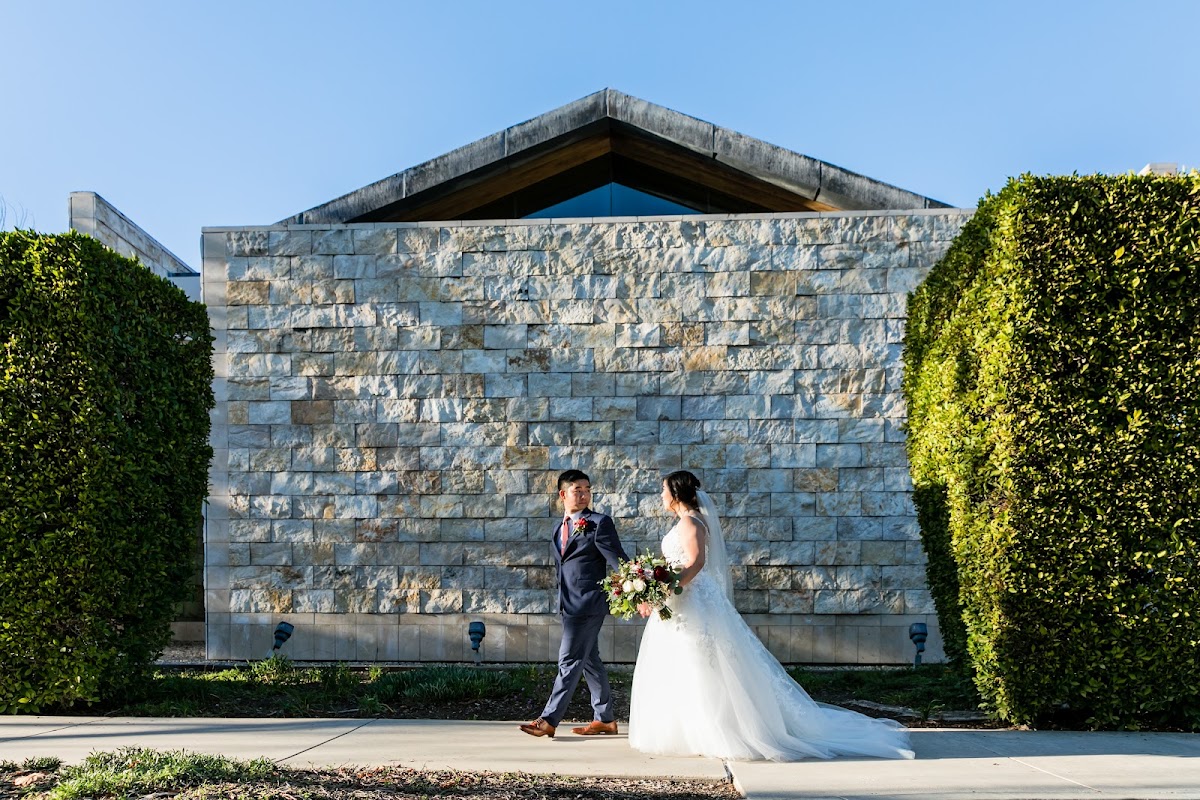
You take the Moulton Parkway exit off the 5, and within minutes you’re turning into what appears to be a typical Southern California church campus — parking lot, clean landscaping, nothing too remarkable at first glance. Then you round the corner past the Fellowship Hall, and everything changes. The private lake appears suddenly, reflecting the sky and the forest of mature trees that rise behind it. A bubbling fountain adds quiet music to the air. The rose garden at the front of the Lakeside Chapel is in full bloom, its fragrance drifting across the courtyard. And then there’s the chapel itself: stone and polished wood, floor-to-ceiling windows flooding the interior with that particular quality of Southern California light that photographers spend their entire careers chasing. This is not what you expect when you hear “church wedding” — this is a garden sanctuary hidden in plain sight just off Interstate 5, surrounded by the suburban sprawl of Orange County yet somehow completely removed from it. Poppy has designed Crossline Community Church wedding flowers for one couple here so far, but we’ve fielded 39 inquiries, and after walking the property ourselves, we understand the appeal entirely. It’s a rare venue: sacred and serene, flexible and surprisingly lush, with a private lake that makes you forget you’re nine miles from Laguna Beach and minutes from five freeway interchanges.
About Crossline Community Church
Crossline Community Church sits on 23331 Moulton Parkway in Laguna Hills, in the heart of suburban Orange County. This is not a historic mission or a Gothic cathedral — it’s a modern community church that happens to occupy one of the most unexpectedly beautiful properties in the area. The centerpiece is the private lake, a serene body of water nestled among mature trees, lush vegetation, and carefully maintained landscaping that creates what one couple described as a “garden oasis” feel. Behind the lake, a small forest provides a natural screen, making the property feel larger and more secluded than its actual footprint. The surrounding neighborhood is characterized by its equestrian history — this is Nellie Gail Ranch territory, where horses still graze on hillside properties and the architecture leans toward ranch-style estates with sprawling yards. But Crossline itself feels more like a secret garden than a church campus, with courtyards, patios, a rose garden, a bubbling fountain, and a natural hedge arch that could have been designed specifically for wedding ceremonies.
The Lakeside Chapel is the architectural anchor. Constructed with Virginia-style stone walls and polished wood beams, it seats up to 200 guests beneath soaring ceilings and walls of glass that flood the space with natural light. The design is timeless rather than trendy, with cool textured stone that photographs beautifully in both direct sunlight and overcast conditions. The chapel provides its own unity candle, ceremony reserved signs, and aisle markers at no additional charge, which tells you something about the venue’s wedding-friendly approach. This is a church that understands its role as both a house of worship and a special events venue, and the staff is accommodating without being rigid. Outside vendors are welcome, including florists, which is not always the case at religious venues. The church has its own kitchen facilities and can arrange bar services through approved partners, but couples can also bring in their own caterers with approval. When we spoke with the events coordinator, they emphasized flexibility — a refreshing stance for a Laguna Hills wedding florist trying to coordinate load-in schedules and setup logistics.
Logistically, Crossline is remarkably accessible despite its tucked-away feel. It borders Interstate 5 on the east side, with five major interchanges nearby, and sits just off the intersection of Moulton Parkway and Alicia Parkway. This means easy access from Los Angeles, San Diego, and Orange County proper, with John Wayne Airport only 15 minutes away for out-of-town guests. Parking is included in the site fee and ample, which is no small consideration for a 200-person wedding. For Poppy’s delivery teams coming from our studio, the drive is straightforward, and the venue provides clear vendor access with dedicated load-in zones near both the chapel and the reception spaces. The events team is responsive and organized, which makes our setup seamless — a detail that matters enormously when you’re transporting delicate floral installations across Southern California traffic.
The property includes multiple event spaces, both indoor and outdoor, which gives couples flexibility to design a wedding day that unfolds across different settings: ceremony in the chapel with its stone walls and lake views, cocktail hour on the lakeside patios with the water glittering in the late afternoon sun, and reception either indoors in the Lake View Banquet Room or Fellowship Hall, or outdoors under the stars. The bridal suite overlooks the lake through a floor-to-ceiling window, providing natural light for getting-ready photos and a serene space for the bride to prepare. It’s the kind of venue that works for both intimate 50-person gatherings and full-scale 200-guest celebrations, and the neutral palette throughout — stone, wood, soft greens — means your floral design can take center stage without fighting against the architecture.
Event Spaces & Floral Opportunities
The Lakeside Chapel
Capacity: 200 seated
Setting: The Lakeside Chapel is where most couples begin their day, and it’s easy to see why. The stone walls — cool gray with warm gold undertones — rise to cathedral ceilings crossed with polished wood beams that glow in the afternoon light. Floor-to-ceiling windows line both sides of the chapel, creating a glass-walled sanctuary flooded with natural light and offering glimpses of the lush vegetation outside. The pews are simple, the architecture is timeless, and the overall effect is one of understated elegance. The church provides a unity candle at no charge, which sits on a simple stand at the altar. There is no fussy décor, no dated carpet, no visual clutter — just stone, wood, glass, and light. It’s a naturally beautiful space that doesn’t need much help from anyone.
Floral approach: The cardinal rule in this chapel is restraint. The architecture does most of the work, so Crossline Community Church wedding flowers here should enhance rather than dominate. We favor a single, substantial altar arrangement — something lush and organic in a low stone urn or aged ceramic vessel that echoes the chapel’s stonework. Think garden roses in soft neutrals (Quicksand, Sahara, Patience), blush ranunculus, white lisianthus, and trailing jasmine vine or smilax that spills asymmetrically over the vessel’s edge. The arrangement should sit low enough that it doesn’t block the officiant but full enough to anchor the ceremony space. For the aisle, simple markers work best: small clusters of blooms and greenery tied to alternating pews with silk ribbon, or hurricane lanterns with floating candles surrounded by eucalyptus and roses. The unity candle can be surrounded by a low wreath of seeded eucalyptus, Italian ruscus, and spray roses, keeping the focus on the symbolic act without overwhelming the stand. If the ceremony is taking place in front of the windows, remember that you’re competing with natural light — anything too delicate will disappear in photographs. Choose blooms with enough density and color saturation to hold their own: garden roses over ranunculus, dahlias over sweet peas. The stone walls provide a neutral, flattering backdrop for nearly any color palette, but soft blush, ivory, champagne, and sage green feel most harmonious with the chapel’s natural tones.
Lake View Banquet Room
Capacity: Varies based on layout (approximately 120-150 seated)
Setting: The Lake View Banquet Room is exactly what its name promises: an indoor reception space with large windows overlooking the private lake. The room itself is a blank canvas — neutral beige walls, simple flooring, no distracting architectural details — which means your décor and floral design become the focal point. The windows provide natural light during the day and reflect candlelight beautifully in the evening. The view of the lake, especially at sunset when the water catches the golden hour glow, is the room’s best feature. The space can be configured for both seated dinners and cocktail-style receptions, and the church provides tables and chairs as part of the rental package.
Floral approach: In a neutral space like this, centerpieces are everything. We recommend a mix of heights to create visual interest across the room: tall arrangements on slender glass cylinders (30+ inches) alternating with low, lush compote-style designs that encourage conversation across the table. For the tall arrangements, use long-stemmed flowers with architectural presence — delphiniums, snapdragons, tuberoses, or branches of flowering cherry or curly willow — paired with trailing greenery (Italian ruscus, plumosa fern) that cascades down toward the table. For the low arrangements, go full and garden-style: garden roses (Juliet, Keira, Romantic Antike), spray roses, lisianthus, stock, and scabiosa in aged brass compotes or textured ceramic vessels. The lake views suggest a palette that complements water and sky: soft blues, sage greens, ivories, and blush pinks feel naturally harmonious here. If the reception runs into the evening, incorporate plenty of candlelight — votives clustered around the low centerpieces, taper candles in brass candlesticks flanking the tall arrangements. The bar area is an opportunity for a statement installation: a large urn overflowing with seasonal blooms and greenery, or a floral garland draped across the bar front with clusters of blooms worked through. The escort card table, typically positioned near the entrance, deserves its own elevated moment — a medium-scale arrangement in a sculptural vessel that sets the tone as guests enter the reception space.
Lakeside Patios
Capacity: Varies based on layout (approximately 150+ for cocktail-style, fewer for seated dining)
Setting: The lakeside patios are the venue’s secret weapon — multiple outdoor spaces directly adjacent to the lake, with water views, mature trees providing natural shade, and a peaceful, resort-like atmosphere. These patios can host outdoor receptions, cocktail hours, or even intimate ceremonies for couples who prefer an alfresco setting. The church provides tables and chairs, and the natural landscaping creates built-in ambiance. On a warm Southern California evening, with string lights overhead and the lake reflecting the sunset, these patios become pure magic.
Floral approach: Outdoor florals need to be both beautiful and durable, which means selecting blooms that can withstand heat, sun, and occasional breezes without wilting or blowing over. For cocktail tables, keep centerpieces low and heavy-based: small arrangements in weighted ceramic or concrete vessels filled with hardy blooms like spray roses, solidago, hypericum berries, and plenty of sturdy greenery (eucalyptus, pittosporum, leather fern). If the patio is being used for a seated dinner reception, the same principles apply: low and lush arrangements that won’t topple in the breeze and won’t wilt in the heat. For focal installations, consider the bar area (a large statement urn or floral garland), the entrance to the patio space (flanking arrangements in tall planters), or the escort card table (a medium arrangement that draws guests toward the seating chart). If there are lounge areas with sofas and armchairs, tuck small bud vases with single blooms onto side tables, or create a larger installation on a central coffee table. The lake itself presents opportunities: floating candles or small floral floats (blooms in shallow dishes) can be placed on the water’s surface near the patio’s edge, creating a magical reflection effect at twilight. String lights and lanterns will do most of the heavy lifting for ambiance here, so let the florals play a supporting role — accents rather than the main event.
Fellowship Hall
Capacity: Varies based on layout (approximately 100-150 seated)
Setting: The Fellowship Hall is a versatile indoor space within the church building that can serve as an alternative reception venue. It’s more utilitarian than the Lake View Banquet Room — think community hall rather than ballroom — but it’s also larger and more flexible for custom layouts. The venue has kitchen facilities adjacent to the hall, which makes catering logistics easier. The space has neutral walls and standard flooring, so it truly becomes whatever you make of it through décor, lighting, and floral design.
Floral approach: In a blank-slate space like Fellowship Hall, florals need to work harder to create atmosphere. We recommend investing in larger-scale installations that transform the room: a dramatic floral installation at the entrance (think a 6-foot arrangement on a pedestal or a wide garland draped across an archway), elevated centerpieces that draw the eye upward, and ample greenery to soften the utilitarian architecture. Consider renting decorative elements — fabric draping, uplighting, chandeliers — to create structure, then layer in florals to add texture and warmth. Garlands work beautifully in this type of space: draped along the head table, wrapped around columns or posts, or suspended from the ceiling in swags. For centerpieces, a uniform look tends to read more elegantly in large halls — choose one style (low and lush, or tall and architectural) and repeat it across all tables for visual cohesion. The neutral walls mean you can go bold with color if desired: jewel tones (deep burgundy, plum, emerald) photograph dramatically in this type of space, or you can keep it soft and romantic with blush, ivory, and champagne. Don’t forget the often-overlooked spaces: the gift table, the cake table (a garland running along the front edge or a pair of flanking arrangements), and the DJ or band area (a garland or statement arrangement that incorporates the entertainment setup into the overall design).
Courtyard
Capacity: Varies based on layout (ideal for cocktail hour, approximately 50-100 guests)
Setting: The courtyard at Crossline is one of the property’s most charming features — an outdoor space surrounded by lush vegetation, mature trees, and serene landscaping. It’s intimate without feeling cramped, verdant without being overgrown, and provides a peaceful transition space between the ceremony and reception. The courtyard works beautifully for cocktail hour, especially when paired with the adjacent fountain and hedge arch areas.
Floral approach: The existing landscaping does most of the work here, so florals should feel like a natural extension of the garden rather than something imposed upon it. For cocktail tables, small arrangements in organic vessels (terra cotta, aged stone, weathered wood) filled with garden-style blooms feel appropriate — consider roses, spray roses, stock, and herbs (rosemary, lavender) that add both visual interest and subtle fragrance. The bubbling fountain presents an opportunity for a statement moment: surround the base with a lush installation of greenery and blooms, or float small floral arrangements in shallow dishes on the water’s surface. The hedge arch, if it’s visible from the courtyard, can be enhanced with a garland of smilax and blooms, creating a photo-worthy backdrop. If there are bistro tables or high-top cocktail tables, consider bud vases with single statement blooms (a dramatic dahlia, a garden rose, a stem of delphinium) rather than full arrangements — it’s a more relaxed, garden-party aesthetic that suits the setting. Lanterns, votives, and string lights will provide ambiance as the sun sets, and florals can be woven around these lighting elements for a cohesive look.
Bridal Suite
Capacity: Bridal party getting-ready space
Setting: The bridal suite at Crossline is thoughtfully designed with a full wall mirror, counter space, cabinet storage, a dedicated gown hanging hook, comfortable seating (couch and chairs), and a floor-to-ceiling window overlooking the lake. It’s a light-filled, serene space that photographs beautifully — exactly what you want for getting-ready portraits.
Floral approach: The bridal suite doesn’t need a large installation, but it deserves a considered floral moment. A small, elegant arrangement on the counter or side table — something that echoes the bride’s bouquet in palette and style — creates a cohesive look for detail shots and adds a touch of luxury to the getting-ready process. We typically design a petite version of the reception centerpieces in a bud vase or small compote: a few stems of the same blooms used throughout the wedding (garden roses, lisianthus, ranunculus) with a bit of greenery. This arrangement can be photographed with the bride’s jewelry, perfume, and other details, then moved to the gift table or cake table during the reception. If the bride is having her bouquet and bridesmaid bouquets delivered to the suite, display them in water-filled vases near the window where the natural light will make them glow in photographs. A few loose petals scattered on the counter add a romantic touch without looking contrived. The window overlooking the lake provides a stunning backdrop for bouquet portraits — make sure your photographer takes advantage of it.
Wedding Flower Ideas for Crossline Community Church
Lakeside Garden
This design leans into the venue’s natural beauty with a palette inspired by an English garden: soft blush, ivory, champagne, and sage green. Garden roses are the stars — Juliet (peachy-blush), Patience (ivory with blush undertones), Keira (soft peach), and Romantic Antike (cream with hints of green). Layer in ranunculus, lisianthus, spray roses, stock, astilbe, and scabiosa for texture. Greenery is essential: Italian ruscus, seeded eucalyptus, jasmine vine, and silver dollar eucalyptus add movement and an organic, just-picked quality. Vessels should feel vintage and collected: aged stone urns, weathered ceramic compotes, mercury glass, and brass candlesticks. This palette works beautifully in the Lakeside Chapel (where it complements the stone walls), on the Lakeside Patios (where it echoes the natural landscape), and in the Lake View Banquet Room (where it feels romantic without competing with the water views). The overall effect is soft, romantic, and timeless — garden elegance that photographs like a dream in Southern California light.
Modern Romance
For couples who want something more contemporary, this design uses a restrained palette of ivory, champagne, and barely-there blush with architectural greenery for contrast. The focus is on structural blooms: white phalaenopsis orchids, champagne calla lilies, ivory garden roses (Patience, Polo), white lisianthus, and white ranunculus. Greenery is kept linear and sculptural: monstera leaves, ti leaves, myrtle, and eucalilis (seeded eucalyptus with a linear stem structure). Vessels are sleek and modern: clear glass cylinders, geometric brass containers, white ceramic, and lucite pedestals. This design works particularly well in the Fellowship Hall (where it provides clean, elegant structure in a blank-canvas space) and in the Lake View Banquet Room (where the neutral palette complements the room’s simplicity). For the chapel, a single dramatic arrangement at the altar — tall and architectural, with orchids and monstera leaves creating a modern focal point against the stone walls — makes a strong statement. The overall effect is refined, sophisticated, and distinctly contemporary while still feeling romantic.
California Sunset
This design captures the warm, golden light of a Southern California evening with a rich palette inspired by sunset over the lake: coral, peach, apricot, gold, and hints of burgundy. Blooms include coral charm peonies (when in season), peach garden roses (Juliet, Free Spirit), apricot ranunculus, gold spray roses, burgundy dahlias, peach stock, and coral snapdragons. Greenery adds depth: olive branches, dusty miller, and eucalyptus in softer silver-green tones that balance the warmth of the blooms. Vessels should have warmth: aged copper, brass, terracotta, and amber glass. This palette is stunning on the Lakeside Patios at golden hour, when the warm blooms echo the sunset reflecting on the water. In the chapel, it adds warmth to the cool stone walls. In the Lake View Banquet Room, it creates a cohesive connection between the indoor space and the outdoor views. The overall effect is warm, vibrant, and quintessentially California — sunset captured in floral form.
Seasonal Considerations
Southern California’s Mediterranean climate means Crossline Community Church is a year-round wedding destination, but each season brings distinct considerations for floral design.
Spring (March-May): Spring in Laguna Hills is spectacular, with moderate temperatures (65-75°F), minimal rain, and an explosion of blooming flowers across Southern California. This is peak season for many of the most coveted blooms: peonies (late April through May), ranunculus, anemones, sweet peas, garden roses, and tulips. The rose garden at the venue is likely in full bloom, providing a naturally fragrant backdrop for outdoor photos. Spring brides have the widest selection of locally-grown California flowers, and prices are generally reasonable due to high availability. The moderate temperatures mean outdoor ceremonies and receptions are comfortable, and blooms hold up beautifully without wilting. If you’re planning a spring Crossline Community Church wedding, take advantage of the seasonal abundance: design with peonies as a focal flower, incorporate ranunculus and anemones for texture, and use plenty of garden roses in soft spring colors. Best months: April and May.
Summer (June-August): Summer weddings in Orange County can be warm, with temperatures ranging from 75-85°F and occasionally higher during heat waves. The coastal proximity keeps temperatures more moderate than inland areas, but outdoor ceremonies in direct sun should be scheduled for late afternoon or evening to keep guests comfortable. For florals, this means selecting heat-tolerant blooms that won’t wilt quickly: roses (both garden and spray), lisianthus, hydrangea (if kept in water until the last moment), dahlias, zinnias, sunflowers, solidago, and hypericum berries. Avoid delicate blooms like sweet peas, anemones, and tulips, which will struggle in the heat. Greenery should be sturdy: eucalyptus, Italian ruscus, leather fern, and pittosporum all hold up well. If your reception is on the Lakeside Patios, consider renting fans or misters to keep guests comfortable, and keep floral arrangements low and heavy-based to withstand any evening breezes. Summer is an excellent time for bold, saturated colors — jewel tones, sunset hues, and vibrant palettes photograph beautifully in bright sunlight. Best months: June and September (shoulder months with slightly cooler temps).
Fall (September-November): Fall in Southern California is arguably the most beautiful season, with warm days (70-80°F), cool evenings, and virtually no rain. The light takes on a golden quality that photographers adore, and the moderate temperatures make outdoor celebrations comfortable from ceremony through late-night dancing. Fall blooms include dahlias (peak season and absolutely stunning), garden roses, spray roses, chrysanthemums, sunflowers, marigolds, celosia, and berries (hypericum, viburnum, privet). Foliage options expand: fall-colored leaves, branches, and ornamental grasses add seasonal texture. This is an ideal season for warm, rich color palettes: burgundy, rust, gold, plum, and burnt orange feel perfectly aligned with the season. At Crossline, fall weddings on the Lakeside Patios are magical — the lake reflects the warm evening light, the surrounding trees begin to show hints of autumn color, and the temperature is perfect for alfresco dining. If you’re planning a fall wedding here, embrace the seasonal abundance of dahlias and design with generous, lush arrangements that feel harvest-inspired without being overtly autumnal. Best months: October and November.
Winter (December-February): Winter in Laguna Hills is mild and often sunny, with temperatures ranging from 55-65°F during the day. While mornings can be cool and evenings require wraps or heaters for outdoor events, winter weather is generally pleasant and precipitation is minimal (most rain falls in January and February, but it’s still relatively rare). Winter blooms include amaryllis, anemones, ranunculus, hellebores, paperwhites, tulips, and plenty of evergreen options (pine, cedar, fir, holly, eucalyptus). Garden roses are available year-round through imports, though prices may be slightly higher. Winter weddings at Crossline often feature ceremonies in the Lakeside Chapel (where the stone and wood architecture feels cozy and intimate) and indoor receptions in the Lake View Banquet Room or Fellowship Hall. For floral design, winter allows for rich, moody palettes — deep burgundy, plum, forest green, ivory, and champagne — as well as traditional holiday-inspired looks if your wedding falls in December. Incorporate texture through evergreens, berries, and branches to add seasonal depth. If your reception is indoors, consider suspended installations or tall centerpieces that draw the eye upward and create drama in the space. Best months: December (for holiday-season romance) and February (for early spring blooms and Valentine’s proximity).
Poppy’s Expert Take
The chapel needs less than you think. First-time visitors to the Lakeside Chapel often arrive with grand plans for ceremony florals, envisioning elaborate altar installations, floral arches, and pew arrangements for every single row. Then they see the space — the soaring ceilings, the stone walls, the floor-to-ceiling windows flooding the room with light — and realize the architecture is doing most of the work. We’ve designed everything from minimal (a single altar arrangement and aisle markers on every third pew) to maximal (full altar installation, every pew marked, and a garland along the first row), and consistently, the minimal approach photographs more beautifully. The stone walls and natural light are so visually compelling that heavy floral décor competes rather than complements. Invest your budget where it matters most: a single, stunning altar arrangement that anchors the ceremony space, simple aisle markers that guide the eye without overwhelming the architecture, and perhaps a small wreath around the unity candle. Save the drama for the reception, where a blank-canvas space like the Lake View Banquet Room or Fellowship Hall will benefit from generous floral installations.
Plan for the lake views. The private lake is the venue’s signature feature, and your floral design should work with it, not against it. This means avoiding top-heavy centerpieces on the Lakeside Patios (they’ll blow over in the breeze), choosing a color palette that complements water and sky (soft blues, greens, ivories, and blush read beautifully against the lake backdrop), and considering how arrangements will photograph with the water behind them. If you’re having a cocktail hour on the patios, position your bar installation where it catches the lake view — a statement arrangement on the bar top or a garland draped across the bar front creates a focal point that includes the water in the background. For seated dinners on the patios, keep centerpieces low so guests can see across the table and out to the lake. The view is the star; let your florals support it.