
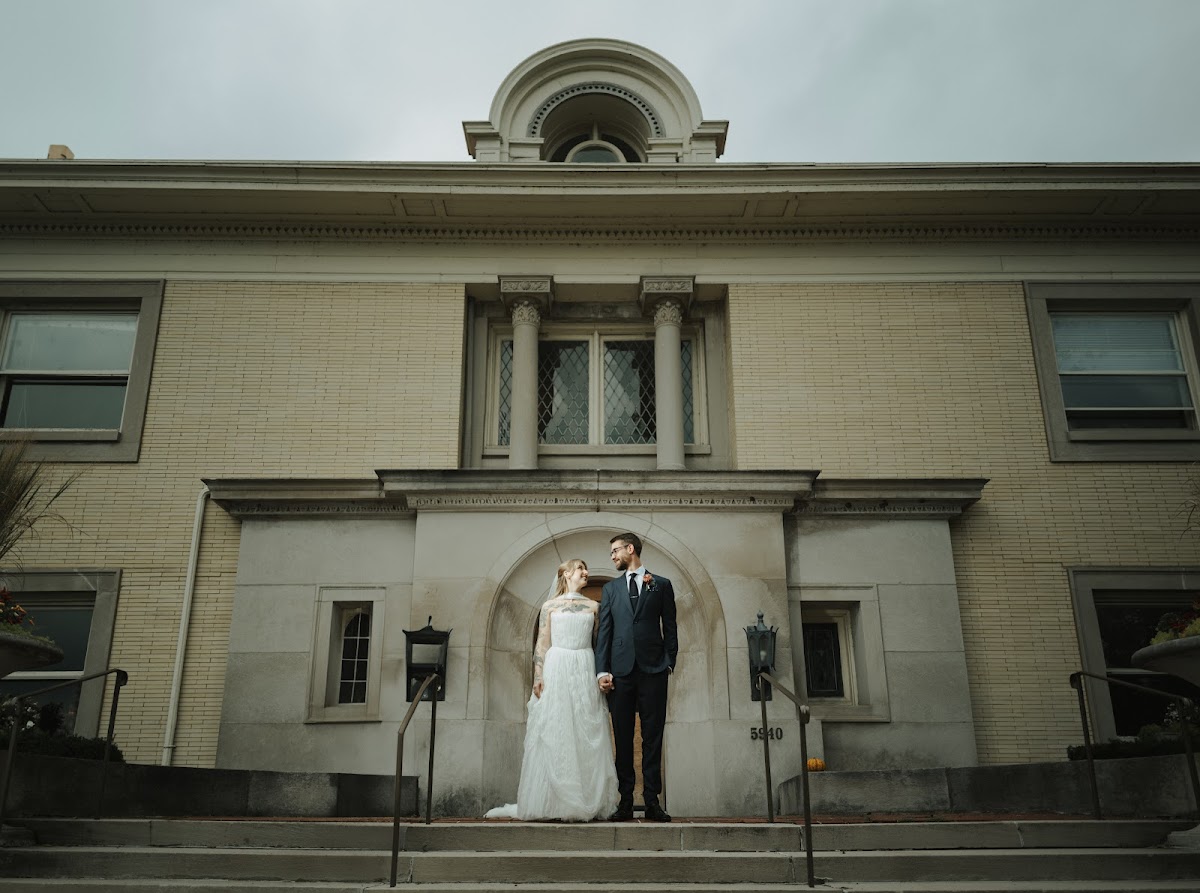
You turn off Sheridan Road, and there it is — the kind of mansion that makes you wonder about the lives lived inside. Built in 1909 when Edgewater was where Chicago’s wealthy built summer homes to escape the heat, Colvin House stands three stories tall with Prairie School lines and a dignity that comes from good bones and meticulous restoration. A four-foot crystal chandelier glints through the front windows. The lake is right there, across the street, sending light and wind through the neighborhood. This is not a hotel ballroom or a converted industrial space. This is someone’s home once, now yours for a day, with marble fireplaces in every room, stained glass catching afternoon sun, and a 4,000-square-foot brick courtyard where garden roses grow against old brick walls. Poppy has designed Colvin House wedding flowers for one celebration here so far, and what struck us most was how the architecture itself suggests what to do — tulip motifs carved into woodwork, geometric patterns in the plasterwork, that grand oak staircase begging for a garland that cascades like something out of a novel. This venue does not need you to transform it. It asks you to collaborate.
About Colvin House
Colvin House occupies a precise moment in American architecture — 1909, when Prairie School designer George Maher was applying his “Rhythm-Motif Theory” to residential design, creating homes where a single decorative element repeats throughout the structure to create visual harmony. Here, that motif is the tulip. You will find it carved into woodwork, rendered in stained glass, abstracted in plaster medallions. Triangular forms echo through doorways and windows. The effect is not busy but intentional, a kind of visual music that plays softly through every room. The home was built for John G. Shedd’s brother-in-law during Edgewater’s first golden age, when this North Side lakefront neighborhood was Chicago’s answer to Newport, full of grand summer estates and beach clubs.
After decades of use and varying states of repair, the mansion underwent a meticulous restoration that preserved original details while updating systems and infrastructure. The result is a venue that feels genuinely historic — original marble mantles, that magnificent crystal chandelier suspended over the oak staircase, stone pillars, decorative plaster molding — without the mustiness or fragility that sometimes accompanies old buildings. The floors are level. The HVAC works. There is a commercial kitchen for caterers and modern restrooms that do not require apologizing to guests.
The property includes not just the main mansion but a separate Coach House (original to the property, now restored as a bar and lounge space), a basement Speakeasy that leans into 1920s glamour with velvet seating and moody lighting, and that glorious courtyard — 4,000 square feet of brick paving, lush perennial gardens, and string lights that turn the space magical after dark. The venue can accommodate up to 100 seated guests, which means this is not a space for massive weddings but rather for couples who want intimacy and architecture over sheer scale.
Location-wise, Colvin House sits at 5940 North Sheridan Road in Edgewater, a neighborhood that runs along Lake Michigan between Uptown and Rogers Park. This is one of Chicago’s most walkable, livable areas — diverse, artistic, full of storefront theaters and independent restaurants, with miles of lakefront parks and beaches right outside the door. Downtown Chicago is a 20-minute drive south. O’Hare Airport is 30 minutes northwest. For guests staying nearby, there are plenty of hotels along the lakefront corridor, and the CTA Red Line provides easy transit access for those coming from other parts of the city.
For Poppy’s team, load-in happens during a two-hour setup window before the event begins, typically through the front entrance and courtyard access. The venue requires all vendors to provide liability insurance and communicate delivery details in advance to the events manager. Parking is available in the courtyard or partner lots nearby. The events team is communicative and professional, which makes coordination straightforward. As a Chicago wedding florist, we appreciate that Colvin House does not restrict floral designers to a preferred vendor list — couples have full freedom to choose their florist, and we bring our own knowledge of the property’s quirks and opportunities.
Event Spaces & Floral Opportunities
Main Floor (Parlor, Foyer, Dining Room, Sunrooms)
Capacity: 100 seated
Setting: The main floor flows through a series of interconnected rooms, each with its own character but unified by Prairie School details and that repeating tulip motif. The foyer centers on the grand oak staircase with the crystal chandelier suspended overhead — this is where nearly every bride pauses for photos, where the processional begins if you are holding your ceremony indoors. The parlor features one of the marble fireplaces, original plaster molding, and enough space for ceremony seating or a cocktail hour lounge setup. The dining room connects to sunrooms that flood with natural light from tall windows, including decorative stained glass that filters the afternoon sun into jewel tones. Stone pillars frame doorways. Everywhere you look, there is architectural detail that photographs beautifully and provides structure for a reception.
Floral approach: The main floor is where Colvin House wedding flowers should honor the architecture without competing with it. That crystal chandelier is your first decision point — we love draping the staircase bannister with a lush garland that appears to spill down from the chandelier itself, using smilax, Italian ruscus, and clusters of garden roses (Patience, Keira, Quicksand) with trailing jasmine vine. The garland should look abundant but not heavy, as if it grew there overnight. For the marble fireplaces, asymmetrical mantle arrangements work beautifully — one side anchored with a large urn overflowing with seasonal blooms and foliage, the other side lighter with trailing elements like amaranthus or scabiosa on delicate stems. On guest tables in the dining room, keep centerpieces low and lush to preserve sightlines and conversation. We favor compote vessels in brass or ceramic, filled with garden-style arrangements — ranunculus, anemones, hellebores, tulips (always tulips here), and textured greenery like dusty miller or eucalyptus. The stained glass windows need nothing, but the stone pillars can be flanked with tall arrangements on pedestals for ceremony backdrops. The key is restraint and intention — this room already has so much visual interest that your florals should feel like they belong to the space, not like they were trucked in from elsewhere.
Courtyard
Capacity: 100 seated
Setting: Step through the back doors, and you are in a completely different world — 4,000 square feet of brick courtyard enclosed by original fencing, with established gardens along the perimeter, vintage light strands overhead, and the open sky above. The brick underfoot is laid in herringbone patterns, weathered and charming. The gardens are lush during growing season — hostas, ferns, flowering perennials — and the space reads as a secret garden in the middle of the city. There is enough room for ceremony seating, a dance floor, dining tables, and a bar setup without feeling crowded. The courtyard can be tented for weather protection, which extends the usable season into cooler months.
Floral approach: The courtyard already has living gardens, which means your floral design should complement rather than replace what is growing. For outdoor ceremonies, we recommend a freestanding arch or chuppah positioned against the brick wall, dressed with garden-style florals that echo the perennial beds — think loose, organic, and slightly wild. Roses (Romantic Antike, Juliet, Patience), foxglove, delphinium, astilbe, and plenty of foliage (eucalyptus, olive branches, wild fern). The structure itself can be wood or iron, stained to blend with the courtyard aesthetic. Aisle markers can be simple — shepherd’s hooks with small arrangements, or lanterns with floral collars. If you are tenting the space, use the tent’s structure for suspended installations — a garland runner along the tent peak, or clusters of blooms at each pole. On dining tables, embrace the garden setting with arrangements that look freshly cut from a cutting garden — loose, textural, slightly asymmetric, in terracotta pots or galvanized buckets that feel at home outdoors. Candles in glass votives (the only permitted candle style per venue rules) add warmth as daylight fades. The courtyard is beautiful on its own; let your flowers enhance that beauty rather than trying to reinvent it.
Coach House
Setting: The Coach House is a two-story outbuilding original to the 1909 property, now restored as a lounge and bar space that splits the difference between covered and open-air. The ground level features a built-in bar, bespoke vintage art on the walls, antique furniture pieces, and two large doors that open to connect the interior with the courtyard. The aesthetic is vintage industrial meets Prohibition-era chic — exposed brick, dark wood, brass fixtures, and just enough patina to feel authentic. This is typically used for cocktail hour or as a satellite bar during receptions, giving guests a secondary space to explore.
Floral approach: The Coach House calls for florals that lean into the vintage character without tipping into overly themed territory. On the bar itself, a long low arrangement works beautifully — imagine a trough-style vessel filled with garden roses (Cafe au Lait dahlias in season, Cappuccino and Quicksand roses otherwise), scabiosa, tweedia, astrantia, and trailing jasmine or passion vine spilling over the edges. The arrangement should feel abundant but not obstruct the bartender’s workspace or guests’ sightlines to the bottles. On side tables and vintage furniture pieces, use smaller arrangements in mismatched vintage vessels — brass bowls, ceramic crocks, milk glass vases — each with its own character. The color palette should feel slightly moody to match the space: dusty rose, mauve, burgundy, sage green, with touches of rust or copper. If you want to add something unexpected, consider hanging a small floral chandelier or wreath from the ceiling beams — just a touch of whimsy that catches the eye when guests step inside.
Basement Speakeasy
Setting: Descend to the basement level, and you have entered another era entirely. The Speakeasy is dark, moody, and glamorous in a way that feels transported from 1925. Plush velvet seating in jewel tones, a full bar, dim lighting, and just enough subterranean mystery to make it feel like you have discovered something secret. This space is perfect for an after-party, a late-night lounge, or even an intimate rehearsal dinner for smaller groups.
Floral approach: The Speakeasy demands drama and richness — this is not the place for pastel garden roses and soft greenery. Think jewel-toned arrangements with deep burgundy dahlias (Black Satin, Thomas Edison), plum calla lilies, dark purple anemones, chocolate cosmos, and near-black hellebores, accented with dusty mauve roses (Quicksand, Amnesia) and burgundy-edged foliage like leucadendron or smoke bush. Vessels should be metallic — aged brass, antique gold, or even black ceramic with gold interiors. The arrangements should be low and lush on cocktail tables, allowing guests to see each other across the table while still making a statement. Consider adding unexpected elements like pheasant feathers, dried artichokes, or even subtle gold leaf accents to enhance the opulent, Gatsby-era vibe. Candles are essential here — masses of votives in amber or burgundy glass, creating pools of warm light that make the florals glow. The Speakeasy is all about mood, and your flowers should amplify that sense of decadent escape.
Lake View Wedding Suite
Setting: On the third floor, the Lake View Wedding Suite serves as the primary getting-ready space, featuring a Juliet balcony that overlooks the neighborhood and offers glimpses of Lake Michigan in the distance. The room is bright, feminine, and comfortable, with space for hair and makeup, photographer access, and that crucial pre-ceremony moment when the bride takes a breath and prepares to walk down those stairs.
Floral approach: A single statement arrangement is all this room needs — something beautiful for detail shots and to add a touch of luxury to the morning preparations. We love a low oval arrangement in soft, romantic tones — blush and white garden roses (Patience, Keira, O’Hara), ranunculus, sweet peas in season, hellebores, and dusty miller or silver brunia for texture. The vessel can be a simple ceramic bowl or a vintage silver tray. Place it on the dressing table or near the window where natural light will illuminate it for photos. If the bride wants florals on the Juliet balcony for outdoor getting-ready photos, a simple garland of greenery (smilax, eucalyptus) with a few blooms tucked in can frame the moment without overwhelming the architectural detail.
Something Blue Room
Setting: The second-floor Something Blue Room provides additional getting-ready space, ideal for bridesmaids or as overflow when the main suite is busy with hair and makeup stations.
Floral approach: Keep it simple and on-theme. A small arrangement featuring blue flowers — blue delphinium, tweedia, thistle, or muscari in spring — mixed with white and blush blooms creates a sweet nod to the room’s name and provides a lovely detail for getting-ready photos. A single bud vase with one perfect stem also works beautifully. This is not the space for large installations; a thoughtful, petite arrangement is all you need.
Wedding Flower Ideas for Colvin House
Maher’s Tulip Garden
This design concept is a love letter to George Maher and his tulip motif, using actual tulips as the foundation for every arrangement throughout the wedding. In spring (prime tulip season), work with French tulips in shades of ivory, blush, coral, and deep wine, mixed with Parrot tulips for their dramatic ruffled edges and feathered petals. Add ranunculus, anemones, hellebores, and sweet peas for textural variety, but tulips remain the star. Vessels should feel geometric and architectural — ceramic compotes in matte finishes, brass pedestals, square ceramic containers that echo the Prairie School’s clean lines. For the staircase garland, weave tulips throughout the greenery so they appear to bloom from the bannister itself. The ceremony arch becomes a tulip arbor — hundreds of stems creating a lush, living structure. On guest tables, low arrangements in shades that shift from soft blush at some tables to deep wine at others create a sense of movement across the room. This concept works best for spring weddings (March through May in Chicago), though high-quality imported tulips can extend the season slightly. The effect is cohesive, architecturally harmonious, and unmistakably connected to Colvin House’s design history.
Edgewater Garden Party
This design embraces the neighborhood’s lakefront, garden-filled character with a loose, organic aesthetic that feels like flowers gathered from a cutting garden and arranged with an artist’s eye. The palette is soft and naturalistic — blush, ivory, peach, soft yellow, sage green, and touches of lilac. Flowers include garden roses (Patience, Romantic Antike, Juliet), spray roses, ranunculus, lisianthus, foxglove, astilbe, veronica, scabiosa, and Queen Anne’s lace. Foliage is abundant and varied — Italian ruscus, eucalyptus in multiple varieties (silver dollar, seeded, spiral), olive branches, ferns, and trailing jasmine vine. Arrangements are intentionally asymmetrical and loose, as if they might have been casually placed in the vase and happened to land perfectly. Vessels vary in style but lean vintage — ceramic crocks, terracotta pots, galvanized buckets for the courtyard, milk glass vases on the main floor. The staircase garland is lush and wild, spilling abundantly down the bannister. The ceremony arch is garden-style and organic, with flowers clustered at the base and trailing up one side, leaving the other side more open to showcase the structure itself. This concept works beautifully for late spring through early fall and feels particularly at home in the courtyard, though it translates seamlessly indoors as well.
Speakeasy Noir
For couples drawn to the drama of the basement Speakeasy and wanting their entire wedding to echo that moody glamour, Speakeasy Noir brings jewel tones and vintage opulence to every space. The palette is rich and saturated — deep burgundy, wine, plum, emerald green, and charcoal, accented with blush and dusty mauve to prevent it from feeling too dark. Flowers include burgundy dahlias (in season), Black Baccara roses, plum calla lilies, dark purple anemones, burgundy ranunculus, chocolate cosmos, and burgundy-tinged hellebores. Accents include dark scabiosa pods, burgundy amaranthus, smoke bush foliage, and eucalyptus in darker varieties. Vessels are metallic and vintage — aged brass urns, antique gold compotes, mercury glass votives, black ceramic with gold interiors. The staircase garland is dramatic and dark, with deep blooms clustered throughout the greenery. On the main floor, tall arrangements on brass pedestals flank the fireplace ceremony backdrop, creating a sense of vintage grandeur. Guest table centerpieces are lush and low in brass compotes, with masses of amber and burgundy votives surrounding each arrangement. In the courtyard, the same palette continues but with slightly lighter touches to balance the outdoor setting. The entire effect is cohesive, dramatic, and unforgettably glamorous — perfect for evening weddings and couples who want their flowers to make a bold statement.
Seasonal Considerations
Chicago’s four-season climate creates distinct opportunities and considerations for Colvin House wedding flowers throughout the year.
Spring (March through May) arrives cautiously in Chicago, with March often still snowy and cold, but by late April and certainly May, the city blooms with gusto. This is tulip season, which makes spring ideal for designs that honor Colvin House’s architectural tulip motif. French tulips, Parrot tulips, fringed tulips — all are at peak availability and affordability. Other spring blooms include ranunculus, anemones, hellebores, sweet peas, lilac branches, cherry blossom branches, and early peonies in May. The courtyard gardens begin to green up in April, though full lush growth typically waits until May. Spring weather is unpredictable — a May wedding might be 75 and sunny or 50 and drizzling — so have a tenting plan for courtyard events. Best months for spring weddings: late April and May.
Summer (June through August) is when Chicago shakes off winter entirely and embraces lake life. The courtyard is at its most beautiful, with perennial gardens in full bloom and warm evenings perfect for outdoor dining. Local and domestic flowers are abundant: garden roses, spray roses, hydrangeas, dahlias (starting in July), lisianthus, veronica, foxglove, Queen Anne’s lace, zinnias, and sunflowers for more casual designs. Chicago summers can be hot and humid, which means delicate flowers like sweet peas or certain garden roses may not hold up as well outdoors. Focus on hardy blooms for courtyard arrangements and save more delicate varieties for indoor spaces. Lake breezes help moderate temperatures, and Edgewater’s lakefront location often runs a few degrees cooler than inland neighborhoods. Best months for summer weddings: June and September (technically early fall but often summer-like in Chicago).
Autumn (September through November) might be Chicago’s most beautiful season, with crisp air, brilliant foliage, and that particular quality of golden light that makes everything cinematic. September often feels like extended summer. October brings peak fall color and ideal weather — cool but not cold, sweaters and sunshine. November turns colder and grayer but still workable for weddings. Autumn flowers include dahlias (at their absolute peak), garden roses, ranunculus, marigolds, celosia, Japanese anemones, chocolate cosmos, and dramatic foliage like oak leaves, maple branches, and sumac. Color palettes can lean into rust, burgundy, marigold, and burnt orange, or stay softer with mauve, dusty rose, and sage. The courtyard remains usable through October with proper tenting and heating if needed. Best months for fall weddings: September and October.
Winter (December through February) is when Chicago gets serious — snow, cold, wind off the lake. But Colvin House becomes particularly magical in winter, with that crystal chandelier sparkling, fireplaces glowing, and the architecture providing warmth and shelter from the elements. Winter weddings happen almost entirely indoors, with possible courtyard use only if fully tented and heated (and even then, it is a commitment). Winter flowers include amaryllis, anemones (imported), ranunculus (imported), hellebores, roses, orchids, evergreen foliage, pine boughs, cedar, berries (ilex, hypericum), and branches (curly willow, birch). This is also the season for luxury imports if budget allows — Dutch parrot tulips, Icelandic poppies, French ranunculus. Embrace the season with rich jewel tones, lots of candlelight (remember: votives only per venue rules), and arrangements that feel lush and opulent to contrast with the stark winter outside. Best month for winter weddings: December, particularly for holiday-adjacent celebrations that lean into festive elegance.
Poppy’s Expert Take
The staircase garland is non-negotiable. That crystal chandelier and oak bannister are Colvin House’s signature feature, and leaving them undecorated feels like a missed opportunity. Invest in a lush garland that runs from the top of the staircase down the bannister — 15 to 20 feet depending on how much trailing drama you want. Use a smilax base for its delicate, cascading nature, add Italian ruscus for body, then weave in clusters of your focal flowers (garden roses, ranunculus, tulips) at intervals so they appear to bloom from the greenery. Secure the garland with zip ties wrapped in floral tape to protect the wood, and ensure your florist coordinates with the venue on installation timing and method. This single installation will appear in countless photos and sets the tone for the entire event.
Work with the tulip motif, not against it. George Maher built tulips into the architecture throughout the house — carved into woodwork, rendered in stained glass, abstracted in plaster. Ignoring this in your floral design feels like walking into the Sistine Chapel and hanging different artwork. You do not have to use actual tulips (though in spring, you absolutely should), but you can echo the motif through repeating elements in your arrangements — the same flower variety at every guest table, geometric vessel shapes that reference the Prairie School’s clean lines, or a consistent color that appears in every space. Cohesion and repetition are Maher’s design principles; let them guide your florals.
Keep candles in check. Colvin House’s candle policy is strict: candles permitted only in glass votives where the flame sits below the rim of the glass. Taper candles are prohibited entirely. This is a safety rule for a historic wooden structure, and it is non-negotiable. The good news is that masses of votives — and we mean masses, 50 to 100+ scattered across tables, mantles, bars, and window sills — create incredible ambiance without violating the rule. Choose votives in amber, burgundy, or clear glass depending on your palette, and cluster them in groups rather than spacing them evenly. The cumulative effect is romantic and warm without the fire hazard.
Allocate budget to multiple spaces, not just the main floor. Colvin House is a multi-room venue where guests flow between the main floor, courtyard, Coach House, and potentially the Speakeasy. If you focus all your floral budget on guest table centerpieces and ignore the other spaces, the experience will feel disjointed. We recommend distributing your budget across key moments: a statement installation for the ceremony (arch or fireplace backdrop), the staircase garland, guest table centerpieces, bar arrangements for the Coach House, and a few strategic placements in transitional spaces (foyer, sunroom window sills). Each space does not need to be equally grand, but each should feel considered.
Photography on upper floors is restricted. Per venue policy, photography on the second and third floors (where the getting-ready rooms are located) is restricted to before the event begins or during cocktail hour with small groups. This means your getting-ready room florals need to photograph beautifully early in the day, and you should plan for most portrait photography to happen on the main floor and courtyard. The staircase with the chandelier is the prime indoor portrait location, which is another reason that garland is so important. Communicate timing expectations with your photographer and florist so everyone knows when upper-floor access is available and when the main floor needs to be fully set and ready.
The courtyard can be tented, and you should consider it. Even in summer, Chicago weather is unpredictable. A tent provides not just rain protection but also structure for lighting, fans, heaters, and suspended floral installations. If your budget allows, tent the courtyard. You gain flexibility, comfort for guests, and the ability to create a cohesive design environment that feels intentional rather than contingent on good weather. A clear-top tent preserves the open-air feel while providing practical benefits. If tenting is not in the budget, have a solid backup plan for moving the entire event indoors to the main floor, and design your florals to work in either space.
Load-in timing is tight — plan accordingly. Colvin House provides a two-hour setup window before your event begins, and all vendors share that window. For a 6:00 PM ceremony, expect setup to begin around 4:00 PM, which means florists, caterers, rental companies, and anyone else setting up are working simultaneously. Poppy’s team is accustomed to efficient installations, but it requires advance coordination and clear communication with the venue and other vendors. If your floral design is complex (extensive garlands, multiple installations, intricate tablescapes), ensure your florist builds in enough setup time and potentially negotiates early access if available. Nothing derails a design faster than a rushed installation.
What Poppy Couples Spend on Flowers Here
Based on our work at Colvin House and similar Chicago estate venues, couples typically invest in one of three tiers for wedding flowers, each offering a different level of floral coverage and impact.
$2,500 - $3,500 | The Essentials
This tier covers the foundational floral needs: personal flowers (bridal bouquet, bridesmaid bouquets, boutonnieres, corsages), a ceremony installation (either a small arch for the courtyard or fireplace arrangements for indoor ceremonies on the main floor), and guest table centerpieces for up to 100 guests. At this level, centerpieces are low and lush in a single style across all tables — think compote vessels filled with garden roses, ranunculus, and seasonal foliage, or bud vase clusters for a more budget-conscious approach. The staircase garland is achievable but will be more greenery-focused with fewer blooms. This budget works well for couples prioritizing the ceremony and reception tablescapes, with minimal floral presence in transitional spaces like the Coach House or foyer. Seasonal, locally available flowers stretch this budget furthest.
$3,500 - $5,500 | The Full Picture
This mid-tier budget allows for more comprehensive coverage and elevated design. Personal flowers remain covered, but the ceremony installation becomes more substantial — a lush garden-style arch for the courtyard or dramatic fireplace flanking arrangements for indoor ceremonies. The staircase garland becomes a true statement piece, lush with blooms and trailing greenery. Guest table centerpieces can vary in height and style — perhaps tall arrangements on pedestals alternating with low compotes to create visual interest across the room. This budget includes bar arrangements for the Coach House, strategic placements in the foyer and sunrooms (window sill arrangements, a statement piece on a side table), and potentially florals for the Speakeasy if you are using that space. You have enough budget to incorporate specialty flowers (garden roses, ranunculus, hellebores) and more complex design elements (suspended installations, asymmetrical mantle arrangements). This is the sweet spot for most Colvin House weddings.
$5,500+ | The Full Experience
At this level, every space receives thoughtful floral attention, and design complexity increases significantly. The staircase garland is abundant and dramatic, potentially extending beyond the bannister to frame the chandelier itself. The ceremony installation is grand — a fully blooming arch or substantial fireplace arrangements with tall flanking pedestals. Guest tables feature varied arrangements with multiple design styles and height variations. The Coach House bar gets an impressive long arrangement, the Speakeasy becomes a moody floral environment with arrangements on every surface, and even the getting-ready rooms receive elevated florals beyond a single arrangement. This budget allows for premium flowers (imported tulips, specialty garden roses, high-end foliage), intricate design details (woven floral runners, suspended installations