
You leave the commercial strip behind on Glen Ellyn Road and turn into Bloomingdale Golf Club, and within seconds the world shifts. The manicured fairways unfold in precise, rolling waves of green. Mature oaks and maples line the drive, their canopies creating dappled shadows that move across the windshield. The clubhouse appears around a gentle curve — a 13,000-square-foot structure that manages to feel both stately and inviting, with cream-colored siding, crisp white trim, and that enormous wrap-around veranda that promises sunset cocktails and easy conversation. Then you step inside, and the ballroom stops you cold. Not because it’s trying too hard, but because it isn’t trying at all. The room simply opens up — vaulted ceilings soaring overhead, vintage chandeliers hanging like constellations, and that 200-foot wall of floor-to-ceiling windows framing the golf course in one unbroken panorama. On a June evening, when the light slants gold across the greens and the trees are in full leaf, the view does ninety percent of the decorative work. This is not a venue that needs rescuing with flowers. It’s a venue that deserves flowers thoughtful enough to match its quiet confidence. Poppy has received 19 inquiries from couples planning Bloomingdale Golf Club wedding flowers, and each time we visit for a site consultation, we’re reminded why this 1924 Tom Bendelow-designed course remains one of the western suburbs’ most enduring wedding destinations.
About Bloomingdale Golf Club
Bloomingdale Golf Club was established in 1924, designed by Tom Bendelow — the Scottish architect whose portfolio includes over 600 courses across the United States, including Medinah’s Course No. 3 and several layouts that helped define American golf in its golden age. The Bloomingdale course reflects Bendelow’s characteristic style: strategic bunkering, generous fairways, and an emphasis on playability that makes the game accessible while still rewarding skillful shot-making. For a wedding, this translates into a landscape that looks spectacular without feeling overly manicured or fussy. The rolling terrain, the mature tree canopy, the long sight lines across the fairways — it all reads as “established estate” rather than “corporate conference center,” which matters when you’re trying to create a sense of occasion.
The clubhouse itself was renovated and expanded over the years, most recently updated to include modern amenities while preserving the architectural bones that give the space its character. The Main Ballroom features vaulted ceilings with exposed wooden beams, vintage-style chandeliers with clear crystal drops and brass fittings, and that defining feature: a 200-foot expanse of windows that wraps around the room’s perimeter like a living mural. The flooring is polished hardwood in a honey tone, and the walls are painted a soft cream that reflects natural light beautifully. The overall effect is classic country club elegance without stuffiness — a balance that’s harder to achieve than it looks.
Logistically, Bloomingdale sits about 25 miles west of downtown Chicago in DuPage County, making it accessible from the city, the northern suburbs, and the western corridor. For Poppy’s delivery teams, the drive from our studio is straightforward via I-290, and the venue offers ample on-site parking with dedicated loading zones near the ballroom entrance. In winter months, the club provides plowing services, which is no small consideration for Chicago-area weddings between November and March. For guests with mobility needs, the venue offers golf cart transportation from the parking lot to the clubhouse — a thoughtful detail that signals the level of service you can expect here.
Bloomingdale Golf Club operates as a full-service venue with exclusive catering provided by Catering with Elegance, a family-owned company with over 40 years of experience. All food is prepared fresh on-site, and the culinary team is flexible about menu customization, whether you’re planning a plated dinner, family-style service, or cocktail reception. The venue includes tables, chairs, chair covers, linens, china, flatware, glassware, and a dance floor in the rental — a comprehensive package that simplifies planning. Couples receive exclusive use of the clubhouse for their event day, meaning you won’t be sharing the space with another wedding or a corporate event. The events team coordinates directly with outside vendors, and while the venue requires liability insurance (which they provide), there are no restrictions on floral designers, giving couples the freedom to work with Poppy or any other Bloomingdale wedding florist they prefer. The ballroom is available all day for vendor setup, with most teams arriving mid-afternoon to allow for unhurried installations.
Event Spaces & Floral Opportunities
Main Ballroom
Capacity: 220 seated
Setting: The Main Ballroom is the heart of Bloomingdale Golf Club, and it earns that designation honestly. The room measures 13,000 square feet with vaulted ceilings that rise to a dramatic peak supported by exposed wooden beams stained a rich walnut. Vintage chandeliers — five in total — hang at staggered heights, their clear crystal drops catching afternoon light and casting soft reflections across the polished honey-toned hardwood floors. The defining architectural feature is the 200-foot wall of floor-to-ceiling windows that wraps around two sides of the ballroom, offering unobstructed views of the golf course, the fairways rolling toward the tree line, and the mature oaks and maples that frame the property. The windows are separated by narrow cream-painted mullions, creating a grid that segments the view into living portraits. On a clear day, natural light floods the room from mid-morning through late afternoon, and at sunset, the western exposure turns everything amber and rose gold. The overall palette is neutral and warm — cream walls, honey floors, brass chandelier fittings — which provides a versatile canvas for any floral design.
Floral approach: The cardinal rule in this ballroom is to respect the windows. Anything placed at eye level that rises above twelve to fourteen inches risks blocking the golf course view, and that view is why people book this venue. We favor low, lush centerpieces that mound generously but stay below sightline — think garden roses (Keira, Patience, and Juliet), ranunculus in blush and ivory, spray roses, and textural accents like astilbe, scabiosa, and tweedia in compote bowls or vintage brass vessels. For couples who prefer height, consider tall, elevated arrangements on clear glass risers that lift the florals above twenty-four inches, allowing guests to see through the base. The vaulted ceilings and exposed beams present an opportunity for suspended installations — a garland of Italian ruscus and smilax running the length of the head table, punctuated with clusters of Quicksand roses and white lisianthus, can add drama without cluttering the table surface. The vintage chandeliers should generally be left unadorned; they’re statement pieces on their own, and wrapping them in greenery risks looking overwrought. If you do want to integrate florals with the chandeliers, limit it to a single installation above the dance floor — a floral chandelier or hanging greenery sphere that becomes a focal point for photos. For the entrance into the ballroom, a pair of large-scale arrangements flanking the doorway — overflowing urns filled with flowering branches (cherry, quince, or dogwood depending on season), hydrangea, roses, and trailing jasmine vine — signals the transition from cocktail hour to the reception. Bloomingdale Golf Club wedding flowers should feel like a natural extension of the manicured landscape visible through those windows: elegant, organic, and grounded in a sense of place.
Outdoor Ceremony Space
Capacity: 220 seated
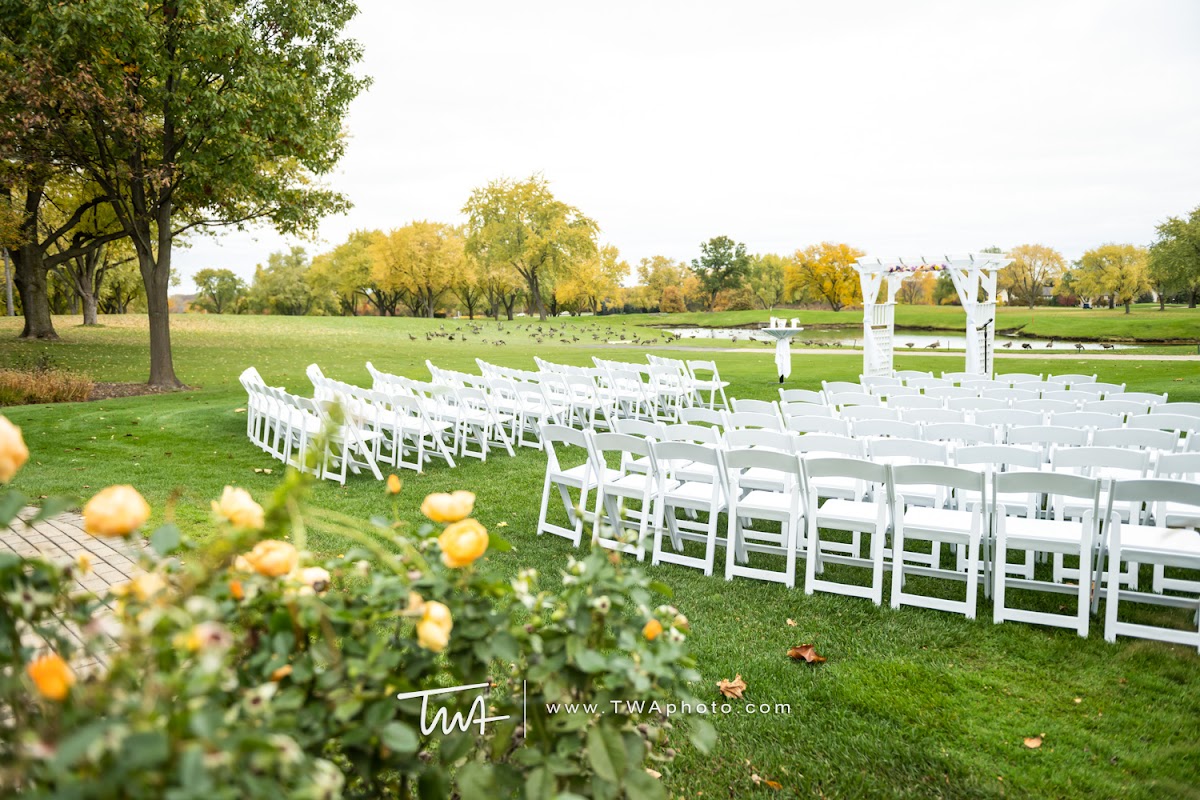
Setting: The outdoor ceremony space at Bloomingdale Golf Club is located on the manicured golf course grounds, typically positioned on a flat section of fairway or near a grove of mature trees that provides a natural backdrop. The setting is what you’d expect from a professionally maintained course: lush, rolling greenery, thick-trunked oaks and maples with broad canopies, and long sight lines that create a sense of spaciousness and privacy. The location feels secluded despite being visible from the clubhouse veranda, giving guests the sense that they’ve escaped to a countryside estate rather than a suburban venue twenty-five miles from Chicago. Depending on where the ceremony is positioned, the backdrop might be a tree line, a fairway stretching toward the horizon, or a carefully chosen angle that frames the couple against greenery and sky.
Floral approach: The natural beauty of the golf course is the primary design element here, so the floral approach should enhance rather than dominate. A ceremony arch or chuppah serves as the focal point — we recommend a wooden hexagonal arch or a simple birch frame adorned with asymmetric clusters of flowers and greenery rather than a fully covered structure. Use garden roses (Romantic Antike, Patience, Garden Rose Mayra), white or blush hydrangea, spray roses, and plenty of greenery — Italian ruscus, eucalyptus, and jasmine vine work beautifully. The goal is to create an organic, just-gathered look that complements the manicured but natural setting. For the aisle, shepherd’s hooks with hanging arrangements (mason jars or small metal buckets filled with seasonal blooms) add romance without overwhelming the greenery underfoot. Alternatively, simple low markers — clusters of flowers and greenery in bronze urns placed every few rows — provide definition without obstruction. Keep the palette soft and natural — ivory, blush, champagne, soft peach — to harmonize with the green landscape. Avoid anything too formal or symmetrical; the golf course setting calls for a more relaxed, garden-inspired aesthetic. And coordinate closely with the venue on setup timing — most golf courses require ceremony installations to happen later in the day to avoid interfering with morning play.
Wrap-around Veranda
Capacity: Flexible, depending on setup (typically used for cocktail hour or as ceremony overflow)
Setting: The wrap-around veranda is one of Bloomingdale Golf Club’s most versatile spaces, encircling the clubhouse and providing 360-degree access to the golf course grounds. The veranda is covered, with a traditional sloped roof supported by white painted columns, and the flooring is either composite decking or stone pavers (depending on the section). The space connects seamlessly to the Main Ballroom through multiple French doors, allowing guests to flow easily between indoor and outdoor areas. The veranda overlooks the fairways, the tree line, and often the ceremony site itself, making it an ideal location for cocktail hour. It’s also used occasionally for outdoor ceremonies when weather permits, though the dedicated lawn space is more common.
Floral approach: For cocktail hour, the veranda benefits from small, high-impact installations that don’t interfere with guest circulation. Scattered bud vases or small compote arrangements on cocktail tables (single stems of roses, lisianthus, or seasonal blooms) add elegance without crowding the surface. Near the entrance from the parking lot, a larger welcome arrangement — an oversized urn filled with flowering branches, hydrangea, and trailing greenery — sets the tone as guests arrive. If the veranda is being used as an extension of the ceremony space (for overflow seating or as a backdrop for the ceremony itself), the floral approach should echo the main ceremony installations: simple greenery garlands along the railings, small arrangements on pedestals at the entrance points, or clusters of flowers tied to the columns. The veranda’s connection to both the ballroom and the outdoor ceremony space makes it a natural location to establish floral continuity — use the same vessels, the same color palette, and the same flower varieties to create a cohesive visual thread that runs throughout the day. Keep arrangements low enough that they don’t obstruct the view of the ceremony or the golf course beyond.
Private Bridal Suite
Setting: The Private Bridal Suite is a full-sized dressing room reserved exclusively for the wedding party to prepare for the day. The space includes seating, mirrors, natural light, and privacy — essentially everything needed for getting-ready photos and last-minute touch-ups. While the suite isn’t used for guest-facing events, it’s an important space for the bride and bridesmaids, and it’s often heavily photographed during the early hours of the wedding day.
Floral approach: The bridal suite doesn’t require extensive floral installations, but a single, thoughtful arrangement makes a meaningful difference in both the ambiance and the photos. A small arrangement on a side table or dresser — perhaps a loose, garden-style bouquet in a ceramic or glass vase featuring the same flowers as the bridal bouquet — creates visual continuity and gives the photographer something beautiful to capture during detail shots. Consider using a few stems of the bride’s favorite flowers: garden roses (Juliet, Keira), ranunculus, sweet peas, and lush greenery. This is also an opportunity to repurpose the bridal bouquet itself if it’s been delivered early enough in the day; placing it in a vase in the bridal suite ensures it’s photographed in context and keeps the flowers hydrated until the ceremony. The cost is minimal, but the impact on getting-ready photos is substantial.
Wedding Flower Ideas for Bloomingdale Golf Club
Heritage Garden
This concept honors Bloomingdale Golf Club’s 1924 heritage with a soft, romantic palette and classic flower varieties that would have been cultivated in estate gardens of that era. The foundation is ivory and blush garden roses (Patience, Keira, Juliet, O’Hara), layered with white and blush ranunculus, spray roses (Bombastic, Majolika), and delicate sweet peas. Add textural accents with astilbe, tweedia, and scabiosa, and soften everything with trailing jasmine vine and Italian ruscus. Arrangements sit in vintage brass compote bowls, mercury glass vessels, and cream ceramic urns that echo the ballroom’s warm neutral palette. For the ceremony arch, use a wooden hexagonal frame adorned with asymmetric clusters of the same blooms, creating an organic, just-picked look. This palette photographs beautifully in the ballroom’s natural light and complements the golf course greenery visible through the windows. It’s timeless, elegant, and quietly romantic — the kind of design that feels appropriate for a venue with nearly a century of history.
Modern Meadow
For couples who want something less traditional, Modern Meadow takes a field-to-vase approach with wildflower-inspired textures and a more relaxed structure. The palette expands beyond blush and ivory to include soft yellows (Catalina or Lemonade roses), peach (Juliet roses, peach ranunculus), lavender (stock, scabiosa), and plenty of textured greenery (eucalyptus, Queen Anne’s lace, maiden hair fern, jasmine vine). Use a mix of vessels — clear glass cylinders, small bronze urns, ceramic pitchers — clustered in groups of three or five on guest tables for an organic, gathered look. The ceremony arch can be lighter and airier, with greenery as the primary element and flowers clustered at the base and corners rather than evenly distributed. This design feels fresh, seasonal, and slightly undone in the best possible way. It’s perfect for spring or summer weddings and pairs beautifully with the golf course’s natural landscape. The wildflower aesthetic works particularly well on the outdoor ceremony space, where it blends seamlessly into the surrounding greenery.
Vintage Elegance
For a more formal, opulent approach, Vintage Elegance leans into the ballroom’s chandeliers and classic country club aesthetic with a richer, more saturated palette. Use burgundy and deep red roses (Black Baccara, Hearts, or Tess), blush and ivory garden roses (Quicksand, Cappuccino, Keira), white hydrangea, and dark foliage (Italian ruscus, burgundy-toned eucalyptus). Arrangements are structured and full, sitting in tall gold candelabras, brass urns, or mirrored pedestals that elevate the florals above sightlines. For the head table, consider a low, continuous garland runner with roses, hydrangea, and trailing greenery interspersed with pillar candles in gold holders. The ceremony arch can be more symmetrical and fully covered, creating a dramatic focal point that reads as formal and intentional. Add touches of gold or antique brass in the vessels and candle holders to tie into the ballroom’s warm metallic accents. This palette is ideal for fall or winter weddings and photographs gorgeously in late afternoon light when the ballroom glows amber. It’s bold, romantic, and unapologetically elegant.
Seasonal Considerations
Bloomingdale, Illinois sits in USDA Hardiness Zone 5b, with cold winters, humid summers, and dramatic seasonal transitions that shape both the landscape and floral availability.
Spring (March–May): Spring arrives slowly in northern Illinois, with March still prone to freezing temperatures and occasional snowfall. By mid-April, the golf course comes alive with flowering trees — crabapples, magnolias, dogwoods — and the fairways turn vibrant green. This is peak season for tulips, daffodils, hyacinths, and ranunculus, all of which are locally available and affordable. Garden roses become more accessible in late April and May. Spring weather is unpredictable; outdoor ceremonies should have a backup plan, as afternoon thunderstorms and temperature swings (from 50°F to 70°F in a single day) are common. The golf course is lush and green by May, making it one of the most beautiful times of year for Bloomingdale Golf Club weddings. Floral installations hold up well in the cooler temperatures, and the natural light in the ballroom is bright and clear without the haze of summer humidity.
Summer (June–August): Summer in Bloomingdale is warm and humid, with daytime temperatures ranging from 75°F to 90°F and occasional heat waves pushing into the mid-90s. The golf course is at its peak — thick green fairways, mature trees in full leaf, and long daylight hours that extend golden hour well into the evening. Garden roses, hydrangeas, dahlias, and lisianthus are all in season and readily available. However, heat can be a challenge for floral installations, particularly for outdoor ceremonies. Choose heat-tolerant varieties (roses, hydrangeas, solidago) and avoid delicate blooms like sweet peas or anemones that wilt quickly in high temperatures. For outdoor ceremonies, schedule the start time for late afternoon or early evening to avoid the peak heat, and ensure arrangements are set up as close to the ceremony time as possible. The ballroom’s air conditioning keeps indoor florals fresh throughout the evening. Summer is also peak wedding season, so pricing for both venue dates and florals tends to be higher.
Fall (September–November): Fall is arguably the most spectacular season at Bloomingdale Golf Club. September and early October offer warm days and cool evenings, with the golf course framed by turning leaves in shades of gold, amber, and crimson. By mid-October, the tree canopy is at peak color, creating a natural backdrop that rivals any floral installation. This is prime season for dahlias (Café au Lait, Peaches and Cream), chrysanthemums, marigolds, and late-season roses. The cooler temperatures make outdoor ceremonies comfortable, and florals hold up beautifully throughout the day and evening. November transitions into late fall, with bare branches and a more subdued landscape; consider incorporating seasonal elements like burgundy foliage, wheat, dried grasses, and deep jewel-toned florals (burgundy dahlias, deep red roses, plum-toned calla lilies) to echo the season. Weather becomes more unpredictable in November, with the possibility of early snow or freezing rain, so indoor backup plans are essential.
Winter (December–February): Winter weddings at Bloomingdale Golf Club have a cozy, intimate quality, with the ballroom’s vintage chandeliers glowing warmly against the darkened windows. The golf course is dormant, often dusted with snow, which creates a striking minimalist backdrop. Winter florals lean heavily on imported blooms — amaryllis, anemones, ranunculus, hellebores, and evergreens (pine, fir, cedar) for texture. White and cream palettes with touches of evergreen and burgundy feel seasonally appropriate and photograph beautifully against the neutral ballroom. Consider incorporating candles extensively — pillar candles in gold or brass holders, tapered candles in vintage candelabras — to add warmth and ambiance. The venue provides heating and plowing services, making winter weddings logistically feasible, but guests will need clear directions and ample time to arrive safely. Winter is also the most affordable season for venue rental, and floral availability (while more limited) can be supplemented with greenery and branches for a lush, textured look at a lower cost.
Poppy’s Expert Take
Embrace the window wall, don’t compete with it. That 200-foot expanse of glass overlooking the golf course is the ballroom’s defining feature, and it should dictate your entire floral strategy. Keep centerpieces low (under twelve inches) or dramatically elevated (over twenty-four inches on clear risers) to preserve sightlines. The view is your backdrop; the flowers are the frame. Any arrangement that blocks the windows is working against the venue’s greatest asset. When consulting with Poppy, bring photos of the ballroom at the time of day your reception will take place — the light changes dramatically from afternoon to evening, and that affects how florals will photograph.
Plan for the golf course ceremony logistics early. If you’re planning an outdoor ceremony on the fairway or near the tree line, coordinate setup timing with the venue’s golf operations team. Most courses can’t accommodate ceremony installations until late morning or early afternoon, which means your florist will be working on a compressed timeline. Confirm load-in windows, golf cart access for transporting arrangements, and whether the venue allows stakes or shepherd’s hooks to be placed in the grass (some courses are protective of their turf and restrict ground installations). Have a detailed weather backup plan, and communicate to your florist whether ceremony florals will be moved indoors or if you’ll need duplicate installations for both spaces.
Use the veranda as a transitional design moment. The wrap-around veranda connects the outdoor ceremony space to the indoor ballroom, making it the perfect location to establish visual continuity. Repeat your ceremony florals in miniature on the veranda — a small version of your ceremony arch arrangement at the veranda entrance, or the same bud vases from cocktail tables echoing the aisle markers outside. This creates a cohesive floral narrative throughout the day and ensures that no single space feels disconnected from the overall design.
Take advantage of the bridal suite for getting-ready photos. Photographers spend significant time in the bridal suite capturing details, dresses, shoes, jewelry, and candid moments. A single, well-placed floral arrangement makes those photos exponentially more beautiful and creates a cohesive aesthetic when the full wedding gallery is delivered. Ask your florist to include a small arrangement (even just a few stems in a bud vase) as part of your personal flowers package. It’s a minimal cost with maximum photographic impact.
Consider floral installation timing for optimal light. The ballroom’s floor-to-ceiling windows flood the space with natural light, but that light changes throughout the day. If your reception begins in late afternoon, the western exposure will create a warm, golden glow that enhances blush, peach, and champagne-toned florals. If your reception begins at sunset, the light will be cooler and softer, which can wash out pale florals but makes jewel tones and deeper colors sing. Discuss timing with your florist and choose your palette accordingly. Also consider that once the sun sets, the windows turn into dark mirrors, reflecting the room back at itself — which is why candlelight and chandelier lighting become critical for ambiance after dusk.
Budget for the ceremony arch as your primary focal point. At Bloomingdale, the ceremony arch or chuppah is the single most photographed floral installation of the day (aside from the bridal bouquet). Guests will see it during the ceremony, it will be the backdrop for your vows, and it will appear in countless photos. If you’re working with a limited budget, prioritize the ceremony flowers first, then reception centerpieces. A stunning ceremony arch with minimal reception florals will always photograph better than elaborate centerpieces with a bare ceremony backdrop.
Communicate your vision for the chandeliers early. The vintage chandeliers in the ballroom are beautiful on their own, and many couples prefer to leave them unadorned. If you do want to incorporate florals — perhaps a hanging greenery installation above the dance floor — make sure your florist understands the height, the structure, and the venue’s restrictions on what can be attached to the fixtures. Suspended installations require rigging, which means additional labor and materials. Decide early whether this is worth the investment, or whether you’d rather allocate that budget to more impactful installations elsewhere.
What Poppy Couples Spend on Flowers Here
While Poppy hasn’t yet completed a wedding at Bloomingdale Golf Club, we’ve received 19 inquiries from couples planning weddings here, and based on comparable country club venues in the Chicago area, most couples invest between $3,500 and $8,500 on wedding flowers. Here’s how that typically breaks down across three budget tiers:
$3,500 – $5,000 | The Essentials This tier covers the foundational floral elements for a Bloomingdale Golf Club wedding: bridal bouquet, bridesmaid bouquets (4–5), boutonnieres (6–8), corsages (2–3), low centerpieces for guest tables (15–18 tables), and a simple ceremony arch with moderate floral coverage. Arrangements use a focused palette of two to three flower varieties (garden roses, spray roses, and greenery, for example) in classic colors like ivory, blush, and champagne. Centerpieces are low and lush in compote bowls or simple glass vessels, and the ceremony arch is a wooden or metal frame with asymmetric clusters of flowers and greenery rather than full coverage. This budget works well for couples having a ceremony on the golf course with a reception in the Main Ballroom, where the natural beauty of the setting does much of the decorative work. You’ll have beautiful, cohesive florals that complement the venue without overwhelming your budget.
$5,000 – $7,500 | The Full Picture This mid-tier budget allows for more variety, more installations, and more visual impact. In addition to all personal flowers and guest table centerpieces, you can add a larger, more densely covered ceremony arch, aisle markers (shepherd’s hooks with hanging arrangements or clusters of florals on pedestals every few rows), a welcome arrangement for the veranda entrance, florals for the bar or cocktail tables, and either elevated centerpieces on alternating tables or additional floral moments like a head table garland or a floral installation near the entrance to the ballroom. The palette expands to include three to five flower varieties (garden roses, ranunculus, hydrangea, lisianthus, and spray roses) with textural accents like astilbe, scabiosa, or tweedia. This tier is ideal for couples who want their Bloomingdale Golf Club wedding flowers to feel abundant and lush without being extravagant, and it’s the sweet spot for most weddings at this venue.
$7,500+ | The Full Experience At this level, florals become a defining element of your wedding design. You’ll have everything from the mid-tier, plus statement installations that create “wow” moments: a fully covered ceremony arch or chuppah, a suspended floral installation above the dance floor or head table, large-scale arrangements flanking the ballroom entrance, lush florals throughout the veranda and cocktail areas, and the option to include specialty blooms like peonies (in season), garden roses in unique varieties (Juliet, Patience, Keira), or imported flowers like anemones and hellebores. Centerpieces can be varied and dramatic — mixing low, lush arrangements with tall elevated designs on mirrored or glass pedestals, or creating a continuous garland runner for the head table. This budget also allows for extensive greenery installations, such as garlands along the veranda railings or framing the ballroom windows. The result is a fully immersive floral experience where every space feels intentional, cohesive, and abundant. This tier is for couples who view flowers as a central part of their wedding aesthetic and want to create a lush, romantic atmosphere that complements Bloomingdale’s historic elegance.