
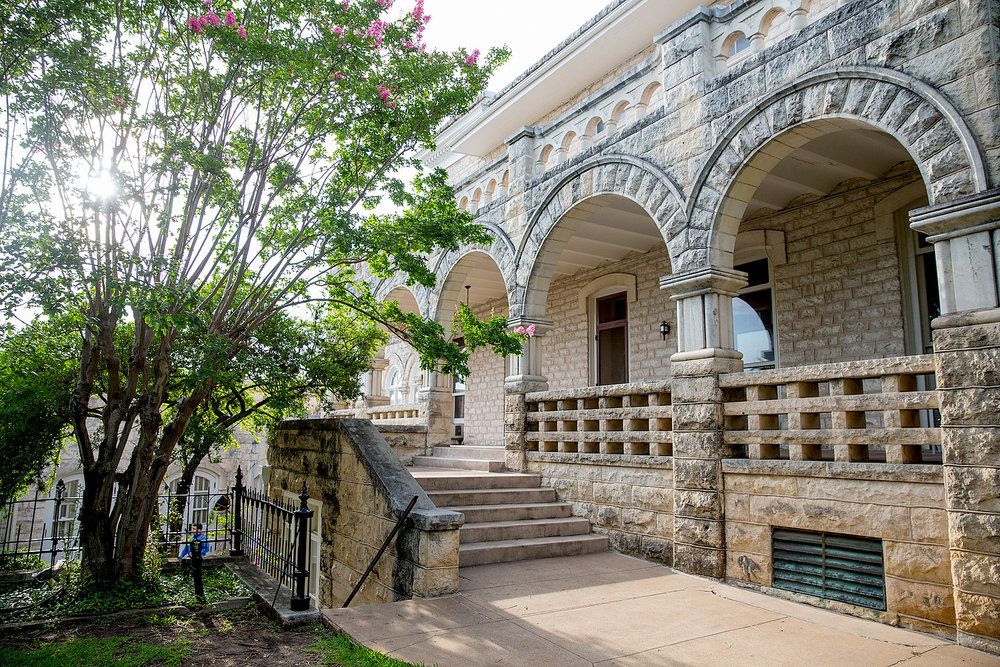
You don’t expect it, tucked behind the bars and construction and traffic noise of downtown Austin. You park in the lot off San Antonio Street — which is already remarkable, free parking downtown — and then you walk through an unassuming gate, and suddenly you are standing in front of a limestone mansion that could have been lifted from the Loire Valley. Chateau Bellevue, built in 1874 as the Bremond House, rises three stories with hand-carved details, stained glass windows that catch the Texas sun in jewel tones, and those unmistakable French Romanesque arches that frame doorways, windows, and the courtyard like a series of stone embraces. Inside, the grand staircase curves upward beneath carved banisters. The Grand Ballroom stretches wide and open, all honey-toned hardwood and a Baby Grand Piano waiting on a raised stage. And then, in the back, you step into the courtyard — where a massive magnolia tree spreads its glossy green canopy and the city noise fades to nothing — and you understand why couples fall for this place. It is an escape without leaving the city, a 19th-century European manor house one minute from Sixth Street. Poppy has designed Chateau Bellevue wedding flowers for 2 celebrations here, and each time we pull up with our van full of blooms, we feel that same small shock of delight: this exists, here, now, in the middle of Austin.
About Chateau Bellevue
Chateau Bellevue occupies a rare position in Austin’s wedding landscape: it is genuinely historic — 150 years old, built by prominent Austin merchant Eugene Bremond during Reconstruction — and genuinely downtown, located at the corner of West 8th and Nueces. Most venues offer one or the other. This one delivers both. The architecture is French Romanesque Revival, executed in locally quarried limestone with intricate hand-carved details that have survived a century and a half of Texas weather. The stained glass windows, original to the house, throw colored light across the interior rooms. The grand staircase, which appears in approximately 90% of the wedding photos taken here, features hand-carved balustrades and newel posts that are small works of craft. This is not a replica or a restoration gone too far. This is the real thing, maintained with care and adapted thoughtfully for modern events.
The property includes multiple indoor and outdoor spaces across three levels, from the intimate Chateau Library to the 150-person Grand Ballroom to the rooftop patio with its downtown skyline views. The courtyard, anchored by that magnificent magnolia tree, functions as both ceremony site and cocktail space depending on the season and the couple’s vision. The upper terrace offers another outdoor ceremony option with stone architecture as the backdrop. What makes the venue particularly appealing for destination weddings — and a significant portion of Chateau Bellevue’s bookings come from out-of-state couples drawn to Austin’s music and food scene — is the combination of character and convenience. Your guests can walk to dinner on Sixth Street after the rehearsal. They can stay at any of a dozen downtown hotels within a ten-minute drive. And yet the wedding itself feels tucked away, private, a world apart.
Logistically, Chateau Bellevue operates as a full-service venue with required in-house catering provided by their executive chef. The food program here earns consistent praise — this is not generic ballroom fare but thoughtful, locally sourced cuisine that reflects Austin’s culinary identity. The venue provides all table linens, china, flatware, and glassware as part of the base package, along with 20 round tables, 10 rectangular banquet tables, and 150 cushioned gray chairs. Couples bring their own alcohol (BYOB), which the venue staff serves, a cost-saving arrangement that sets Chateau Bellevue apart from venues with steep bar minimums. The 80-space private parking lot is another downtown rarity that eliminates guest stress and valet expenses.
For Poppy’s delivery and setup, access is straightforward with advance coordination through the venue’s events team. Load-in happens through the main entrance, and the staff is accustomed to working with outside florists, photographers, and DJs (all permitted, unlike the catering restriction). The venue requires liability insurance for couples and vendors, a standard ask. One practical note: the historic building lacks central air conditioning on the upper floors, so summer getting-ready sessions in the Bridal and Groom’s Suites can be warm. Plan accordingly with fans, hydration, and makeup artists who understand Texas heat. For floral installations, the venue is protective of the historic finishes — no nails, no tape on walls — but the staff is solution-oriented and helps us work around those constraints with hooks, easels, and freestanding arrangements.
Event Spaces & Floral Opportunities
Grand Ballroom
Capacity: 150 seated
Setting: The Grand Ballroom is where most Chateau Bellevue receptions unfold, and it earns that honor. The space runs nearly the full width of the building with a large, unobstructed hardwood dance floor that gleams under the room’s chandeliers. At one end, a raised stage holds the Baby Grand Piano — functional, not decorative, and often played during dinner or the first dance. French doors line one wall, opening onto interior hallways and allowing cross-ventilation on temperate evenings. The ceiling is high but not cavernous, the walls painted in warm cream, and the overall effect is elegant without being fussy, classic without feeling dated. The room accommodates up to 20 round tables comfortably with plenty of space for the dance floor, the stage, and a head table if desired.
Floral approach: The Grand Ballroom’s neutral palette and classic proportions make it a florist’s dream — almost anything works here, provided it’s executed well. Centerpieces can run low and lush (garden roses, ranunculus, and spray roses in ceramic compotes that sit 8-10 inches tall, allowing sightlines across tables) or dramatically elevated (arrangements on 24-inch clear glass risers that lift blooms above the conversation zone). For couples who want maximum impact, flanking the stage with two large-scale arrangements — we often use tall silver urns filled with branches, hydrangea, and cascading amaranthus in the couple’s palette — frames the piano beautifully and anchors the room visually. The hardwood floor allows for additional statement moments: a pair of arrangements flanking the ballroom entrance, perhaps in aged brass vessels with Quicksand roses, white lisianthus, and trailing jasmine vine. If the couple opts for a sweetheart table instead of a head table, that becomes another opportunity for a lush, asymmetrical installation that photographs beautifully against the stage backdrop. The room’s lighting is warm, which flatters most florals, though we always recommend a lighting designer for evening receptions to add uplighting and pinspots that bring the arrangements to life after sunset.
Courtyard
Capacity: Flexible, typically 80-100 for ceremonies
Setting: Step through the French doors at the back of the house and you enter the courtyard, a limestone-paved outdoor space that feels impossibly private for its downtown address. The centerpiece is a mature magnolia tree with a canopy that spreads 30 feet, providing dappled shade and a natural focal point. French Romanesque arches frame two sides of the courtyard, their limestone glowing gold in afternoon light. The space is intimate, enclosed by the mansion on one side and garden walls on the others, with climbing vines softening the stone. String lights are often hung between the arches and the tree, creating a canopy of light for evening events. The courtyard serves triple duty: ceremony site, cocktail hour space, and occasionally dinner for smaller weddings who want an al fresco experience.
Floral approach: The magnolia tree is the star here, and our job is to support, not compete with, its presence. For ceremonies held under the tree, we typically recommend a simple aisle treatment — low arrangements in natural stone or concrete vessels placed every other row, filled with blooms that complement the magnolia’s dark green foliage. White and ivory palettes work beautifully (Playa Blanca roses, white ranunculus, ivory lisianthus), as do softer palettes with blush, peach, and champagne tones. The ceremony arch or backdrop is where we can make a statement: a freestanding wooden arch draped with smilax garland and clusters of garden roses, or a circular moon gate installation wrapped in Italian ruscus with trailing ribbons and seasonal blooms. The French Romanesque arches themselves are ideal for floral garlands — we drape them with greenery (seeded eucalyptus, silver dollar eucalyptus) and tuck in blooms at intervals, creating a romantic frame without overwhelming the architecture. For cocktail hour, we add arrangements to the high-top tables (compact designs in bud vases or small compotes, around 6-8 inches tall, so guests can set drinks down without knocking over flowers) and often place a larger arrangement on the bar if one is set up in the courtyard. The space is naturally beautiful; our florals simply amplify what’s already there.
Upper Terrace
Capacity: 80-100 for ceremonies
Setting: The Upper Terrace is accessed via an exterior staircase and sits on the building’s second level, overlooking the courtyard below. The terrace itself is stone, framed by the mansion’s limestone walls and wrought-iron railings. The backdrop for ceremonies here is pure architecture — carved stone, arched windows, and the building’s historic façade. It is a more dramatic, elevated ceremony space than the courtyard, with the height adding a sense of occasion and the stone backdrop photographing like something out of Provence.
Floral approach: The architecture here is so strong that it can handle — and even demands — equally strong floral moments. We love a large freestanding arch placed at the ceremony site, substantial enough to hold its own against the stone walls. A wooden hexagonal arch wrapped entirely in greenery (Italian ruscus, eucalyptus, olive branches) with asymmetrical clusters of blooms (Café au Lait dahlias, Juliet garden roses, white anemones, scabiosa) creates a lush, organic focal point. Aisle arrangements should be low and grounded — terracotta pots or stone urns filled with blooms that echo the arch’s palette, placed at each row or every other row depending on budget. The stone terrace can get hot in full sun, so timing matters; spring and fall ceremonies here are ideal, and for summer weddings, we recommend late afternoon start times when the building casts shade. The terrace’s elevation means wind can be a factor — choose sturdy vessels with wide bases, and avoid tall, top-heavy arrangements on aisle markers. After the ceremony, these arrangements can be easily moved to the Grand Ballroom or courtyard for the reception, maximizing the floral budget.
Rooftop Patio
Capacity: 50-75 for cocktails
Setting: The Rooftop Patio is Austin embodied — a modern urban space atop a 19th-century mansion, with downtown’s skyline rising in one direction and the Texas State Capitol dome visible in the other. The patio surface is concrete with metal railings, and the vibe is decidedly contemporary, a sharp contrast to the historic interiors below. This space works best for cocktail hour, particularly at sunset when the light turns the city golden and the temperature drops just enough to be pleasant. Some couples also use it for a post-ceremony champagne toast or as a lounge area during the reception.
Floral approach: The rooftop calls for a different floral vocabulary than the rest of the venue — cleaner lines, more architectural shapes, and blooms that read as modern. We often use elevated vessels here: tall cylindrical glass vases (20-24 inches) with submerged stems and a single variety — all white tulips, all Sahara roses, all calla lilies — for a sculptural, minimalist look. For high-top cocktail tables, we keep arrangements compact and wind-resistant: low glass cubes or concrete vessels with succulents, craspedia, protea, or other sturdy blooms that won’t shatter in a gust. The skyline is the view, so florals should enhance the tables without blocking sightlines. If the couple wants a bar installation, this is the place for it — a long, low arrangement running the length of the bar with tropical foliage (monstera leaves, palm fronds) and bold blooms (bird of paradise, anthurium, orange roses) that lean into Austin’s sun and heat rather than fighting it. Avoid delicate blooms like sweet peas or fritillaria up here; they wilt too quickly in the sun and wind. And always weight your vessels — a sudden gust off downtown’s glass towers can send a tall vase toppling.
Chateau Library
Capacity: 20-30 for intimate gatherings
Setting: The Chateau Library is a jewel box of a room, lined with built-in bookshelves, vintage furniture, and stained glass windows that cast colored light across the hardwood floor. The scale is intimate, the atmosphere hushed and elegant, and the room functions beautifully as a cocktail space, a lounge area during the reception, or the site for a small, family-only ceremony or dinner.
Floral approach: Small, detailed, considered. The Library demands arrangements with a sense of history and craft — vintage blooms in antique vessels, not modern statements. We love using old brass candlesticks as bud vases, each holding a single Quicksand rose or a stem of hellebore. Or a collection of mismatched vintage teacups arranged on the mantle, each with a small posy of ranunculus, spray roses, and dusty miller. For a cocktail table, a low arrangement in a silver compote filled with blush garden roses (Keira, Patience), white lisianthus, and seeded eucalyptus feels appropriately scaled. If the Library is serving as the guest book area, we create a small arrangement for the table — something detailed enough to withstand close inspection, with interesting textures like scabiosa pods, tweedia, or nigella. The stained glass windows throw color across everything, so we pay attention to how our floral palette interacts with those tones — soft pinks, ivories, and mauves tend to harmonize beautifully, while stark whites can look washed out in the colored light.
Evans Dining Room
Capacity: 30-40 seated
Setting: The Evans Dining Room serves as an auxiliary dining space, often used for rehearsal dinners, intimate wedding dinners, or as an overflow area for larger receptions. The room features elegant wood paneling, traditional furnishings, and large windows that let in abundant natural light during the day.
Floral approach: Florals here should coordinate with the main reception in the Grand Ballroom but scaled to the room’s more intimate proportions. Centerpieces on the dining tables can be slightly more elaborate than cocktail arrangements but still low enough to encourage conversation — think 10-12 inches tall. Garden-style compote arrangements with a mix of garden roses, ranunculus, stock, and greenery in ceramic or silver vessels work beautifully. If the room is being used for a rehearsal dinner, we sometimes create one larger statement arrangement for the head table or a sideboard, with cascading greenery and a more textured, organic feel. The wood paneling provides a warm, neutral backdrop that flatters most palettes, though richer tones (burgundy, plum, burnt orange) tend to look especially elegant against the wood.
Stone Balcony
Capacity: Not a functional event space, but a major photo location
Setting: The Stone Balcony is one of Chateau Bellevue’s most photographed features — a limestone balcony with carved stone arches overlooking downtown Austin. Most couples don’t hold events here, but every couple takes portraits here, particularly at sunset when the light is magic.
Floral approach: Because the balcony is historic stone and structurally delicate, we can’t install large arrangements or hang anything from the arches. What we can do is place a few carefully chosen potted arrangements — terracotta pots with blooming plants (white hydrangea, lavender, ornamental grasses) — near the balcony entrance to add color and texture to the background of photos. Some couples request a small bouquet or two placed on the stone ledge for close-up detail shots. The key is keeping everything lightweight, movable, and non-invasive to the structure. The balcony itself is so photogenic that it needs very little help from us.
Grand Staircase
Capacity: Photo backdrop and transition space
Setting: The grand staircase, with its hand-carved wood banisters and graceful curve, is a signature feature of the mansion and a favorite spot for family portraits, couple portraits, and bridal party photos. It connects the first and second floors, and guests pass by it throughout the event.
Floral approach: The staircase is an ideal location for a floral installation that guests will see repeatedly throughout the evening. We often run a garland along the banister — lush greenery (smilax, Italian ruscus, seeded eucalyptus) with clusters of blooms tucked in at intervals. The garland can be as simple or elaborate as budget allows: a basic greenery garland with blooms every few feet reads as elegant and understated, while a fuller installation with roses, ranunculus, and trailing amaranthus woven throughout becomes a show-stopping moment. We secure the garland with floral zip ties (which don’t damage the wood) and check multiple times during setup to ensure it’s stable — the last thing anyone wants is a garland sliding down mid-reception. At the base of the staircase, a large floor arrangement in an urn or tall vessel creates a focal point for photos and signals the transition from one level to the next. The staircase has beautiful natural light during the day, so we often schedule a portion of setup here during daylight hours to take advantage of those conditions for our own behind-the-scenes documentation.
Bridal Suite
Setting: The Bridal Suite is spacious and well-lit, designed for getting ready with plenty of room for the bride, bridesmaids, hair and makeup artists, and the photographer capturing it all. The suite includes mirrors, seating, and enough square footage that it doesn’t feel cramped even with a full bridal party.
Floral approach: A small, elegant arrangement for the getting-ready space adds a touch of luxury and provides a beautiful detail for photos. We typically deliver a low arrangement in a ceramic or glass vessel — garden roses, ranunculus, and greenery in the wedding palette — that sits on a table or vanity where it won’t be in the way but will appear in the background of photos. Some brides also request a few loose stems (single roses, eucalyptus sprigs) for styling shots with the dress, shoes, rings, and invitation suite. The Bridal Suite gets warm in summer, so we use blooms that hold up well in heat (roses, lisianthus) and deliver them as late as possible in the setup timeline.
Groom’s Suite
Setting: The Groom’s Suite is located on an upper floor and provides a separate getting-ready space for the groom and groomsmen. The room is comfortable but tends to run warmer than the Bridal Suite due to heat rising in the historic building.
Floral approach: We keep it simple and masculine: a small arrangement in a modern vessel — concrete, black ceramic, or brushed metal — with greenery (eucalyptus, olive branches) and either no blooms or a few understated ones (succulents, white roses, dark burgundy dahlias). The arrangement should feel intentional but not precious, something the guys won’t worry about knocking over. Like the Bridal Suite, we deliver this as late as possible in our setup schedule to keep everything looking fresh despite the room’s warmth.
Wedding Flower Ideas for Chateau Bellevue
Belle Époque
This concept leans into the mansion’s 1874 origins with a palette and style that feels transported from turn-of-the-century Paris. The color story is soft and romantic: blush pink, ivory, champagne, with accents of dusty lavender and mauve. We use garden roses almost exclusively — Keira, Patience, Juliet, and Romantic Antike — combined with blush ranunculus, white sweet peas, lavender stock, and dusty miller for texture. The arrangements sit in antique silver compotes, vintage brass vessels, and milk glass vases that look like they could have been part of the Bremond family’s original table settings. For the Grand Ballroom, we create low, lush centerpieces that cascade slightly over the edges of the vessels, garden-style and organic. In the courtyard, we drape the French Romanesque arches with garlands of seeded eucalyptus and tuck in clusters of roses. The ceremony arch is either draped fabric (silk in champagne or blush) adorned with asymmetrical floral clusters, or a simple wooden frame completely covered in blooms and foliage. This palette photographs beautifully in the stained glass light of the interior rooms and complements the limestone’s warm tones throughout the property.
Modern Magnolia
Named for the courtyard’s iconic tree, this concept balances the historic architecture with contemporary Austin style. The palette is clean and graphic: white, deep green, and black (or very dark burgundy for a softer take). We use architectural blooms with strong shapes — white calla lilies, white anthuriums, white phalaenopsis orchids — combined with lush greenery like monstera leaves, Italian ruscus, and magnolia foliage (a nod to the courtyard tree). Vessels are modern: sleek black ceramic cylinders, matte white cube vases, and clear glass with submerged stems. In the Grand Ballroom, centerpieces are tall and sculptural on clear risers, creating negative space beneath the blooms that keeps tables feeling uncluttered. On the Rooftop Patio, we lean fully into the modern aesthetic with minimalist arrangements and metallic accents. For the ceremony in the courtyard, the arch is a simple geometric shape — hexagonal or circular — wrapped entirely in magnolia foliage with clustered white blooms at the base and top. The effect is clean, sophisticated, and distinctly contemporary while respecting the venue’s history. This concept works particularly well for couples who love both Austin’s modern food and art scene and the Chateau’s Old World charm, and who want their florals to bridge that duality.
Texas Wildflower Elegance
Austin sits at the edge of the Hill Country, where bluebonnets and Indian paintbrush carpet the roadsides every spring. This concept takes that Texas wildflower heritage and elevates it for a black-tie ballroom. The palette is vibrant but not garish: true blue (delphinium, tweedia), burnt orange (ranunculus, marigolds), bright yellow (billy balls, garden roses), coral (ranunculus, tulips), and white to ground it all. We mix these cultivated versions of wildflower colors with textured greenery — native grasses, wild olive branches, and jasmine vine. Arrangements are loose and organic, gathered-from-the-meadow in style but executed with polish. Vessels are natural materials: terracotta pots, weathered wood boxes, ceramic crocks in earth tones. In the Grand Ballroom, this style creates a warm, joyful atmosphere — the kind of celebration that feels inherently Texan without veering into kitsch. In the courtyard, we add pops of color throughout the space with arrangements on cocktail tables and garlands on the arches. The ceremony arch could be a simple wooden structure adorned with clusters of wildflower-inspired blooms and trailing grasses. This concept works beautifully for spring weddings (March through May when actual wildflowers are blooming) and for couples who want to honor Texas’s natural beauty while celebrating in an elegant, historic setting. It is also significantly more budget-friendly than rose-heavy designs, as many of these blooms are more affordable and regionally abundant.
Seasonal Considerations
Spring (March-May) is peak wedding season in Austin, and for good reason. Temperatures are mild — typically 70s and 80s — and the Hill Country comes alive with wildflowers. This is the season to lean into Texas’s natural beauty with bluebonnets, paintbrush, and other wildflower-inspired palettes. Locally, we have excellent availability of ranunculus, tulips, anemones, and sweet peas. The courtyard and Upper Terrace are ideal for ceremonies during spring, as the weather is reliably pleasant and outdoor spaces are comfortable without additional cooling. Spring is also when the Chateau’s magnolia tree blooms, creating an incredibly lush backdrop for courtyard ceremonies. The main challenge in spring is rain — March and April can bring sudden afternoon thunderstorms — so always have a backup plan for outdoor events. The Grand Ballroom provides a beautiful indoor ceremony option if needed.
Summer (June-August) in Austin is hot. Genuinely, relentlessly hot, with temperatures regularly exceeding 95°F and humidity that makes it feel even warmer. For Chateau Bellevue weddings during summer months, we strongly recommend evening ceremonies (after 6 PM) to avoid the worst of the heat, and prioritize indoor or shaded spaces. The courtyard becomes less comfortable for extended periods during peak afternoon heat, though it works well for brief ceremonies or evening cocktail hours once the sun is lower. Floral-wise, we choose heat-tolerant blooms: roses (especially spray roses), lisianthus, celosia, sunflowers, zinnias, and tropical flowers like ginger and anthurium. Delicate blooms like sweet peas and garden roses with many petals can wilt quickly in Austin’s summer heat, even with proper hydration. We also build extra time into our setup schedule to keep arrangements in our climate-controlled van until the last possible moment. The Rooftop Patio is best utilized for sunset cocktails in summer, when the city lights come up and the temperature drops slightly. Consider providing fans, parasols, or cold towel stations for guest comfort at outdoor spaces.
Fall (September-November) is Austin’s second prime wedding season, with September still quite warm but October and November offering ideal weather — sunny days in the 70s and 80s, cool evenings, and lower humidity. Fall brings a shift in available blooms: dahlias are at their absolute peak, chrysanthemums arrive, and we have access to beautiful autumn foliage and berries. This is the season for richer color palettes — burgundy, burnt orange, deep plum, mustard yellow — that complement the Chateau’s limestone and the autumn light. All outdoor spaces are in play during fall, and we often see couples choose courtyard ceremonies followed by receptions in the Grand Ballroom. The evening light during October and November is particularly stunning, golden and warm, which makes the Stone Balcony and exterior photos extraordinary. Fall is also when Texas olive branches and native grasses are at their most beautiful, perfect for adding texture to arrangements and installations. The main consideration for fall weddings is timing: book early, as October and November dates fill quickly.
Winter (December-February) in Austin is mild by most standards, with daytime temperatures typically in the 50s and 60s, though cold snaps can bring freezing weather for brief periods. Winter is an underrated season for Chateau Bellevue weddings — fewer couples book these months, which can mean better pricing and availability, and the venue’s historic interiors feel especially cozy during cooler weather. The Grand Ballroom becomes the heart of the celebration, with the Baby Grand Piano, warm lighting, and elegant décor creating a romantic winter atmosphere. Florally, winter is the season for rich textures and deeper colors: amaryllis, ranunculus (which actually peaks in winter and early spring), anemones, hellebores, and evergreen foliage. We love incorporating seasonal elements like magnolia leaves, cedar, pine, and berries for texture and a subtle nod to the season. White and ivory palettes feel especially elegant during winter, with white amaryllis, white ranunculus, and silver brunia creating a sophisticated, almost ethereal look. December weddings can lean into subtle holiday elements — evergreen garlands, white blooms, mercury glass vessels — without feeling overly Christmas-themed. The courtyard can still be used for cocktail hour or brief ceremonies during winter, but have heaters and blankets available for guest comfort, and be prepared to move indoors if a cold front rolls through.
Poppy’s Expert Take
The Staircase Installation is Worth It. That grand staircase is in nearly every photo, and guests pass it repeatedly throughout the night — it’s one of the few floral installations that truly every attendee will see and appreciate. A lush garland running the length of the banister, even a relatively simple one with smilax and