
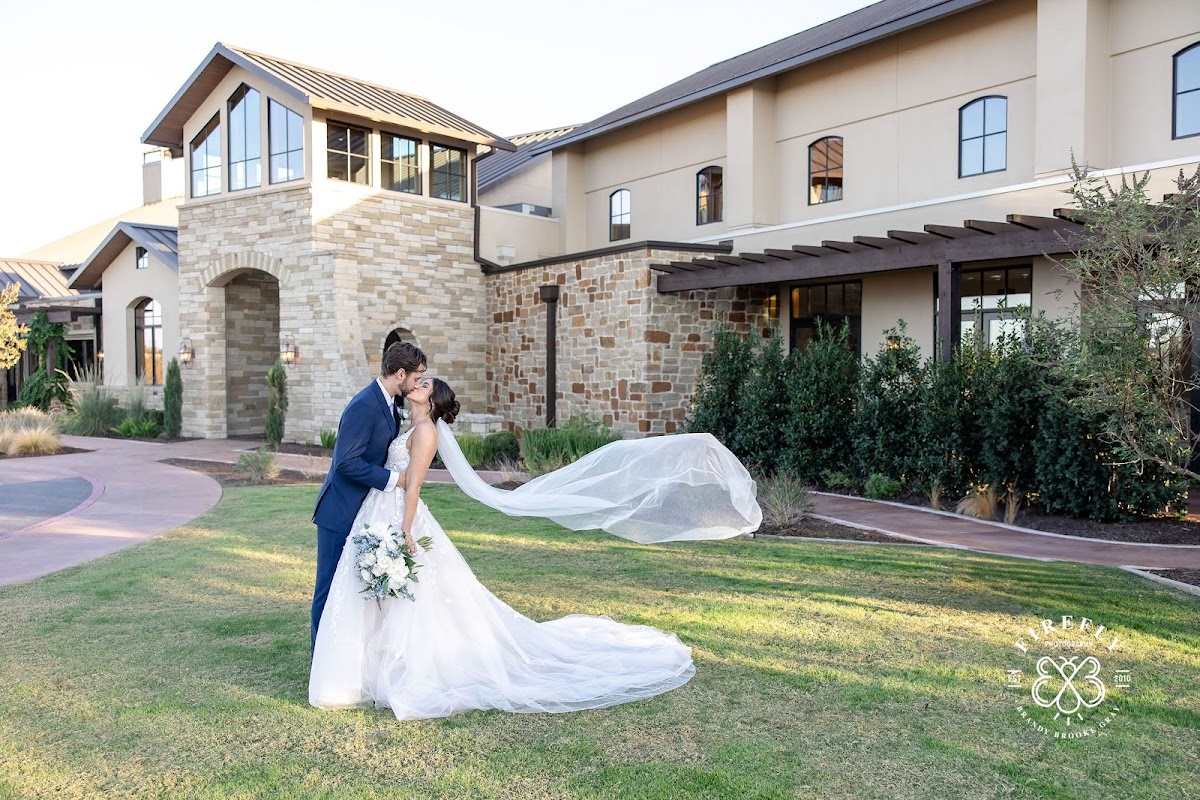
The road out to Canyonwood Ridge teaches you something before you ever set foot inside the building. You wind west from Austin along Ranch Road 12, the terrain lifting and folding as strip malls and traffic lights give way to cedar breaks and limestone outcroppings, until the Hill Country opens up around you in every direction. Then you turn onto South Canyonwood Drive, climb a ridge, and there it is — a 12,000-square-foot facility perched at the edge of the world, or at least at the edge of a view so wide and wild that it feels like the world’s ending and beginning at the same time. Rolling hills layered in cedar and live oak, the sky enormous above them, and that particular quality of Texas Hill Country light that turns everything golden for about forty-five minutes every evening. This is Dripping Springs, the self-declared Wedding Capital of Texas, and Canyonwood Ridge is one of the reasons the town earned that title.
Poppy has designed flowers for 8 weddings at Canyonwood Ridge — more than enough to know this venue intimately. We have watched brides gasp when the retractable barn doors slide open to reveal 250 seated guests in candlelight. We have watched the sunset pour through the chapel’s panoramic windows and turn white garden roses the color of apricot preserves. We have stood on the trellis ceremony site at golden hour and understood, viscerally, why couples keep coming back to this particular ridge. At an average floral investment of $2,750, Canyonwood Ridge weddings tend to land in a sweet spot where the venue does so much heavy lifting atmospherically that flowers can be focused, intentional, and deeply personal rather than compensatory.
About Canyonwood Ridge
Canyonwood Ridge occupies a rare position in the Dripping Springs wedding landscape. Where many Hill Country venues lean hard into the rustic barn aesthetic — reclaimed wood, tin roofs, hay bale seating — Canyonwood takes a different path. The architecture is contemporary and minimalist, with clean lines, neutral tones, and enormous windows designed to frame the landscape rather than compete with it. The result is a venue that feels both modern and deeply rooted in its setting, a building that understands the Hill Country without cosplaying as a farmstead.
The facility spans 12,000 square feet and includes an indoor chapel, a reception hall with those now-famous retractable barn doors, a covered patio, a landscaped Great Lawn, an 800-square-foot bridal suite (recently expanded in 2025), and a dedicated groom’s room. Outside, the Outdoor Trellis Ceremony Site sits at the ridge’s highest point, flanked by mature live oaks that have been standing watch over this particular stretch of limestone for longer than anyone can remember.
The logistics at Canyonwood Ridge reflect a venue that has thought carefully about the wedding day timeline. Couples receive 15 hours of exclusive access, from 9 AM to midnight, which is unusually generous for the market. That early start time matters tremendously for floral teams — it means your Dripping Springs wedding florist can begin installation at a civilized hour without the pressure-cooker setup windows that plague venues offering only six or eight hours of access. The entire property is 100% handicap accessible, a detail that matters more than people realize until they need it.
Dripping Springs itself sits about 25 miles west of downtown Austin along Highway 290, a corridor that has become increasingly dotted with wineries, distilleries, and event venues over the past decade. The town maintains a rural character — population hovering around 5,000 — while benefiting from proximity to Austin’s international airport, hotels, and restaurant scene. For destination wedding guests flying in from out of state, the combination of Austin accessibility and Hill Country atmosphere is hard to beat. Most couples house their guests in hotels along the 290 corridor or in downtown Austin, with shuttle service bridging the 35-minute drive.
Event Spaces & Floral Opportunities
Outdoor Trellis Ceremony Site
Capacity: 300 seated
Setting: The Outdoor Trellis Ceremony Site is where Canyonwood Ridge makes its most dramatic first impression. Positioned at the ridge’s apex, the site offers unobstructed 180-degree views of the Hill Country — layer upon layer of rolling hills covered in cedar and live oak, stretching to a horizon that seems impossibly far away. A custom trellis structure stands at the focal point of the ceremony, flanked by mature oak trees whose canopies provide dappled shade and a sense of permanence. The ground is level and well-maintained, with enough space for 300 chairs arranged in a traditional center-aisle configuration.
Floral approach: The trellis is the centerpiece of this space, and it rewards thoughtful, restrained floral treatment. The most successful installations we have designed here work with the trellis rather than burying it — an asymmetrical arrangement concentrated on one corner, for example, cascading down the left side with smilax vine, garden roses in blush or ivory, lisianthus, and trailing amaranthus, then allowing the rest of the structure to remain clean and geometric against the sky. The effect is modern and organic simultaneously, a controlled wildness that mirrors the landscape.
For aisle florals, we tend to favor ground arrangements in low vessels at every third or fourth row rather than markers on every chair. Arrangements of quicksand roses, stock, dusty miller, and seeded eucalyptus in weathered stone or concrete containers feel connected to the limestone terrain. During wildflower season (March through May), incorporating locally sourced Texas wildflowers — Indian paintbrush, black-eyed Susans, standing cypress — into aisle arrangements creates a continuity between the designed florals and the blooming landscape beyond the ceremony site.
One important consideration: wind. The ridge-top position that gives this site its breathtaking views also exposes it to unpredictable gusts. We always secure trellis installations with zip ties and floral wire rather than relying on friction alone, and we weight ground arrangements with stones or sand at their bases. Lightweight petals and loose arrangements that look romantic in a sheltered garden can become a problem up here. Plan accordingly.
Indoor Chapel
Capacity: 300 seated
Setting: The Indoor Chapel is Canyonwood Ridge’s answer to the Texas weather question. Floor-to-ceiling windows wrap the space, pulling in vast Hill Country panoramas and flooding the room with natural light that shifts throughout the day — bright and clarifying in the morning, warm and directional in the afternoon, and then, during that magic hour before sunset, absolutely extraordinary. The light turns honeyed and amber, and everything it touches — the white-wash Chiavari chairs, the couples’ faces, the flowers — glows. The chapel’s acoustics are superb, designed to carry a violinist’s bow stroke or a reader’s voice to every corner without amplification. The ceiling height is generous, giving the room an airy, almost cathedral-like quality despite its contemporary materials.
Floral approach: The chapel’s windows are the star of the show, and the most effective floral designs we have executed here respect that hierarchy. Rather than building a massive altar installation that blocks the view, we favor flanking arrangements — two substantial pieces positioned on either side of where the couple will stand, low enough that the landscape remains visible between and above them. Tall, footed vessels (30-36 inches) holding lush, garden-gathered arrangements of hydrangea, roses, snapdragons, spray roses, and mixed greenery work beautifully, creating visual weight at the ceremony’s focal point without competing with the windows.
For aisle treatments, the Chiavari chairs accept pew markers elegantly — clusters of greenery and a few statement blooms tied with ribbon at every fourth or fifth chair. We have used olive branches with ranunculus, Italian ruscus with dahlias, and simple sprays of eucalyptus with a single garden rose to great effect. The chapel’s neutral palette means almost any color story reads well in this space. We have seen bright, saturated palettes (fuchsia, tangerine, burgundy) look just as stunning as soft, muted ones (mauve, sage, champagne).
One design note worth mentioning: the chapel catches sunset light on its west-facing windows in a way that can intensify warm tones dramatically. If your ceremony is timed for late afternoon, warmer flower colors will appear to radiate from within. Cooler tones — lavender, dusty blue, pale blush — will provide a striking contrast against that golden ambient light. Both effects are beautiful; both are worth planning for intentionally.
Reception Hall
Capacity: 300 seated (up to 400 when combined with the Chapel)
Setting: The Reception Hall is where Canyonwood Ridge pulls off its most theatrical trick. The space is connected to the chapel by a set of retractable custom barn doors — massive, beautifully crafted panels that, when closed, create a complete visual barrier between the ceremony and reception spaces. After the ceremony concludes and guests move to the covered patio for cocktail hour, the event team flips the chapel and opens those doors. When guests are invited back inside for the reception, they walk through the chapel and the barn doors slide apart to reveal the fully dressed reception hall — centerpieces lit, candles flickering, DJ booth glowing — in a single, breathtaking moment. We have seen this reveal reduce guests to actual tears. It is one of the most effective built-in design moments in any Austin-area venue.
The hall itself is intentionally understated — minimalist contemporary design, neutral walls, clean architectural lines, good ceiling height. It accommodates up to 40 round tables (60-inch rounds) comfortably, with ample space for a dance floor, DJ or band setup, and the venue’s signature granite bar stations.
Floral approach: The barn-door reveal moment means your centerpieces need to land. This is not the space for subtle, barely-there table florals — when those doors open and 250 guests take in the room simultaneously, the flowers should contribute to the collective intake of breath. We have found that a mix of heights works best here: roughly half the tables with tall, elevated arrangements (on gold or clear glass risers, 28-32 inches) and half with lush, lower designs creates visual rhythm and keeps sightlines interesting without blocking conversation.
For elevated arrangements, a candelabra or tall cylinder vase holding a cloud of hydrangea, garden roses, stock, and draping greenery (Italian ruscus, smilax vine) creates the romantic abundance that reads well at scale. The lower companion arrangements might feature the same flowers in a compote or footed bowl, dense and lush, surrounded by votives. Keeping the bloom palette consistent across both heights while varying the vessels and greenery maintains cohesion without monotony.
The head table is a significant floral moment in this room. A long, lush garland running the table’s length — smilax vine as the structural base, woven with roses, spray roses, lisianthus, ranunculus, and seasonal accents — creates the Instagram-worthy sweetheart or king’s table that anchors the room. We typically recommend extending the garland six to eight inches past each end of the table for a generous, overflowing effect.
Do not overlook the granite bar. The two mobile satellite bar stations with their granite counters are gathering points throughout the reception, and small, structured arrangements on each bar — low and tight, so they do not interfere with bartenders or glassware — add polish. A compact arrangement of garden roses, hypericum berries, and eucalyptus in a low vessel works well, or a short garland runner that traces the front edge of the granite.
Covered Patio
Capacity: Cocktail-style gathering space (accommodates 10 cocktail tables)
Setting: The Covered Patio serves as Canyonwood Ridge’s cocktail hour destination, and it earns its keep. The covered structure provides shade — critical during Texas summers — while remaining open on its sides to the Hill Country views that define the property. The patio faces west, which means cocktail hour during late afternoon catches the beginning of sunset, a natural conversation starter that does half the ambiance work for you.
Floral approach: Cocktail hour florals should feel effortless, as though the flowers simply appeared rather than being designed. Bud vases with one to three stems each — a single garden rose, a spray of chamomile, a ranunculus paired with a sprig of eucalyptus — scattered across the cocktail tables create a collected, gathered-from-the-garden quality that suits the outdoor setting. We typically prepare 10 small arrangements for the cocktail tables, keeping them low and compact enough that they do not interfere with drinks and appetizer plates.
If budget allows, a small statement arrangement on the bar station during cocktail hour — something with a little more presence than the table bud vases, perhaps incorporating seasonal branches or flowering branches like quince or spirea — gives the patio a focal point. This arrangement can later be relocated to the reception hall’s gift table or restroom during the transition, maximizing your floral investment.
Great Lawn
Capacity: Flexible outdoor space
Setting: The Great Lawn is Canyonwood Ridge’s landscaped outdoor expanse — a manicured stretch of green that sits adjacent to the building and slopes gently toward the Hill Country panorama. The lawn serves multiple purposes: overflow space during cocktail hour, a location for lawn games, a backdrop for portrait sessions, and, for some weddings, an additional ceremony or gathering area.
Floral approach: Most couples do not invest heavily in Great Lawn florals, and frankly, the landscape does not demand it. The lawn’s value is in its openness, its green against the Hill Country’s tawny palette, and the sky above it. Where florals make sense on the Great Lawn, they tend to be architectural or structural — a floral-adorned welcome sign at the lawn’s entrance, a garland-wrapped barrel or whiskey bar for an outdoor cocktail station, or potted greenery defining the edges of a lounge seating area. For couples hosting part of their reception outdoors, tall arrangements on stands at the corners of a dance floor or dining area can delineate the space and create a sense of enclosure without walls.
Bridal Suite
Capacity: Private getting-ready space
Setting: The recently expanded Bridal Suite is 800 square feet of thoughtfully designed preparation space. Large windows flood the room with natural light — a genuine gift for photography, as getting-ready photos taken in dim, lamp-lit hotel rooms rarely compare to images captured in a space like this. The suite includes a private bathroom, ample seating, and enough room for a bridal party of eight to ten without anyone stepping on anyone else’s dress.
Floral approach: The Bridal Suite is where the day’s florals first come to life. We deliver bouquets and personal flowers here before the bride arrives, arranging them where they will photograph beautifully — the bridal bouquet laid on a settee or windowsill, bridesmaid bouquets lined up in order, boutonnieres pinned to a linen-covered surface. A small “suite arrangement” — a compact design in the wedding’s color palette — placed on the vanity or coffee table elevates the getting-ready experience and appears naturally in background shots throughout the morning. This is not a required expense, but at $75-125, it is one of the highest-impact, lowest-cost additions we recommend.
Granite Bar Stations
Capacity: Two mobile satellite bars
Setting: Canyonwood Ridge’s bar setup is a cut above. Two custom mobile satellite bars with granite countertops, a walk-in cooler for kegs, and commercial-grade soda guns give the bar service a polished, professional quality. The bars are positioned within the reception hall and can be arranged to optimize flow for your guest count.
Floral approach: Bar florals are one of those details that separate a good-looking reception from a truly finished one. Each granite bar station benefits from a low, compact arrangement — we are talking 8-10 inches tall, in a vessel that will not get knocked by bartender elbows or guest gestures. Heavy, stable containers are key: stone, ceramic, or weighted metal. A tight cluster of roses, hypericum berries, and seeded eucalyptus, or a monobotanical arrangement of garden roses in the wedding’s feature color, reads as intentional and elevated without creating a logistics headache for the bar team. For couples wanting more drama, a suspended greenery installation above one of the bar stations — a simple smilax garland hung from a frame or overhead structure — creates a canopy effect that draws guests toward the bar and photographs exceptionally well.
Wedding Flower Ideas for Canyonwood Ridge
Hill Country Wildflower
This concept leans into the landscape that makes Canyonwood Ridge special in the first place. Rather than importing a design aesthetic from somewhere else, you let the Hill Country tell you what to do. The palette pulls from the land itself — the sage green of cedar foliage, the warm gold of autumn grasses, the saturated pinks and oranges of Indian paintbrush, the buttery yellow of coreopsis, and the soft purple of winecup wildflowers.
The execution is loose, organic, and textural. Bouquets look gathered rather than designed, with stems of varying heights and flowers at different stages of bloom. Centerpieces combine garden roses and ranunculus with wild-feeling additions: chamomile, queen Anne’s lace, tweedia, scabiosa pods, and grasses. The trellis installation incorporates branches of native Texas mountain laurel or twisted cedar alongside cultivated blooms, blurring the line between the designed space and the wild landscape beyond.
Key flowers: Garden roses, ranunculus, chamomile, queen Anne’s lace, scabiosa, tweedia, stock, solidago, seasonal wildflowers, seeded eucalyptus, olive branches
Best season: Spring (March-May), when the Hill Country wildflower bloom is at its peak and local stems can supplement cultivated flowers
Modern Monochrome
Canyonwood Ridge’s minimalist architecture practically begs for a monochromatic approach. Choose one color and explore every shade and texture within it. An all-white wedding here is devastating — the neutral venue recedes, the Hill Country views become the color, and the flowers glow with a quiet, luminous intensity. But monochrome does not have to mean white. An all-burgundy scheme (dahlias, garden roses, ranunculus, amaranthus, scabiosa, crimson foliage) against the venue’s pale walls is equally striking.
The execution is precise and architectural. Bouquets are tight, rounded, and uniform in shape. Centerpieces use vessels that match or complement the flower color — matte white ceramics for a white scheme, tinted glass or oxidized copper for a colored one. The trellis installation, if included, is restrained: a single corner of blooms in the chosen hue, with the rest of the structure left clean.
Key flowers: For white — garden roses, ranunculus, hydrangea, lisianthus, white stock, white delphinium, maiden fern, white majolica spray roses. For burgundy — dahlias, red piano roses, burgundy ranunculus, scabiosa, astilbe, crimson Italian ruscus
Best season: Year-round — monochromatic designs rely on cultivated flowers that are available in any season
Sunset Terracotta
This concept takes its cue from the most reliably spectacular thing about Canyonwood Ridge: the sunset. Every evening, the Hill Country sky cycles through a palette of warm tones — peach, coral, terracotta, rust, amber, deep rose — that this design concept translates into flowers. The result is warm, earthy, and deeply romantic, with a richness that photographs extraordinarily well against the venue’s neutral interior.
The palette moves from soft peach and blush at its lightest through coral and terracotta at its midpoint to rust and burgundy at its deepest. Greenery is warm-toned as well — olive branches, bronze eucalyptus, and dried grasses rather than bright green ferns. The execution balances lush and organic, with arrangements that feel abundant without being fussy. The trellis ceremony site is the ideal showcase for this concept, where warm-toned florals against a sunset sky create a visual harmony that feels almost orchestrated.
Key flowers: Toffee roses, cappuccino roses, terracotta ranunculus, rust dahlias, peach garden roses, orange spray roses, bronze eucalyptus, dried bunny tail grass, pampas grass accents, amaranthus
Best season: Late summer through fall (August-November), when the warmest-toned dahlias and roses are at peak availability and the Hill Country grasses have turned golden
Garden Romantic
For couples who want lush, overflowing, impossibly romantic flowers, Canyonwood Ridge’s clean backdrop becomes the perfect foil. This concept is all abundance — flowers spilling from vessels, garlands cascading down tables, bouquets so full they barely fit in one hand. The palette is soft and dreamy: blush, mauve, lavender, cream, and sage, with touches of deeper plum for contrast and depth.
The reception hall is where this concept truly shines. Long garlands down the center of king’s tables, tall centerpieces dripping with smilax vine and garden roses, the head table overflowing with blooms — when the barn doors open and guests see the room for the first time, the effect should be breathtaking. The chapel ceremony benefits from generous flanking arrangements and aisle treatments that make the walk feel like moving through a garden.
Key flowers: Garden roses (Keira, Juliet, Quicksand), ranunculus, peonies (seasonal), lisianthus, sweet peas (seasonal), stock, astilbe, smilax vine, Italian ruscus, jasmine vine
Best season: Spring (April-June), when peonies and sweet peas are available to add to the lush, garden-gathered quality
Seasonal Considerations
The Texas Hill Country has a climate that is generous and punishing in equal measure, and Canyonwood Ridge’s ridge-top position amplifies both qualities. Understanding the seasonal rhythms of this landscape is essential for planning Canyonwood Ridge wedding flowers that not only look beautiful but survive the day.
Spring (March - May)
Spring is the Hill Country’s showpiece season and the most popular window for Canyonwood Ridge weddings. Temperatures range from the mid-60s in March to the low 80s by late May — comfortable for outdoor ceremonies on the trellis site, warm enough for cocktail hour on the patio without anyone reaching for a wrap. The light is clear and bright without the haze that summer heat brings.
The real magic of a spring Hill Country wedding is the wildflower bloom. From mid-March through late April, the roadsides and meadows surrounding Canyonwood Ridge erupt in bluebonnets, Indian paintbrush, pink evening primrose, and dozens of other native species. This visual context matters for your floral design — your flowers are not just in conversation with the venue architecture but with an entire blooming landscape. Spring is the season to incorporate locally sourced wildflowers, to let your arrangements feel connected to the land, and to keep the patio and lawn areas looking their most verdant.
Flower availability is excellent in spring. Peonies arrive in late April through early June. Sweet peas, ranunculus, and anemones are at their peak. Garden roses begin their first flush. Pricing tends to be favorable for most cultivated stems, though peonies and imported English garden roses carry seasonal premiums.
Poppy tip: For spring trellis ceremonies, we build arrangements that incorporate seasonal branches — blooming pear, quince, or cherry — for height and movement. The branches catch the breeze in a way that dense floral arrangements cannot, and they connect the designed installation to the flowering trees visible in the landscape behind.
Summer (June - August)
Summer at Canyonwood Ridge is a test of planning and logistics. Temperatures regularly exceed 100 degrees from mid-June through early September, and the combination of heat, humidity, and direct sun on the ridge top can stress even the hardiest blooms. This is the season where Canyonwood Ridge’s indoor spaces — the chapel, reception hall, and air-conditioned bridal suite — earn their keep. Most summer couples move their ceremony indoors to the chapel, a decision that is practical and often produces better photographs than squinting guests and wilting bouquets would.
For couples committed to an outdoor trellis ceremony in summer, timing is everything. Ceremonies starting at 6:30 PM or later catch the ridge after the worst of the direct sun, and the venue’s western exposure means sunset light arrives while temperatures begin to drop. Even so, floral installations on the trellis should be set as late as possible — ideally within two hours of the ceremony — and should rely on heat-tolerant blooms.
Heat-tolerant flowers that perform well in Texas summers include: orchids (phalaenopsis and cymbidium), protea, king protea, tropical foliage, succulents, dahlias (surprisingly resilient when hydrated properly), zinnias, celosia, chrysanthemums, and most greenery varieties including eucalyptus, Italian ruscus, and olive branches. Flowers that suffer most in extreme heat are garden roses (which blow open rapidly), peonies (avoid entirely in summer), hydrangea (wilts within an hour in direct sun unless treated), and sweet peas (do not even attempt).
Poppy tip: For summer weddings, we transport all flowers in refrigerated vehicles and keep arrangements in the venue’s air-conditioned spaces until the last possible moment. We also mist bouquets and personal flowers throughout the day. The venue’s walk-in cooler (designed for beverage kegs) can serve as emergency cold storage for flowers if coordinated with the bar team in advance — a trick we have used more than once.
Fall (September - November)
Fall is the Hill Country’s second golden season and arguably the best time for a Canyonwood Ridge wedding. September can still run hot — expect highs in the low 90s through mid-month — but by October, temperatures settle into the 70s and 80s, and by November, crisp mornings and warm afternoons create ideal conditions for outdoor ceremonies. The Hill Country does not produce the dramatic foliage change of New England, but the shift is real: sumac and cypress turn red and orange, native grasses go golden, and the live oaks remain green, creating a tapestry of warm tones that makes the view from the trellis ceremony site feel like a painting.
Flower availability in fall is exceptional. Dahlias are at their absolute peak from September through early November, available in every size and color from tiny pompons to dinner-plate varieties in rust, burgundy, peach, and coral. Garden roses remain available year-round but develop richer, deeper tones in fall. Chrysanthemums, marigolds, celosia, and amaranthus offer textural variety at reasonable price points. For couples drawn to dried and preserved elements — pampas grass, bunny tail grass, dried palms, preserved leaves — fall is the natural season for these materials.
Poppy tip: Fall weddings at Canyonwood Ridge benefit enormously from the warm afternoon light that pours through the chapel windows. We often shift our color palettes slightly warmer for fall — adding terracotta, amber, or wine tones — knowing that the late-afternoon light will intensify these hues. If your fall ceremony is on the trellis at golden hour, warm-toned flowers will appear to be lit from within.
Winter (December - February)
Winter in the Hill Country is mild compared to most of the country — average highs in the 50s and 60s, with occasional cold fronts pushing into the 30s and 40s. Snow is exceedingly rare. The landscape goes dormant but not bleak: live oaks keep their leaves, cedar stays green, and the ridge-top views take on a quieter, more atmospheric quality, with morning mists and sharper light.
Winter weddings at Canyonwood Ridge are almost exclusively indoor ceremonies in the chapel, and the space rises to the occasion. Winter light through the panoramic windows has a clarity and coolness that makes white and green arrangements glow, and the contrast between the warm interior and the dormant landscape visible through the glass creates a cozy, intimate atmosphere even with 200 guests.
Flower availability in winter narrows somewhat, but the core wedding flowers — roses, ranunculus, anemones, lisianthus, stock, and tulips — are all available and often at their best quality and pricing. Amaryllis, paperwhites, and hellebores add seasonal specificity. Evergreen foliage, cedar branches, and berried branches (ilex, privet, viburnum) bring a winter richness without veering into holiday-decoration territory.
Poppy tip: Winter is the value season at Canyonwood Ridge, and not just for flowers. Venue availability is higher, vendor pricing tends to be more flexible, and the flowers that are in season — ranunculus, anemones, tulips — are among the most beautiful and romantic available. A winter Canyonwood Ridge wedding with a $2,500 floral budget can often achieve the same visual impact as a $3,500 spring wedding, simply because the flowers in season are abundant and beautifully priced.
Poppy’s Expert Take
Eight weddings at a single venue teaches you things that no site visit or vendor brochure can. Here is what we have learned about designing flowers at Canyonwood Ridge.
The barn door reveal is your single biggest design moment. When those retractable doors slide apart and 250 guests see the reception hall for the first time, your centerpieces and table florals need to be ready for their close-up. We have seen couples invest heavily in ceremony florals and then underplay the reception, and the reveal falls flat. Our recommendation: allocate at least 50-55% of your floral budget to the reception hall. The ceremony spaces — both the trellis and the chapel — have so much built-in visual drama that they need less floral support than you might think.
The trellis does not need to be fully covered. One of the most common instincts couples have is to cover the entire trellis structure in flowers and greenery, turning it into a full floral arch. We have done this, and it looks beautiful — but it is also expensive ($800-1,200 for the trellis alone) and it obscures the architectural geometry that makes the trellis visually interesting. Our most photographed, most complimented trellis installations have been asymmetrical — a lush cluster on one corner, a trailing garland along one side — that treat the trellis as a design partner rather than a blank surface.
Repurpose ceremony flowers to the reception. The 15-hour access window and the cocktail-hour gap between ceremony and reception create a natural opportunity for floral repurposing. We move the two flanking altar arrangements from the chapel (or the trellis corner piece, if the ceremony was outdoors) to the reception hall during cocktail hour — typically to the head table ends, the gift table, or the bar stations. This effectively gives you two uses out of one set of arrangements and can save $300-500.
Bring a steamer for the chapel. The chapel’s acoustics are legendary, but the same sealed environment that makes a string quartet sound sublime also traps the scent of strongly fragrant flowers. Stargazer lilies, tuberose, and large quantities of stock can become overwhelming in this enclosed space. We are not saying avoid them entirely — just be judicious. And if you want fragrance, a few stems of garden roses or sweet peas tucked into altar arrangements provide a subtle, romantic scent without overpowering.
The patio is hotter than you think. Even with the covered roof, the patio faces west and catches reflected heat from the building and the concrete surface during afternoon cocktail hours in spring, summer, and early fall. We keep cocktail-hour flower arrangements in the air conditioning until 15 minutes before guests arrive, and we favor hardy stems (succulents, olive branches, hypericum) over delicate ones (sweet peas, hydrangea) for patio florals.
Coordinate with the venue on table counts early. Canyonwood Ridge can accommodate up to 40 round tables in the reception hall, but the actual number depends on your guest count, dance floor size, and whether you are combining the chapel and reception hall (which increases seated capacity to 400). Nailing down your table count at least six weeks before the wedding allows us to order the right number of centerpieces and avoid last-minute additions or wasted arrangements.
The Great Lawn is a portrait goldmine. Even if you do not invest in florals for the lawn itself, hold your portrait session here. The combination of manicured green grass, Hill Country views, and open sky produces some of the most stunning bridal and couple portraits in any venue in our portfolio. For brides who want a “floral portrait” moment — being photographed surrounded by their bouquet, bridesmaids’ bouquets, and a few ceremony arrangements laid on the grass — the Great Lawn delivers.
Use the bridal suite delivery to set the tone. We arrive at Canyonwood Ridge around 10-11 AM for most weddings, and the first thing we do is set up the bridal suite flowers. When the bride walks in to start getting ready and sees her bouquet, her bridesmaids’ bouquets, and a small arrangement in her wedding colors waiting for her, it sets an emotional tone for the entire day. It is a small detail that pays enormous dividends in the wedding-day experience.
What Poppy Couples Spend on Flowers Here
Across our 8 weddings at Canyonwood Ridge, the average floral investment has been $2,750. That number reflects the venue’s sweet spot: a space with so much inherent atmosphere and architectural beauty that flowers can be focused and intentional rather than space-filling. Here is what different budget levels typically achieve at this venue.
$1,500 - $2,000: The Essentials
At this level, you are covering the must-haves with quality stems and thoughtful design. A bridal bouquet, 3-5 bridesmaid bouquets, boutonnieres, a simple trellis or altar accent (single corner arrangement), and 10-15 low centerpieces for the reception. The centerpieces will be compact but lush — bud vase trios or low compote arrangements featuring roses, stock, and seasonal greenery. This budget works well for couples with smaller guest counts (under 100) or those who are comfortable with the venue’s natural beauty carrying the visual weight.
$2,000 - $3,000: The Sweet Spot
This is where most Canyonwood Ridge couples land, and for good reason. A full personal flower package (bridal bouquet, 4-6 bridesmaid bouquets, boutonnieres, corsages), a meaningful ceremony installation (asymmetrical trellis arrangement or flanking chapel pieces), 15-20 centerpieces mixing two heights, a head table garland or arrangement, and small bar florals. At this budget, the barn-door reveal moment lands with impact and every major space has intentional floral presence. Repurposing ceremony flowers to the reception stretches this budget further.
$3,000 - $4,500: The Full Experience
At this level, every space at Canyonwood Ridge gets its moment. A lush ceremony installation on the trellis or in the chapel, 20-30 mixed-height centerpieces, a generous head table garland, bar florals on both granite stations, cocktail hour arrangements for the patio, a bridal suite arrangement, and a full personal flower package with premium blooms (garden roses, dahlias, ranunculus). This is also the budget level where suspended installations or greenery canopies over the dance floor become possible, adding a dramatic overhead element that elevates the entire reception.
$4,500+: The Statement
For couples who want Canyonwood Ridge fully transformed, this budget opens the door to large-scale installations. A fully dressed trellis ceremony structure, chapel flanking arrangements and aisle treatments, a reception hall with elevated centerpieces on every table, cascading greenery installations, a lush garland running the full length of a king’s table, bar canopy installations, patio and lawn florals, and premium blooms throughout. At this level, flowers become architecture — they define the space, shape the atmosphere, and create the kind of visual experience that stops guests in their tracks when the barn doors open.
Regardless of budget, every Poppy couple at Canyonwood Ridge receives a custom floral proposal based on their specific wedding date, guest count, color palette, and priorities. We have designed beautiful weddings here at every price point, and the venue’s inherent beauty means your investment goes further than it would at a more neutral space. The flowers are not compensating for anything — they are completing an already remarkable picture.