
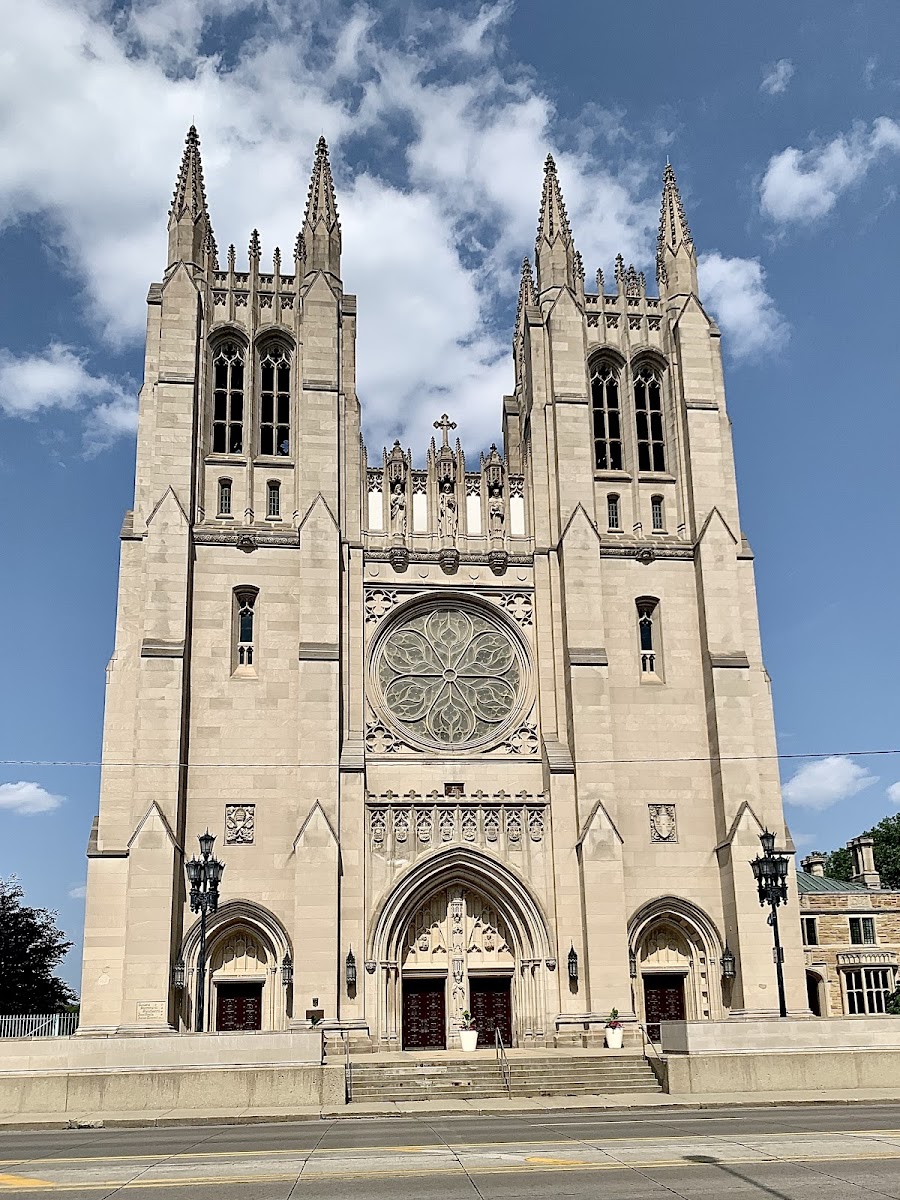
You approach from Woodward Avenue, Detroit’s historic spine, and before you see the cathedral itself, you see the twin bell towers rising above the New Center skyline. Gray limestone and Ohio sandstone, stacked in Gothic Revival symmetry, they mark the cathedral’s presence like sentinels — massive, unadorned, somehow both severe and welcoming at once. The towers were meant to have spires, soaring pointed caps that would have made the whole structure taller still, but those were never built. What remains feels honest, substantial, a little unfinished in the way all great human endeavors are. Pull into the guarded parking lot, and you understand the scale. This is no neighborhood chapel. The Cathedral of the Most Blessed Sacrament seats 850 guests in its main nave. The center aisle is 250 feet long — longer than most city blocks, longer than you think you need, until you walk it yourself and realize the procession becomes a meditation, a passage not just across space but through a threshold. Poppy has designed Cathedral of the Most Blessed Sacrament wedding flowers for ceremonies here, working with couples who want their florals to honor the grandeur of the space without overwhelming the spiritual gravity it holds.
About Cathedral of the Most Blessed Sacrament
The Cathedral of the Most Blessed Sacrament was designed by Henry A. Walsh and completed in stages between 1913 and 1951, with George Diehl finishing the bell towers. It sits on Woodward Avenue in the New Center neighborhood, a district that grew in the 1920s as Detroit expanded beyond its original downtown core. New Center is now a place where Detroit’s auto industry history, the birth of Motown, and a revitalized urban energy intersect — office buildings, music venues, restaurants, and residential blocks all pressed together with the kind of density that makes a city feel alive. The cathedral itself is a landmark, visible from blocks away, and its presence anchors the neighborhood in history and continuity.
Architecturally, the cathedral is Neo-Gothic and Norman Gothic, drawing on medieval European church design. The exterior is clad in gray limestone and Ohio sandstone, with stone buttresses running along the side walls and pointed arch doorways that signal the transition from street to sanctuary. Inside, the nave is a study in verticality and light. Twenty-two stained glass windows by Willet Studios of Philadelphia punctuate the walls, each one featuring medieval-style imagery framed by Indiana limestone traceries. The natural light that filters through these windows changes throughout the day — soft amber in the morning, jewel-toned at midday, deep and saturated in the late afternoon. The floor is Italian marble, installed during early 2000s renovations and carefully matched to the original stone. The effect is one of permanence and careful craftsmanship, every surface chosen to last.
The sanctuary was redesigned between 2001 and 2003 by architect Gunnar Birkerts, who extended it into the congregation and reconfigured the altar area. The altar itself is elevated to 3.5 feet, creating clear sightlines from even the back pews. Around the sanctuary stand fourteen carved wooden statues of apostles and angels, created in Italy in 1927. The apostles stand seven feet tall, the angels eight feet, all painted in rich, muted tones that have deepened with age. These statues are not decorative; they are part of the cathedral’s liturgical life, and they command respect.
From a florist’s perspective, the Cathedral of the Most Blessed Sacrament is both a gift and a challenge. The gift is the architecture itself — a space this beautiful does much of the aesthetic work on its own. The challenge is scale. Arrangements that would feel generous in a parish church can look lost in this nave. The cathedral’s wedding coordinator is organized and communicative, requiring vendor contracts and certificates of insurance submitted at least 60 days prior to the ceremony. Flowers and pew bows are welcomed, but nothing can be taped, stapled, or glued to any surface. Floral arrangements in the sanctuary cannot exceed 3.5 feet in height, a rule designed to keep the altar visible and central. For Poppy’s delivery teams, load-in is straightforward with ample guarded parking on-site and clear pathways into the cathedral. We typically arrive several hours before the ceremony to allow time for installation, photography checks, and coordination with other vendors. The acoustics in this space are extraordinary — voices carry, footsteps echo — so we work quietly and deliberately, treating the space with the reverence it deserves.
Event Spaces & Floral Opportunities
Cathedral Main Nave and Sanctuary
Capacity: 850 seated
Setting: The nave is the cathedral’s defining feature — a 250-foot-long hall lined with padded pews, soaring Gothic arches, and those twenty-two stained glass windows casting pools of colored light across the Italian marble floor. The ceiling feels impossibly high, drawing the eye upward in the way Gothic architecture was designed to do, creating a sense of both awe and intimacy. At the front, the sanctuary extends into the congregation, flanked by the fourteen carved statues and centered on the elevated altar. The space is air-conditioned, a detail that matters more than you might expect during summer weddings when guests are dressed formally and emotions run high. The natural light is the room’s co-designer — it changes the mood from hour to hour, and any floral palette must account for how blooms will look under both the jewel-toned window light and the warmer overhead lighting used during evening ceremonies.
Floral approach: The long aisle is where we begin. A 250-foot processional path is a rare luxury, and it deserves floral punctuation. We favor pew markers at every third or fourth row rather than every pew — this creates visual rhythm without overwhelming the space or the budget. Each marker can be a simple bouquet of three to five stems (Playa Blanca roses, white lisianthus, seeded eucalyptus) tied with silk ribbon and hung from the end of the pew with a velvet or satin ribbon loop. For a more dramatic approach, consider fuller arrangements in small compote vessels affixed to alternating pews with floral wire and foam bases, using garden roses (Patience, Ivory Tower), spray roses, white stock, and trailing jasmine vine. The key is to create a path that leads the eye forward without blocking sightlines or impeding the processional itself.
At the altar, the 3.5-foot height restriction requires thoughtful planning. We design arrangements that are full and lush but horizontally oriented rather than towering. Two matching arrangements flanking the altar — in substantial silver or pewter urns — can feature a foundation of white hydrangea, layered with Quicksand and Ivory Tower garden roses, white ranunculus, white tulips (in season), white stock for height and fragrance, and Italian ruscus and seeded eucalyptus for textural contrast. These arrangements should be designed in the round, visible from all angles, since guests will be seated in a semicircle around the sanctuary. A third, wider arrangement can be placed at the base of the altar itself, running horizontally along the marble step, incorporating low mounds of blooms that don’t obstruct the altar’s visibility.
Candelabras are a traditional and effective addition in a space this large. We often place two tall brass or silver candelabras flanking the altar arrangements, each one dressed with garlands of smilax, plumosa fern, and small clusters of spray roses and waxflower. The candlelight adds warmth and movement, especially during evening ceremonies when the stained glass windows fade to darkness and the interior lighting takes over.
For the entrance, the Italian marble floor just inside the cathedral doors is a natural place for a welcoming moment. Two large pedestal arrangements — overflowing with seasonal blooms in whites, ivories, and soft greens — frame the transition from street to sacred space. These can be taller (4 to 5 feet on pedestals), incorporating flowering branches (dogwood in spring, cherry blossoms in early summer, curly willow year-round) for height and architectural interest. The twin bell towers visible just outside create a dramatic backdrop for arrival and departure photos, and a pair of arrangements flanking the exterior doors can extend the floral story outdoors. Just be mindful of weather — Detroit summers can be hot, and blooms left in direct sun will wilt quickly.
Petals are a tempting addition for a space with such beautiful marble flooring, but consult with the cathedral coordinator first. Policies vary, and the marble is both expensive and historically significant. If petals are permitted, we recommend using them sparingly — a light scattering along the center aisle just before the ceremony begins, nothing heavy or slippery. White or ivory rose petals are classic; for a softer look, delphinium or hydrangea petals create a confetti-like effect that photographs beautifully.
Wedding Flower Ideas for Cathedral of the Most Blessed Sacrament
Sacred Simplicity
This concept honors the cathedral’s spiritual purpose with a restrained, monochromatic palette. Imagine white and ivory blooms exclusively: Playa Blanca roses, white lisianthus, ivory Patience garden roses, white ranunculus, white stock, white tulips (spring), white hydrangea, and white phalaenopsis orchids for the altar arrangements. Greenery is limited to seeded eucalyptus and Italian ruscus, both in soft gray-green tones that don’t compete with the blooms. Vessels are silver, pewter, or brushed nickel — nothing shiny or ornate, just clean lines that disappear into the architecture. Pew markers are simple tied bouquets, altar arrangements are lush but horizontal, and candelabras are dressed with minimal greenery and a few trailing orchid stems. The effect is timeless, elegant, and deeply reverent. This palette works in any season and under any light, and it photographs as beautifully in color as it does in black and white. Sacred Simplicity is ideal for couples who want their ceremony to feel classic and uncluttered, allowing the cathedral’s architecture and the sacrament itself to be the focus.
Stained Glass Romance
Inspired by the cathedral’s twenty-two medieval stained glass windows, this concept brings the jewel tones from the glass into the floral palette. Deep ruby red (Black Baccara roses, burgundy dahlias in season), sapphire blue (delphinium, blue hydrangea, thistle), amethyst purple (stock, lisianthus, sweet pea in spring), and emerald green (bells of Ireland, succulents, lush foliage). These saturated colors are softened with blush pink garden roses (Quicksand, Keira), ivory ranunculus, and dusty lavender accents. Vessels are aged brass or gold-toned, adding warmth and a hint of opulence. Pew markers alternate between jewel-toned bouquets, creating a rhythmic color progression as guests walk the aisle. Altar arrangements are rich and dimensional, with deep colors concentrated at the base and lighter tones lifting toward the top, mimicking the way light moves through stained glass. This concept is particularly stunning during afternoon ceremonies when sunlight floods through the windows and the floral colors echo the colored light pooling on the marble floor. Stained Glass Romance is ideal for couples who want bold color, historical reference, and a sense of celebration within the sacred space.
Garden Cathedral
This concept softens the cathedral’s Gothic formality with organic, garden-inspired florals. The palette is soft and romantic: blush, peach, ivory, lavender, and sage green. Flowers include Juliet and Patience garden roses, peach ranunculus, blush astilbe, lavender stock, white sweet pea (spring), white anemones (fall/winter), blush hellebores (winter/spring), and an abundance of textured greenery — jasmine vine, smilax, Italian ruscus, lamb’s ear, and scented geranium foliage. Arrangements are loose and flowing rather than structured, with blooms appearing to tumble out of vessels in an abundant, just-picked-from-the-garden way. Pew markers incorporate trailing vines and irregular bouquet shapes. Altar arrangements are asymmetrical, with one side slightly taller or fuller than the other, creating movement and visual interest. Candelabras are heavily dressed with garlands that drape and trail. This concept brings softness and warmth into the cathedral’s stone-and-marble palette, creating a contrast that feels intentional and beautiful. Garden Cathedral is ideal for romantic, detail-oriented couples who want their ceremony to feel intimate despite the grandeur of the space, and it works beautifully in spring and summer when garden roses and soft-toned blooms are at their peak.
Seasonal Considerations
Detroit’s four seasons are pronounced, and each brings distinct opportunities and challenges for Cathedral of the Most Blessed Sacrament wedding flowers.
Spring (March–May) arrives tentatively in Detroit. March can still be bitterly cold, with snow lingering into early April, but by late April and throughout May, the city shakes off winter and blooms. Tulips, daffodils, hyacinth, ranunculus, anemones, hellebores, sweet pea, and early garden roses (Patience, Ivory Tower) are available and at their best. Flowering branches — dogwood, cherry blossom, quince — are particularly stunning in the cathedral, where high ceilings allow them to stretch upward. Spring light through the stained glass windows is soft and diffused, perfect for pastel and white palettes. The challenge is weather unpredictability. An April wedding might be 70 degrees or 40 degrees, and we keep flowers in climate-controlled transport until the last possible moment. The cathedral is climate-controlled, which protects arrangements once installed. Spring is also wedding season, so popular flower varieties can be in high demand — book early and confirm availability with your florist.
Summer (June–August) is warm, humid, and green. Detroit summers are lush, with temperatures ranging from the 70s to the 90s and occasional thunderstorms. Roses, hydrangea, lisianthus, stock, delphinium, dahlias (late summer), sunflowers (if appropriate for the space), and zinnias are abundant. The challenge is heat. Flowers transported in hot cars will wilt before they reach the cathedral, so Poppy uses refrigerated vehicles for all summer deliveries. Once inside the air-conditioned cathedral, blooms stabilize quickly. The stained glass light in summer is intense and jewel-toned, particularly in the late afternoon, which can make soft-colored flowers appear washed out. We often recommend richer, more saturated colors in summer to hold up against the brilliant light. Hydration is critical — we mist arrangements just before the ceremony begins and ensure all mechanics (foam, water tubes) are saturated.
Autumn (September–November) is Detroit’s most beautiful season, and many couples choose fall weddings for good reason. Temperatures cool to the 50s and 60s, the air is crisp, and the city’s tree-lined streets turn red, gold, and amber. Dahlias, roses, chrysanthemums, marigolds, hypericum berries, calla lilies, amaranthus, and ornamental kale are in season. The warm, rich tones of autumn — burgundy, burnt orange, rust, gold, deep plum — are particularly stunning against the cathedral’s gray stone and Italian marble. Fall light through the stained glass windows is deep and saturated, creating dramatic color pools on the floor that shift as the sun moves. This is an ideal time for bold, jewel-toned floral concepts like Stained Glass Romance. The cathedral’s interior warmth is also a welcome contrast to the cooling outdoor temperatures, making autumn ceremonies feel especially cozy and sacred. November weddings should account for shorter daylight hours — ceremonies after 4 p.m. will rely more on interior lighting than natural window light.
Winter (December–February) is cold, dark, and often snowy in Detroit. Temperatures drop to the 20s and 30s, and daylight is scarce. But winter weddings in the cathedral have a magic all their own. The space feels warmer, the candlelight more essential, the stained glass windows like lanterns against the early darkness outside. Amaryllis, paperwhites, white roses, white hydrangea, white ranunculus, anemones, hellebores, and evergreen branches (pine, cedar, fir) are available and seasonally appropriate. Frosted or silver-painted branches, ilex berries, white brunia, and dusty miller add winter texture without feeling overly Christmassy. The Sacred Simplicity concept is particularly suited to winter, with its white-and-ivory palette and silver vessels. Winter also brings holiday decorations — the cathedral may have poinsettias, wreaths, or other seasonal decor in place, so coordinate with the wedding coordinator to understand what will be present and how your florals can complement (or request removal of) existing elements. The cold is a non-issue for flower transport — blooms are happy in cold cars — but beware of frozen mechanics. Water tubes and foam can freeze if left in vehicles overnight, so we transport all materials indoors the night before and assemble arrangements in climate-controlled spaces.
Poppy’s Expert Take
Know the height restriction — and design for visibility anyway. The 3.5-foot height limit on sanctuary arrangements is non-negotiable, and it’s there for a good reason: the altar must remain the focal point. But limited height doesn’t mean limited impact. Design arrangements that are lush, full, and horizontally oriented, with blooms cascading outward rather than stacking upward. Use substantial vessels (wide-bodied urns, footed compotes) that give arrangements visual weight without adding height. And remember that the elevated altar provides natural visibility — even a 3-foot-tall arrangement will be seen from the back of the nave because it’s sitting on a 3.5-foot platform. Work with the rule, not against it.
The aisle is your canvas — use it wisely. A 250-foot aisle is rare and wonderful, but floraling every pew is financially and visually overwhelming. We recommend pew markers at every third or fourth row, which creates rhythm without clutter and keeps the budget realistic. If you want more, consider alternating styles: full arrangements on some pews, simple ribbon bows on others, creating a pattern that draws the eye forward. And think about the processional experience from the bride’s perspective. She’ll be walking this aisle for several minutes. Floral punctuation should feel like encouragement, not competition.
Respect the statues and the stained glass. The fourteen carved Italian statues in the sanctuary are religious art, and the twenty-two stained glass windows are the room’s defining feature. Your florals should complement these elements, not compete with them. Avoid placing arrangements directly in front of statues or blocking windows. Instead, design with the statues as your backdrop — altar arrangements that flank the sanctuary will be photographed with the apostles and angels behind them, creating depth and context. Similarly, choose floral colors that harmonize with the jewel tones in the stained glass rather than clashing with them. If you’re unsure, bring your florist to a site visit and observe the light at the time of day your ceremony will take place.
Bring a lighting test. The stained glass windows create dramatically different lighting conditions depending on the time of day and weather. A sunny 2 p.m. ceremony will flood the nave with colored light. A cloudy 4 p.m. ceremony will be dimmer and rely more on overhead lighting. An evening ceremony will have almost no natural light at all. Ask your florist to bring flower samples to the cathedral at the same time of day your ceremony will take place, and observe how colors read under the actual lighting. Soft pastels can disappear in dim light. Bright whites can look blown-out in direct sun. Testing prevents unpleasant surprises.
Coordinate with your photographer on the entrance arrangements. The twin bell towers and the exterior entrance are prime photo locations, and if you place large arrangements flanking the doors, they will appear in nearly every arrival, departure, and couple portrait taken outside. This is an opportunity, not a problem — but it requires coordination. Make sure your florist and photographer discuss the entrance design in advance. If your photographer wants clean architectural lines, keep arrangements minimal. If they want lush, romantic framing, go bigger. And make sure arrangements are positioned symmetrically; nothing ruins an exterior shot faster than lopsided urns.
Ask about existing cathedral decor. Depending on the liturgical season, the cathedral may have its own seasonal decorations in place — poinsettias at Christmas, lilies at Easter, greenery during Advent. Some couples appreciate this and design their florals to complement it. Others prefer a clean slate and request that seasonal decor be removed (if allowed). Either way, ask the wedding coordinator what will be present on your wedding day so you can plan accordingly. You don’t want to arrive and discover that the sanctuary is already filled with flowers you didn’t choose.
Plan for vendor load-in logistics. The cathedral requires vendor contracts and certificates of insurance submitted 60 days in advance, and there’s no wiggle room on this. Miss the deadline, and your florist may not be permitted to enter the building. Additionally, the cathedral is an active parish with daily Mass, meetings, and other events. Your florist’s load-in time will be assigned, and it may not be as early as you’d like. Make sure your florist builds in enough time for setup, and communicate clearly with the wedding coordinator about access. The guarded parking is generous, but the cathedral is on Woodward Avenue, a busy thoroughfare, and unloading during rush hour can be tight. Mid-morning to early afternoon load-ins are typically easiest.
What Poppy Couples Spend on Flowers Here
The Cathedral of the Most Blessed Sacrament is a ceremony-only venue, and because Poppy hasn’t yet completed a booked wedding here, we’re projecting typical investment levels based on the venue’s scale, layout, and comparable Detroit religious venues where we’ve worked.
$2,500 - $4,000 | The Focused Ceremony
This tier prioritizes the most visible floral elements: two substantial altar arrangements flanking the sanctuary (in silver or pewter urns, featuring white hydrangea, Patience and Playa Blanca roses, white stock, and greenery), pew markers for every fourth row (approximately 15 to 20 markers, simple tied bouquets of three to five stems each), and two entrance arrangements near the cathedral doors (pedestal-based, incorporating seasonal blooms and flowering branches). Personal flowers — bridal bouquet, bridesmaid bouquets, boutonnieres, and corsages — are included. This tier delivers a polished, elegant ceremony aesthetic that honors the cathedral’s grandeur without requiring florals at every pew. It works best for couples with 150 to 300 guests who want the altar and aisle to feel complete without stretching the budget to cover every surface.
$4,000 - $6,500 | The Complete Ceremony
This tier adds depth and rhythm throughout the space. Altar arrangements are larger and more complex (incorporating garden roses like Juliet and Quicksand, ranunculus, delphinium or stock, white orchids, and lush greenery), pew markers appear at every third row (approximately 25 to 30 markers, fuller arrangements in small compotes or as substantial tied bouquets), two tall brass or silver candelabras flanking the altar (dressed with garlands of smilax and spray roses), and four entrance arrangements (two inside, two outside flanking the exterior doors). Personal flowers are more elaborate — larger bridal bouquet, bridesmaid bouquets with premium blooms, additional boutonnieres and corsages, and flower girl petals (if permitted). This tier also allows for a small floral arrangement or greenery installation near the guest book table or ceremony programs, tying the entire experience together. This level works well for couples with 300 to 500 guests who want the full 250-foot aisle to feel intentionally designed.
$6,500+ | The Cathedral Showcased
This tier treats the cathedral as the masterpiece it is, with florals that match its scale and grandeur. Altar arrangements are monumental (4 to 5 feet wide, overflowing with premium blooms including garden roses, orchids, hydrangea, ranunculus, and seasonal showstoppers like peonies or dahlias), pew markers at every second or third row (30 to 40 markers, fuller compote-style arrangements or lush tied bouquets with trailing vines), heavily dressed candelabras, and six or more entrance and processional arrangements (including additional installations along the side aisles or near the baptismal font if visible). This tier also includes specialty elements like a floral runner or garland along the altar step, greenery installations along the stone buttresses (if permitted), and elevated personal flowers such as a cascading bridal bouquet, premium boutonnieres with rare blooms, and corsages for extended family. Some couples at this level also commission a floral installation for their reception venue that intentionally echoes the cathedral ceremony florals, creating visual continuity throughout the day. This investment is ideal for couples with 500+ guests, or for those who view the cathedral ceremony as the centerpiece of their wedding day and want every detail to reflect that priority.