
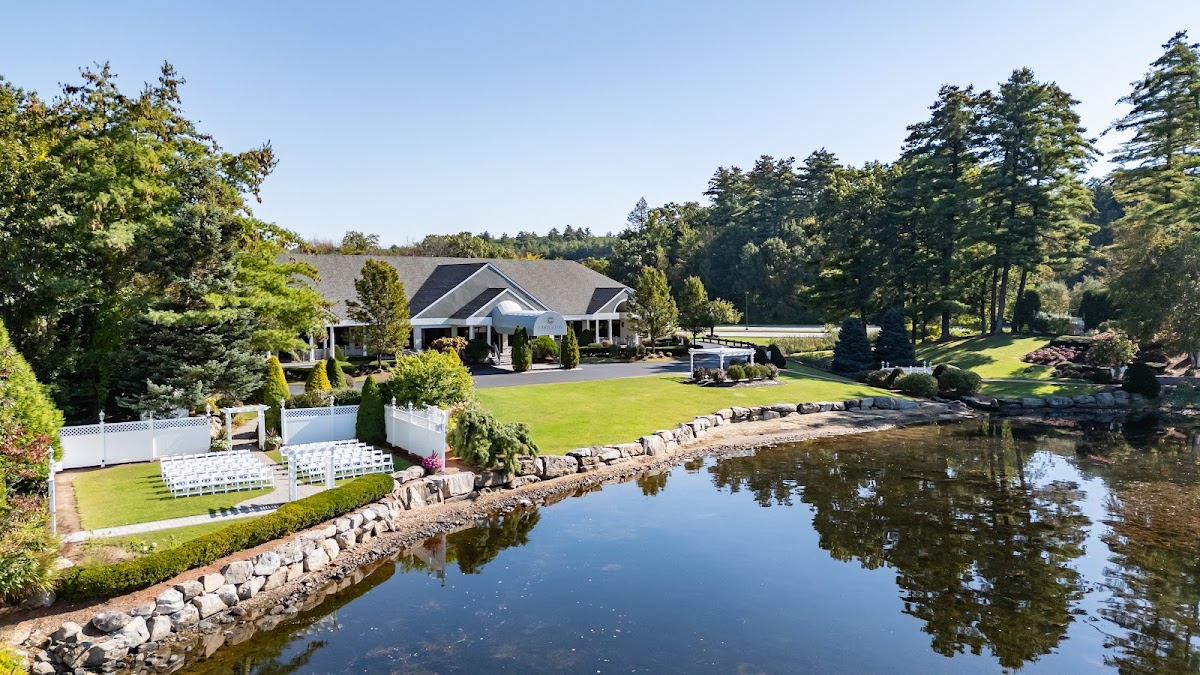
The approach tells you what kind of place this is. You leave Route 93N behind, wind through the residential edges of Windham, and turn onto Enterprise Drive — not the name you would expect for a wedding venue, but Castleton has never been about pretense. What it is about becomes clear the moment you pass through the entrance: a cascading rock waterfall announces the property, water spilling over natural stone into a reflecting pond that catches the sky. Beyond it, the land opens to reveal Cobbetts Pond, crystal-clear and private, bordered by emerald lawns that roll down to the water’s edge. There is a white pergola overlooking the pond, a hidden footbridge tucked among the gardens, a 38-foot cobblestone aisle that leads to a ceremony trellis framed by topiary and seasonal blooms. This is southern New Hampshire at its most serene — accessible enough for Boston and Manchester guests, yet secluded enough to feel like a genuine escape. Poppy has received inquiries for Castleton Banquet & Conference Center wedding flowers, and while we have not yet had the pleasure of designing here, the property’s combination of manicured gardens, waterfront ceremony sites, and versatile indoor ballroom presents the kind of blank canvas that makes a floral designer’s hands itch to start sketching.
About Castleton Banquet & Conference Center
Castleton sits on a private waterfront estate in Windham, New Hampshire, a charming town that manages to feel both tucked-away and entirely convenient. The drive from Boston takes about 45 minutes via Route 93N, an easy shot north that brings you into New Hampshire’s gentler landscape of lakes, stone walls, and white clapboard churches. Manchester is 25 minutes west, making Castleton accessible for guests flying into Manchester-Boston Regional Airport. But despite that accessibility, the property feels removed — the kind of place where the loudest sound at cocktail hour is the waterfall at the entrance and the occasional laugh drifting across the lawn.
The estate was designed with intentionality. The manicured gardens are not an afterthought but a focal point, with paved walkways threading through beds of perennials, topiary plants shaped into elegant spheres and spirals, and flower gardens that shift with the seasons. The Hidden Bridge — a secluded footbridge over a reflecting pond — has become one of the property’s signature photo locations, the kind of spot that looks like it was lifted from a storybook. The Garden Ceremony Area features a white trellis structure (6 feet 4 inches high, 4 feet 2 inches wide, sized to accommodate roughly 6 yards of fabric if you want to drape it) positioned at the end of a 38-foot cobblestone aisle. It is a setup that needs very little enhancement, though the right floral treatment can elevate it from lovely to unforgettable.
The Waterfront Ceremony site offers an alternative: vows exchanged on the shores of Cobbetts Pond, with the water as your backdrop and the white gazebo visible in the periphery. There is a stone fire pit near the gazebo, and on cooler evenings, the venue can light it for cocktail hour, creating a gathering point that feels both rustic and refined. The pond itself is described as crystal-clear, and that clarity matters — reflections are sharp here, which means florals placed near the water will double their visual impact.
Inside, the venue operates on a modular principle. The Ashby and Castle spaces can be combined into one grand 8,144-square-foot ballroom accommodating up to 500 guests, or they can be sectioned off into smaller configurations: three-quarter hall, half halls, even a quarter hall for intimate gatherings of 100. The aesthetic is deliberately neutral — delicate chandeliers, minimalist lines, and in some areas, red damask wallpaper that adds warmth without overwhelming the palette. Castleton calls it a “blank canvas,” and that descriptor is accurate. This is not a venue with strong architectural opinions. It will become whatever you make of it, which for a florist means freedom but also responsibility. There is no ornate molding to play off, no dramatic stone fireplace to anchor your centerpieces. Your florals will need to define the space.
Logistically, Castleton is a full-service venue with in-house catering provided by Waterfront Dining (outside catering is permitted only for cultural cuisines the culinary team cannot prepare, and only with a full-day facility rental). The bar program includes wine lists, signature drinks, and options for cash or open bar service. Outside vendors are allowed and even welcomed, which is a relief for florists — some New Hampshire venues maintain restrictive preferred vendor lists, but Castleton does not. The events team provides setup and teardown services and assists with day-of coordination, and there is ample parking: a private paved lot accommodates 170 cars, with an additional upper unpaved lot for overflow, bringing total capacity to over 200 vehicles. For Poppy’s delivery and setup, the venue’s proximity to Route 93N makes load-in straightforward, and the multiple entry points to the property mean we can stage materials near whichever space we are dressing without excessive hauling.
One detail worth noting: pets are allowed on the grounds for ceremonies and photos (leashed, of course), though only service animals are permitted indoors. It is a small policy point, but it speaks to the venue’s flexibility. Castleton understands that weddings are personal, and it does not impose unnecessary restrictions.
Event Spaces & Floral Opportunities
Entire Hall (Ashby & Castle)
Capacity: 500 seated
Setting: The full venue rental combines the Ashby and Castle spaces into a single 8,144-square-foot ballroom with a 1,800-square-foot dance floor — one of the largest unobstructed dance floors in the southern New Hampshire area. Two bar spaces anchor opposite ends of the room, allowing for traffic flow and reducing bottlenecks during cocktail service. The ceiling is fitted with delicate chandeliers that cast soft, even light across the space, and the walls are painted in warm neutrals with sections of red damask wallpaper adding texture and depth. There are no columns, no awkward sightlines, no architectural quirks to navigate. It is a true blank canvas, which means the room will feel exactly as full or as intimate as your design choices make it.
Floral approach: With 500 guests, the priority is creating visual anchors that prevent the space from feeling like a hotel conference room. We recommend starting with a dramatic entrance installation — a pair of large-scale urns overflowing with seasonal branches, hydrangea, and garden roses in vessels that feel grounded and substantial (aged stone, patinated copper, or dark ceramic work beautifully here). For the tables, a mix of heights is essential: low, lush centerpieces (mounded garden roses, ranunculus, anemones, trailing jasmine vine) on half the tables, and tall arrangements on clear glass risers or gold candelabras on the others, lifting the blooms above guest sightlines so the room feels layered and dynamic. The dance floor is massive, so consider framing it with four large-scale arrangements positioned at the corners — this defines the space without cluttering it. The two bar areas are prime real estate for elevated floral displays: think overflowing arrangements that incorporate texture (smokebush, amaranthus, Italian ruscus) and movement. The delicate chandeliers can be left as-is or softened with a very light touch of greenery, though we generally recommend restraint — the fixtures are beautiful on their own, and over-decorating them risks making the ceiling feel busy. Castleton Banquet & Conference Center wedding flowers in this configuration should feel abundant without being overwhelming, designed to fill a large space while maintaining a sense of elegance.
Three Quarter Hall (Ashby & Castle C)
Capacity: 300 seated
Setting: At 5,787 square feet, the three-quarter hall offers a generous middle ground between the full ballroom and the more intimate half halls. It retains the full 1,800-square-foot dance floor, which means your guests have plenty of room to move without the space feeling cavernous. The room configuration is flexible — long banquet tables, rounds, a mix of both — and the neutral palette allows for any design direction. The delicate chandeliers remain a feature, and there is still access to one of the bar areas, making this a fully functional reception space that simply feels a bit cozier than the full hall.
Floral approach: With 300 guests, you can afford to be a bit more detailed in your floral installations. We favor a mix of centerpiece styles here: low, garden-style arrangements in aged brass compotes for half the tables (Juliet garden roses, Quicksand roses, white ranunculus, blushing bride protea, silver dollar eucalyptus), and tall, elegant arrangements on the others — think delphinium, lisianthus, and trailing amaranthus in tall glass cylinders or gold stands that lift the blooms to 30 inches above the table. The dance floor can be framed with four corner arrangements as in the full hall, or you can opt for a single statement installation at the band or DJ booth — a lush backdrop of greenery (smilax, Italian ruscus, seeded eucalyptus) with clusters of blooms woven through. The bar area is an opportunity for a showstopper: a large, organic arrangement that spills over the edge of the bar and incorporates seasonal textures (privet berries in fall, tulips and fritillaria in spring, garden roses and peonies in summer). The key in this space is maintaining visual interest without overcrowding — the three-quarter hall is large enough to handle bold gestures but intimate enough that every detail will be noticed.
Half Hall - Ashby
Capacity: 200 seated
Setting: The Ashby half hall offers 3,679 square feet of event space with a 900-square-foot dance floor. It can be used independently for a 200-guest reception or combined with the Castle half hall for larger events. The space has access to one of the venue’s two bars, and the neutral palette — warm walls, delicate chandeliers, minimalist lines — creates a sophisticated backdrop that works with any design style. Because the room can be sectioned off with airwalls, it feels intentionally sized rather than like half of something larger.
Floral approach: In a half hall, every floral choice carries more weight. We recommend committing to a single centerpiece style rather than mixing heights — either all low and lush, or all elevated. If you choose low centerpieces, make them substantial: mounded arrangements of garden roses (Patience, Keira, Romantic Antike), ranunculus, hellebores, and scabiosa in aged stone vessels or textured ceramic compotes, sitting 8 to 10 inches tall and spreading 16 to 18 inches wide. If you go tall, use elevated stands (clear glass, brushed gold, or matte black depending on your aesthetic) that lift arrangements to 24 to 30 inches, with blooms that have movement and drape — think delphinium, larkspur, amaranthus, and trailing jasmine vine. The dance floor can be defined with a pair of arrangements flanking the entrance, and the bar is the ideal location for your most dramatic installation — a lush, asymmetrical design that incorporates branches, textured foliage, and statement blooms. The entrance to the half hall should also get attention: a pair of smaller arrangements on pedestals or console tables signals the transition from cocktails to dinner and sets the tone for the room.
Half Hall - Castle
Capacity: 200 seated
Setting: The Castle half hall mirrors the Ashby hall in both size (3,679 square feet) and features (900-square-foot dance floor, bar access, delicate chandeliers). It can be used independently or combined with Ashby to create the full ballroom. Because the two spaces are symmetrical, they work beautifully for events that want to use one hall for the ceremony and flip it into a cocktail space while the other hall serves as the reception — a setup that requires careful floral planning but can be executed seamlessly with the right approach.
Floral approach: If you are using both Ashby and Castle for a ceremony-to-reception flip, the floral strategy should prioritize portability and dual-purpose installations. Ceremony arrangements positioned along the aisle can be moved to cocktail tables during the flip. The ceremony altar arrangement — perhaps a large, organic installation on a wooden hexagon arch or a lush ground piece flanking a simple fabric drape — can be relocated to the reception entrance or behind the sweetheart table. For the reception itself, follow the same approach as Ashby: commit to a single centerpiece style, define the dance floor with strategic placements, and use the bar as an opportunity for a statement piece. If the two halls are not being used for a flip, treat Castle as its own independent space with a cohesive design that does not need to reference Ashby at all.
Quarter Hall (Castle A & B)
Capacity: 100 seated
Setting: At 1,943 square feet with a 225-square-foot dance floor, the Quarter Hall is the most intimate of Castleton’s indoor configurations. It works beautifully for micro weddings, elopement receptions, or smaller celebrations where the couple wants a sense of coziness and closeness. The space retains the same neutral palette and delicate lighting as the larger halls, but the scale shifts the feeling entirely — this is a room where guests can easily converse across tables, where the couple feels genuinely surrounded by their closest people.
Floral approach: In an intimate space, restraint is your friend. Over-designing a 100-person room can make it feel cluttered and overwhelming. We recommend low, lush centerpieces in the 6- to 8-inch height range — think bud vases clustered in groups of three, small compotes overflowing with garden roses and ranunculus, or low wooden boxes filled with a mix of blooms and textured greenery (dusty miller, eucalyptus, olive branches). The dance floor is small, so resist the urge to frame it with large arrangements — instead, place a single statement piece near the band or DJ that serves as a backdrop without encroaching on the dance space. The bar area, if accessible in this configuration, can handle a medium-sized arrangement that feels abundant but not oversized. The entrance is a good place to invest a bit more: a pair of arrangements on pedestals or a single lush installation on a console table welcomes guests and signals that the space, while small, has been carefully considered. The beauty of the Quarter Hall is that it does not need much — a few well-placed arrangements, thoughtful blooms, and good lighting will make the space feel complete.
Garden Ceremony Area
Capacity: 200 seated
Setting: The Garden Ceremony Area is Castleton’s signature outdoor ceremony space. A 4-foot-wide by 38-foot-long cobblestone aisle runs through manicured lawns, flanked by topiary plants and seasonal flower gardens, and terminates at a white trellis structure (6 feet 4 inches high, 4 feet 2 inches wide). The trellis is designed to be draped with fabric and adorned with florals, and it sits against a backdrop of mature trees and gardens that change with the seasons. The setup accommodates 200 ceremony chairs in a traditional layout: ten rows of ten chairs on each side of the aisle. The space is bordered by paved walkways, and the overall aesthetic leans toward English garden meets New England estate — formal but not stuffy, structured but not rigid.
Floral approach: The trellis is the hero of this space, and it should be treated as such. We recommend starting with a base of lush greenery — smilax garland, Italian ruscus, seeded eucalyptus — draped across the horizontal beams and cascading down the vertical supports. Woven into that greenery, clusters of blooms in a complementary palette: garden roses (Patience, Keira, Juliet), spray roses, ranunculus, lisianthus, and seasonal accents (tulips and sweet peas in spring, hydrangea and dahlias in summer, chrysanthemums and berries in fall). The goal is an organic, almost overgrown look that feels like the flowers grew there rather than being placed. The cobblestone aisle can be lined with arrangements every few feet — low, lush designs in natural containers (wooden boxes, woven baskets, aged terra cotta) that echo the garden setting. Alternatively, you can scatter petals along the cobblestones for a softer, more romantic look. The entrance to the ceremony space — where guests transition from the paved walkway onto the lawn — is an ideal spot for a pair of larger arrangements on shepherd’s hooks or wooden pedestals, signaling the start of the ceremony journey. Because the surrounding gardens already provide color and texture, Castleton Banquet & Conference Center wedding flowers in this space should complement rather than compete — choose a palette that harmonizes with the existing plantings, and let the natural setting do some of the work for you.
Waterfront Ceremony
Setting: The Waterfront Ceremony site offers an entirely different aesthetic from the Garden Ceremony Area. Here, vows are exchanged on the shores of Cobbetts Pond, with the crystal-clear water as your backdrop and the emerald green lawn stretching out behind the guests. A white gazebo with a stone fire pit is positioned nearby, and the overall feeling is less formal, more open, more connected to the landscape. There are no built-in structures here — no trellis, no aisle markers — which means you have complete freedom to design the ceremony setup from scratch.
Floral approach: The pond is the focal point, and anything you place in front of it should enhance rather than obscure the view. We recommend a simple ceremony structure — a wooden hexagon arch, a low ground arrangement, or even just a pair of statement urns flanking the couple — styled with organic, flowing florals that feel connected to the water. Think soft, romantic blooms in shades that play well against the blue of the pond and the green of the lawn: white and cream roses, blush ranunculus, soft blue delphinium, pale lavender lisianthus, and lots of greenery (eucalyptus, olive branches, smilax). The aisle can be defined with low arrangements placed every few feet, or with a simple runner of petals scattered across the grass. The gazebo, if it is visible from the ceremony site, can be adorned with a garland of greenery and a few clusters of blooms to tie it into the overall design. The key with the Waterfront Ceremony is restraint — the setting is so naturally beautiful that over-designing it will dilute rather than enhance the experience.
White Pergola
Setting: The White Pergola is an outdoor lounge space near the waterfront, featuring a white pergola structure, lounge furniture, and a stone fire pit. It is designed as a gathering spot for cocktail hour or for evening socializing, a place where guests can relax with a drink and take in the pond views. The space has a casual, resort-like feel — less formal than the ceremony areas, more about creating a comfortable, inviting atmosphere.
Floral approach: The pergola structure itself can be softly adorned with greenery — a garland of smilax or Italian ruscus woven along the beams, perhaps with a few clusters of blooms at the corners (garden roses, hydrangea, or seasonal accents). The lounge furniture offers surfaces for small floral arrangements: low designs in textured vessels (ceramic compotes, aged brass bowls, wooden boxes) that feel substantial but not fussy. The stone fire pit can be surrounded with a low ring of greenery and blooms, creating a soft, romantic frame that photographs beautifully as the sun sets. The goal here is not to make a floral statement but to enhance the space’s existing charm — think of the florals as accents rather than focal points, designed to complement the furniture, the pergola, and the pond views beyond.
Waterfront Dining
Capacity: 35 seated
Setting: Waterfront Dining is Castleton’s most intimate offering: a private dining space on Cobbetts Pond that accommodates 10 to 35 guests. Available on Thursday evenings (and possibly other times with full-day rentals), this space is ideal for micro weddings, vow renewals, or rehearsal dinners. The setup is simple and elegant: tables positioned to take advantage of the pond views, with the water as the primary decor element.
Floral approach: With such a small guest count and such a stunning natural backdrop, the floral approach should be delicate and personal. Low centerpieces in the 6- to 8-inch height range work best — think garden roses, ranunculus, and seasonal blooms in small compotes or bud vases, arranged in a way that feels abundant but not overwhelming. Candlelight is essential here, both for ambiance and for highlighting the floral details as the sun sets over the pond. Consider incorporating natural elements that echo the waterfront setting: driftwood accents, river stones, or even small potted succulents as guest favors. The entrance to the dining area can be marked with a pair of small arrangements, and if there is a sweetheart table or head table, a slightly larger installation — a low, lush runner of greenery and blooms — can serve as a focal point without obstructing the pond views.
Wedding Flower Ideas for Castleton Banquet & Conference Center
New England Garden Romance
This design leans into the manicured gardens and English-manor aesthetic of Castleton’s outdoor spaces. The palette is soft and romantic: blush, cream, soft peach, pale lavender, and lots of green. Start with garden roses as the foundation — Patience, Keira, Juliet, Quicksand — and layer in spray roses, ranunculus, lisianthus, and sweet peas for texture. Add trailing elements like jasmine vine, clematis, or passion vine to create movement and soften the edges of arrangements. For the ceremony trellis, drape the structure with smilax garland and weave in clusters of the blooms, allowing some to cascade down the sides. Centerpieces sit in aged brass compotes or soft gray ceramic vessels, mounded and lush, with blooms crowded together in a way that feels organic and slightly overgrown. Aisle arrangements are placed in woven baskets or wooden boxes that echo the garden setting. This style works beautifully in the Garden Ceremony Area and translates seamlessly into the ballroom for the reception, where the soft palette plays off the neutral walls and delicate chandeliers.
Lakeside Serenity
Inspired by Cobbetts Pond and the waterfront ceremony sites, this concept builds around a palette of blues, whites, and greens with subtle hints of silver. White roses (Playa Blanca, Vendela), white ranunculus, and white lisianthus form the foundation, accented with soft blue delphinium, dusty blue hydrangea, and pale blue tweedia. Greenery is key: eucalyptus in multiple varieties (seeded, silver dollar, baby blue), olive branches, and dusty miller add silvery tones that mimic the reflection of light on water. Vessels should feel natural and understated: clear glass cylinders, weathered wooden boxes, or soft gray ceramic compotes. For the Waterfront Ceremony, use a low ground arrangement of these blooms and greens, or a simple hexagon arch with greenery and minimal floral clusters. In the ballroom, the blue tones add just enough color to keep the palette from feeling sterile while maintaining a serene, sophisticated vibe. Incorporate candlelight in mercury glass votives to enhance the reflective quality of the design, and consider adding a few natural elements — smooth river stones, small pieces of driftwood — to the centerpieces for textural interest.
Autumn in New Hampshire
New Hampshire’s fall foliage is legendary, and this design captures the warmth and richness of the season. The palette moves through burnt orange, deep burgundy, golden yellow, rust, and chocolate brown, with pops of cream to keep it from feeling too heavy. Dahlias are the star here — Café au Lait, Labyrinth, Jowey Mirella — supported by garden roses in warm tones (Toffee, Cappuccino, Shimmer), ranunculus, hypericum berries, and seasonal branches (oak leaves, bittersweet, beech). Texture is everything: add scabiosa pods, privet berries, smokebush, and amaranthus in burgundy and rust tones. Vessels should feel rustic and grounded: aged copper urns, dark wood boxes, hammered brass compotes. For the Garden Ceremony trellis, drape it with a garland of fall foliage and weave in clusters of dahlias and roses, allowing some of the branches to extend beyond the structure for an organic, wild look. Centerpieces are low and lush, mounded in a way that feels abundant and harvest-inspired. In the ballroom, this palette works beautifully with candlelight — amber-toned votives and pillars that echo the warmth of the blooms. This is a design for September and October weddings, when the surrounding landscape is at its most dramatic and the air has that crisp, apple-cider quality that defines a New England fall.
Seasonal Considerations
New England’s four-season climate offers distinct opportunities and challenges for wedding flowers at Castleton, and understanding the rhythm of the region’s growing seasons will help you make smart choices about bloom availability, outdoor ceremony logistics, and design direction.
Spring (April - June): Spring arrives late in southern New Hampshire, with the last frost typically occurring in mid-to-late April. May and June are the sweet spot, when the gardens at Castleton burst into bloom and the risk of cold, rainy weather diminishes. Locally available flowers include tulips (available through May), daffodils and narcissus (early spring), peonies (late May through June, weather dependent), sweet peas, lilac branches, and flowering fruit tree branches (apple, cherry). Spring in New England can be unpredictable — a 70-degree day can be followed by a 45-degree drizzle — so if you are planning an outdoor ceremony in April or early May, have a solid backup plan and communicate clearly with your coordinator about the timeline for making the call. Spring blooms tend to be delicate and benefit from cooler temperatures, so they will hold up well in both outdoor and indoor settings. The gardens at Castleton will be coming to life during this season, with daffodils and tulips in the beds and trees leafing out, so your floral palette can take cues from the surrounding landscape.
Summer (July - August): Summer is peak wedding season in New Hampshire, and the weather is generally cooperative — warm days, cool evenings, lower humidity than the mid-Atlantic. Locally available flowers are abundant: garden roses, hydrangea, dahlias (starting in mid-July), zinnias, sunflowers, lisianthus, and an array of wildflowers and grasses. The manicured gardens at Castleton are in full bloom, with perennials like coneflowers, black-eyed Susans, and hostas adding color and texture to the landscape. Heat can be a concern for certain blooms — garden roses and ranunculus will need to be kept hydrated and out of direct sun during setup — but the cooler New England evenings mean flowers will perk up as the sun sets. For Waterfront Ceremony sites, summer offers the best chance for calm, clear weather and that golden late-afternoon light that makes the pond sparkle. Plan your ceremony for late afternoon or early evening to avoid the hottest part of the day, and make sure your florist has access to water and shade for staging arrangements before the event begins.
Fall (September - November): Fall is arguably the most beautiful season in New England, and Castleton’s setting — with mature trees surrounding the property — means you will have foliage as a natural backdrop. September