
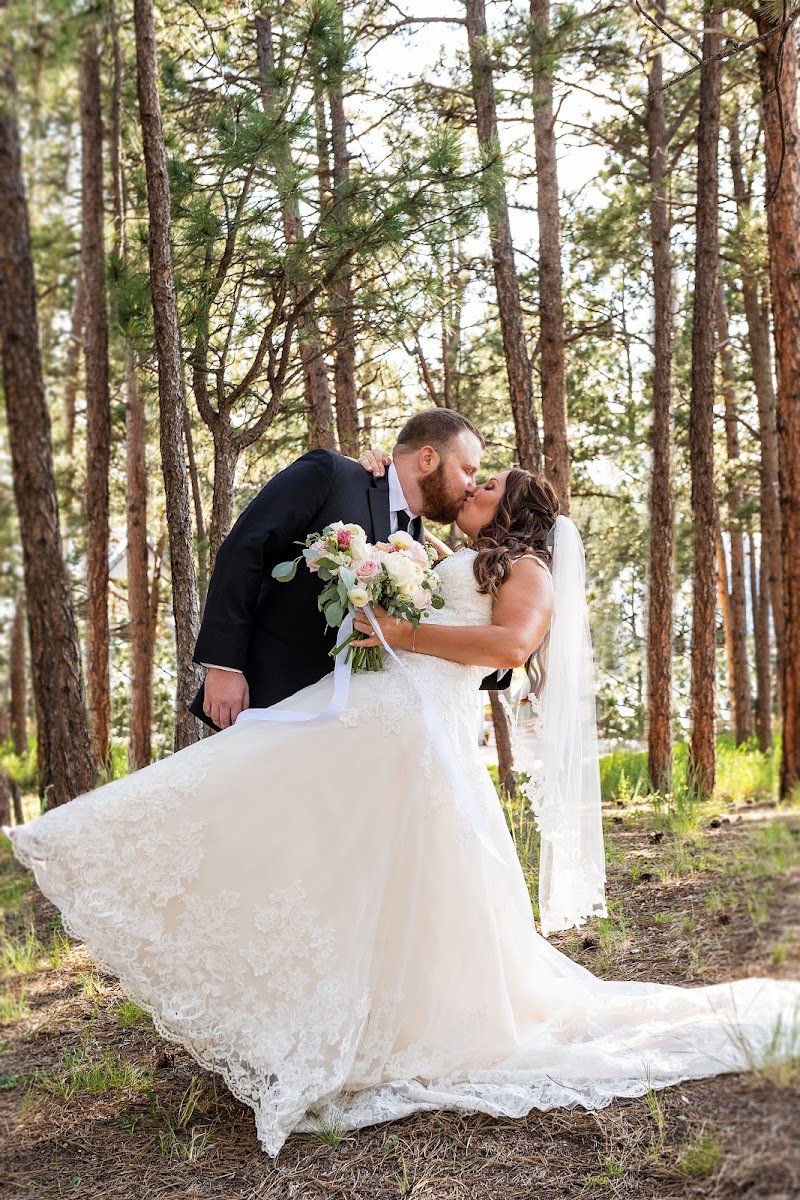
You take Black Forest Road north from Colorado Springs, and the city falls away quickly. The road narrows. Suburban developments give way to acreage properties, and then the forest closes in — not the scrubby pinyon-juniper mix of the lower elevations, but proper pines, tall and dense, the kind that filter light into cathedral shafts and smell of resin and sun-warmed needles. At 12375 Black Forest Road, the trees part just enough to reveal Black Forest by Wedgewood Weddings: warm wood buildings with stone accents, accordion glass doors that dissolve the boundary between inside and out, and through every window, the forest itself — towering Ponderosa pines and blue spruce that create a living backdrop no decorator could replicate. Stand on the outdoor ceremony lawn with the water feature behind you and the forest rising like walls of a natural cathedral, and you understand immediately why couples drive up from the Springs or down from Denver for this place. It is not trying to be anything other than what it is: a pocket of mountain quiet an hour from the city, elegant enough for a ballroom wedding, wild enough to feel like an escape. Poppy has designed Black Forest by Wedgewood Weddings wedding flowers for 9 celebrations here, and every time we make the drive up through the pines, we are reminded that the best floral design at this venue is not about competing with the forest — it is about knowing when to step back and let those trees do the work.
About Black Forest by Wedgewood Weddings
Black Forest by Wedgewood Weddings occupies eight secluded acres in the historic Black Forest community northeast of Colorado Springs, a region named by German settlers in the 1800s who saw in the dense pine forests a resemblance to the Schwarzwald of their homeland. The venue sits at approximately 7,200 feet elevation, high enough to claim a mountain microclimate — cooler summers, snowy winters, and that particular quality of high-altitude light that turns every hour into golden hour. The property is accessible: roughly 20 minutes north of central Colorado Springs, 50 minutes south of Castle Rock, and just over an hour from Denver — close enough for guests from the Front Range metro corridor, far enough to feel like a true retreat into the forest.
The architectural approach is rustic refined, which is another way of saying the venue honors its woodland context without sacrificing elegance. The Grand Hall features soaring vaulted ceilings with exposed beams, crystal chandeliers that catch the light from the floor-to-ceiling windows, and accordion glass doors that fold completely open to connect the ballroom with the outdoor ceremony and cocktail spaces. Pocket windows slide up and out of sight, erasing the line between indoors and out entirely when the weather cooperates. The warm wood tones throughout — honey-colored floors, natural timber beams, wooden window frames — create a cohesive palette that reads as mountain lodge rather than barn, elegant rather than rustic-for-rustic’s-sake. The indoor chapel, with its own vaulted ceilings and chandelier, provides a second ceremony space that is not a compromise but an entirely different aesthetic: intimate, formal, and weather-insulated.
Outside, the ceremony lawn is framed on three sides by towering pines and anchored by a tranquil water feature — a natural focal point that reflects sky and trees and provides the kind of built-in backdrop most venues hire florists to create artificially. The forest here is not decorative. This is a working woodland ecosystem, home to wildlife and genuine solitude, and on a clear day you can see Pikes Peak rising to the southwest through gaps in the canopy.
As a Wedgewood Weddings property, Black Forest operates on the brand’s signature all-inclusive model. Coordination, catering (handled by Wedgewood’s in-house culinary team), bartending, linens, tables, chairs, and day-of planning are bundled into tiered packages. Outside vendors are permitted for photography, florals, and certain specialty services, though couples must provide certificates of insurance for vendors not on the preferred list — standard practice for the brand. The all-inclusive structure simplifies planning considerably and means that florals are often the primary creative decision couples make independently, which gives Poppy’s work here an outsized visual impact. The venue’s events team is organized and communicative, load-in access is straightforward with ample on-site parking, and setup logistics are smooth. From a Colorado Springs wedding florist’s perspective, this is one of the easier mountain venues to service — high enough to feel alpine, accessible enough to avoid the logistical headaches of true backcountry properties.
Black Forest earned an Editor’s Choice Award in 2020 and consistently ranks among the top wedding venues in the Colorado Springs market, which speaks to its combination of natural beauty, architectural quality, and the operational efficiency that comes with being part of a larger venue brand.
Event Spaces & Floral Opportunities
Outdoor Ceremony Site
Capacity: Up to 300 guests
Setting: The outdoor ceremony site is the venue’s signature space, and it delivers on every expectation a couple might have for a mountain forest wedding. Rows of white garden chairs face an altar area backed by the water feature — a low stone fountain with gentle cascades that provide both visual interest and a soothing ambient sound. Behind the water feature, the forest rises in a solid wall of green: blue spruce, Ponderosa pine, and Douglas fir reaching 60 to 80 feet, creating vertical drama that no floral arch could match. The ceremony lawn itself is manicured and flat, with enough space for a wide center aisle or dual side aisles. The light here changes throughout the day — dappled morning sun through the canopy, bright midday exposure, and in late afternoon, that particular golden Colorado light that photographers dream about.
Floral approach: The cardinal rule for this ceremony site is restraint. The forest is your backdrop, the water feature is your focal point, and your flowers should frame and complement rather than compete. A simple wooden or metal arch positioned in front of the water feature, dressed asymmetrically with mixed greenery — eucalyptus, Italian ruscus, ferns, olive branches — and clustered blooms at one or both corners, grounds the ceremony space without obscuring the trees behind it. Think loose and organic rather than dense and structured. Garden roses (Juliet, Patience, Keira), spray roses, and seasonal blooms like ranunculus or dahlias in soft neutrals — ivory, blush, champagne, sage green — harmonize with the forest’s natural palette. For fall ceremonies, warm amber, rust, and burgundy tones echo the turning aspens and mountain grasses.
Aisle markers are optional but effective: small arrangements in wooden crates, stone vessels, or lanterns wrapped with greenery garlands define the processional path without overwhelming the sight lines. At this elevation and in Colorado’s variable weather, secure all outdoor arrangements with weighted bases — sudden afternoon wind gusts are common. Structurally resilient blooms (roses, spray roses, solidago, hypericum berries) perform better than delicate varieties (sweet peas, cosmos, fritillaria) in mountain conditions. The water feature itself offers an opportunity for floating arrangements — small blooms or petals released into the water create a romantic, organic accent for photos — though this should be discussed with the venue in advance.
Indoor Wedding Chapel
Capacity: Ceremony seating for approximately 150 guests
Setting: The indoor chapel is more than a weather backup — it is a fully realized ceremony space with its own architectural presence. Vaulted ceilings draw the eye upward, a crystal chandelier provides ambient light and elegance, and warm wood tones throughout the space create an intimate, formal atmosphere. Large windows frame views of the surrounding forest, bringing the natural context inside even when weather moves the ceremony indoors. The chapel’s proportions are generous without feeling cavernous, and the acoustics are excellent for spoken vows and live music.
Floral approach: In the chapel, you have the freedom to design more substantial floral installations because you are not competing with an outdoor backdrop. Tall pedestal arrangements flanking the altar — reaching 36 to 42 inches above the pedestal base — create visual drama that complements the vaulted ceiling without overwhelming the space. Use symmetrical pairs for a formal look or asymmetrical arrangements for a more organic aesthetic. The warm wood tones pair beautifully with jewel-toned palettes for fall and winter weddings: deep burgundy dahlias (Café au Lait Royale, Black Satin), plum ranunculus, chocolate cosmos, and amaranthus in dark wine tones, balanced by soft mauve and dusty rose accents. For spring and summer ceremonies, lighter palettes shine: garden roses (Quicksand, Sahara, Patience), white ranunculus, lisianthus, and trailing jasmine vine or smilax create an airy, romantic feeling.
A floral garland or greenery swag draped along the altar railing or across the front of the ceremony space adds lushness without blocking sight lines. Aisle arrangements on alternating pews or chairs — small clusters tied with ribbon or set in simple glass vessels — guide the processional and add color at eye level. The chandelier can be enhanced with a light touch of greenery or left unadorned; we generally recommend the latter unless the couple is committed to a maximalist aesthetic. The chapel’s architecture is strong enough to carry the room on its own.
Grand Hall
Capacity: 300 seated for dinner and dancing
Setting: The Grand Hall is where Black Forest’s dual identity — rustic setting, refined event space — comes into full focus. Vaulted ceilings with exposed wooden beams soar overhead, creating a sense of scale and drama. Crystal chandeliers hang at intervals down the length of the room, providing both functional lighting and a layer of sparkle that elevates the space beyond typical mountain lodge aesthetic. The accordion glass doors along one wall fold completely open, dissolving the boundary between the ballroom and the outdoor terrace and ceremony lawn. When the doors are open, the forest becomes part of the room — you hear the breeze in the pines, smell the resin, feel the mountain air. Pocket windows along adjacent walls slide up and out of sight, reinforcing the indoor-outdoor connection.
The flooring is polished wood, the walls are warm honey tones, and the overall palette is neutral enough to accommodate any color story. The room seats 300 comfortably with a dance floor, DJ setup, and head table, though it scales down gracefully for more intimate gatherings of 150 to 200. The visual rhythm of the space — the repeating beams overhead, the chandeliers, the tall windows — creates a structural elegance that does not require extensive decoration to feel complete.
Floral approach: In the Grand Hall, your floral investment should focus on two areas: the head table and the guest tables. A lush greenery garland running the full length of the head table — eucalyptus, Italian ruscus, and smilax, punctuated every 18 to 24 inches with clustered blooms (garden roses, spray roses, dahlias) and interspersed with pillar candles in varying heights — is consistently the single highest-impact floral installation in the room. The horizontal line of the garland echoes the ceiling beams and creates a visual anchor that grounds the reception space. Draping the garland to cascade slightly over the front edge of the table adds dimension and softness.
For guest tables, a mix of heights creates the best visual interest. Elevated arrangements on gold or natural wood risers — lifting blooms 28 to 34 inches above the table — interact with the vaulted ceiling and chandeliers, drawing the eye upward and filling the vertical space. Alternate these with low, lush compote arrangements (8 to 12 inches tall) in ceramic or brass vessels, surrounded by votives and taper candles. The low arrangements maintain intimacy and keep conversation flowing, while the elevated pieces add drama. The color palette should harmonize with the warm wood tones: blush, champagne, ivory, dusty mauve, sage green, and soft terracotta all photograph beautifully in this space. For fall weddings, deeper tones — burgundy, amber, rust — echo the seasonal forest outside the windows.
The accordion doors and pocket windows present an opportunity for floral continuity between indoor and outdoor spaces. If the ceremony is held outdoors and the reception immediately follows, consider repurposing ceremony arrangements as cocktail hour accents on the terrace or flanking the entrance to the Grand Hall. The Wedgewood team is experienced with quick transitions and will work with florists on timing and placement.
Greenery garlands or clusters wrapped around the base of select chandeliers add a layer of organic texture without obscuring the crystals, though this requires venue approval and proper installation to avoid damaging the fixtures. We typically recommend investing the budget in table-level florals rather than ceiling installations, as guests spend more time looking across the room than looking up.
Outdoor Terrace and Cocktail Areas
Setting: The outdoor terrace adjacent to the Grand Hall serves as the primary cocktail hour space when weather permits. The terrace features bistro tables, space for bar setups, and direct views of the forest and ceremony lawn. The accordion doors allow guests to flow freely between the terrace and the ballroom, creating an indoor-outdoor cocktail experience.
Floral approach: Cocktail hour florals are optional and budget-dependent, but small arrangements on bistro tables or flanking the bar area add a polished touch. Use simple bud vases with single-variety blooms (spray roses, ranunculus, or seasonal stems) or small mixed arrangements in rustic vessels (wooden boxes, ceramic crocks) that echo the ceremony and reception aesthetic. If budget allows, repurposing ceremony arch florals or altar arrangements as cocktail hour focal points maximizes the value of those installations and creates visual continuity throughout the event.
Wedding Flower Ideas for Black Forest by Wedgewood Weddings
Pines & Roses
This design concept leans into the forest setting with an organic, slightly wild aesthetic that feels gathered rather than arranged. The palette is rooted in the natural tones of the Black Forest itself: soft ivory, blush pink, dusty mauve, sage green, and warm taupe, anchored by abundant mixed greenery. Garden roses form the foundation — Patience, Quicksand, Café Latte, and Keira — their open, cupped blooms providing romantic texture without excessive formality. Spray roses (Majolica, Bombastic, White Lydia) add smaller-scale blooms that fill spaces between the larger roses. Eucalyptus in multiple varieties (silver dollar, seeded, baby blue) provides the dominant greenery, supplemented with Italian ruscus, olive branches, and ferns. Textural accents include scabiosa pods, astilbe, and trailing jasmine vine or smilax.
Arrangements feel loose and organic, with slightly irregular edges and natural movement, as if the blooms were just gathered from a mountain meadow. Vessels should be natural materials: wooden boxes with liner, ceramic crocks in cream or soft gray, aged brass compotes, or clear glass to let the stems show. For the ceremony arch, an asymmetric greenery installation with clustered roses at one or both corners grounds the structure without blocking the forest backdrop. Reception centerpieces are low and lush, surrounded by wood-wick candles in amber glass. This palette works year-round but is particularly stunning in summer when the forest outside is deep green, creating a seamless visual transition between the florals and the landscape beyond the windows.
Mountain Meadow
A celebration of Colorado’s high-country wildflower season, this concept is best suited for late spring through summer weddings when local growers can provide seasonal variety. The palette is soft and romantic: lavender, soft yellow, dusty blue, blush pink, and ivory against abundant green. Delphinium and larkspur provide tall, spiky vertical elements. Wildflower varieties — black-eyed Susans, bachelor’s buttons, Queen Anne’s lace, yarrow — add organic texture and a sense of the regional landscape. Garden roses (Romantic Antike, Patience) and spray roses soften the wildflower mix with cultivated blooms that photograph well. Grasses and wheat add movement and a meadow-like quality.
Vessels should feel rustic and found: galvanized buckets, wooden crates, ceramic pitchers, or simple glass jars wrapped with twine or burlap ribbon. The overall effect is relaxed, organic, and distinctly Colorado — arrangements that look like they could have been gathered from a mountain trail. This style works beautifully for the outdoor ceremony lawn, where the wildflower arrangements blend naturally with the forest setting, and translates well to the Grand Hall, where the organic aesthetic softens the crystal chandeliers and polished architecture. Bouquets are loose and hand-tied with visible stems, wrapped in natural linen ribbon. This is the most budget-friendly concept because wildflowers and seasonal varieties are typically less expensive than premium garden roses, and the slightly unstructured aesthetic requires less labor-intensive arranging.
Autumn Gold
For fall weddings when the aspens are turning and the forest takes on amber and rust tones, this palette is a natural fit. Deep burgundy dahlias (Café au Lait Royale, Jowey Mirella), burnt orange roses (Free Spirit, Toffee), amber chrysanthemums, chocolate cosmos, and rust-toned hypericum berries create arrangements that feel like the forest dressed up for the season. Cream and champagne blooms — garden roses in Quicksand or Sahara, ivory ranunculus — lighten the palette and prevent it from feeling too dark. Foliage includes preserved copper beech leaves, turning aspen branches (when available), burgundy-toned eucalyptus, and olive branches.
Vessels in warm metals — copper, bronze, aged brass — or dark wood boxes reinforce the autumn aesthetic. Dried elements (wheat, pampas grass, preserved oak leaves) add seasonal texture without additional cost for fresh blooms. For the ceremony arch, asymmetric clusters of dahlias and roses in autumn tones, woven through eucalyptus and olive branches, create a focal point that complements the natural forest backdrop without competing with it. Reception centerpieces are rich and textural, with low arrangements in bronze compotes surrounded by pillar candles in amber and burgundy tones.
This palette photographs beautifully in late September and October when the light is golden and the landscape outside every window matches the florals inside. The warm tones glow against the Grand Hall’s honey-wood walls and complement the crystal chandeliers without clashing. For couples marrying in autumn, this is the design concept that feels most connected to the specific moment and place.
Seasonal Considerations
Black Forest sits at approximately 7,200 feet elevation, which creates a distinct mountain microclimate with weather patterns and growing conditions that differ meaningfully from Colorado Springs below and introduce specific considerations for wedding flowers.
Spring (April - June): Spring arrives late at this elevation. April can still bring heavy snow and hard freezes; the forest does not fully green up until mid-May. Late May and June are the sweet spot for spring weddings — the forest is freshly green, temperatures are comfortable (60s to low 70s during the day, 40s at night), and Colorado’s legendary afternoon thunderstorms have not yet become a daily occurrence. Garden roses, ranunculus, tulips, and sweet peas are available through wholesale channels, though local Colorado blooms are limited this early in the season. Most spring florals at Black Forest are sourced from California or South American growers.
Weather is variable: a sunny 70-degree afternoon can drop to freezing overnight, which means any outdoor ceremony must have the indoor chapel as a ready backup. The Wedgewood team is experienced with last-minute pivots and handles the logistics smoothly. From a floral perspective, design outdoor ceremony pieces that can be moved indoors if needed — weighted bases on arches, self-contained arrangements in weatherproof vessels. Delicate blooms like sweet peas and tulips perform best in cooler spring temperatures but can wilt quickly if the day turns unexpectedly warm.
Summer (July - August): Peak wedding season at Black Forest and throughout Colorado. Summer at elevation is glorious: warm days (70s to low 80s), cool evenings perfect for outdoor dining, and the forest at its most lush and fragrant. The trade-off is Colorado’s afternoon thunderstorm pattern — dramatic, brief storms that roll through almost daily between 2 and 5 PM, then clear to brilliant evening skies. Couples who schedule outdoor ceremonies for late afternoon or early evening (5 or 6 PM) almost always get clear weather, and the post-storm light is extraordinary for photography.
Dahlias, zinnias, sunflowers, lisianthus, and garden roses are at peak availability in summer, with Colorado-grown dahlias becoming available in July and continuing through October. The long daylight hours at this latitude extend golden hour well into the evening, which is a gift for photographers and means your flowers will be lit beautifully through the reception. The altitude’s lower humidity helps most blooms hold up well, though the intense high-elevation sun can stress delicate petals during setup — we shade arrangements when possible and keep them in water until the last moment.
Fall (September - October): The consensus favorite season at Black Forest and the most in-demand booking period. The forest transforms: aspens and undergrowth turn gold, orange, and red, creating a natural backdrop so vivid it feels almost unreal. Dahlias hit their absolute peak in September — Colorado dahlias in late summer are exceptional — and the cooler temperatures mean blooms last longer and open more slowly, giving arrangements extended vase life. Chrysanthemums, richly toned garden roses (Toffee, Free Spirit, Cappuccino), and autumn foliage complement the landscape perfectly.
September offers the best weather balance: warm days, crisp evenings, and fewer afternoon storms than summer. By October, temperatures drop sharply — daytime highs in the 50s, nighttime lows in the 20s — and the first hard freeze can arrive any time after mid-October, which limits outdoor ceremony options and requires hearty blooms (dahlias, chrysanthemums, solidago, hypericum) that can withstand cold. The forest’s fall color peaks in late September through early October, making this a two-week window when the venue is at its most spectacular. Book early if you want an autumn wedding here.
Winter (November - March): Snow-dusted pines and the secluded forest setting create a storybook atmosphere for winter weddings, though all ceremonies move indoors to the chapel due to cold and snow. The Grand Hall, glowing with crystal chandelier light and candlelight against dark windows that frame the snow-covered forest, is deeply romantic in winter. Daytime temperatures range from the 30s to low 40s; nighttime temperatures drop well below freezing. Snow is likely from November through March, and occasional winter storms can bring significant accumulation.
Winter florals at elevation require specific care. Amaryllis, anemones, hellebores, garden roses, tulips (forced for winter availability), and evergreen foliage — pine boughs, cedar, juniper berries, magnolia leaves — all perform well in cold weather. The extreme dryness of mountain winter air is the greater challenge: flowers dehydrate rapidly in heated indoor spaces. We use floral sealant spray, ensure generous water reservoirs in every arrangement, and time deliveries as late as practical to minimize the time blooms spend in dry indoor air. Personal flowers (bouquets, boutonnieres, corsages) get extra attention with damp stem wraps and misting upon arrival.
Winter weddings at Black Forest tend to be smaller (100 to 150 guests rather than 250 to 300) and more intimate, with a cozy, candlelit aesthetic that plays beautifully against the snowy forest views. The lower guest count often translates to a more generous per-table floral budget, which allows for richer, more luxurious centerpieces.
Poppy’s Expert Take
Poppy has designed flowers for 9 weddings at Black Forest by Wedgewood Weddings, and this venue has taught us that the forest itself is the most valuable design asset on the property — which means the best floral work here is about strategic enhancement rather than comprehensive decoration.
The forest is your ceremony backdrop. Build around it, not over it. The most successful ceremony designs we have created at Black Forest used minimal floral installations — a simple wooden arch with asymmetric greenery clusters and a few dozen blooms, positioned to frame the pines behind it rather than obscure them. Total ceremony floral cost: under $500. The result was stunning because the 80-foot pines did the heavy lifting. We have also watched couples invest $2,000+ in elaborate ceremony arches that looked small and unnecessary against the forest backdrop. The trees are your architecture; your flowers are the accent. An arch treatment with lush greenery (eucalyptus, ferns, olive) and clustered blooms at one or both base corners is visually sufficient. Anything more dense risks competing with the natural setting, and the natural setting will win.
The accordion doors change the entire reception dynamic. When the Grand Hall’s accordion glass doors are fully open — which is possible from late spring through early fall — the room transforms into an indoor-outdoor space where the forest is part of the event. This means your reception florals should harmonize with the view outside, not compete with it. Neutral, organic palettes (ivory, blush, champagne, sage, eucalyptus green) create visual continuity between the florals and the forest. Highly saturated or unnatural colors (electric blue, hot pink, neon) create visual dissonance against the natural backdrop. We have found that couples who choose soft, nature-inspired palettes are consistently happiest with their photos, because the florals blend seamlessly with the forest setting visible in every frame.
Head table garland is the highest-impact reception investment. At Black Forest’s typical floral budget ($1,200 to $1,500), every dollar must work hard. A lush greenery garland running the length of the head table — 15 to 20 feet of eucalyptus, Italian ruscus, and smilax, with clustered blooms and pillar candles every 18 to 24 inches — is the single most impactful use of budget in the Grand Hall. It creates a strong horizontal focal point that anchors the room, photographs beautifully, and elevates the head table into a true statement piece. Compare this to spreading the same budget across elaborate centerpieces on every guest table, which dilutes the visual impact. We typically recommend investing 30 to 40 percent of the reception floral budget in the head table garland, then designing simpler centerpieces (low compotes surrounded by votives) that feel polished but not extravagant.
Altitude and dryness affect flowers more than cold. At 7,200 feet, the air is significantly drier than at lower elevations, and flowers dehydrate faster than most couples expect. This is true year-round but especially pronounced in winter when indoor heating compounds the dryness. We spray all delicate blooms (roses, ranunculus, dahlias) with floral sealant to slow moisture loss, use foam or water tubes with generous reservoirs, and keep all arrangements in water until the last possible moment before delivery. For personal flowers, we wrap stems with damp cotton beneath the ribbon wrap and mist bouquets and boutonnieres on arrival. The getting-ready suites have air conditioning, which further dries the air — we deliver personal flowers as late as practical to minimize exposure time.
Plan outdoor ceremonies for late afternoon or early evening. Colorado’s summer afternoon thunderstorms at elevation are reliable: they arrive between 2 and 5 PM, drop rain and sometimes hail for 20 to 45 minutes, and then clear to brilliant skies by early evening. Couples who schedule outdoor ceremonies for 5:30 or 6 PM almost always get clear weather and are rewarded with post-storm light that is extraordinary — saturated colors, long shadows, dramatic clouds. The trade-off is that you must commit to the indoor chapel as a backup and design ceremony florals that can be moved indoors if the storm lingers. The Wedgewood team handles weather pivots efficiently, and the chapel is a genuinely beautiful space, not a compromise. From a floral perspective, use sturdy mechanics (heavy-gauge wire, weighted bases, waterproof vessels) for outdoor arrangements and avoid delicate blooms that shred in wind and rain (sweet peas, cosmos, fritillaria).
The Wedgewood all-inclusive model changes the floral equation. Because the venue package covers coordination, catering, linens, tables, chairs, and setup, most Black Forest couples have already allocated a significant portion of their budget to the venue itself. This often results in more modest floral budgets than at à la carte venues — and that is completely fine. A beautiful bridal bouquet ($150 to $200), simple ceremony greenery and arch treatment ($300 to $500), and low centerpieces for guest tables ($600 to $900 for 15 to 20 tables) delivers a polished, complete look for $1,200 to $1,600 total. We have designed stunning weddings at this venue for under $1,000, and they photographed beautifully because the forest and architecture did so much of the aesthetic work. Poppy’s approach at Black Forest is always about maximizing value: invest strategically in high-impact pieces (bridal bouquet, head table, ceremony focal point) and keep the rest simple.
Secure everything outdoors. Mountain wind gusts at elevation are unpredictable and can arrive without warning. Every outdoor arrangement — ceremony arch, altar florals, aisle markers, cocktail hour tables — needs a weighted base or secured mechanics. We use sandbags concealed in vessels, heavy ceramic or stone containers, or stakes driven into the ground (with venue approval). Tall, top-heavy arrangements are particularly vulnerable; keep ceremony pieces low and wide rather than tall and narrow. This is not optional — we have seen arrangements topple mid-ceremony when wind swept down through the forest canopy.
What Poppy Couples Spend on Flowers Here
Black Forest by Wedgewood Weddings couples tend to invest modestly in florals, reflecting both the venue’s all-inclusive model (which covers most other wedding costs) and the forest’s natural beauty, which reduces the need for extensive decoration.
Average floral investment: $1,223 across Poppy’s 9 weddings here
Budget range: From $600 (essentials only) to $3,000+ (full design across all spaces)
$600 - $1,000 | The Essentials
This