
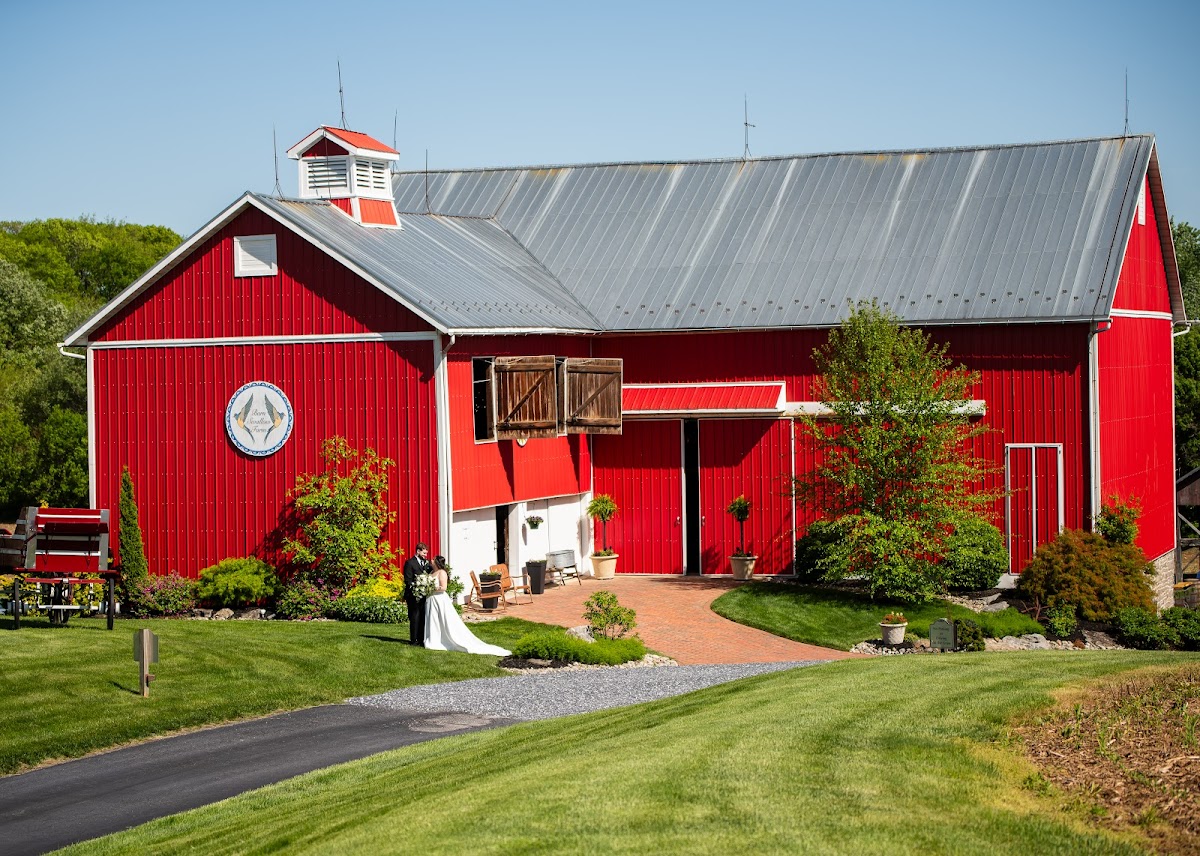
You turn off East Bullshead Road, and the landscape shifts from suburban sprawl to something older, quieter. Rolling farmland unfolds on either side, the kind of Pennsylvania countryside that hasn’t changed much in a century. Then you see it: the red barn. Not faded barn-red, but vivid, almost cinematic against the green cornfield that surrounds it like a living fence. This is Barn Swallow Farm, and it announces itself with the confidence of a place that knows exactly what it is. Drive closer and the details emerge — the deep brown wood interior visible through open doors, the elegant chandelier catching afternoon light, the babbling brook that runs along the ceremony site where a simple wooden arbor stands waiting. In summer, the cornfield grows twelve feet tall, creating a verdant corridor that makes guests feel like they’ve stepped into a secret world. In fall, the same field turns golden, rustling in the wind like a whisper. Barn Swallow Farm sits in Northampton Township, just twelve miles from Bethlehem and Allentown in Pennsylvania’s Lehigh Valley, close enough to the New York and Philadelphia metro areas to feel accessible but far enough to feel like a genuine escape. Poppy has received inquiries for Barn Swallow Farm wedding flowers from couples who want rustic elegance without the clichés, and we understand why. This is not a barn that tries too hard. It simply welcomes you home.
About Barn Swallow Farm
Barn Swallow Farm is a family-owned wedding venue set on a working farm property in the heart of the Lehigh Valley. The centerpiece — that striking red barn — has been meticulously renovated to preserve its agricultural bones while providing modern amenities. Step inside and you’re greeted by deep brown wooden walls that glow honey-warm in the light from the chandelier and string lights overhead. The exposed beams, intricate woodwork, and generous 4,000-5,000 square foot footprint give the space both intimacy and grandeur. This is a barn that can accommodate 160 guests comfortably without feeling cavernous, a balance that many rustic venues struggle to achieve.
The property includes a private outdoor ceremony site tucked into the natural landscape, where a simple wooden arbor stands before a backdrop of mature trees and a babbling brook. The water is not a decorative feature pumped in for ambiance — it’s a natural creek that runs through the property, providing both sound and movement. Surrounding everything is that twelve-acre cornfield, planted each spring and towering by midsummer, creating a living wall of green that turns photos into something out of a storybook. The covered wagon shed serves as the cocktail hour space, positioned between ceremony and reception areas to create a natural flow for the celebration.
Logistically, Barn Swallow Farm sits in Allen Township, accessible via PA Route 329 and Route 248, about 70 miles from Philadelphia and 90 miles from New York City. Lehigh Valley International Airport is ten miles away, making it convenient for guests flying in from out of town. The surrounding area offers the kind of rolling hills and agricultural charm that defines this part of Pennsylvania, along with easy access to Bethlehem’s historic downtown, Allentown’s cultural attractions, and the wine trails and farm-to-table restaurants scattered throughout the region.
For florists, the venue logistics are straightforward. The property includes ample parking and load-in space, with the barn’s wide doors allowing easy access for large installations. The venue operates with a selective vendor policy: florists are welcome from outside the preferred list, giving couples freedom to choose their Northampton wedding florist based on style rather than restriction. Catering is exclusively handled by Roots Mobile Catering, which offers farm-to-table menus with flexibility for dietary needs, and bartending services come through Served with a Twist. The venue provides tables, chairs, linens, and curated decor elements including wood rounds, greenery, and elegant lighting, which means floral designs can be more focused — you’re not starting from nothing. Poppy’s approach to Barn Swallow Farm wedding flowers centers on enhancing what’s already beautiful rather than trying to transform the space. The barn wants to stay a barn. Our job is to make it the most beautiful version of itself.
Event Spaces & Floral Opportunities
The Barn (Reception Space)
Capacity: 160 seated
Setting: The barn is generous in scale — 4,000 to 5,000 square feet of deep brown wooden interior that feels both rustic and refined. The walls are original timber, warm and textured, with intricate wood details that catch light beautifully. An elegant chandelier anchors the center of the space, surrounded by strings of bistro lights that create a soft, romantic glow as evening falls. The venue provides wood rounds, greenery accents, and elegant lighting as part of the rental, creating a foundation that already feels decorated. The ceiling beams are exposed and substantial, the kind that beg for garlands and hanging installations. There’s a designated dance floor area, and the open floor plan allows for flexible table arrangements.
Floral approach: The cardinal rule here is to work with the wood, not against it. The deep brown walls are stunning on their own and create a warm backdrop that makes almost any floral color pop, but they also absorb light, so pale pastels may disappear at dusk. Vibrant jewel tones, rich creams, and anything with strong contrast will photograph beautifully. For centerpieces, we recommend low and lush arrangements in neutral ceramic or wood vessels that echo the barn’s materiality — perhaps mounded garden roses (Patience, Keira, Romantic Antike), chocolate cosmos, burgundy dahlias (Karma Choc, Black Jack), and burgundy scabiosa, with trailing jasmine vine and Italian ruscus spilling over the edges. Alternatively, slightly elevated arrangements on natural wood risers create visual interest without blocking conversation. The exposed beams present a spectacular opportunity for installation work: imagine a twenty-foot garland of smilax, seeded eucalyptus, and olive branches running the length of the head table or crisscrossing above the dance floor, with clusters of café au lait dahlias, quicksand roses, and white lisianthus woven in at intervals. The chandelier is beautiful on its own, but a delicate greenery treatment — spiral eucalyptus or silver dollar branches loosely wrapped around the arms — can soften its presence without competing. For the entrance into the barn from the cocktail area, a pair of large-scale arrangements in aged wooden crates or galvanized buckets filled with seasonal branches, hydrangea, and local foliage creates a moment of transition. The lighting in this space is your friend: the string lights and chandelier will make your florals glow at night, so choose blooms with texture and depth rather than flat, one-dimensional forms.
Outdoor Ceremony Site
Capacity: 160 seated
Setting: This is where Barn Swallow Farm reveals its softer side. The ceremony site is tucked into the landscape, surrounded by a lush treeline that creates a natural amphitheater. A babbling brook runs along one side, providing gentle sound and movement — the kind of detail you can’t fake. The mature trees create dappled shade, and the simple wooden arbor stands as a focal point without overwhelming the natural beauty around it. Chairs are provided by the venue. Depending on the season, the cornfield may be visible in the distance, adding another layer of pastoral charm.
Floral approach: Less is more here, but “less” doesn’t mean minimal — it means intentional. The wooden arbor is your primary canvas, and it responds beautifully to asymmetrical, organic installations. We favor a lush corner cluster rather than a symmetrical arch treatment: imagine one side of the arbor heavily adorned with garden roses (Juliet, Patience, Keira), white delphinium, blush ranunculus, trailing jasmine vine, and smilax, with a few tendrils reaching across the top and down the opposite side, leaving the rest of the structure visible. This approach feels unforced, like the flowers grew there on their own. For the aisle, consider simple shepherd’s hooks with small arrangements every third row, or lanterns with small floral accents tucked around the base. If budget allows, lining the entire aisle with potted ferns or lavender in galvanized pails creates a romantic, garden-party feeling and can be repurposed as reception decor afterward. The natural treeline and brook backdrop mean you don’t need an extensive floral backdrop — they do that work for you. Instead, focus your floral budget on the arbor and aisle markers to frame the couple without competing with the landscape. One important note: this is an outdoor site with natural ground, so floor-length gowns may collect dirt and grass stains. Floral petals scattered down the aisle are romantic but can be slippery on grass — talk to your coordinator about timing if you want this look.
Wagon Shed
Setting: The covered wagon shed is a transitional space between ceremony and reception, serving as the cocktail hour area. It’s rustic in the truest sense — weathered wood, open sides, a roof overhead. The structure provides shelter from sun or light rain while maintaining that outdoor feeling. This is where guests gather with drinks in hand, reconnecting after the ceremony and building anticipation for the reception.
Floral approach: Cocktail hour florals should be pretty but practical — nothing so precious it can’t handle a bump from a guest holding a drink. Small arrangements on high-top cocktail tables work beautifully here: clusters of bud vases with single stems (spray roses, ranunculus, lisianthus), or compact arrangements in vintage brass or ceramic vessels that won’t tip easily. If there’s a bar setup, a garland treatment along the front edge adds a festive touch — perhaps smilax and eucalyptus with blooms tucked in at intervals. Keep the scale modest; this is not the place for towering installations. The rustic wagon shed aesthetic pairs perfectly with wildflower-inspired designs: black-eyed Susans, wild Queen Anne’s lace, purple statice, yellow solidago, and white feverfew in mason jars or enamelware pitchers. These arrangements feel effortless and abundant without requiring a massive budget. One practical consideration: if cocktail hour is during summer, choose hardy blooms that can tolerate heat and humidity (zinnias, sunflowers, solidago) rather than delicate garden roses that may wilt.
Bridal Suite
Setting: Located in the lower level of the barn, the bridal suite is bright, comfortable, and private — designed specifically for getting-ready moments. Natural light floods the space, making it ideal for hair, makeup, and those detail shots photographers love. There’s ample room for the bridal party to spread out without feeling cramped.
Floral approach: A single thoughtful arrangement makes all the difference here. Choose blooms that echo the bridal bouquet and arrange them in a beautiful ceramic or vintage vessel that will show up in photos. Garden roses (Patience, Juliet, Quicksand), blush ranunculus, white sweet peas, and jasmine vine create a romantic, fragrant moment that elevates the getting-ready experience. Place the arrangement near the window where natural light will make it glow, and it becomes a prop for detail shots — rings resting on petals, perfume bottles arranged nearby, invitation suite styled with blooms. If the bride loves fragrance, include garden roses, freesia, or stock for scent. This is a relatively small investment with significant photographic return, and the arrangement can move to the head table or cake table later in the day.
Groom’s Room
Setting: Also located in the barn’s lower level, the groom’s room offers a comfortable, relaxed space for the groom and groomsmen to prepare and gather before the ceremony. It’s less styled than the bridal suite but still benefits from thoughtful touches.
Floral approach: Keep it simple and masculine. A small arrangement on a side table or a single statement bloom in a bud vase adds refinement without feeling fussy. Consider blooms that complement the boutonnieres: a thistle, a single burgundy dahlia, or a stem of white delphinium in a simple glass or ceramic vessel. This is not a space that requires a significant floral investment, but a small touch shows attention to detail and provides a nice backdrop for getting-ready shots. If the groom is wearing a pocket square or tie in a specific color, echo that in the floral choice.
Wedding Flower Ideas for Barn Swallow Farm
Pennsylvania Fieldwork
This concept draws directly from the surrounding Lehigh Valley landscape, channeling the wildflower meadows and farmland that define the region. The palette is warm and abundant: golden sunflowers (Sunrich Orange, Teddy Bear), burgundy and coral zinnias, chocolate cosmos, yellow craspedia, black-eyed Susans, white feverfew, and wild Queen Anne’s lace. Textural accents include wheat stalks, oat grass, and bunny tail grass. Arrangements sit in galvanized buckets, enamelware pitchers, and weathered wooden crates, giving an authentic farmstand feeling. On the ceremony arbor, clusters of sunflowers and wildflowers create an exuberant, unstructured installation that looks windswept and natural. Reception centerpieces are low and abundant, spilling over the edges of their vessels. This design feels joyful, unpretentious, and deeply connected to place — perfect for couples who want their Barn Swallow Farm wedding flowers to feel like they were gathered from the fields that morning. Best suited for summer and early fall weddings when these blooms are at their peak and the cornfield is towering green or golden.
Heirloom Garden
For couples seeking something softer and more romantic, this concept channels an English country garden with a vintage sensibility. The palette is blush, cream, mauve, and soft peach: garden roses in shades of Patience, Juliet, Keira, and Quicksand, blush ranunculus, white sweet peas, cafe au lait dahlias, peach stock, and dusty pink astilbe. Foliage includes silver dollar eucalyptus, Italian ruscus, jasmine vine, and trailing smilax. Vessels are vintage-inspired brass compotes, ceramic pitchers, and mercury glass — nothing too modern or industrial. The ceremony arbor gets a lush, asymmetrical treatment with roses and vines cascading down one side. Reception centerpieces are low and garden-gathered in feeling, as though someone raided a grandmother’s cutting garden and arranged everything with loose, organic charm. The deep brown barn walls make these soft tones glow rather than disappear, especially under the chandelier and string lights at dusk. This palette works beautifully year-round but is especially stunning in spring and fall when garden roses and dahlias are at their best. It’s romantic without being saccharine, elegant without being stuffy.
Harvest Moon
Designed for autumn weddings, this concept embraces the richness of fall in Pennsylvania. The palette is warm and grounded: deep burgundy dahlias (Karma Choc, Black Jack), burnt orange roses (Free Spirit, Amazing Grace), rust-colored chrysanthemums, burgundy scabiosa, deep plum calla lilies, and yellow craspedia. Textural elements include privet berries, hypericum berries, burgundy amaranthus, and branches of bittersweet or autumn oak leaves. Vessels are aged wooden crates, copper compotes, and terracotta pots. On the ceremony arbor, clusters of dahlias and trailing amaranthus create a moody, romantic installation. Reception centerpieces mix flowers with seasonal elements like small pumpkins, gourds, or pomegranates for a harvest-table feeling. This design is dramatic and saturated with color, standing up beautifully against the deep brown barn walls and complementing the golden cornfield (if your wedding is timed when the corn is still standing). It’s sophisticated rather than overtly “fall” — no hay bales or artificial leaves, just the genuine colors of the season. Perfect for September through November weddings.
Seasonal Considerations
Barn Swallow Farm’s location in Pennsylvania’s Lehigh Valley means four distinct seasons, each offering unique opportunities and considerations for wedding flowers.
Spring (April - June): Spring in the Lehigh Valley is unpredictable — warm one day, frost the next. April can still see overnight lows in the 30s, so if you’re planning an early spring wedding, stick with hardy blooms (tulips, daffodils, hyacinth) and have a backup plan for protecting outdoor arrangements from cold snaps. By May, temperatures stabilize in the 60s-70s, and the surrounding farmland explodes with green. This is prime time for tulips, ranunculus, anemones, peonies (late May/June), sweet peas, and lilac. The treeline at the ceremony site will be lush with new growth, reducing the need for extensive backdrop florals. May and June are peak wedding season here, so book your Northampton wedding florist early. One practical note: spring rains are common, so ensure outdoor ceremony florals are water-resistant or protected. Best months: May and June, when temperatures are mild and peony season overlaps with late tulips.
Summer (July - September): Summer brings warm temperatures (75-85°F), high humidity, and that towering cornfield at peak height — 12 feet of verdant green creating a dramatic backdrop for photos. Locally available blooms include sunflowers, zinnias, dahlias, lisianthus, hydrangea, and wildflowers. The humidity can be challenging for delicate blooms like garden roses, which may wilt in extreme heat, so consider hardier varieties (spray roses, zinnias, dahlias, solidago) for outdoor installations. The babbling brook and tree cover at the ceremony site provide some natural cooling. For cocktail hour in the wagon shed, choose blooms that can tolerate warmth without wilting. Evening receptions in the air-conditioned barn are comfortable. Late August and September (technically early fall) offer the best of both worlds: warm days, cooler evenings, and the beginning of fall foliage. The cornfield begins transitioning from green to gold in September, creating stunning photo opportunities. Best months: August and September, when weather is warm but not oppressive and dahlias are abundant.
Fall (October - November): Autumn is spectacular in the Lehigh Valley. The treeline at the ceremony site turns brilliant shades of red, orange, and gold, creating a natural backdrop that requires minimal floral enhancement. Temperatures range from the 50s to 70s — ideal for outdoor ceremonies. Locally available blooms include dahlias (at their absolute peak), chrysanthemums, asters, and the last of the seasonal zinnias and sunflowers. This is also the season for branches: bittersweet, oak, maple, and burning bush can be incorporated into installations for dramatic effect. The cornfield may still be standing in early October, though it’s often harvested by mid-month. If you’re planning a November wedding, be prepared for colder temperatures (40s-50s) and the possibility of bare trees and brown fields — the landscape takes on a more austere quality. For late fall, focus your floral budget on the indoor reception space where guests will spend most of their time. Best months: September and October, when fall color peaks and dahlias are plentiful.
Winter (December - February): Winter weddings at Barn Swallow Farm are rare but magical. The barn’s warm interior, chandelier, and string lights create a cozy refuge from the cold, and the snowy landscape outside can be breathtaking. Temperatures range from the 20s to 40s, with potential for snow and ice. Outdoor ceremonies are not practical, but the barn’s size allows for an indoor ceremony setup. Winter blooms include amaryllis, evergreens (pine, cedar, fir), holly berries, hypericum berries, winter jasmine, and hellebores. Consider incorporating seasonal elements like pinecones, birch branches, and magnolia branches for textural interest. The deep brown barn walls and warm lighting make rich jewel tones (burgundy, deep red, emerald green) and classic winter whites glow beautifully. Logistics: ensure pathways are cleared of snow and ice, and that any outdoor setup (even brief) accounts for extreme cold affecting blooms. Best month: December, for holiday-season ambiance.
Poppy’s Expert Take
Work with the included decor, not against it. Barn Swallow Farm provides wood rounds, greenery, and elegant lighting as part of the venue rental. This is a gift to your floral budget. Rather than trying to cover or replace these elements, design around them. Use the wood rounds as chargers under low centerpieces, incorporate the venue’s greenery into your installations, and let the chandelier and string lights do the heavy lifting for ambiance. Your floral budget can then focus on high-impact areas like the ceremony arbor, statement reception arrangements, and personal flowers rather than decorating an empty shell from scratch.
The ceremony arbor is your hero moment. With the natural backdrop of trees and the babbling brook doing so much scenic work, the wooden arbor is where you should concentrate ceremony florals. A lush, asymmetrical installation here creates a focal point that photographs beautifully from every angle without requiring an extensive aisle treatment or backdrop structure. Invest here rather than trying to line every inch of the aisle — a few strategically placed shepherd’s hooks or lanterns will suffice when the arbor is stunning.
Embrace the cornfield in your design narrative. If your wedding falls during growing season (June through September), that twelve-acre cornfield is a design element you didn’t have to pay for. Let it influence your floral choices: golden yellows, fresh greens, rustic wildflowers, and organic textures all complement the agricultural surroundings. Your photographer will use that cornfield extensively, so ensure your bouquet and personal flowers look cohesive with the landscape in those shots.
Plan for the barn’s lighting at dusk. The chandelier and string lights transform the barn as evening falls, creating a warm, romantic glow. This lighting can make certain floral colors pop (jewel tones, deep burgundies, rich creams) while causing others to disappear (pale pastels, light yellows). If your reception extends into evening — and it likely will — choose blooms with enough saturation and contrast to hold up under warm artificial light. Bring color swatches to a site visit at dusk if possible to see how your palette translates.
The wagon shed is not the place for precious florals. Cocktail hour in a semi-outdoor space with drinks flowing means florals need to be practical. Small, sturdy arrangements that won’t tip easily, hardy blooms that can tolerate temperature fluctuations, and nothing so delicate it will be ruined by a bump or splash. Save your most precious, expensive blooms (peonies, specialty garden roses) for the ceremony and reception where they’ll be protected and showcased properly.
Coordinate with Roots Mobile Catering on table logistics. Since Barn Swallow Farm has an exclusive catering relationship with Roots Mobile Catering, connect with them early about table sizes, linen colors, and service style (plated, buffet, family-style). This affects centerpiece design significantly — a family-style setup with serving platters requires lower, more compact arrangements than a plated dinner. Getting these details sorted early prevents last-minute redesigns.
Budget for repurposing ceremony florals. The timeline at Barn Swallow Farm allows for moving ceremony arrangements to the reception space — ceremony arbor pieces can become entry statement arrangements, aisle markers can be scattered throughout the cocktail area or used to flank the barn entrance. Build this into your floral plan and coordinate with your day-of coordinator about who will handle the move and where pieces should land. This strategy stretches your budget significantly, giving you twice the impact from the same investment.
What Poppy Couples Spend on Flowers Here
While Poppy hasn’t yet designed flowers for a completed wedding at Barn Swallow Farm, we can provide guidance based on our experience with similar barn venues in the New York market and the five inquiries we’ve received from couples planning celebrations here. Barn weddings in the Lehigh Valley typically see slightly lower floral budgets than metropolitan New York venues due to lower regional costs and the venue’s included decor reducing the need for extensive styling.
$3,000 - $5,000 | The Foundation This range covers the essentials: bridal bouquet and bridesmaid bouquets, boutonnieres and corsages for immediate family, a ceremony arbor installation with asymmetrical floral cluster and greenery, six to eight aisle markers (shepherd’s hooks with small arrangements or lanterns with floral accents), and reception centerpieces for up to 16 tables using a mix of high and low arrangements (perhaps eight low compotes with garden roses, dahlias, and greenery, and eight slightly elevated arrangements on wood risers). You’ll also have budget for a small arrangement in the bridal suite and modest cocktail hour touches (four to six small arrangements for high-top tables). This level prioritizes the most visible moments — what the bride carries, what frames the vows, and what sits on dinner tables. To maximize this budget, consider a smaller bridal party (fewer bouquets and boutonnieres), choose seasonally abundant blooms (summer zinnias and dahlias, fall chrysanthemums, spring tulips), and repurpose ceremony flowers to the reception (arbor pieces flanking the barn entrance, aisle markers on the cocktail tables). The barn’s existing chandelier, string lights, and wood round decor mean you’re not starting from zero, allowing this budget to create a cohesive, beautiful floral story.
$5,000 - $8,000 | The Complete Picture This range adds layers of polish and abundance. You’ll have everything from the Foundation level, but with more generous installations: a fuller ceremony arbor with florals cascading down both sides and across the top, ten to twelve substantial aisle markers, and all reception centerpieces in lush, elevated designs (perhaps alternating between low mounded arrangements and tall compositions on natural wood risers). You can add a statement installation in the barn — perhaps a twenty-foot garland suspended from the ceiling beams above the head table or dance floor, woven with smilax, eucalyptus, and blooms. Cocktail hour gets fuller treatment with eight to ten arrangements and a bar garland installation. You’ll also have budget for a groom’s room arrangement, entrance statement pieces (large urns flanking the barn doors), and a small cake-table arrangement. At this level, you can incorporate more premium blooms (garden roses, cafe au lait dahlias, peonies in season) and add textural specialty elements (amaranthus, jasmine vine, flowering branches). This investment creates a cohesive floral presence across all spaces — ceremony, cocktail hour, and reception — with enough abundance that florals feel like a key design element rather than an accent.
$8,000+ | The Full Experience This budget allows for floral artistry that transforms the venue. Every space receives considered attention: the ceremony arbor becomes a lush, abundant installation that looks like it grew there naturally, aisle lined entirely with arrangements or potted plants, dramatic hanging installations in the barn (multiple garlands, perhaps a cloud-like installation above the dance floor), every reception table with generous, textured centerpieces featuring premium blooms and cascading foliage, statement arrangements flanking the barn entrance and throughout the space, full bar treatments in both cocktail and reception areas, and specialty touches like a floral chandelier treatment or greenery wrapped around the barn’s existing chandelier arms. You can incorporate high-end specialty blooms (imported garden roses, unusual dahlias, rare foliage), seasonal branches and textural elements, and elaborate installations that require advanced mechanics and installation time. At this level, florals become an immersive experience — guests notice them in every corner, photographers can’t help but capture them in every frame, and the overall aesthetic feels lush, considered, and utterly romantic. This investment makes sense for couples who see flowers as central to their design vision and want Barn Swallow Farm’s rustic beauty elevated to something truly extraordinary.