
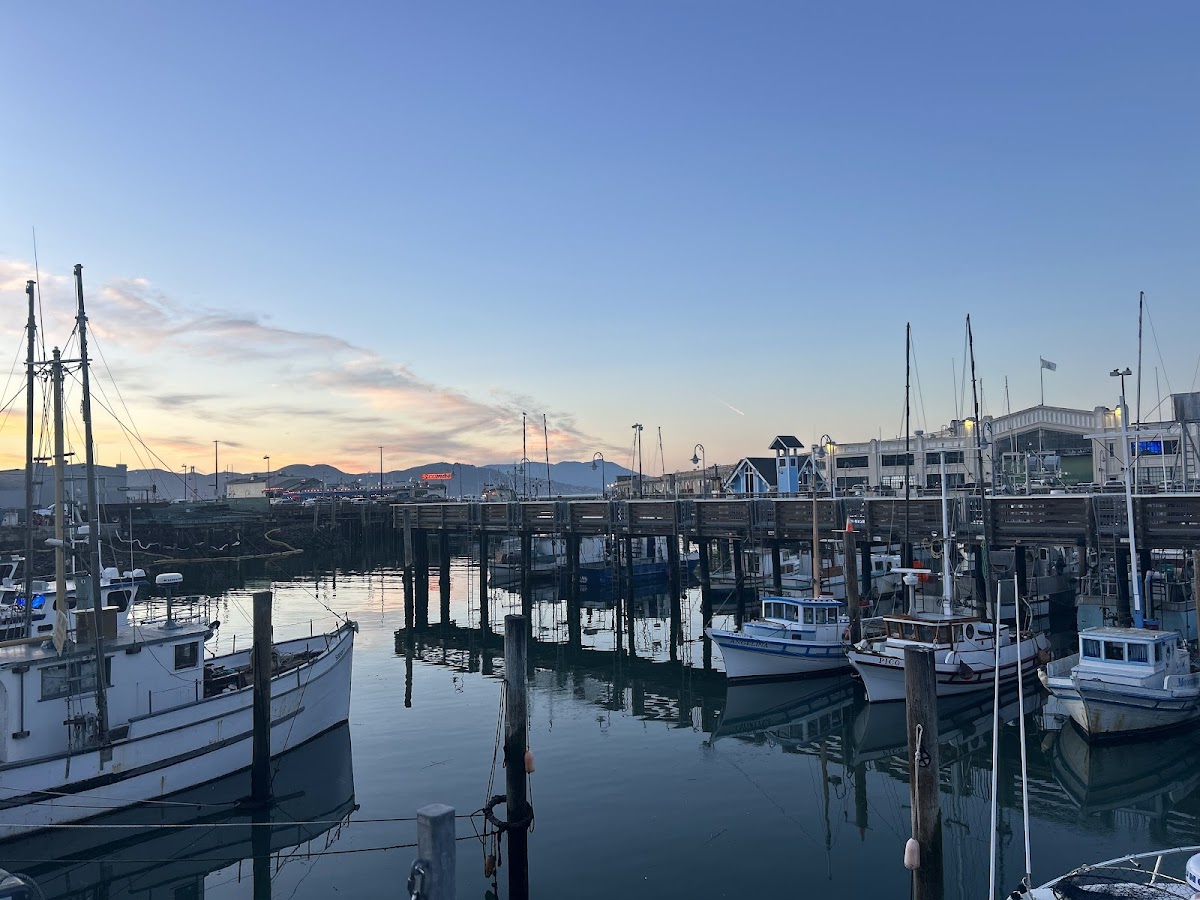
We know this venue well from our work here, and the primary design challenge at Scoma’s is one of restraint. Because this is a functioning, historic restaurant with a “food-first” philosophy, the floral design must be intentional, compact, and highly stable. You are designing for a space where the salt air is part of the atmosphere and the view of the fishing fleet is the main attraction.
The Spaces
Bayside Patio
This is the most atmospheric space at Scoma’s, situated right at the water’s edge. It offers a raw, authentic San Francisco experience, but it comes with the logistical reality of the Embarcadero’s microclimate.
- What works: Heavy stone or ceramic vessels that won’t tip in a gust. Ground-level “growing” gardens at the entrance provide a lush welcome without catching the wind like a tall pedestal would.
- Skip: Tall, top-heavy glass vases or lightweight plastic containers. Anything with a high center of gravity will end up in the Bay.
- Watch out: The “moderate” wind mentioned in the venue data is often an understatement. Use museum wax on the bottom of smaller vessels. Budget hero move: Focus your spend on a lush, floor-based semi-circle for the ceremony area that can be moved to flank the patio entrance for the reception.
Main Dining Room
The heart of the restaurant is defined by its 1960s nautical charm and warm wood tones. It is cozy, bustling, and has a very specific “old school” San Francisco energy.
- What works: Warm-toned florals like copper-colored ranunculus, deep burgundy dahlias, or classic white anemones with dark centers. These colors stand out against the dark wood paneling.
- Skip: Oversized arrangements that interfere with the restaurant’s efficient service. The staff moves quickly here; flowers should stay within the footprint of the table.
- Watch out: Table space is at a premium once bread service and wine glasses arrive. Budget hero move: A series of high-quality bud vases in varying heights creates a “full” look without the cost or footprint of a massive centerpiece.
Bay Marin Room
Named for its views of Mt. Tamalpais and Sausalito, this room is the choice for larger private events that require a dedicated space.
- What works: Low, horizontal compote arrangements. The windows are the star of this room, and your flowers should act as a foreground element to the maritime scenery.
- Skip: High-reaching branches or tall pampas grass. They will look like clutter against the clean lines of the Bay views.
- Watch out: The room has an 85-inch television for presentations; ensure your floral placement doesn’t block the screen if it’s being used.
The Scalia and Gannon Rooms
These are the most intimate spaces, perfect for rehearsal dinners or micro-weddings. The Scalia room is particularly dense with history and celebrity photos.
- What works: Monochromatic floral “clouds.” Because the walls are busy with photos and wood grain, a single-color palette (all white, all peach, or all deep red) provides a sophisticated visual rest for the eye.
- Skip: Multi-colored, “wildflower” looks which can feel messy in such a storied, structured environment.
- Watch out: These tables are often narrow. Measure the width before committing to wide-reaching centerpieces.
What Works at Scoma’s
Prioritize the “Front-to-Back” View. In any room at Scoma’s, guests are looking through the windows. Use “airy” flowers like Cosmos, Scabiosa, or Thalictrum. These allow the eye to see through the arrangement to the water beyond, rather than creating a solid wall of petals.
Lean into the Nautical Palette. You don’t need anchors and ropes to be “on theme.” Use navy blue viburnum berries, sea holly (Eryngium), and eucalyptus to subtly nod to the maritime setting. These textures pair perfectly with the restaurant’s aesthetic.
Stable, Low-Profile Vessels. Whether you are inside or on the patio, low-profile compotes are the superior choice. They keep the conversation flowing across the table and ensure that even if a tray is bumped during a busy dinner service, the flowers stay put.
Repurposing with Purpose. The transition from a ceremony on the Bayside Patio to a dinner in the Bay Marin Room is a common flow. Invest in pieces that are easy to carry—like “meadow” pieces in heavy trays—that can be moved by two people in under sixty seconds.
Architectural Greenery. In the larger dining areas, a few well-placed, large-scale foliage arrangements (like Magnolia branches or Olive) can bridge the gap between the historic interior and the natural world outside.
Budget Guide
| Tier | Investment | Floral Scope |
|---|---|---|
| Essentials | $1,750 - $2,500 | Personal flowers (bouquets/boutonnieres) and a collection of premium bud vases for 5-8 tables. Focus is on quality over volume. |
| Sweet Spot | $3,500 - $5,000 | Full personal flowers, low-profile compote centerpieces for 10 tables, and a small statement piece for the bar or entrance. |
| Full Experience | $5,500 - $8,000 | Includes a repurposed ceremony installation (like a ground-level meadow), lush table centerpieces, and floral accents for the bar and lounge areas. |
| Statement | $10,000+ | Full-scale floral immersion including a custom installation for the patio, high-density centerpieces, and greenery accents across the ceiling beams where feasible. |
Scoma’s is a venue where heritage and hospitality take center stage, so your floral budget should focus on enhancing the existing charm rather than trying to transform the space into something it isn’t.
Tips
Valet is your best friend. Loading into Fisherman’s Wharf is notoriously difficult; coordinate with the venue to use their valet or the Triangle Parking Lot for a seamless drop-off.
Weight your outdoor arrangements. If you are using the Bayside Patio, specify to your designer that every vessel must be weighted with stones or heavy mechanics to withstand the afternoon gusts.
Respect the white linens. Scoma’s uses classic white tablecloths; ensure all floral water is treated and vessels are leak-proof to prevent staining the restaurant’s inventory.
Think about the evening light. The restaurant has a warm, retro glow at night. Avoid very dark purples or blues that might disappear into the shadows; use “illuminating” colors like cream, butter yellow, or soft coral.
Coordinate with the “Food-First” timeline. Restaurant weddings move at a different pace than ballroom weddings. Ensure your setup is completed well before the first course of clam chowder hits the table.