
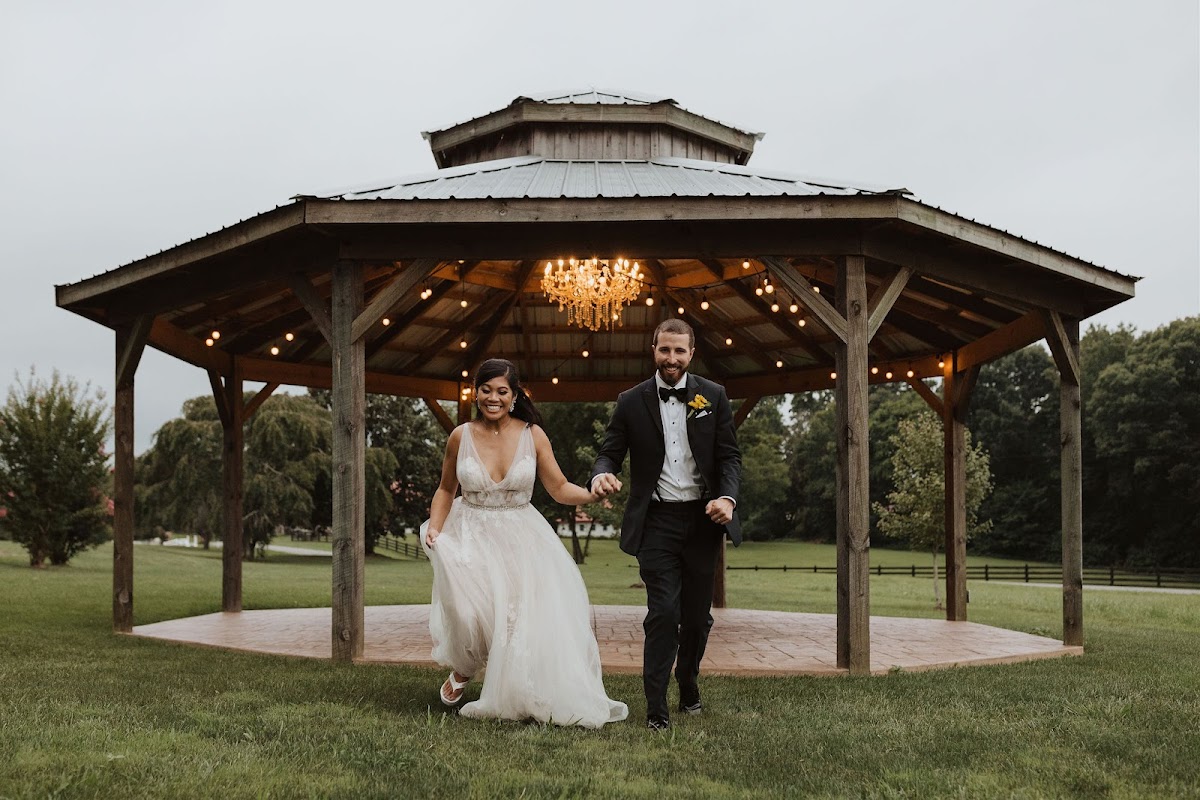
The approach to Fairview Farm Events reads like a love letter to Virginia’s Piedmont countryside. You leave the commercial strip of Midlothian behind, wind through the rolling farmland of Powhatan County, and somewhere along Ballsville Road the land opens up the way only a true working farm can — 115 acres of pasture, woodland, and water stretching toward the tree line. The 1951 red Ford pickup appears first, parked just so near the entrance, its patina of rust and old paint telegraphing authenticity from fifty yards away. Then the barns reveal themselves: not the decorative kind, but actual 1920s structures restored with enough reverence for their bones that you can still smell the century-old wood underneath the bistro lights. The lake glints beyond the ceremony lawn, the woods rise to the west, and somewhere in the middle distance, the 1915 farmhouse sits exactly as farmhouses should — square-shouldered, white-painted, entirely unbothered by trends. Poppy has designed Fairview Farm Events wedding flowers for one celebration here so far, and the thing that struck us most was this: the venue doesn’t perform rusticity. It simply is rustic, which changes everything about how flowers should behave here.
About Fairview Farm Events
Fairview Farm Events occupies 115 acres of family-owned farmland in Powhatan County, Virginia, roughly thirty minutes west of Richmond’s city limits. This is not a venue that was purpose-built for weddings and then decorated to look historic. The property has been in agricultural use for over a century, and the family’s decision to open it for events came with a commitment to preserving the working farm’s character while retrofitting the infrastructure for modern celebrations. The 1920s Dairy Barn and Hay Barn were structurally reinforced and climate-controlled, but the original post-and-beam construction remains visible throughout. The 1915 farmhouse, which serves as the bridal suite, retains its original pine floors, crown molding, and the kind of deep windowsills that only old houses possess. Even the vintage vehicles — the ‘51 and ‘56 Ford pickups, the red tractor — are not rentals trucked in for photo ops. They belong to the property, remnants of the farm’s operational history now repurposed as surprisingly charming backdrops for first looks and family portraits.
The venue’s event infrastructure is thoughtfully layered onto this agricultural foundation. The Main Reception Barn is a two-story, climate-controlled space that seats 225 guests under original timber beams now strung with chandeliers and bistro lighting. The All-Weather Pavilion — a 2,400-square-foot covered structure adjacent to the barn — bridges indoor and outdoor with an antique bar, more chandeliers, and open-air sides that let the breeze through while protecting guests from rain. The Lakefront Ceremony Site offers a gazebo, dock, and fountain arrangement overlooking still water, while the “Wedding in the Woods” site is exactly what it sounds like: a clearing surrounded by oak and poplar where couples who want a truly intimate, forest-canopy ceremony can exchange vows with only the sound of leaves rustling overhead. There’s also a 2,000-square-foot Game Room building stocked with pool tables, air hockey, and pinball machines — the kind of detail that keeps groomsmen occupied during portrait time and adds an element of weekend-at-the-farm casualness to the proceedings.
Logistically, Fairview Farm Events is accessible but secluded. The thirty-minute drive from Richmond is straightforward via Route 60 West, and the property includes ample lighted parking with a parking attendant included in weekend packages. Vendor arrival is permitted starting at noon on Friday for weekend events, which gives florists like Poppy generous setup time — a luxury we don’t take for granted, especially when working with large-scale installations. The venue provides ten hours of planning services with a lead coordinator and assistant, and the included seasonal decor means couples often arrive to find the barns already dressed with antiques, vintage props, and curated details that reduce the need for extensive additional decoration. This is a double-edged sword for florists: on one hand, less decorating to do; on the other, the existing aesthetic is strong enough that your florals need to complement rather than compete. Fairview Farm’s catering is handled through exclusive on-site menus (buffet, family-style, or plated service, $35-$55 per guest) or through preferred caterers, and the venue allows BYOB with discounted alcohol pricing available, which often frees up budget for couples to invest more in florals, entertainment, or photography.
For Poppy’s delivery and setup, the load-in process is efficient. We typically stage in the barn or pavilion depending on the day’s timeline, and the venue’s staff is communicative about where we can store buckets, access water, and coordinate with other vendors. The property’s multiple ceremony and reception options mean we’re often designing for three or four distinct spaces in a single event — ceremony at the lake, cocktails in the pavilion, dinner in the barn, and late-night s’mores by the fire pits — which requires careful planning but yields a wedding that feels like a true journey through the farm rather than a static, single-room affair.
Event Spaces & Floral Opportunities
Main Reception Barn
Capacity: 225 seated
Setting: The Main Reception Barn is the heart of Fairview Farm Events — a two-story, climate-controlled structure with original 1920s timber framing, soaring ceilings, and walls clad in reclaimed wood that has aged to a soft silver-gray. Chandeliers descend from the beams at intervals, casting warm light across the space, while bistro lights crisscross overhead to add sparkle without harshness. The barn comes fully furnished with the venue’s collection of farm tables, including a stunning 15-foot antique pine table from the 1860s that serves as the perfect head table. Three barrel buffet tables with walnut tops provide serving stations, and the venue decorates seasonally — autumn brings in pumpkins and dried cornstalks, winter adds evergreen garlands and lanterns, spring features cherry blossom branches, summer incorporates wildflower bunches. The aesthetic is rustic chic without veering into kitschy: think less “barnyard wedding” and more “refined farmhouse supper club.”
Floral approach: This is a barn that rewards restraint and natural abundance in equal measure. The existing decor is substantial enough that your florals need to feel integrated rather than applied. For the 15-foot farm table, we recommend a garden-style runner treatment: a continuous, organic installation of Quicksand and Café au Lait roses, white lisianthus, ivory ranunculus, and textured greenery (Italian ruscus, seeded eucalyptus, jasmine vine) that cascades down the center of the table with intentional gaps and asymmetry — this is not a tight, formal runner but rather a loose, picked-from-the-garden arrangement that echoes the farm’s agrarian roots. For guest tables, low compote arrangements in aged bronze or wooden vessels work beautifully, filled with seasonal blooms that complement the venue’s existing decor: in autumn, burgundy dahlias (Spartacus, Black Jack), rust-toned chrysanthemums, and bittersweet vine; in spring, coral charm peonies, tulips in soft peach and blush, and flowering branches. The chandeliers and beams offer opportunities for suspended installations — consider greenery garlands with clusters of blooms woven through, or individual floral hoops hung at varying heights to create dimension without blocking sightlines. The barrel buffet tables are ideal for elevated arrangements — tall, slightly wild compositions in galvanized buckets or vintage crocks that rise above the food displays and serve as visual anchors. Resist the urge to over-floralize this space; the barn’s architecture and the venue’s seasonal decor are doing significant aesthetic work, so your flowers should accent and enhance rather than dominate.
All-Weather Pavilion
Capacity: Flexible (typically cocktail-style or ceremony seating)
Setting: The All-Weather Pavilion is one of Fairview Farm’s smartest features — a 2,400-square-foot covered structure with a roof and support posts but open sides that allow for cross-breeze and views of the surrounding property. Chandeliers hang from the ceiling beams, bistro lights add ambient sparkle, and an antique wooden bar anchors one end of the space. The pavilion is used variously for cocktail hours, outdoor-yet-covered ceremonies, and rehearsal dinners, and its flexibility makes it invaluable for Virginia’s unpredictable weather. You get the atmosphere of an outdoor space without the risk of rain-soaked guests or wind-toppled arrangements.
Floral approach: The pavilion’s open structure invites organic, flowing floral installations that mimic natural growth patterns. The support posts are prime real estate for greenery garlands — long runs of smilax, Italian ruscus, and seeded eucalyptus punctuated with clusters of garden roses (Juliet, Patience, Keira), spray roses, and seasonal accent flowers. These garlands should feel deliberately imperfect, with trailing ends and asymmetrical blooms, as if they grew up the posts naturally. The antique bar is an opportunity for a statement installation: a lush, overflowing arrangement in a wooden crate or galvanized trough, filled with a profusion of blooms and foliage that spills over the sides — think café au lait dahlias, white hydrangea, blush stock, and trailing jasmine vine. If the pavilion is being used for a ceremony, consider a wooden arbor dressed with greenery and blooms, positioned to frame the couple against the lake or woodland backdrop beyond. For cocktail hour use, scattered highboy tables can be dressed with low arrangements in mason jars or small galvanized buckets — simple, abundant, and easily moved when the space needs to flip for dinner. The weather-protected nature of the pavilion means you can use more delicate blooms here than you might risk at a fully outdoor space, but the open sides still expose arrangements to breeze, so avoid tall, top-heavy designs that could tip.
Lakefront Ceremony Site
Capacity: Flexible
Setting: The Lakefront Ceremony Site is Fairview Farm’s showpiece for outdoor vows — a large wooden deck extends toward the water, where a white gazebo serves as the ceremony focal point, with a dock and fountains creating gentle water sounds in the background. The lake itself is still and reflective, surrounded by grasses and trees that shift color dramatically with the seasons. The setting is naturally picturesque, the kind of place that requires very little augmentation to feel special. Guests can be seated on the lawn facing the gazebo and lake, or the ceremony can be held on the deck itself for a more intimate configuration.
Floral approach: The gazebo is the obvious hero here, and it deserves a treatment that enhances without overwhelming its clean lines. We typically recommend either a full floral arch — a lush, asymmetrical installation of blooms and greenery that wraps around one side and cascades down, leaving the other side lighter to maintain visual balance — or a simpler garland treatment along the top beam with concentrated floral clusters at the corners. For a spring wedding, this might be white peonies, blush garden roses, and trailing wisteria (or wisteria-like delphinium if true wisteria isn’t available); for summer, hydrangea, lisianthus, and queen anne’s lace with lots of airy, romantic texture; for autumn, dahlias, garden roses in warm tones, and seeded eucalyptus with rust and amber accents. The aisle is best marked with understated treatments — either low arrangements in wooden boxes or galvanized buckets placed at intervals, or simple shepherd’s hooks with hanging arrangements (we favor this option as it keeps the aisle clear and visually elevated). If the dock is being used for photos, consider placing a single statement arrangement — a large urn overflowing with seasonal blooms — at the entrance to the dock, which provides a beautiful foreground element for portraits with the lake in the background. The fountains require no floral enhancement; they’re providing movement and sound, and flowers would only distract. Keep the focus on the gazebo and the natural beauty of the water, and your ceremony florals will feel perfectly integrated into the landscape.
Wedding in the Woods
Capacity: Flexible (best suited for intimate ceremonies)
Setting: The “Wedding in the Woods” ceremony site is tucked into a wooded area on the property, where oak, poplar, and hickory trees form a natural canopy overhead. Dappled light filters through the leaves, and the ground is soft with moss and fallen leaves depending on the season. There are walking trails nearby, and the overall effect is one of seclusion and intimacy — the kind of place where you feel like you’ve stepped away from the world entirely, even though the reception barn is just a short walk away. This site works best for smaller guest counts or couples who want a truly private, nature-immersed ceremony.
Floral approach: The cardinal rule for woodland ceremonies is this: the forest is already doing the work. Your job is to accent, not compete. We recommend a minimal approach focused on the altar area and aisle. For the altar, consider a low wooden bench or vintage door frame dressed with a simple garland of greenery (ferns, maidenhair fern, sword fern, and trailing ivy) with small clusters of woodland-appropriate blooms — hellebores, astilbe, wild roses, and foraged-looking accents like berries or seed pods. The goal is to create something that looks like it could have grown there naturally. Aisle markers should be equally understated: low arrangements in moss-covered containers, or simple bundles of flowers and greenery tied to shepherd’s hooks or tree branches. If the couple is open to it, consider using potted ferns or small trees to mark the aisle, which can then be repurposed as decor in the barn reception. Avoid anything overtly formal or structured — no tall vases, no symmetrical arrangements, no blooms that read as “wedding flowers” in the conventional sense. This is the space for scabiosa, chocolate cosmos, wild clematis, and anything that feels foraged. The tree canopy provides natural drama and framing, so trust it. Your florals are supporting actors, not the leads.
1915 Farmhouse - Bridal Suite
Capacity: Accommodates up to 15 guests overnight, functions as getting-ready space for larger bridal parties
Setting: The 1915 Farmhouse is a white clapboard two-story structure with all the charm of a century-old Virginia home: original pine floors that creak in the right places, crown molding, a working fireplace, and a dedicated bridal suite wing with a queen bed and jacuzzi bath. The rooms are furnished with vintage pieces — upholstered chairs, wooden dressers, brass fixtures — and the windows are deep-set with generous sills. Natural light pours in during morning getting-ready hours, which makes this an ideal space for detail shots and bridal prep photography. The atmosphere is cozy, historic, and utterly removed from any barn-venue cliché.
Floral approach: The farmhouse is where your personal flowers — bridal bouquet, bridesmaid bouquets, boutonnieres — become the stars. We recommend placing the bridal bouquet on a vintage tray or wooden table near a window where natural light will illuminate it for detail shots. A small arrangement for the vanity or bedside table — something scaled to the intimacy of the space, perhaps a low compote of garden roses, ranunculus, and sweet pea in soft, romantic tones — adds a touch of luxury without crowding the room. If the fireplace mantel is visible in getting-ready photos, consider a simple garland of greenery with a few blooms tucked in, but keep it understated; this is not the place for large-scale installations. The jacuzzi bath, if photographed, can be dressed with floating petals (rose or peony petals in water create a lovely, spa-like effect) or a small arrangement on the tub’s edge. The key is to enhance the farmhouse’s existing charm rather than attempting to transform it. Think in terms of accents and details that will photograph beautifully and contribute to the morning’s calm, romantic atmosphere.
1920s Dairy Barn and Hay Barn Lofts
Capacity: Accommodations for overnight guests (4,000 sq ft Dairy Barn Loft, 2,000 sq ft Hay Barn Loft)
Setting: The restored barn lofts offer guest accommodations with an upscale rustic aesthetic — exposed beams, chandeliers, comfortable furnishings, and enough space for guests to spread out and feel like they’re staying in a unique, memorable space rather than a generic hotel. These lofts are part of what makes Fairview Farm Events a true destination venue; guests can stay on the property, wake up to pastoral views, and ease into the wedding day without the logistical stress of offsite accommodations.
Floral approach: Floral needs in the guest lofts are minimal but impactful. Consider placing a single arrangement on a central table or kitchen island — something welcoming and abundant, like a large mason jar or galvanized bucket filled with seasonal blooms and greenery that guests will see when they first enter the space. If the chandeliers are particularly dramatic, a simple greenery garland draped casually over the beam or railing adds a festive touch without requiring significant effort. These are not spaces that demand extensive florals, but a thoughtful accent or two signals to guests that every corner of the property has been considered and cared for.
Fire Pits
Capacity: Flexible gathering spaces
Setting: Fairview Farm Events has multiple fire pits — both gas and wood-burning — scattered across the property, creating cozy gathering spots for late-night conversations, s’mores stations, or simply extending the celebration beyond the barn walls. In cooler months, these fire pits become natural hubs for guests, and they add a layer of warmth and casual conviviality to the event.
Floral approach: Fire pits don’t need flowers, but the areas around them can be enhanced with potted arrangements (mums in autumn, hydrangeas in summer, evergreens in winter) or lanterns with small floral accents — perhaps a few stems of greenery tucked into the lantern base or a simple wreath hung nearby. The key is to keep any floral elements far enough from the flames to avoid fire hazards, and to choose arrangements that can withstand outdoor conditions and guest traffic. Think in terms of ambiance and setting the scene rather than traditional floristry.
Vintage Vehicle Props
Capacity: N/A (photo opportunity)
Setting: The 1951 restored red Ford pickup, 1956 vintage Ford pickup, and old red tractor are stationed around the property as charming relics of the farm’s working past. They’ve been embraced as photo props and backdrops, and couples routinely use them for couple portraits, family photos, and even as a display surface for welcome signs or floral installations.
Floral approach: The truck beds are ideal for floral installations that feel abundant and slightly wild. Consider filling the bed of the red pickup with a profusion of seasonal blooms and greenery — sunflowers, zinnias, and wildflowers in summer; dahlias, chrysanthemums, and ornamental grasses in autumn; tulips and flowering branches in spring. The arrangement should overflow the sides and look as if it were just harvested from a cutting garden and tossed into the truck bed. Alternatively, the truck bed can hold the bridal bouquet and bridesmaid bouquets for a group detail shot, or serve as a welcome display with a large arrangement flanking a chalkboard or wooden sign. The tractor can be dressed with a simple wreath hung on the steering wheel or a small arrangement tucked into the seat. These vehicles read as authentically rustic, so your florals should match that energy — nothing too precious or formal, everything slightly disheveled and farm-fresh.
Wedding Flower Ideas for Fairview Farm Events
Harvest Table
This concept draws directly from the farm’s agricultural identity and the venue’s seasonal decor tradition. The palette centers on warm, earthy tones: terracotta, rust, amber, cream, and deep burgundy. Blooms include café au lait dahlias, Quicksand and Cappuccino roses, peach and apricot ranunculus, burnt orange chrysanthemums, and chocolate cosmos for depth. Textured foliage — seeded eucalyptus, olive branches, dried grasses, and bundles of wheat — adds movement and an unmistakably harvest-time feel. Arrangements sit in wooden boxes, galvanized buckets, and ceramic crocks in earthy glazes. The 15-foot farm table in the Main Reception Barn gets a full runner treatment with these blooms cascading organically down the center, interspersed with small pumpkins, gourds, and votives. Guest tables receive low, lush compote arrangements that echo the runner’s abundance. The All-Weather Pavilion bar is dressed with a dramatic arrangement overflowing a wooden crate. This palette works beautifully from late August through November, and pairs perfectly with the venue’s autumn aesthetic.
Virginia Garden
This concept leans into the romance of a cultivated cutting garden — the kind you’d find behind an old Virginia farmhouse, slightly overgrown and utterly charming. The palette is soft and layered: blush, peach, cream, soft lavender, and pale yellow. Blooms include garden roses (Juliet, Patience, Keira), peonies (when in season), ranunculus, sweet pea, lisianthus, stock, and astilbe for texture. Greenery is abundant and loose — jasmine vine, Italian ruscus, maidenhair fern — with tendrils trailing naturally. Arrangements sit in vintage-inspired vessels: aged brass compotes, ceramic pitchers, mercury glass, and mismatched china. The bridal bouquet is a loose, slightly asymmetrical clutch that looks freshly picked. Ceremony arrangements at the Lakefront Gazebo are lush but airy, with lots of movement and a just-gathered quality. This palette works year-round by substituting seasonal blooms (tulips in spring, garden roses in summer, dahlias in fall, hellebores and anemones in winter) but maintaining the soft, romantic color story. It’s particularly stunning in the 1915 Farmhouse getting-ready photos and pairs beautifully with the barn’s neutral wood tones.
Wildwood
This concept honors the “Wedding in the Woods” ceremony site and brings the forest aesthetic into the barn spaces. The palette is moody and organic: forest green, deep plum, burgundy, taupe, and cream. Blooms include burgundy and plum dahlias (Black Satin, Thomas Edison), deep red garden roses (Tess, Munstead Wood), hellebores, scabiosa, astilbe in mauve and burgundy, and chocolate cosmos. Foliage is lush and varied — sword fern, maidenhair fern, eucalyptus in silver-dollar and seeded varieties, trailing ivy, and foraged branches with interesting texture (dogwood, curly willow, birch). Arrangements incorporate natural elements like moss, bark, and seed pods. Vessels are earthy and substantial: aged wood containers, dark ceramic, bronze compotes. The woodland ceremony site gets minimal treatment — a low altar arrangement and simple aisle markers — while the barn reception brings the forest indoors with dramatic centerpieces that feel like miniature woodland landscapes. The overall effect is moody, romantic, and deeply connected to the property’s natural surroundings. This palette is particularly stunning in autumn and winter and photographs beautifully in the barn’s warm, bistro-lit interior.
Seasonal Considerations
Fairview Farm Events sits squarely in Virginia’s Piedmont region, which experiences a humid subtropical climate with four distinct seasons. Understanding these seasonal shifts is crucial for planning Fairview Farm Events wedding flowers that will thrive in the conditions and look their best throughout the celebration.
Spring (March - May): Spring in Powhatan is a gradual unfurling. March can still be chilly with unpredictable weather — warm afternoons giving way to cold evenings, occasional late frosts, and temperamental rain showers. By April, the farm begins to green up in earnest, and by May, the landscape is lush and fully awakened. Spring blooms available locally and regionally include tulips (incredible variety and color range, peak availability April-early May), daffodils and narcissus (March-April), hyacinth, ranunculus, anemones, hellebores, flowering branches (dogwood, cherry, quince, forsythia), and early peonies (late May if you’re lucky). Spring is also when Virginia’s native wildflowers begin to appear — trillium, Virginia bluebells, bloodroot — though these are best appreciated in situ rather than cut. For outdoor ceremonies at the Lakefront or in the Woods, be prepared for variable weather; have a backup plan and choose hearty blooms that can handle a breeze. The All-Weather Pavilion becomes invaluable in spring. Best months: Late April and May offer the most reliable weather and peak bloom availability.
Summer (June - August): Virginia summers are hot, humid, and lush. Temperatures routinely reach the upper 80s and 90s with high humidity, which means outdoor ceremonies require careful timing (early evening or late afternoon to avoid peak heat) and floral choices that can withstand warmth. Summer is peak growing season, so bloom availability is extraordinary: garden roses (David Austin varieties are at their best), hydrangea (both local and imported), peonies (June only, then they’re gone), dahlias (beginning mid-summer and running through fall), lisianthus, zinnias, sunflowers, cosmos, Queen Anne’s lace, delphinium, and an abundance of local wildflowers and grasses. The barn’s climate control is a blessing for summer weddings, keeping guests comfortable and ensuring that floral installations inside won’t wilt. For outdoor arrangements, choose blooms known for heat tolerance (zinnias, sunflowers, celosia, hydrangea if kept hydrated) and avoid delicate flowers like sweet pea or tulips (not seasonally available anyway). Ceremony timing matters: a 5 or 6 p.m. ceremony at the Lakefront will be far more comfortable than a 2 p.m. one. Summer is also tick season in Virginia, so guests attending a Woods ceremony should be advised accordingly. Best months: June for peonies, September for the shift toward autumn without the peak heat.
Fall (September - November): Autumn is arguably Fairview Farm’s most spectacular season. The trees surrounding the property blaze with color, the air turns crisp, and the landscape takes on a golden, nostalgic glow. September is still warm but less humid than high summer; October is peak fall foliage season with mild days and cool evenings; November can be chilly but still pleasant, with bare branches and a more austere beauty. Fall blooms are abundant and dramatic: dahlias in every conceivable color and form (this is dahlia peak season), garden roses