
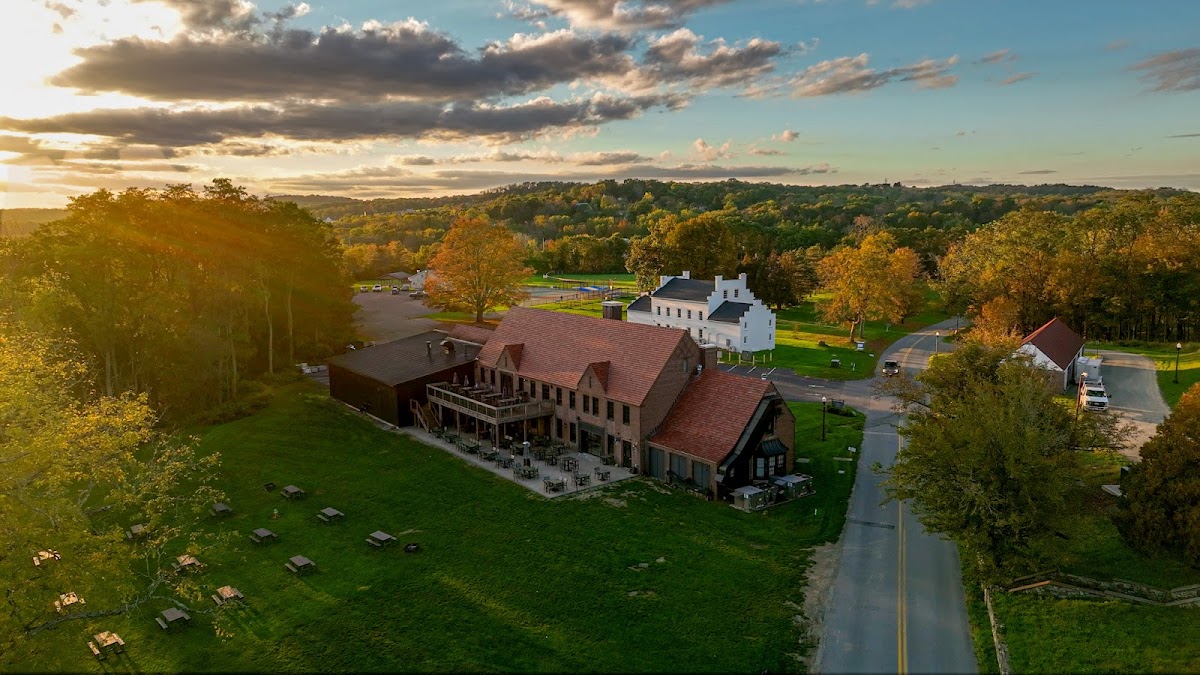
You leave the main road in Warwick and follow State School Road into terrain that hasn’t changed much in a century. The Black Dirt spreads out on either side — some of the richest agricultural soil in America, dark as coffee and famous for onions that have fed New York City for generations. You pass farm stands and century-old barns, and then the landscape opens up: 700 acres of rolling farmland with the Appalachian Mountains rising in the distance like a promise. Drowned Lands Brewery sits in the middle of it all — a 100-year-old building that has lived several lives as farmland infrastructure and now serves as a cathedral to craft beer and industrial romance. The name comes from the ancient glacial lake bed the property sits on, land that was quite literally drowned centuries ago and re-emerged as the most fertile growing region in the Hudson Valley. Inside, gleaming copper brewing equipment rises beside exposed brick walls and timber beams salvaged from the original structure. Outside, Wawayanda Creek cuts through the property, providing the water feature for outdoor ceremonies and the backdrop for first looks on the creek bank. This is a venue that understands how to balance working brewery authenticity with the kind of romance that makes wedding guests stop and stare. Poppy has designed Drowned Lands Brewery wedding flowers for 1 celebration here so far, and we left that day understanding exactly what this venue needs: florals that honor both its agricultural roots and its industrial present, arrangements that are garden-grown and copper-polished at once.
About Drowned Lands Brewery
Drowned Lands Brewery is not a venue playing at being a brewery — it is a fully operational craft brewery that happens to host extraordinary weddings on weekends. The distinction matters. The copper kettles and steel fermentation tanks are not decorative props; they produce award-winning beers that get distributed across the Hudson Valley. The smell of malt and hops drifts through certain rooms. The entire operation occupies a building constructed over a century ago as part of the region’s agricultural infrastructure, and the bones of that history are visible everywhere: hand-laid brick walls that were mortared before World War I, reclaimed timber beams that still bear the marks of their original milling, arched windows that frame views of farmland that has been cultivated since the 1800s. When the brewery renovated the space, they respected what was already there — reinforcing rather than replacing, revealing rather than covering. The result is a venue that feels genuinely historic without feeling precious about it.
The property sits on 700 acres in the Black Dirt Region of Orange County, about an hour north of New York City. The Black Dirt itself is legendary among farmers — a glacial lake bed that drained thousands of years ago and left behind soil so dark and nutrient-rich it looks almost artificial. This is onion country, celery country, the kind of farmland that supplies produce stands along every back road and feeds restaurants throughout the metropolitan area. Drowned Lands Brewery’s location within this agricultural landscape means that outdoor ceremony sites come with views of working farms and mountain ridges, and the overall aesthetic is decidedly rural rather than manicured. Wawayanda Creek runs along the property’s edge, providing both a water source for the brewery and a natural ceremony backdrop that requires no floral decoration to be beautiful — though it certainly benefits from some.
Logistically, the venue is straightforward for florists. Load-in happens through a side entrance with easy access to the upper-level River View Hall, and the events team is experienced with coordinating multiple vendors on wedding days. There are three hours of setup time included before the event start, which is adequate for most floral installations though couples should budget for additional time if planning elaborate suspended installations or complex ceremony structures. The 15 farm tables in River View Hall are included with the rental, which is a meaningful detail for floral budgeting — no need to design around unknown table sizes or last-minute rentals. Parking is ample and on-site. The venue requires couples to use their in-house catering (farm-to-table, family-style or buffet), but florists are selected by the couple from any source, which allows Poppy to work here without restriction.
The surrounding Warwick area offers charming accommodations for wedding guests — historic inns, farm stays, and boutique hotels in the village, which is about 10 minutes away and worth exploring for its walkable downtown and local shops. For couples planning a full weekend celebration, the proximity to other Hudson Valley attractions (wineries, hiking trails, antique shops) makes Drowned Lands Brewery an ideal anchor for a destination wedding experience that doesn’t require flying anywhere.
Event Spaces & Floral Opportunities
River View Hall
Capacity: 150 seated
Setting: The main event space occupies the entire upper level of the brewery, a room with exposed brick walls that glow warm and terracotta in afternoon light, timber beams overhead that speak to the building’s agricultural past, and large windows that frame views of the surrounding farmland and distant mountains. The aesthetic is industrial-rustic — not trying to be a barn, not trying to be a loft, but occupying some confident middle ground where both influences coexist. Fifteen long farm tables come with the space, already set up for family-style dining, which gives the room an immediate sense of conviviality and shared celebration. An industrial chandelier hangs as the room’s focal point, all geometric lines and exposed bulbs, the kind of fixture that anchors the space without overwhelming it. The overall palette is warm: brick red, honey-toned wood, black metal accents, cream walls. Natural light floods in during daytime events, and the room transitions beautifully to candlelit intimacy after sunset.
Floral approach: The farm tables are your foundation here, and they beg for garland runners rather than individual centerpieces. We recommend continuous installations running the full length of each table — smilax, Italian ruscus, and seeded eucalyptus as the base, with clusters of blooms woven in every 18-24 inches: Café au Lait dahlias, Quicksand roses, white lisianthus, and burgundy scabiosa for texture. The key is keeping everything low and organic, sprawling across the table surface like a garden that decided to grow horizontally. For a pop of unexpected charm, incorporate elements that reference the Black Dirt’s agricultural heritage: small bundles of wheat or barley, heirloom tomatoes on the vine, or even bunches of just-harvested onion tops (cleaned and dried, naturally) as textural accents. The industrial chandelier presents an opportunity for a suspended floral wreath — a 36-inch ring covered in greenery with trailing jasmine vine and clusters of spray roses and astilbe. If budget allows, consider flanking the entrance to River View Hall with a pair of large urns (at least 24 inches tall) overflowing with seasonal branches, garden roses, and cascading amaranthus. The exposed brick walls can handle a floral installation behind the head table if couples want a focal point — we favor an asymmetrical deconstructed arch using copper pipe as the structural element (to echo the brewery equipment) covered with lush, organic florals: garden roses, ranunculus, hellebores, and plenty of trailing greenery.
Private Deck
Capacity: 50 seated
Setting: Adjacent to River View Hall, the Private Deck extends the celebration outdoors with wooden decking, string lights overhead, and unobstructed views of the Appalachian Mountains rolling across the horizon. This is cocktail hour territory, intimate and atmospheric, especially during golden hour when the sun sets behind the ridgeline and everything turns amber and rose. The deck accommodates high-top cocktail tables, lounge furniture, or a mix of both, and the string lights provide built-in ambiance that requires minimal additional decoration to feel complete.
Floral approach: This is a supporting space, not a showcase space, so florals should be charming but not labor-intensive. We recommend cocktail arrangements in brewery-inspired vessels — clean-lined copper mugs, small galvanized buckets, or even growlers (the venue can often provide empties) filled with garden-style clusters of zinnias, cosmos, feverfew, and herbs like rosemary or lavender that guests can brush their hands against for scent. If there’s a bar setup on the deck, that’s your opportunity for a statement arrangement — a large-scale installation in a copper vessel featuring bold blooms like sunflowers, orange dahlias, and burgundy amaranthus with trailing hops vine (if you can source it locally) to reference the beer-making happening below. The deck railing can be dressed with a simple garland of seeded eucalyptus and smilax, kept loose and organic rather than formal. For couples who want to lean into the agricultural setting, consider potted herbs (basil, mint, thyme) clustered on cocktail tables as living centerpieces that double as aromatic conversation pieces.
Catwalk
Setting: This is where the venue reveals its most dramatic architectural feature. The Catwalk is an elevated wooden walkway that bridges across the brewery space below, positioned beneath soaring timber ceilings and flanked by exposed brick walls. It overlooks the gleaming brewery tanks and equipment, providing a bird’s-eye view of the working production facility. The light up here is cathedral-like — high, diffused, golden — and the scale of the space makes every photo taken on the Catwalk feel cinematic. This is where first looks happen, where couples steal away for portraits, where the industrial and the romantic collide most successfully.
Floral approach: The Catwalk doesn’t host guests, so florals here are optional, but if couples want to create a moment for photography, this is the space to do it. A suspended installation is ideal given the height and drama of the ceilings — think a 10-to-15-foot length of jasmine vine and smilax with clusters of blooms (Juliet roses, white ranunculus, blush astilbe) appearing to cascade from the rafters. The installation should feel wild and organic, like something that grew there rather than something that was installed there. Alternatively, a floral garland along the wooden bridge railing creates a romantic pathway for portrait sessions — keep it airy and loose, predominantly greenery with occasional blooms, so it enhances rather than dominates the architectural lines. If there’s a particular angle where couples will stand for portraits, a single statement arrangement on a pedestal (a large brass or copper urn overflowing with seasonal branches and blooms) can serve as an anchor point for photos without overwhelming the space.
Outdoor Ceremony Space
Setting: Down the hill from the main building, the outdoor ceremony site occupies a grassy lawn bordered by mature trees, with Wawayanda Creek running along one edge and a small pond reflecting the sky nearby. The centerpiece is a simple wooden pergola structure — four posts and a frame, unadorned and rustic, positioned to face the water and the tree line beyond. This is a naturalistic setting, the kind where birds sing during vows and the breeze carries the scent of grass and creek water. Three large mature trees provide dappled shade, and the overall atmosphere is pastoral rather than formal, organic rather than manicured.
Floral approach: The wooden pergola is begging for a full floral treatment, and this is where ceremony budgets should be focused. We recommend an asymmetrical installation that covers the top beam and cascades down one side, leaving the other side more minimal for visual balance. Use a base of smilax and Italian ruscus to create volume, then layer in blooms: Café au Lait dahlias, peach Juliet roses, white lisianthus, blush astilanthus, and trailing jasmine vine that reaches nearly to the ground. The effect should be lush and slightly wild, like the garden decided to climb the pergola of its own accord. For the aisle, simple markers work best in this naturalistic setting — shepherd’s hooks with hanging arrangements, or low urns placed every few rows with meadow-style clusters of wildflowers, grasses, and seasonal blooms. The three mature trees can be incorporated with simple hanging arrangements (floral balls or kissing balls suspended from branches at varying heights) that create a sense of enchantment without competing with the ceremony structure. If the ceremony happens in late afternoon or evening, consider how florals will be lit — the setting sun will backlight the pergola, so choose blooms that glow rather than flatten when illuminated from behind (peach, coral, and blush over deep burgundy or purple).
The Yard
Setting: This is Drowned Lands Brewery’s largest outdoor space, a sprawling area with gravel underfoot, communal picnic tables, wooden benches, and string lights crisscrossing overhead. The Yard offers 360-degree views: mountains to one side, creek to another, farmland stretching in every direction. It has the vibe of a beer garden — which makes sense, because that’s exactly what it is during normal brewery operations — and that casual, convivial energy translates well to cocktail hours, welcome receptions, or even full outdoor receptions for couples who want a relaxed, festival-style celebration.
Floral approach: Treat The Yard as an extension of the landscape rather than a formal event space. Welcome arrangements should be visible from the parking area — large-scale installations flanking the entrance to The Yard, using galvanized buckets or wooden crates overflowing with seasonal branches, sunflowers, zinnias, and wild grasses. If there are communal tables in use, consider low arrangements in brewery growlers or copper mugs, clustered in groups of three at table centers for visual impact without formality. Lounge areas benefit from potted plants (ferns, hostas, or even small ornamental grasses) that reference the surrounding agricultural landscape and require no water source during the event. For couples using The Yard as a full reception space, string lights do most of the aesthetic work — florals can be minimal and still feel abundant if you focus on a few high-impact installations (a large bar arrangement, welcome urns, clusters at the entrance) rather than trying to decorate every surface. This is a space where less is often more, where the views and the atmosphere carry the beauty and florals simply punctuate what’s already working.
Taproom
Setting: The working taproom occupies the ground level, a space where guests can order Drowned Lands’ craft beers directly from the source. Exposed brick walls, stainless steel taps, brewery-branded glassware, and an authentic beer-hall atmosphere define the space. It’s not a formal event room, but many couples allow guests to wander through during cocktail hour or incorporate it as a late-night hang-out spot where the celebration can continue in a more casual setting.
Floral approach: Florals in the Taproom should be minimal and thematic. A single statement arrangement on the bar — a large copper vessel filled with hops vines (if available), barley stalks, sunflowers, and textural grasses — nods to the ingredients that become beer and creates a visual anchor for photos. Alternatively, small bud vases with single stems (sunflowers, zinnias, or dahlias) placed along the bar give a cheerful, approachable vibe without interfering with the working-bar functionality. This is not a space that needs full floral treatment; instead, one or two well-placed arrangements signal that the Taproom is part of the celebration while respecting its identity as a functional brewery space.
Wedding Flower Ideas for Drowned Lands Brewery
Black Dirt Harvest
This concept draws directly from the agricultural heritage of the venue’s location, using a palette inspired by the rich, fertile soil and the crops it produces. The foundation is earthy and organic: chocolate cosmos (for their nearly-black petals and subtle cocoa scent), burgundy dahlias (Karma Choc, Black Satin), deep orange ranunculus, and burnt-orange roses (Free Spirit, Toffee). Lighten the palette with peach Juliet roses, champagne lisianthus, and touches of mauve astilbe. Textural elements are key: include heirloom tomatoes on the vine, bundles of wheat or barley, purple kale leaves, seed pods, and actual black soil visible in clear glass vessels as a grounding element. Arrangements sit in terracotta pots, wooden crates, and galvanized metal buckets — vessels that look like they came from a farmstand rather than a florist. This palette thrives in River View Hall where the warm brick walls amplify the earthy tones, and it photographs beautifully in The Yard where it blends seamlessly with the surrounding farmland. The ceremony pergola dressed in this style feels like the harvest itself decided to grow there overnight.
Copper & Cream
This concept bridges the industrial brewery elements with soft, romantic florals by anchoring the design in copper vessels and accents. The palette is deliberately restrained: cream, blush, champagne, and soft peach, with touches of copper-colored foliage (copper beech branches, fall oak leaves, or preserved magnolia leaves with a copper underside). Flowers include Patience garden roses, Quicksand roses, champagne lisianthus, cream ranunculus, and white sweet peas. Textural greenery like dusty miller, eucalyptus, and olive branches adds movement without adding color. All arrangements sit in copper vessels — hammered copper urns, copper julep cups, or copper pipe structures for the ceremony arch. The overall effect is soft and luminous but grounded in the venue’s industrial identity. This works beautifully for couples who want romance without rusticity, elegance without formality. The palette glows in natural light (ideal for the Private Deck during golden hour) and transitions seamlessly to candlelight in River View Hall.
Creek & Meadow
Inspired by Wawayanda Creek and the meadows that border it, this concept uses a palette pulled from wildflower fields and waterways: soft blues (delphinium, tweedia, nigella), lavenders (stock, lisianthus, veronica), whites (sweet peas, ranunculus, cosmos), and touches of warm yellow (craspedia, solidago). The arrangements are loose and organic, as if you gathered wildflowers during a walk along the creek bank and simply placed them in vessels without fuss. Grasses are essential — include bunny tails, fountain grass, and wild oats for texture and movement. Trailing elements like jasmine vine and passion vine create the sense of water flowing through the arrangements. Vessels should feel natural: ceramic crocks, blue-and-white pottery, or clear glass that shows stems underwater. This palette is ideal for spring or summer weddings and works beautifully in the Outdoor Ceremony Space where it complements rather than competes with the natural creek backdrop. In River View Hall, it provides a cool, refreshing contrast to the warm brick tones and prevents the industrial space from feeling too heavy.
Seasonal Considerations
Drowned Lands Brewery sits in the Hudson Valley, which experiences four distinct seasons with dramatic shifts in temperature, foliage, and bloom availability. Your floral choices should reflect not only what’s beautiful but what’s practical for the season.
Spring (April–May): Hudson Valley springs are unpredictable — one day might be 70 degrees and sunny, the next might bring a late frost or cold rain. The Black Dirt region wakes up slowly, and while bulbs and early bloomers arrive on schedule (tulips, daffodils, hyacinths, ranunculus, anemones), the landscape itself remains bare until late April. Flowering branches (cherry, apple, quince) are at their peak in early May and create dramatic ceremony installations. Spring weather means having a rain plan for outdoor ceremonies is non-negotiable. The upside: spring light in the Hudson Valley is extraordinary, clear and golden, and the venue’s large windows flood River View Hall with it. May is ideal for Creek & Meadow palettes with peonies (if you catch the narrow upstate bloom window in late May), sweet peas, and delphinium. Temperatures can swing 30 degrees between afternoon and evening, so florals need to be hardy.
Summer (June–August): This is peak wedding season, and Drowned Lands Brewery’s outdoor spaces shine. Daytime temperatures can reach the 80s and 90s with humidity, which means delicate blooms (sweet peas, tweedia, anemones) will struggle in outdoor installations. Focus on heat-tolerant flowers: sunflowers, zinnias, celosia, dahlias (once they’re in season by mid-July), and lisianthus. The surrounding farmland is lush and green, the creek is flowing, and everything feels abundant. The Private Deck is ideal for summer cocktail hours with mountain sunset views. For outdoor ceremonies, schedule them for late afternoon or early evening to avoid midday heat, and ensure florals are hydrated thoroughly before installation. July and August bring the Black Dirt’s agricultural bounty to peak — consider incorporating local produce (small gourds, heirloom tomatoes, herbs) into arrangements for a true farm-to-table aesthetic. Mosquitoes can be present near the creek in evening; couples should consider citronella elements or work with the venue on pest control.
Fall (September–November): The Hudson Valley in autumn is arguably the most beautiful version of itself, and Drowned Lands Brewery’s mountain views become a tapestry of crimson, gold, and orange. This is the season when the venue requires the least floral help — the landscape does half the work. September offers the best weather (warm days, cool evenings, low humidity) and the widest bloom availability: dahlias at their peak, garden roses, sunflowers, cosmos, zinnias, marigolds, and the first chrysanthemums. October is peak foliage season; expect the surrounding hills to be ablaze with color. Black Dirt Harvest palettes are ideal here, using deep burgundy, burnt orange, and chocolate brown to echo the autumn landscape. November can be unpredictable with potential for early snow, so outdoor ceremonies become riskier. Consider incorporating seasonal foliage (oak leaves, beech branches, bittersweet vine) into arrangements for texture and to tie designs to the landscape. The cooler temperatures mean florals hold up beautifully indoors and out.
Winter (December–February): Winter weddings at Drowned Lands Brewery are rare but magical. The industrial warmth of River View Hall feels especially cozy when snow blankets the fields outside. The floral palette shifts to evergreens (cedar, pine, fir, eucalyptus), winter berries (ilex, hypericum, privet), and blooms that tolerate cold (hellebores, ranunculus, anemones, amaryllis). White and cream palettes with silver or copper accents feel appropriate for the season without being overtly holiday-themed. Outdoor ceremonies are not practical unless under a heated tent. Focus floral budget on River View Hall, the entry, and the Black Spiral Staircase (which could be stunning wrapped in a greenery garland with trailing ribbon). The bare trees and dormant landscape outside mean florals carry more visual weight indoors — this is the season to go fuller and more lush. Logistics note: confirm winter access with the venue; State School Road is maintained but can be tricky in heavy snow.
Poppy’s Expert Take
The farm tables are your foundation; design for garlands, not centerpieces. River View Hall’s 15 included farm tables are not just furniture — they define the entire aesthetic of the reception. Individual centerpieces on farm tables look disjointed and awkward; continuous garland runners look intentional and abundant. Budget for long, low installations that run the full length of each table rather than trying to space out individual arrangements. This approach also saves on vessel costs and creates more visual impact per dollar spent.
The Catwalk is for portraits, not for guests, so florals there are optional budget allocators. Many couples fall in love with the Catwalk’s dramatic look and want to dress it with florals, but remember: guests will never be up there. If your budget is tight, invest in spaces where people gather (River View Hall, Private Deck, ceremony site) rather than photo-only locations. If you do want Catwalk florals for portraits, a single suspended installation or a statement arrangement on a pedestal gives you the visual without the expense of decorating the entire space.
Ceremony pergola florals need to be secured for wind; the hilltop location is exposed. The Outdoor Ceremony Space sits on open land with mountain views, which means wind. Any floral installation on the pergola must be mechanically secured (zip ties, floral wire, and lots of it) in addition to being designed well. Lightweight florals (baby’s breath, astilbe, delicate vines) will shred in a strong breeze. Base your installation on sturdy greenery (smilax, Italian ruscus) and anchor blooms deeply into the structure. Your florist should arrive early enough to assess wind conditions and make adjustments.
The venue’s beer-hall aesthetic means florals can be playful, not precious. Drowned Lands Brewery is not a country club, and your florals shouldn’t look like they are either. This is a venue where whimsy works: repurpose growlers as bud vases, incorporate hops vines or barley into arrangements, use galvanized buckets and copper mugs without apology. The industrial-rustic setting rewards florals that feel organic and unfussy over arrangements that are tightly controlled and formal. Lean into the agricultural vibe rather than fighting it.
Coordinate with the catering team on table setup timing for garland installations. Because the venue includes farm tables, there’s sometimes ambiguity about when they’ll be set with linens and place settings. Garland runners should ideally be installed after linens are down but before full table settings go on — this requires coordination with the catering team (who the venue requires you use). Confirm timing in advance so your florist isn’t waiting around or rushing to install while servers are trying to set plates.
The exposed brick walls create incredible photo backdrops; design florals that frame rather than cover them. River View Hall’s brick walls are warm, textured, and photogenic — don’t hide them. If you’re doing a floral installation behind the head table or sweetheart table, consider an asymmetrical arch or deconstructed installation that allows the brick to show through. The texture of the brick provides visual interest that complements rather than competes with florals. Similarly, the industrial chandelier is a feature, not a problem; it doesn’t need to be covered in flowers to look beautiful in photos.
Budget for additional setup time if you want suspended installations; three hours is tight. The venue provides three hours of pre-event setup time, which is adequate for standard floral work (ceremony arrangements, centerpieces, bar florals). But if you’re planning suspended installations on the Catwalk, floral wreaths on the chandelier, or elaborate garland runners on 15 tables, three hours will disappear fast. Purchase additional setup time through the venue ($250/hour) to ensure your florist can execute complex designs without rushing. Rushed installations are unstable installations.
What Poppy Couples Spend on Flowers Here
$2,500–$3,500 | The Foundation
This budget covers the essentials with thoughtful restraint: bridal bouquet, four bridesmaid bouquets, boutonnieres for the groom and groomsmen, and simple ceremony florals (a partially dressed pergola with greenery and bloom clusters on two corners rather than a full installation). At the reception, focus spending on River View Hall with low garland runners on a selection of the farm tables (maybe 8 of the 15, strategically placed where photographers will focus) using primarily greenery with bloom clusters every few feet. Add a single statement arrangement for the bar on the Private Deck and small bud vase arrangements (using growlers or simple glass) on cocktail tables. This budget requires prioritization — you cannot dress every space, so focus on where guests spend the most time and where photos will happen. Skip the Catwalk, skip The Yard, and keep the Taproom minimal or undecorated. The result is intentional and lovely rather than sparse, but it requires accepting that some spaces will rely on the venue’s existing aesthetic rather than added florals.
$3,500–$5,500 | The Full Picture
This mid-tier budget allows you to create floral moments in multiple spaces without compromise. Start with a fully dressed ceremony pergola (all four corners plus the top beam, lush and asymmetrical, using greenery as the base and layering in seasonal blooms), plus aisle markers (simple shepherd’s hooks with hanging arrangements or low urns every few rows). Personal flowers expand to include corsages for mothers and grandmothers,