
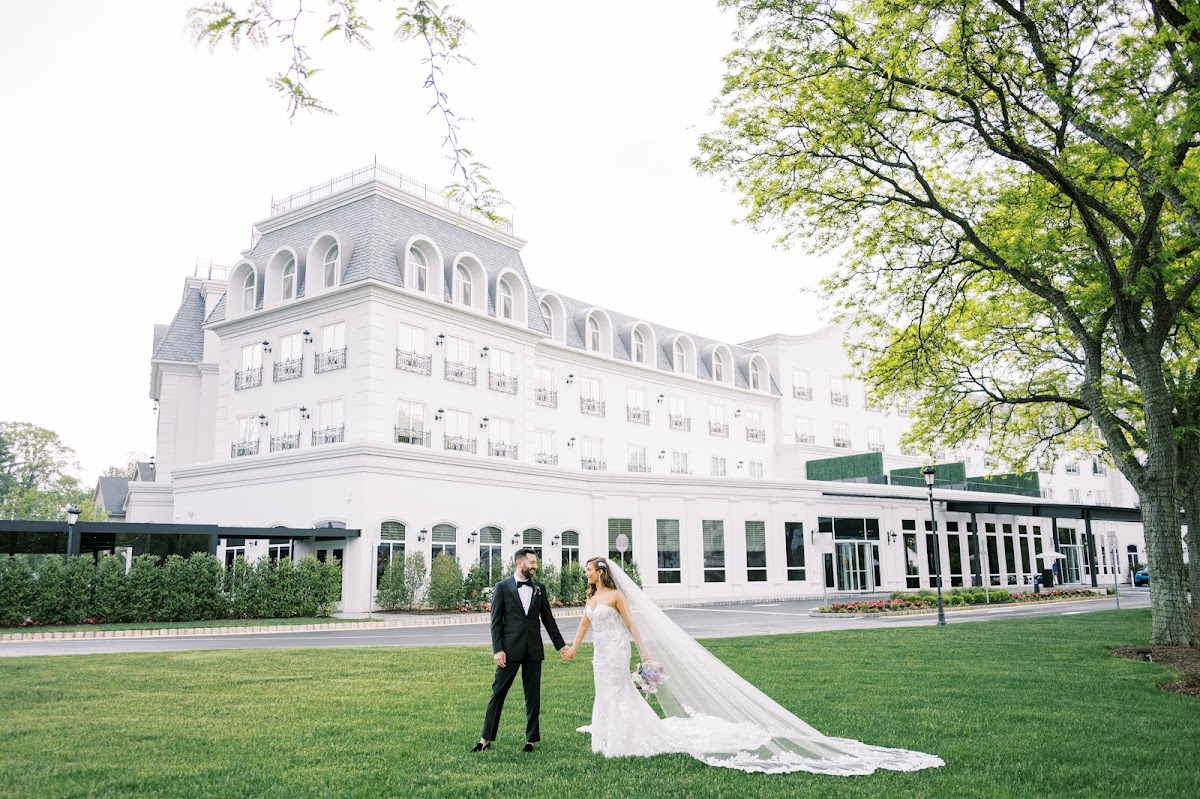
You exit the New Jersey Turnpike at Exit 9, leave behind the industrial corridor of Route 18, and turn onto Cranbury Road. The shift is immediate. Strip malls give way to tree-lined streets, and then, set back from the road on fifteen manicured acres, the Chateau Grande Hotel announces itself not with ostentation but with quiet confidence. The circular drive curves past formal gardens where boxwood hedges frame perennial beds, and the building itself — a study in architectural duality — manages to be both Belle Epoque grand and mid-century sleek depending on where you stand. Through those floor-to-ceiling ballroom windows, you catch a glimpse of trees lit from below at night, glowing like sentinels. This is not a venue pretending to be a French chateau or a country estate. It is precisely what it claims to be: a luxury hotel that has carved out a wedding program sophisticated enough to attract celebrity chef David Burke’s Orchard Park restaurant and discerning enough to let Neesh, the event coordinator, handle your vendor logistics before you even think to ask. Poppy has designed Chateau Grande Hotel wedding flowers for 2 celebrations here, and both times we have appreciated the way this property offers couples something rare in suburban New Jersey — a genuine sense of occasion without requiring a two-hour drive into the countryside.
About Chateau Grande Hotel
Chateau Grande Hotel sits on 670 Cranbury Road in East Brunswick, a Middlesex County township that benefits from its proximity to major arteries — the New Jersey Turnpike, Route 18, Route 1 — without suffering from their aesthetic intrusions. The hotel occupies fifteen rolling acres that have been landscaped with the kind of attention typically reserved for estate properties: formal gardens punctuate the grounds, specimen trees provide shade and structure, and the overall impression is one of deliberate elegance. This is a working luxury hotel with 108 guest rooms and suites, including the Palomar Suite, which means your wedding guests are not just attending an event; they are checking into a full-service property with amenities, room service, and a celebrity chef restaurant steps from the ballroom.
The architecture reflects a design philosophy that embraces duality. The public spaces lean into Belle Epoque grandeur — high ceilings, ornate moldings, a sense of historical weight — while other areas adopt the clean lines and geometric clarity of mid-century modernism. For a florist, this presents an interesting challenge and opportunity: you can design toward either aesthetic or find a middle ground that honors both. The CGH Ballroom, with its floor-to-ceiling windows and circular dance floor, feels decidedly modern. The formal gardens, with their classical symmetry, evoke a more traditional European sensibility. Couples are drawn to Chateau Grande precisely because it does not force them into a single stylistic lane.
David Burke’s Orchard Park restaurant is a significant feature. Burke, a James Beard Award-winning chef known for his innovative approach to American cuisine, brings a level of culinary credibility that elevates the entire wedding experience. The restaurant’s outdoor terrace seats up to 100 guests, making it an ideal space for rehearsal dinners or smaller receptions. The culinary program — managed by Chateau Grande Events by David Burke — is exclusive, meaning no outside catering is permitted, but given Burke’s reputation, most couples view this as a feature rather than a restriction.
Logistically, Chateau Grande Hotel is approximately 35 minutes from Newark, 50 minutes from Manhattan, and easily accessible via the New Jersey Turnpike. For Poppy’s delivery teams, the drive from our studio is straightforward, and the venue provides ample load-in access. Neesh, the event coordinator, is proactive about vendor communication — she contacts florists directly, confirms timelines, and handles certificate of insurance requirements without couples needing to manage every detail. This level of coordination is not universal in the wedding industry, and it makes our setup process significantly smoother. The venue requires COI documentation, standard across luxury properties, and manages it efficiently.
Parking is plentiful, with valet service available for guests and a $15 overnight parking fee for hotel guests — a minor detail but worth noting for your save-the-dates. The hotel bar closes at 2 a.m., which matters if you are hosting a ballroom reception next door and want your guests to have an after-party option. Bar service is priced at $60 per person with open bar, cash bar, and limited bar configurations available, along with champagne toasts and signature cocktails. Outside alcohol is not permitted in the lobby, a standard policy for a venue with an on-site liquor license.
Event Spaces & Floral Opportunities
CGH Ballroom
Capacity: 120 seated
Setting: The CGH Ballroom is the venue’s flagship reception space, and it earns that designation through architectural restraint rather than excess. The defining feature is the wall of floor-to-ceiling windows — not a decorative gesture but a functional design element that floods the room with natural light during daytime events and frames the illuminated trees outside after dark. The windows face the property’s landscaped grounds, and at night, uplighting transforms the mature trees into glowing sculptures visible from every table. The circular dance floor, centered in the room, is not a detail you notice immediately, but once you do, it informs every other design decision. The palette is neutral — soft grays, warm whites, polished wood — which means the ballroom does not impose a color scheme so much as invite one. An enclosed heated patio extends off the ballroom, offering a climate-controlled indoor-outdoor transition space that works year-round.
Floral approach: The circular dance floor is your organizing principle. Everything else in the room should either echo that geometry or provide a deliberate counterpoint. For guest tables, consider low, lush arrangements in round vessels — compotes or shallow bowls filled with garden roses (Keira, Patience, Romantic Antike), ranunculus, and hellebores in soft blush and ivory tones that glow under the modern chandeliers. Alternatively, tall arrangements on clear acrylic or gold risers lift florals above sightlines, allowing guests to enjoy both the centerpieces and the views through those windows. We have installed a floral hoop — a circular installation suspended above the dance floor using the ballroom’s rigging points — featuring smilax, Italian ruscus, and clusters of white phalaenopsis orchids that appears to float in midair and reinforces the room’s geometry. The patio offers an opportunity for potted arrangements — fiddle leaf figs, olive trees, or large ferns in ceramic planters — that soften the transition from ballroom to outdoor terrace. For the entrance, a pair of tall arrangements in modern cylindrical vessels (white calla lilies, white tulips, silver dollar eucalyptus) signals the shift from cocktail hour to reception. Chateau Grande Hotel wedding flowers in this ballroom should feel both polished and organic, never overly structured or stiff.
Orchard Park Outdoor Terrace
Capacity: 100 seated
Setting: The Orchard Park Outdoor Terrace is David Burke’s domain, and that affiliation matters. This is not a generic hotel patio; it is an extension of a celebrated restaurant known for ingredient-driven cuisine and thoughtful presentation. The terrace is uncovered, open to the sky, with views of the hotel’s grounds and enough space to accommodate 100 guests for a seated dinner or cocktail reception. The design is sleek and contemporary, with modern outdoor furniture, clean lines, and a neutral palette that allows the food — and the florals — to take center stage. The connection to the restaurant means your guests are likely to encounter Burke’s signature dishes, and the culinary sophistication should inform your floral approach.
Floral approach: This is the space to embrace edible florals and herb-forward arrangements. We have designed centerpieces for this terrace that incorporate rosemary, thyme, sage, and lavender alongside traditional blooms like spray roses, lisianthus, and scabiosa. Use herbs not as garnish but as primary design elements — a low arrangement in a rustic ceramic bowl featuring lavender, lamb’s ear, dusty miller, and pale pink Keira roses creates a multi-sensory experience that complements the culinary focus. For cocktail tables, small arrangements in bud vases or clustered votives with floating blooms (ranunculus heads, anemones) keep the design light and allow conversation to flow. Consider using vegetables as unexpected vessels or design elements — hollowed-out artichokes as votive holders, ornamental kale as textural filler. For a rehearsal dinner on this terrace, a long farm table with a continuous garland of eucalyptus, olive branches, and white blooms (lisianthus, stock, spray roses) interspersed with herbs and small produce creates a harvest-table aesthetic that honors Burke’s farm-to-table philosophy without veering into rustic territory. The terrace’s upscale focus demands polished presentation — nothing too wild or unstructured — but the culinary connection gives you permission to experiment with ingredients you would not typically see in ballroom centerpieces.
Outdoor Ceremony Space
Capacity: Flexible, uncovered
Setting: The outdoor ceremony space sits within the formal gardens that punctuate Chateau Grande’s fifteen-acre property. This is not a raw natural setting; it is a cultivated landscape with boxwood hedges, perennial beds, specimen trees, and manicured lawns. The space is uncovered, meaning weather is a factor, but the gardens provide a backdrop that already reads as designed. Depending on where ceremony chairs are positioned, couples can face the hotel’s architecture or the deeper garden vistas. The gardens are enchanting in the way formal European gardens are enchanting — through symmetry, structure, and the careful orchestration of color and texture across seasons.
Floral approach: The cardinal rule in this space is to complement, not compete. The existing landscaping is your collaborator, and your ceremony florals should feel like a natural extension of the garden rather than an imported element. For the ceremony arch or chuppah, we favor an asymmetrical design that mimics organic growth patterns — a structure covered on one side with climbing greenery (smilax, jasmine vine) and blooms (white garden roses, ranunculus, sweet peas) that appears to be growing from the ground rather than placed atop it. Aisle markers can be simple and elegant: low arrangements in stone urns or ceramic vessels placed every other row, filled with garden-style blooms (tulips, anemones, hellebores, eucalyptus) that echo the colors in the perennial beds. Because the space is uncovered, choose flowers that tolerate sun and heat — avoid hydrangeas in summer, lean on roses, lisianthus, and sturdy foliage. For a spring ceremony, a design featuring tulips, daffodils, and flowering branches (cherry, dogwood, quince) connects to the season’s natural bloom cycle. The formal symmetry of the gardens invites a more structured approach than a meadow or woodland ceremony site, but that structure should come from placement and repetition rather than rigid design. Think garden party, not botanical specimen display.
La Pomme Room
Capacity: Intimate gatherings
Setting: La Pomme Room functions as the venue’s intimate event space, ideal for smaller celebrations, private dining experiences, or pre-wedding gatherings like welcome dinners or post-wedding brunches. The room’s design leans toward classic elegance with refined details, and the scale is deliberately human — this is not a space trying to accommodate 120 guests or impress with volume. It is a room designed for conversation, for seeing the person across the table clearly, for meals that unfold over multiple courses.
Floral approach: Scale and detail are your priorities here. A single statement arrangement on a central dining table can anchor the entire room — consider a low, lush compote arrangement overflowing with garden roses (Juliet, Patience, Quicksand), ranunculus, sweet peas, and hellebores in soft romantic tones that invite guests to lean in and examine the details. Alternatively, a series of smaller arrangements — bud vases down the center of a long table, each featuring a different bloom but unified by palette (all blush and cream, or all burgundy and mauve) — creates visual rhythm without overwhelming the space. This is the room for personal touches: incorporate blooms from the couple’s engagement story, use vintage vessels sourced from antique shops, include family heirloom containers. For a welcome dinner, consider arrangements that include fragrant elements — garden roses, stock, freesia — that contribute to the sensory experience. The intimate scale allows for design experimentation that would read as too precious in a 120-person ballroom: individual floral favors at each place setting, small wreaths hung on chair backs, a dramatic installation above the table if the ceiling height permits.
Wedding Flower Ideas for Chateau Grande Hotel
Belle Epoque Reverie
This concept leans into the venue’s historical design influence with a palette drawn from French Impressionist paintings — soft, romantic, and luminous. Think Renoir’s party scenes: blush, champagne, ivory, and the palest peach, with accents of dusty mauve. The floral roster includes garden roses (Juliet, Patience, Keira, Romantic Antike), peonies when in season (Sarah Bernhardt, Shirley Temple), ranunculus, sweet peas, hellebores, and clouds of white lilac. Foliage is soft and textured: Italian ruscus, dusty miller, lamb’s ear, silver dollar eucalyptus. Vessels are gilded — not shiny gold but aged, matte gold compotes, urns, and candelabras that look like they were sourced from a French flea market. For the ceremony arch, create a cascading, asymmetrical design that appears to spill naturally rather than sit in rigid symmetry. In the CGH Ballroom, use low arrangements on guest tables with trailing jasmine vine that spills onto the linen, and consider a dramatic installation above the dance floor — a floral hoop or chandelier dripping with blooms. This palette is especially stunning in spring and early summer when peonies are available, and it photographs beautifully in the natural light from those floor-to-ceiling windows.
Mid-Century Modernist
For couples drawn to the venue’s sleek, contemporary side, this concept embraces clean lines, bold color, and sculptural form. The palette is graphic: bright white, deep coral, burnt orange, and pops of fuchsia, grounded by dark green foliage. Flowers are chosen for architectural shape: calla lilies (white, orange, and fuchsia), anthuriums, phalaenopsis orchids, protea, and bird of paradise. Foliage is structural: monstera leaves, ti leaves, bear grass. Vessels are geometric: cubes, cylinders, and rectangular containers in lucite, matte white ceramic, or brushed brass. Arrangements are intentionally asymmetrical, with a focus on negative space and line rather than volume. For the CGH Ballroom, place tall single-stem arrangements — a single King Protea or a cluster of white calla lilies — in slim cylindrical vases at varying heights down the center of long tables. For the ceremony, consider a minimalist arch with a single dramatic focal point: a large tropical leaf arrangement with white phalaenopsis orchids clustered at the base. This style is a beautiful counterpoint to the formal gardens and creates striking contrast in photos. It works particularly well for summer and fall weddings when coral and orange tones complement the outdoor light.
Garden Alchemy
This concept honors the venue’s fifteen acres of formal gardens by bringing that cultivated-but-organic aesthetic indoors. The palette shifts with the season but always feels pulled from the landscape: spring brings tulips, hellebores, ranunculus, and flowering branches in soft pastels; summer offers garden roses, lisianthus, cosmos, and foxglove in blush, peach, and cream; fall introduces dahlias, chocolate cosmos, amaranthus, and berry branches in rust, burgundy, and gold; winter embraces amaryllis, paperwhites, evergreens, and berries in deep reds and greens. The approach is loose and garden-gathered, with an emphasis on movement and texture. Use a mix of vessel styles — vintage ceramic pitchers, aged stone urns, terracotta pots — that look like they were sourced from a potting shed. For the outdoor ceremony space, create aisle markers using small weathered terracotta pots overflowing with blooms and trailing greenery. In the ballroom, cluster centerpieces at varying heights using mismatched vessels unified by a cohesive palette. On the Orchard Park Terrace, incorporate herbs and edible flowers (nasturtiums, pansies, borage) into arrangements. This style is ideal for couples who want their Chateau Grande Hotel wedding flowers to feel connected to the property’s landscape rather than imported from elsewhere.
Seasonal Considerations
East Brunswick, New Jersey, sits in USDA Hardiness Zone 7a, which means the region experiences four distinct seasons with cold winters, warm summers, and genuine spring and fall transitions. For wedding florals, this seasonality matters — both for what is blooming locally and for how weather impacts outdoor spaces and floral longevity.
Spring (March-May): Spring in New Jersey is unpredictable. March can bring late snowstorms or unseasonably warm afternoons. April and May are more reliably pleasant, with temperatures ranging from the mid-50s to the low 70s. This is the season of bulbs and flowering branches. Take advantage of tulips (French, parrot, and fringed varieties), daffodils, hyacinths, ranunculus, anemones, hellebores, and sweet peas. Flowering branches — cherry, dogwood, quince, magnolia — are at their peak and provide dramatic height and architectural structure. For the outdoor ceremony space, spring’s natural bloom cycle means the gardens are already coming alive with color, so your ceremony florals can be lighter and more restrained. Be prepared for weather contingency plans; the enclosed heated patio is ideal for a backup cocktail hour if spring showers arrive. Early spring weddings (March-early April) may require more greenhouse-grown product, while late spring (late April-May) opens up local farm options. Peonies arrive in late May, and when they do, use them everywhere — their season is brief and their impact is unmatched.
Summer (June-August): New Jersey summers are warm and humid, with temperatures regularly reaching the mid-80s to low 90s and high humidity levels that can stress delicate blooms. This is the season to choose sturdy flowers: garden roses, lisianthus, zinnias, sunflowers, celosia, scabiosa, and gladiolus all perform well in heat. Avoid hydrangeas for outdoor installations unless they will be in constant shade and water access; they wilt quickly in direct sun. The Orchard Park Outdoor Terrace is uncovered, so summer cocktail hours require florals that tolerate heat — consider potted arrangements that can be watered throughout the event. For the CGH Ballroom, the climate-controlled environment allows for more delicate blooms (peonies in early June, garden roses, ranunculus if kept cool during transport). Summer’s long daylight hours mean your ceremony can start later without sacrificing golden hour photos, but afternoon heat is a real consideration for guest comfort. The formal gardens are lush and green in summer, providing a verdant backdrop that requires less floral augmentation than other seasons. Color palettes can go bold — coral, fuchsia, orange, bright yellow — or stay soft with whites, creams, and blush tones that feel cooling.
Autumn (September-November): Fall is peak wedding season in New Jersey for good reason. Temperatures are mild (60s and 70s in September, 50s and 60s in October and November), humidity drops, and the landscape transforms. By mid-October, the trees on Chateau Grande’s property are turning, creating a backdrop of red, orange, and gold visible through the ballroom windows. This is the season for dahlias (café au lait, Majorca, Cornel Bronze), chrysanthemums (the sophisticated varieties, not grocery store mums), autumn roses (Quicksand, Cappuccino, Toffee), marigolds, celosia, and ornamental grasses. Incorporate fall foliage, berry branches (hypericum, privet, viburnum), and textural elements like seed pods and dried grasses. For the outdoor ceremony space, the gardens are still active in September and early October, but by late October and November, the landscape is more subdued, which means your ceremony florals need to provide more color and structure. Fall’s natural palette — burgundy, rust, burnt orange, mustard, deep plum — pairs beautifully with the formal gardens’ autumnal shift. November weddings may require earlier ceremony start times as daylight shortens, but the soft afternoon light is particularly flattering for photos.
Winter (December-February): Winter in East Brunswick is cold, with temperatures regularly dipping below freezing and occasional snow. The outdoor ceremony space is weather-dependent, though the enclosed heated patio offers a climate-controlled alternative for cocktail hours or even ceremonies. Winter florals lean on greenhouse availability and imported product: amaryllis, paperwhites, anemones, ranunculus, hellebores, tulips (forced), roses, and evergreens (cedar, pine, fir, eucalyptus). This is the season to embrace richness — deep reds, burgundy, emerald green, ivory, and gold. Incorporate seasonal elements like pinecones, berry branches, and evergreen boughs into arrangements. For a December wedding, holiday-adjacent design (without tipping into overtly Christmas territory) works beautifully: amaryllis and evergreens with gold accents, red roses and cedar branches, white amaryllis and silver details. The CGH Ballroom’s floor-to-ceiling windows show the winter landscape — bare trees, possible snow — which creates a dramatic backdrop for romantic, warm-toned florals. Winter weddings benefit from candlelight; pair floral installations with abundant candles (tapers, pillars, votives) to create a warm, intimate glow.
Poppy’s Expert Take
The circular dance floor is your geometry guide. That circular dance floor in the CGH Ballroom is not just a design detail — it is your compositional anchor. Round centerpieces, circular installations above the dance floor, and curved garlands reinforce the room’s geometry. If you go rectangular or linear, you create deliberate tension, which can work if that is your intent, but for most couples, echoing the circle creates visual cohesion. We have installed a 6-foot floral hoop suspended directly above the dance floor using the ballroom’s existing rigging points, and the effect is transformative — it defines the space, draws the eye upward, and creates a focal point for first dances and photos.
Let David Burke’s culinary program inform your terrace florals. If you are hosting cocktail hour or a rehearsal dinner on the Orchard Park Outdoor Terrace, take a cue from the restaurant’s farm-to-table, ingredient-driven approach. Incorporate herbs (rosemary, thyme, lavender, sage) into your arrangements, use edible flowers (nasturtiums, pansies, borage), and consider vegetables as design elements (ornamental kale, artichokes). This is not about making your florals look like a farmer’s market display; it is about creating conceptual continuity between the food your guests are eating and the flowers they are seeing. It elevates both.
The formal gardens require restraint. The outdoor ceremony space is beautiful precisely because it is already designed — the boxwood hedges, perennial beds, and specimen trees create structure and color. Your ceremony florals should enhance this landscape, not compete with it. Over-designing this space with massive floral arches and heavily decorated aisles can actually detract from the setting. Instead, use the gardens as your backdrop and add targeted floral moments: an asymmetrical arch on one side, simple aisle markers every other row, a statement arrangement flanking the ceremony entrance. The goal is for your florals to look like they belong in the garden, not like they were dropped in from elsewhere.
Neesh handles vendor logistics, but communicate early. The event coordinator, Neesh, is proactive and organized, which is a gift for vendors. She reaches out directly, confirms timelines, and manages certificates of insurance without couples needing to chase details. That said, florists should initiate contact early in the planning process to confirm load-in times, setup locations, and access to water sources. The property has ample space for deliveries, but coordinating with other vendors (caterers, rental companies, AV teams) ensures smooth setup. We typically arrive three to four hours before the ceremony start time for a full installation, and Neesh or her team is available to answer questions and unlock spaces as needed.
The enclosed heated patio is your weather insurance. For couples planning outdoor ceremonies or cocktail hours, the enclosed heated patio off the CGH Ballroom is invaluable. It is climate-controlled, can accommodate a significant number of guests, and maintains visual connection to the outdoors without exposure to rain, wind, or temperature extremes. From a floral perspective, this space allows you to design for an outdoor aesthetic (potted arrangements, garden-style florals) while ensuring your installations are protected. If weather forces a ceremony indoors, this patio can be transformed into a ceremony space with chairs facing the windows and a floral arch positioned to frame the garden views.
Maximize the 108-room hotel for extended floral impact. Because Chateau Grande is a full-service hotel, your floral program can extend beyond the ceremony and reception. Consider florals for the bridal suite (Palomar Suite) — a welcome arrangement when the bride arrives to get ready, or a small bouquet for the getting-ready photos. The hotel lobby offers an opportunity for a statement arrangement if your budget allows, creating a sense of arrival for guests checking in. Post-wedding, couples sometimes arrange for leftover centerpieces to be placed in guest rooms as a thank-you gesture, which extends the floral investment beyond the wedding day itself.
Photography leverages those ballroom windows and garden backdrops. The floor-to-ceiling windows in the CGH Ballroom and the formal garden settings are photographer magnets. When designing florals, consider how they will photograph in these spaces. Backlit florals against the ballroom windows create a soft, glowing effect in photos. In the gardens, florals that contrast with or complement the existing landscape (depending on season) ensure they read clearly in images. Work with your photographer to identify key photo locations — the garden paths, the ballroom dance floor, the terrace — and make sure those areas have floral moments worth capturing.
What Poppy Couples Spend on Flowers Here
Based on Poppy’s experience designing Chateau Grande Hotel wedding flowers, couples invest an average of $7,115 in their floral program. This figure aligns with the venue’s luxury positioning and the comprehensive floral opportunities the property presents — from the formal gardens to the CGH Ballroom to the Orchard Park Terrace. However, floral budgets are deeply personal and can be optimized across a range of investment levels depending on priorities, guest count, and design complexity.
$4,000 - $5,500 | The Refined Essentials
This tier covers a beautifully designed floral program for a wedding of 80-100 guests with strategic focus on high-impact areas. You would have a bridal bouquet and three to four bridesmaid bouquets in a cohesive palette, four to six boutonnieres for the groom and groomsmen, and two corsages for mothers. For the outdoor ceremony space in the formal gardens, a medium-scale floral arch or chuppah (5-6 feet wide, adorned on one side with greenery and blooms) provides a focal point without overwhelming the existing landscape, plus four to six aisle markers in simple vessels placed every other row. Cocktail hour on the Orchard Park Terrace would include six to eight small arrangements for cocktail tables — low clusters of garden roses, herbs, and foliage in ceramic vessels. In the CGH Ballroom, twelve to fifteen low centerpieces in round compotes (garden roses, ranunculus, seasonal foliage) anchor guest tables, with a pair of larger arrangements flanking the ballroom entrance or sweetheart table. At this level, you are prioritizing coverage and cohesion rather than large-scale installations, and the result is polished, intentional, and well-balanced across the wedding day.
$5,500 - $9,000 | The Full Vision
This tier reflects our average spend at Chateau Grande and allows for more substantial installations and extended floral moments. Your personal flowers are more generous: a bridal bouquet with premium blooms (garden roses, peonies if in season, ranunculus), five to six bridesmaid bouquets, six to eight boutonnieres, two to four corsages, and a toss bouquet if desired. The ceremony installation in the formal gardens becomes more dramatic: a large asymmetrical arch (7-8 feet, heavily covered with greenery, garden roses, and trailing elements), eight to ten elevated aisle markers in stone urns, and a pair of statement arrangements flanking the ceremony entrance. Cocktail hour on the Orchard Park Terrace includes ten to twelve arrangements plus additional moments like the bar arrangement or small potted herbs as favors. In the CGH Ballroom, you have sixteen to twenty low centerpieces, a dramatic floral installation above the circular dance floor (suspended hoop or chandelier), arrangements for the sweetheart table or head table, and florals for the cake table and escort card display. The enclosed heated patio can receive additional potted arrangements or garland details that extend the design cohesively. This tier also allows for seasonal flexibility and more premium blooms — peonies in spring, specialty dahlias in fall, amaryllis in winter.
$9,000+ | The Immersive Experience
At this level, Chateau Grande Hotel wedding flowers become an immersive design program that transforms every space your guests encounter. Personal flowers are abundant and luxurious: oversized bridal bouquet, six to eight bridesmaid bouquets, eight to ten boutonnieres, four corsages, flower girl florals (crown, basket, or petals), and perhaps floral accessories like bridesmaid flower crowns or wrist corsages. The ceremony in the formal gardens receives a show-stopping installation: a large architectural arch or chuppah (8-10 feet, fully covered in blooms and greenery), twelve to fifteen aisle markers in varied heights and styles, arrangements flanking every row, and perhaps a floral-lined aisle runner. Cocktail hour is fully designed with fifteen-plus arrangements on the Orchard