
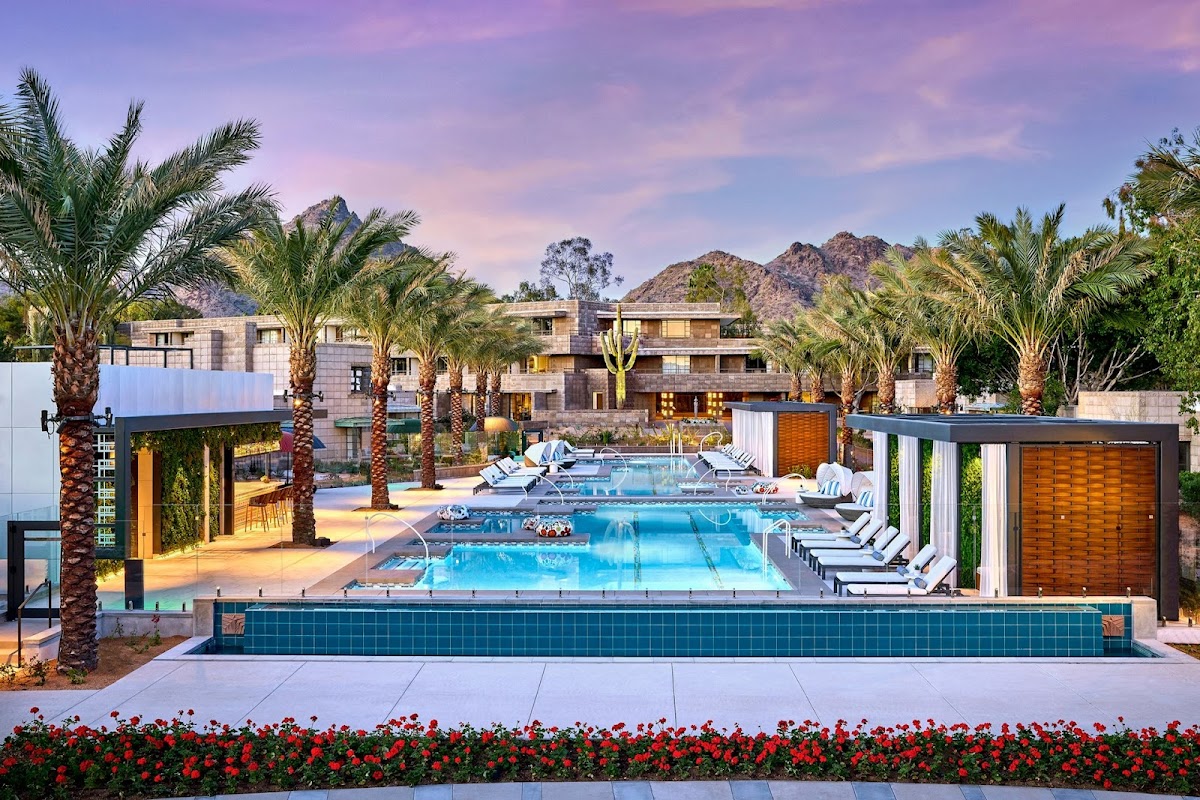
You approach the Arizona Biltmore on East Missouri Avenue, and the first thing that registers is not the building itself but the quality of light — that particular Phoenix radiance that makes everything look touched by gold leaf. Then the palms come into view, towering Washingtonia robustas lining the drive like sentries, their fronds casting geometric shadows across the pavement. The resort unfolds gradually: first the low stone walls in that unmistakable Wright-influenced pattern, then the main building with its textile block facade — those iconic Biltmore Blocks, each one a stylized palm tree cast in concrete, repeating in perfect rhythm across the exterior. You park, step out into the dry desert air, and already you understand why this place has been called the “Jewel of the Desert” since 1929. This is not merely a hotel. This is architecture as theater, history as living backdrop, the Sonoran Desert rendered in art deco geometry and gold. Poppy has received 31 inquiries for Arizona Biltmore wedding flowers, and every time we load in through the service entrance, past the immaculate grounds and into those soaring ballrooms, we are reminded that this venue demands florals equal to its legacy.
About Arizona Biltmore
The Arizona Biltmore opened on February 23, 1929 — just eight months before the stock market crash — and it has weathered every decade since with the kind of grace that only comes from exceptional bones. Albert Chase McArthur designed the resort with consultation from Frank Lloyd Wright, whose geometric sensibility permeates every corner of the property. The Biltmore Blocks, Wright’s interpretation of a palm tree cross-section, are not decorative afterthoughts; they are the structural and aesthetic spine of the entire complex, appearing on facades, as interior accents, even worked into textiles and furnishings. This is a venue where architecture is not background but co-star, and floral designers ignore that fact at their peril.
The resort sits on 39 meticulously landscaped acres in the heart of Phoenix’s Biltmore neighborhood, an enclave of old-money elegance and modern sophistication about eight miles northeast of downtown. Camelback Mountain rises to the east, the Phoenix Mountains Preserve stretches north, and the property itself is a study in how to make the desert lush without losing its essential character. You will find Canary Island date palms, queen palms, citrus groves, olive trees, beds of bougainvillea in magenta and coral, and saguaro cacti standing sentinel near the cottages. The landscaping is abundant but never fussy, desert-appropriate but never austere — a balance every Phoenix wedding florist should study closely.
The Gold Room, perhaps the Biltmore’s most famous space, features the second-largest gold-leaf ceiling in the world (behind only the Taj Mahal), with 7,083 square feet of 23-karat gold leaf applied during a 1973 restoration. Fourteen-foot ceilings, floor-to-ceiling windows, sweeping art deco mirrors, and priceless Maynard Dixon paintings depicting Arizona landscapes — this is a room that announces itself. The Grand Ballroom, with its Wright-inspired chandeliers and 16-foot ceilings, offers a more neutral palette but no less drama. The Aztec Room, smallest of the indoor spaces, is pure Wright: stained glass, geometric patterns, intimate scale that feels like stepping into a jewel box. And outdoors, Paradise Garden provides 7,298 square feet of manicured lawn framed by palms, with the mountains as backdrop.
Logistically, the Biltmore operates as a full-service venue. They require couples to use their in-house catering (no outside food), and while they offer a preferred vendor list with coordination incentives, florists are not restricted — a significant detail for couples seeking a Phoenix wedding florist with specific aesthetic expertise. Valet parking is available at $4 per guest, and the resort provides ample accommodations for wedding parties and guests. Load-in for vendors happens through the service entrance near the Cottage Court area, with event staff coordinating access and providing detailed timelines. The team is professional and experienced, accustomed to high-end weddings and capable of managing complex setups. One bartender is required per 75 guests at $275 each, and liability insurance is mandatory for all vendors. Final guest counts are due five business days prior, menu selections four weeks in advance.
From a Phoenix wedding florist’s perspective, the Biltmore presents both opportunities and challenges. The architecture is so distinctive that florals must either complement the geometry or provide intentional softness — there is no middle ground. The desert climate means heat-sensitive blooms require careful handling, especially for outdoor ceremonies. But the sheer variety of event spaces allows for dramatically different looks within a single property, and the resort’s commitment to excellence means your work will be displayed in the best possible light, both literally and figuratively.
Event Spaces & Floral Opportunities
Gold Room
Capacity: 320 seated, 500 reception-style
Setting: Walk into the Gold Room and your eyes go up. You cannot help it. The ceiling is a field of 23-karat gold leaf, 14 feet overhead, catching and multiplying every light source until the entire room seems to glow from within. The space measures 54 by 130 feet — substantial but not cavernous — with art deco mirrors along the walls, Maynard Dixon paintings depicting saguaro-studded landscapes, and floor-to-ceiling windows framing views of the resort grounds. The aesthetic is 1930s Hollywood glamour filtered through desert modernism: opulent but restrained, dramatic but never overwrought. The adjacent Gold Room Patio adds another 200-person capacity outdoors, with direct access and mountain views. The room’s neutral base — cream walls, geometric carpeting in soft grays and taupes — allows the gold ceiling to dominate without competing elements.
Floral approach: The gold ceiling is not a suggestion; it is a mandate. Every floral decision in this room must account for that shimmering expanse overhead. We favor one of two strategies: either echo the metallics with warm-toned florals in golds, ambers, and champagnes (Café au Lait dahlias, Juliet garden roses, butterscotch-toned ranunculus, champagne spray roses), or provide intentional contrast with deep jewel tones that hold their own against the gilt (burgundy Othello garden roses, plum-toned lisianthus, chocolate cosmos, deep purple clematis). Vessels matter enormously here — polished brass compotes, mercury glass cylinders, or matte gold ceramic urns all amplify the room’s inherent glamour. The art deco mirrors double your floral impact, which means you can use fewer (but larger) statement arrangements rather than cluttering every table. Centerpiece height should stay below 14 inches or go dramatically tall (30+ inches on clear risers) to avoid blocking sightlines while guests are seated. For the entry, a pair of substantial urns flanking the doorway — overflowing with seasonal branches, hydrangea, garden roses, and trailing jasmine — announces the transition from cocktails to dinner. The priceless Maynard Dixon paintings should never be obscured; resist the urge to place florals on the walls. Let the art breathe, and let your arrangements live at table level and in key architectural moments like the corners where mirrors create reflection opportunities.
Grand Ballroom
Capacity: 360 seated, 550 reception-style, 320 dinner and dance
Setting: The Grand Ballroom is the Biltmore’s largest interior space, measuring 7,298 square feet with 16-foot ceilings that provide a sense of volume without the Gold Room’s gilded intensity. Wright-inspired chandeliers — geometric, angular, utterly distinctive — hang at intervals, their bronze and glass construction echoing the Biltmore Block motif. The carpeting features repeating geometric patterns in warm neutrals: taupe, cream, soft brown. One full wall is glass, with floor-to-ceiling windows opening onto an adjacent lawn framed by palms and offering views of the Phoenix Mountains Preserve and Camelback Mountain. Natural light floods the space during daytime events, and the curtains can be drawn for evening affairs to create a more intimate cocoon. The room’s proportions are generous but not intimidating, and the neutral palette provides a blank canvas that can shift toward any aesthetic direction.
Floral approach: The chandeliers are your primary architectural consideration. They hang at a height that makes suspended floral installations tricky — you risk visual competition rather than complement — so we generally recommend leaving the chandeliers unadorned and focusing floral drama at table level and on the perimeter. The windowed wall is a gift: those mountain views should be framed, not blocked, which means keeping centerpieces low (under 12 inches) or using tall, elevated arrangements on slender clear risers that lift blooms above sightlines entirely. For a classic approach, consider low and lush compote arrangements in aged brass or ceramic vessels: garden roses (Patience, Juliet, Keira), white majolica spray roses, ranunculus, anemones, astilbe, and trailing jasmine vine, all densely packed in a rounded silhouette that feels abundant without towering. For a more modern interpretation, go architectural: clusters of tall pillar candles surrounded by rings of low florals (succulents, air plants, desert marigold, thistle, scabiosa pods), or single-variety arrangements in geometric vessels (all white phalaenopsis orchids in matte black cubes, or all pale peach garden roses in angular concrete planters). The entrance deserves a statement — either a pair of large urns with flowing, asymmetric arrangements that spill generously, or a longer installation along the entry console using varied heights and groupings of vessels to create a collected, organic look. If the reception extends onto the adjacent lawn, florals should transition seamlessly: what begins indoors with refined arrangements can become looser and more organic as you move outside, with potted palms, lanterns on shepherd’s hooks, and low arrangements in weathered terracotta.
Aztec Room
Capacity: 80-120 seated
Setting: The Aztec Room is the Biltmore’s most intimate interior space, and it is pure, undiluted Frank Lloyd Wright. Stained glass windows in geometric patterns filter light into jewel tones — amber, ruby, sapphire, emerald. The ceiling features exposed beams in a grid pattern, and the Biltmore Blocks appear as textural accents along the walls. The room is smaller, more contained, with a warmth that the larger ballrooms cannot replicate. This is the space for the couple who wants 100 of their favorite people in a room that feels like a designed embrace, where every architectural detail repays close attention. The color palette already exists in the stained glass and the blocks; your job as a floral designer is to listen to what the room is telling you.
Floral approach: In the Aztec Room, less is more, but what you include must be exquisite. The stained glass windows provide your color cues: pull the jewel tones directly from the glass and use them in your florals. Deep burgundy garden roses (Tess, Piano), plum-toned lisianthus, garnet-red ranunculus, coral poppies, amber-yellow garden roses (Julia Child, Golden Tower), and pops of sapphire delphinium or tweedia for blue accents. Vessels should be simple and sculptural to echo Wright’s geometric sensibility: matte ceramic cylinders, low rectangular troughs, or even terracotta pots that nod to the Southwest without veering into cliché. Centerpieces should be low and lush, allowing conversation to flow easily across the tables. The small scale of the room means you can invest in quality over quantity: one stunning arrangement per table, each a dense garden of color and texture, is more impactful than multiple smaller pieces. Consider a subtle nod to Wright’s textile block motif by using flowers with geometric forms — scabiosa with their perfect spherical centers, craspedia (billy balls), or the architectural structure of protea. Avoid anything overly romantic or loose; this room calls for intentionality and structure softened by organic blooms. For the entry or a focal point like the gift table, a single large arrangement in a hammered copper or bronze vessel — overflowing with those same jewel-toned blooms plus textural elements like millet, seeded eucalyptus, and olive branches — provides a welcoming moment without overwhelming the space.
Paradise Garden
Capacity: 360 seated, 550 standing
Setting: Paradise Garden is the Biltmore’s outdoor ceremony site, a landscaped courtyard spanning 7,298 square feet of manicured artificial turf bordered by mature palms, bougainvillea, and modern stone architecture. The space is essentially a large lawn with built-in greenery — palms provide vertical drama and natural framing, while the surrounding shrubs and desert plantings soften the edges. Views extend toward the Phoenix Mountains Preserve and Camelback Mountain, providing a classic Arizona backdrop of desert peaks and endless sky. The “artificial turf” detail is important: no sprinkler surprises, no muddy patches, and a reliably green surface year-round, even during Phoenix’s driest months. The garden is sheltered enough to feel intimate despite its size, and the existing landscaping does much of the aesthetic heavy lifting.
Floral approach: Paradise Garden’s greatest asset is also its design constraint: the space already has abundant greenery and natural structure, which means your floral work should enhance rather than compete. For ceremonies, a substantial but not oversized arch or arbor provides the focal point without blocking the mountain views. We favor natural wood structures (weathered cedar, driftwood, or even a simple bamboo frame) dressed with asymmetric floral installations: one side fuller than the other, with blooms clustered in organic groupings rather than evenly distributed. Think apricot and coral garden roses (Lady Patience, Vuvuzela), blush quicksand roses, peach ranunculus, ivory lisianthus, and trailing jasmine, smilax, or passion vine for movement. Desert elements can be incorporated thoughtfully: pampas grass for soft texture, dried grasses, even small paddle cacti (secured safely) for a nod to the landscape. Aisle markers should be low and unobtrusive — hurricane lanterns filled with pillar candles, clusters of potted succulents in woven baskets, or simple shepherd’s hooks with small floral posies in terracotta pots every third or fourth row. The existing palms can be uplit dramatically for evening ceremonies, and if your budget allows, consider renting additional potted palms or ficus trees to define the ceremony space further. For cocktail hour, the garden can accommodate high-top tables with low floral clusters, but keep arrangements minimal — guests will be moving, mingling, and drawn toward the mountain views. If the reception also takes place outdoors, florals should feel cohesive but not identical to the ceremony: slightly fuller centerpieces, more candlelight as the sun sets, and perhaps market lights or string lights overhead to activate the vertical space as twilight falls.
Cottage Court & Cottage Lawn
Capacity: 250 (Cottage Court), 150 (Cottage Lawn)
Setting: The Cottage Court and Cottage Lawn are the Biltmore’s more casual outdoor spaces, adjacent to the resort’s private cottage accommodations. These areas offer flexibility — less formal than Paradise Garden, with a residential feel that suits intimate gatherings, rehearsal dinners, or receptions for couples seeking a relaxed garden-party vibe. Mature trees provide natural shade, pathways wind through landscaped beds, and the architecture is lower-profile and less imposing. The setting feels like an elegant private estate rather than a grand resort, which gives you license to experiment with looser, more organic floral styles.
Floral approach: In these more intimate outdoor spaces, florals can be relaxed, gathered, even slightly wild. Think garden-style abundance rather than formal precision. Centerpieces might include just-picked-looking arrangements in mismatched vintage vessels: garden roses, cosmos, zinnias, snapdragons, stock, all slightly unkempt in their beauty. Wooden farm tables can be dressed with long, low garlands of eucalyptus, Italian ruscus, and olive branches interspersed with candles in glass hurricanes and bud vases with single blooms. For a southwestern twist, incorporate terracotta pots, woven baskets, and desert blooms like desert marigold, penstemon, or brittlebush (if seasonally available). Strung bistro lights or Edison bulbs overhead provide ambient lighting as the evening cools, and florals should be designed to look beautiful by both natural daylight and the warmer glow of evening illumination. If the event is a rehearsal dinner or welcome party, consider embracing the residential scale: potted herbs as centerpieces (lavender, rosemary, basil) that guests can take home, or small succulents in hand-stamped terracotta pots as favors. The more casual setting allows for playful touches — citrus fruits incorporated into arrangements, fresh figs, pomegranates in autumn — that would feel out of place in the Gold Room but are perfectly charming here.
Wedding Flower Ideas for Arizona Biltmore
Desert Deco
This concept marries the art deco glamour of the Gold Room with the natural palette of the Sonoran Desert, resulting in a sophisticated look that feels both vintage and of-place. The color story centers on warm desert tones — terracotta, burnt orange, golden amber, soft peach — accented with metallics in aged brass and copper. Blooms include Café au Lait dahlias (those oversized dinner-plate blooms in creamy blush with amber centers), butterscotch-toned ranunculus, peach Juliet garden roses, apricot spray roses, golden Billy Balls (craspedia), and touches of rust-colored celosia for texture. Foliage leans architectural: pampas grass for soft drama, dried grasses, seeded eucalyptus, and olive branches. Vessels are angular and geometric — art deco-inspired brass compotes, hammered copper cylinders, matte ceramic rectangular troughs — that echo the Biltmore Block motif throughout the property. This palette shines in the Gold Room, where the golden ceiling amplifies the warm tones, but it translates beautifully to Paradise Garden as well, where the desert landscape provides a natural extension of the color story. For ceremony arbors, imagine a modern asymmetric installation on a geometric copper frame, with blooms clustered densely on one side and trailing toward the ground. Centerpieces stay low and lush, mounded arrangements that feel abundant but never fussy, with candles in amber glass votives clustered around each base.
Wright’s Garden
This concept takes direct inspiration from Frank Lloyd Wright’s philosophy of organic architecture — bringing the outside in, blurring boundaries, respecting natural forms while imposing structure. The palette is earthy and grounded: deep burgundy, burnt sienna, goldenrod yellow, sage green, with pops of unexpected blue (Wright loved his blues). Flowers include Piano garden roses (that extraordinary deep burgundy-brown), chocolate cosmos, scabiosa in burgundy and rust tones, marigolds in amber and gold, blue tweedia or delphinium for contrast, and plenty of textural foliage: rosemary branches, sage, olive, seeded eucalyptus. Vessels should be either natural (terracotta, unglazed ceramic, wood) or geometric (concrete cubes, angular stone planters, matte black cylinders) — nothing overly romantic or fussy. The key is controlled wildness: arrangements that feel organic and slightly unkempt but are actually carefully structured. This aesthetic works beautifully in the Aztec Room, where the jewel-toned stained glass and Wright’s geometric patterns provide the perfect backdrop, but it also thrives in the Cottage spaces and Paradise Garden, where the more relaxed outdoor setting suits the naturalistic approach. Ceremony installations might incorporate actual Wright-inspired geometric screens (rented or custom-built) with florals woven through the openings, creating a living architectural element. Table arrangements could play with varied heights — some low and mounded, others taller and more linear — creating a dynamic landscape across the reception rather than uniform repetition.
Gilded Elegance
For the couple who wants full luxury, full drama, and florals that match the opulence of that gold-leaf ceiling. This palette is rich, saturated, and unabashedly romantic: ivory, champagne, blush pink, deep plum, and burgundy, all accented with gold. Blooms are lush and abundant: Patience garden roses (ivory with ruffled edges), Juliet garden roses (apricot-peach), Quicksand roses (taupe-blush), burgundy dahlias (Labyrinth, Spartacus), plum-toned lisianthus, white phalaenopsis orchids, ivory hydrangea, and trailing amaranthus for movement. Vessels are metallic and refined: polished brass trumpet vases, mercury glass compotes, gold-rimmed ceramic cylinders, even mirrored risers that reflect candlelight and multiply the floral impact. This is a “more is more” approach, where centerpieces are tall and dramatic (30+ inches), or lush and overflowing at lower heights, and every surface that can hold florals does. The Gold Room becomes a floral jewel box, with arrangements echoing the ceiling’s shimmer. For ceremony arbors, imagine a structure draped in flowing fabric (champagne silk or organza) with massive floral installations at the base and corners — blooms stacked densely, spilling asymmetrically, creating the sense that flowers are overtaking the structure. Even in Paradise Garden, this aesthetic holds: larger arrangements, more abundant arbor installations, and additional floral moments like large urns flanking the aisle entrance. This is the design approach for couples who see the Biltmore’s grandeur and want to match it, not underscore it.
Seasonal Considerations
Spring (March - May)
Spring in Phoenix is a gift. Temperatures climb from the mid-70s in March to the low 90s by May — warm but not punishing, with cool evenings perfect for outdoor ceremonies. This is peak wedding season at the Biltmore, and for good reason: the resort’s landscaping is at its most lush, desert wildflowers are blooming in the surrounding mountains, and the quality of light is exceptional. From a floral perspective, spring offers the widest availability of blooms. Garden roses (Patience, Juliet, Keira, Mayra’s Rose) are abundant and affordable, ranunculus are at their peak in every conceivable color, anemones are plentiful, and peonies arrive toward late April and May if you’re willing to invest. Local growers provide snapdragons, stock, larkspur, and sweet peas in abundance. Desert blooms like brittlebush, lupine, and penstemon can sometimes be sourced from responsible foragers (always verify legality and sustainability). For outdoor ceremonies in Paradise Garden, spring allows maximum flexibility — you can use more delicate blooms without wilting concerns, and setup can happen earlier in the day without heat stress. Consider incorporating seasonal elements like flowering branches (cherry, quince, flowering almond) for dramatic height in large arrangements. The challenge in spring is demand: everyone wants these dates, so book your Phoenix wedding florist early and expect premium pricing during March and April.
Summer (June - August)
Phoenix summer is no joke. Daytime temperatures routinely exceed 110°F, and even evenings offer limited relief, hovering in the 90s until well after sunset. The Biltmore’s air-conditioned ballrooms become essential, and outdoor ceremonies are only feasible at sunset or later — think 7 PM start times in June. From a floral perspective, summer demands careful selection. Delicate blooms like peonies, sweet peas, and even some garden rose varieties will wilt within minutes in the heat. Instead, lean on heat-tolerant options: orchids (phalaenopsis, dendrobium, cymbidium), tropical blooms (anthurium, heliconia, ginger), succulents, cacti, protea, kangaroo paw, and hardy roses like Quicksand and Free Spirit. Hydrangea can work if kept in water-filled tubes and placed in shaded areas, but avoid using it for outdoor ceremony installations. Vessels with built-in water sources (foam-filled with water, or arrangements designed with individual tubes for each stem) are critical for outdoor setups. Setup timing must be strategic: we load in as late as possible for outdoor elements, sometimes arriving just two hours before the ceremony to minimize heat exposure. Consider backup plans: if cocktail hour is outdoors, have a Plan B for moving indoors if temperatures spike unexpectedly. The upside of summer at the Biltmore? Lower venue costs, greater availability, and the drama of those legendary Arizona sunsets painting the sky in bands of orange, pink, and purple behind Camelback Mountain. For evening receptions on the Gold Room Patio or Cottage spaces, summer can be magical once the sun drops and the temperature becomes bearable. Focus florals on indoor spaces where climate control protects your investment, and keep outdoor installations minimal, structural, and heat-hardy.
Fall (September - November)
Fall is Arizona’s second spring. September can still be brutally hot (90s and low 100s), but by October, temperatures moderate into the 80s, and November offers crisp, perfect days in the 70s with cool evenings. The resort’s landscaping remains green and lush, the mountains in the distance take on a golden quality in the changing light, and outdoor events become comfortable again. Floral availability shifts slightly: peonies are gone, but dahlias arrive in full force — those massive dinner-plate varieties in every color imaginable. Garden roses remain available year-round through imports, but fall brings domestic crops back into season. Chrysanthemums (the sophisticated football mums, not the grocery store pom-poms) offer texture and longevity. Fall foliage can be incorporated for texture: oak leaves, maple branches (shipped from cooler climates), or local options like olive branches and eucalyptus pods. For a desert-appropriate autumn palette, consider moving away from traditional oranges and rusts toward warmer, more subdued tones: terracotta, burnt amber, deep burgundy, mauve, and sage green. This palette honors the season without feeling like a New England transplant. Thanksgiving week can be tricky for availability and vendor schedules, so plan accordingly. Otherwise, fall offers some of the best weather and light of the year at the Biltmore, with fewer crowds than spring and the particular magic of Arizona’s long, golden-hour sunsets.
Winter (December - February)
Winter in Phoenix is mild and sunny, with daytime temperatures in the 60s and 70s and cool evenings that dip into the 40s. The resort decorates for the holidays through early January, which can be either a bonus (festive ambiance already provided) or a consideration if you prefer a blank slate. From a floral perspective, winter offers interesting opportunities. Amaryllis in white, red, and burgundy provide dramatic scale and a seasonal feel. Anemones are widely available and affordable, offering those black-centered blooms in white, burgundy, and pink that photograph beautifully. Ranunculus returns in abundance. Tulips become available, though they require careful handling and are best used in arrangements that will remain cool (indoor receptions, not outdoor ceremonies in direct sun, even in winter). Hellebores, with their subtle beauty and surprising color range, work well for more understated designs. Winter also brings certain branches into season: flowering quince, cherry blossom (forced), and curly willow for structural drama. For holiday weddings, you can embrace seasonal elements — evergreen boughs, white roses, red amaryllis, gold accents — or intentionally move in another direction entirely to differentiate your event from the holidays. The cooler temperatures mean you can use almost any bloom without wilting concerns, making winter logistically easier than summer while offering the same cost and availability benefits. Evening ceremonies require minimal additional lighting since sunset arrives earlier (around 5:30 PM in December), though you’ll want to provide warmth for guests — the Biltmore can arrange patio heaters and fire pits for outdoor elements.
Poppy’s Expert Take
The gold ceiling is not optional. We have seen couples try to ignore the Gold Room’s ceiling, as if somehow their florals could exist independently of that vast expanse of 23-karat gold leaf overhead. They cannot. Every floral choice in that room must account for the ceiling — either echoing its warmth with golds, ambers, and champagnes, or providing intentional contrast with deep jewel tones that hold their own against the gilt. Pastels disappear. Bright primaries fight. The ceiling will win every argument, so design with it, not against it.
The Biltmore Blocks are your design language. Frank Lloyd Wright’s geometric textile blocks appear everywhere on this property — exterior walls, interior accents, even woven into the carpeting and textiles. As a Phoenix wedding florist designing for this venue, you should study those blocks and let them inform your work. Geometric vessels, linear arrangements, architectural forms like anthurium or bird of paradise, and structured installations all feel native to the space. This does not mean abandoning organic florals, but it does mean imposing intentional structure. Even a garden-style arrangement should have clean lines and thoughtful composition when placed in the Aztec Room or Grand Ballroom.
**Load-in timing in summer is non-