
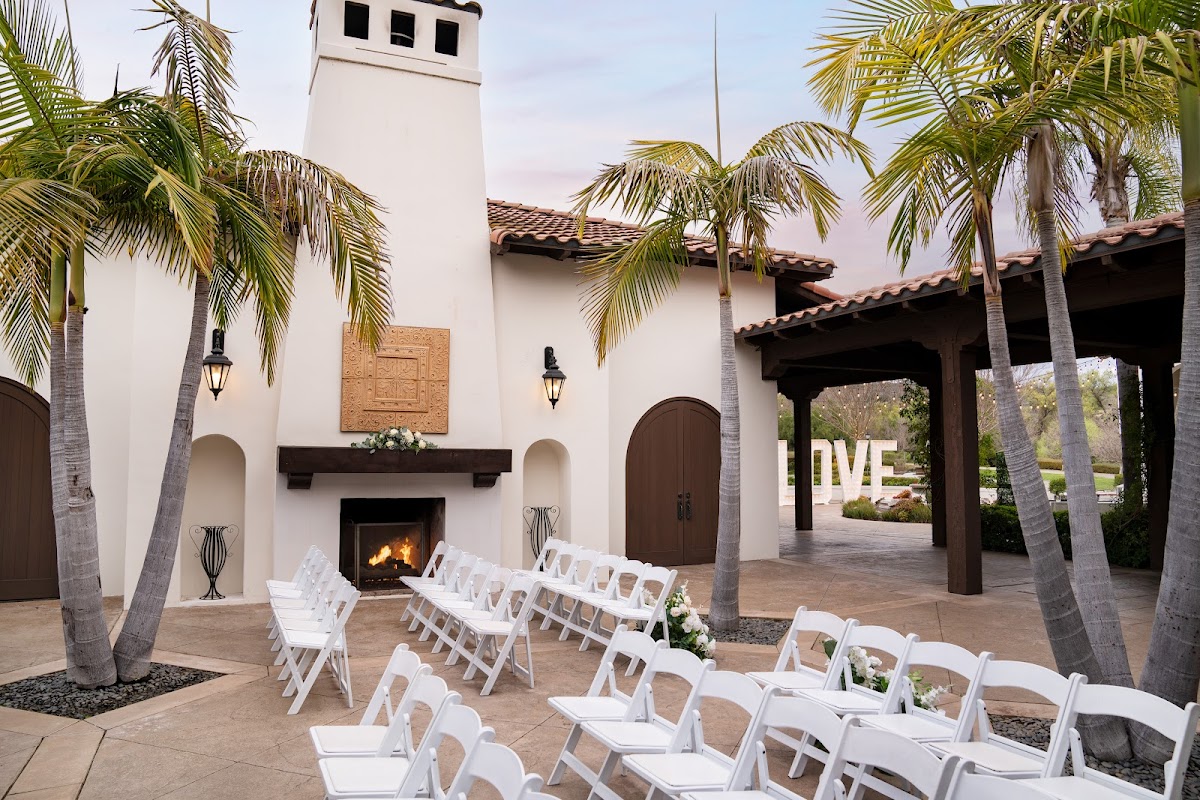
The road into Fallbrook tells you everything before you arrive. You leave the last strip of suburban sprawl behind, wind up into the hills, and suddenly the landscape opens into something older and more deliberate — acres of avocado groves in precise formation, vineyards stitching across the hillsides, and the kind of quiet that only comes with elevation and distance. Flowerwood Lane curves upward, and then Fallbrook Estate by Wedgewood Weddings appears on the hilltop, its red-tile roof glowing against the California sky like something lifted from Andalusia. The Spanish colonial architecture is unmistakable: stucco walls in warm cream, exposed dark wood beams the color of aged sherry, shaded arcades where the light falls in stripes. You park and step out into the scent of eucalyptus and the distant hum of golf carts rolling across the manicured fairways below. From the courtyard, you hear water — the four-tiered stone fountain, splashing quietly in the center of terracotta tile. This is a venue that understands drama without needing to shout about it. Poppy has received 231 inquiries from couples planning Fallbrook Estate by Wedgewood Weddings wedding flowers, and every time we drive up this hill, we understand the pull: this place feels like an escape, even though it’s only an hour from the chaos of San Diego.
About Fallbrook Estate by Wedgewood Weddings
Fallbrook Estate sits on a hilltop in northern San Diego County, in the town that calls itself the “Avocado Capital of the World” — a nickname that is less marketing and more agricultural fact. The region is a patchwork of avocado orchards, citrus groves, and a growing wine industry that rivals nearby Temecula. The estate occupies a prime vantage point overlooking the Fallbrook Golf Club, with panoramic views that stretch across rolling fairways to the distant hills. The location is strategic: far enough from the coast to avoid the marine layer that can blanket beachside venues in June gloom, but close enough (about 18 miles) to offer guests easy access to Oceanside or Carlsbad for post-wedding beach time. The drive from San Diego proper takes about an hour via Interstate 15 and Old Highway 395, and the route itself is scenic once you leave the freeway — two-lane roads through agricultural land and the occasional roadside stand selling avocados by the bag.
The architecture is textbook Spanish Mission Revival, a style that flourished in California in the early 20th century as a romanticized nod to the state’s colonial past. The estate’s red-tile roofs, thick stucco walls, and shaded arcades are practical as well as beautiful — designed to keep interiors cool during the warm, dry summers that define this inland climate. The exposed dark wood beams overhead are substantial, hand-hewn timbers that add warmth and weight to the spaces. The courtyard, with its four-tiered stone fountain and terracotta tile flooring, is the estate’s centerpiece — an intimate, enclosed space that feels transplanted from a Seville plaza. Live palm trees rise from planting beds, their fronds casting dappled shadows, and bistro string lights crisscross overhead, ready to glow as the sun sets. The entire property has been designed with weddings in mind: Wedgewood Weddings operates this as a full-service venue, meaning couples work within an all-inclusive package that includes event coordination, in-house catering, bar service, and cake cutting. The venue provides setup and breakdown, rehearsal access, and a dedicated event team that manages logistics on the day itself.
For Poppy’s delivery and design teams, Fallbrook Estate is straightforward logistically. The venue has ample parking and clear load-in access near both the courtyard and ballroom. Wedgewood’s event coordinators are highly organized and experienced — they know the property inside out and communicate timelines clearly, which allows us to set up efficiently without bottlenecks. The venue does not restrict floral vendors, a welcome contrast to some Wedgewood properties that maintain preferred lists for other categories. We typically arrive two to three hours before the ceremony for outdoor setups, accounting for the Southern California sun and the need to mist delicate blooms. The estate’s hilltop location means wind can be a factor, particularly in the afternoon when thermals rise off the valley floor, so we design with that in mind — weighted vessels, low-profile arrangements, and secure mechanics for anything vertical. Climate control inside the Grand Ballroom is excellent, and the Wedgewood team allows us to access the space early on the wedding day, which is critical for large-scale centerpiece setups.
Event Spaces & Floral Opportunities
Grand Ballroom
Capacity: 215 seated
Setting: The Grand Ballroom is Fallbrook Estate’s indoor jewel — a grand, high-ceilinged space defined by a dozen softly glowing chandeliers, an exposed beam ceiling, and a wall of floor-to-ceiling windows that overlook the golf course. The windows run the length of the room, framing views of the manicured fairways and the hills beyond like a living landscape painting. Double glass doors open onto a terrace, extending the space outward and allowing natural light to flood the room during golden hour. The ballroom also features an indoor two-way fireplace, visible from both the main dining area and an adjacent lounge, adding warmth and a focal point for cooler-season celebrations. The furniture — round tables dressed with Chiavari chairs, modern lounge pieces — is neutral and clean-lined, allowing the room’s architecture and the views to do the talking. The palette is cream, warm wood, and soft gold from the chandeliers.
Floral approach: The Grand Ballroom rewards restraint paired with strategic drama. The chandeliers are your first opportunity: we love suspending greenery installations — long runners of Italian ruscus, smilax, and seeded eucalyptus punctuated with clusters of Quicksand roses, white lisianthus, and Juliet garden roses — that drape from chandelier to chandelier, creating a canopy effect without blocking the sightlines to the windows. If budget allows, these garlands can also incorporate delicate tendrils of jasmine vine or trailing amaranthus for movement. For guest tables, we recommend one of two approaches: either very low, lush arrangements (no more than eight inches tall) in aged gold or mercury glass compotes, mounded with roses, ranunculus, and scabiosa, or dramatically tall centerpieces on slender glass risers that elevate the blooms well above eye level, leaving the views unobstructed. The two-way fireplace mantel is an often-overlooked opportunity — a long, low arrangement of seasonal foliage (olive branches in spring, leucadendron in fall) with textural blooms tucked in creates a focal point for the lounge area and photographs beautifully. Entry tables near the double doors can hold statement urns overflowing with garden roses, hydrangea, and branches to signal the transition from cocktail hour to the main event. Because the ballroom’s windows face west, the light is extraordinary during sunset receptions — choose florals that glow in warm light: peach, blush, champagne, and gold tones rather than stark whites that can read flat.
Courtyard Ceremony Site
Capacity: 215 seated
Setting: The Courtyard is where Fallbrook Estate’s Spanish colonial soul lives most fully. Enclosed by stucco walls and shaded arcades, the space is paved entirely in terracotta tile that warms to a burnt orange glow in the afternoon sun. The four-tiered stone fountain anchors the center, its water cascading down levels of carved stone — it’s both a visual and acoustic focal point, the gentle splashing providing natural ambiance. Live palm trees in raised beds frame the perimeter, their tall trunks and feathery fronds adding vertical interest and a hint of the tropics. Overhead, bistro string lights are strung in a grid pattern, ready to illuminate the space as dusk falls. The arcades provide shaded seating for guests during daytime ceremonies, and the red-tile roofline in the background photographs like a postcard from southern Spain. The courtyard opens to views of the golf course, which stretch beyond the low courtyard walls, adding depth and greenery to the scene.
Floral approach: The fountain is your natural altar backdrop, and our instinct is to let it shine rather than obscure it. We typically design a low, lush collar of florals around the fountain’s base — a ring of garden roses (Patience, Keira, and blush O’Hara), white spray roses, eucalyptus, and Italian ruscus that softens the stone and ties the fountain into the ceremony’s floral language without overwhelming its architecture. If the couple prefers a more defined ceremony structure, a freestanding asymmetrical arch positioned just in front of the fountain — built on a driftwood or copper base, draped with smilax and olive branches, and punctuated with clusters of roses, ranunculus, and hanging amaranthus — creates a layered, dimensional look. For the aisle, we favor simplicity: terracotta pots filled with white hydrangea or lush greenery arrangements, placed every third row, echo the Spanish aesthetic without cluttering the tight space. Alternatively, lanterns wrapped with eucalyptus and tied with silk ribbon line the aisle and can be repurposed later for the terrace cocktail area. The live palm trees can be subtly accented with floral collars or hanging arrangements, but resist the urge to over-decorate — the courtyard’s bones are strong, and too much floral can tip into visual chaos. The bistro lights overhead are perfect for weaving in very light greenery (smilax works beautifully here), but keep it minimal so the lights themselves remain visible and functional.
Fountain Plaza
Capacity: 215 seated
Setting: The Fountain Plaza is an open-air variation of the Courtyard Ceremony Site, essentially the same terracotta-tiled courtyard space with the four-tiered fountain as the star. The plaza is framed by the estate’s Spanish colonial architecture on three sides, with the fourth side open to views of the golf course. The setting is intimate despite the capacity — the high stucco walls and red-tile roofline create a sense of enclosure without feeling cramped. The fountain’s stone tiers catch the light beautifully, whether in full sun or during the softer glow of late afternoon.
Floral approach: Treat the Fountain Plaza with the same approach as the Courtyard Ceremony Site: the fountain itself is the backdrop, so florals should frame and complement rather than compete. A low floral collar at the base, terracotta pots or lanterns lining the aisle, and minimal accents on surrounding architecture create a cohesive, romantic look. If the couple wants more visual impact, consider floating flowers — white roses, peonies, or floating candles — in the fountain’s upper tiers (with venue approval and mechanics to keep blooms in place). The fountain’s water movement will catch light and create gentle ripples, adding a dynamic element to the ceremony backdrop.
Palm-Lined Lawn Ceremony Site
Capacity: 215 seated
Setting: The Palm-Lined Lawn offers a more open, naturalistic setting for ceremonies compared to the enclosed courtyard. This site features a wooden trellis bridge that serves as a dramatic entrance for the bridal party, set beneath a canopy of slender trees that dapple the light. The manicured lawn stretches across open green space, with panoramic views of the golf course rolling away in the background. A stone archway — part of the estate’s architecture — provides a natural ceremony focal point, and the towering palm trees frame the scene on either side. The setting feels less formal than the courtyard, with a garden-party quality that works beautifully for daytime celebrations.
Floral approach: The wooden trellis bridge is the hero here — we love adorning it with full, lush garlands of smilax, eucalyptus, and olive branches, woven with clusters of Patience roses, white lisianthus, and trailing jasmine vine. The garland should be generous and organic, draping naturally over the wood and creating a floral entrance moment that photographs beautifully as the bride walks through. The stone archway at the end of the aisle can be dressed similarly, either with a full floral installation (an asymmetrical arch built on the existing stone structure, overflowing with garden roses, hydrangea, and textured greenery) or, for a more minimal look, two large-scale urns flanking the archway, filled with tall branches (curly willow, manzanita, or blooming fruit branches in season) and lush low blooms. The palm trees provide natural vertical drama, so floral accents here should be subtle — floral collars at the base or simple hanging arrangements if the couple wants to tie the palms into the overall design. For the aisle, consider low arrangements on shepherd’s hooks or simple clusters of florals in clear glass cylinders placed on the grass every few rows, allowing the view beyond to remain visible. Because this is an open lawn site, wind protection is essential — use weighted vessels, low profiles, and secure mechanics for anything that rises above knee height.
Terrace Cocktail Patio
Setting: The Terrace Cocktail Patio is a wrap-around outdoor space adjacent to the Grand Ballroom, designed for pre-reception cocktails and mingling. The patio features an outdoor fireplace, bistro string lights overhead, and views of the rolling hills and golf course. The Spanish colonial architecture provides a warm, golden backdrop, and the fireplace becomes a natural gathering point, especially as the sun sets and the temperature drops. The space flows easily into the ballroom, making the transition from cocktails to dinner seamless.
Floral approach: Cocktail hour florals should be elevated but not intrusive — you want visual interest without blocking conversation or the flow of passed appetizers. Small, tight arrangements in gold or ceramic bud vases on cocktail tables (single stems of roses, ranunculus, or dahlias paired with a sprig of eucalyptus) add color and refinement without taking up precious table real estate. The outdoor fireplace mantel is prime real estate for a longer, low garland of seasonal greenery (olive branches, eucalyptus, or rosemary in summer) with clusters of blooms tucked in, creating a focal point that draws guests toward the warmth. If the couple wants more impact, consider flanking the fireplace with a pair of large urns filled with tall branches and lush low blooms, creating a lounge-worthy vignette that also photographs beautifully. The bistro string lights overhead can be subtly woven with very light garlands of smilax or Italian ruscus, but keep it minimal — you don’t want to obscure the lights themselves, which provide essential illumination as the evening progresses. If the patio includes lounge furniture, small arrangements on side tables or a low floral runner on a central coffee table ties the space into the overall design. Remember that cocktail hour arrangements can often be repurposed: bud vases move easily to the Grand Ballroom bar or gift table, and fireplace mantel garlands can transition to sweetheart table backdrops if timed correctly.
Wedding Flower Ideas for Fallbrook Estate by Wedgewood Weddings
Spanish Sunset
This palette leans into the estate’s Spanish colonial roots and the golden light of Southern California evenings. Think warm, glowing tones: deep terracotta dahlias (Gitts Attention, Cornel), burnt orange roses (Free Spirit, Tycoon), golden yellow Billy Balls, peach ranunculus (Cloony Salmon, Cappuccino), and rust-colored celosia. Soften the warmth with blush Juliet garden roses, champagne spray roses, and cream lisianthus. Greenery includes dusty olive branches, eucalyptus (silver dollar and seeded), and sprigs of rosemary for fragrance. Vessels are terracotta pots (perfect for aisle markers or courtyard installations), aged brass compotes, and ceramic pieces in warm ochre or cream. This palette glows in the ballroom’s sunset light and complements the courtyard’s terracotta tile perfectly. Use Spanish Sunset for couples marrying in late spring through fall, when the sun is strong and the estate’s warm tones are at their peak.
Garden Romance
A softer, more romantic approach that feels lush and English-garden inspired, adapted for the California setting. The palette centers on blush, cream, and soft lavender: Patience garden roses, Quicksand roses, white O’Hara garden roses, blush ranunculus (Cloni Gessica, Amandine), lavender stock, white lisianthus, and white hydrangea. Add texture with scabiosa pods, astilbe in soft pink, and Queen Anne’s lace. Greenery is lush and varied: Italian ruscus, smilax, seeded eucalyptus, and variegated pittosporum. Vessels are mercury glass compotes, clear glass cylinders, and aged white ceramic urns. This palette works beautifully in the Grand Ballroom for a classic, timeless reception, and on the Palm-Lined Lawn for a softer, more organic ceremony look. Garden Romance is ideal for spring and early summer weddings, when garden roses are at their most abundant and affordable.
Mediterranean Grove
This concept draws from Fallbrook’s agricultural identity — avocado groves, olive orchards, and citrus trees — for a fresh, organic palette. The foundation is greenery-heavy: olive branches with their silvery leaves, eucalyptus in multiple varieties (silver dollar, baby blue, seeded), Italian ruscus, and lemon leaf. Florals are white and cream to keep the look clean and modern: white garden roses (Patience, Playa Blanca), white ranunculus, white anemones with their dark centers, cream lisianthus, and white sweet peas for fragrance. Add unexpected texture with kumquats or small lemons tucked into arrangements (wired securely), privet berries, and scabiosa pods. Vessels are natural wood boxes, clear glass cylinders that show stems, and rustic ceramic pots. This palette feels fresh and California-modern, perfect for couples who want an understated, organic look. It works across all seasons and is particularly stunning in the courtyard, where the greenery echoes the live palms and the white florals pop against the terracotta tile.
Seasonal Considerations
Fallbrook’s inland location in northern San Diego County gives it a Mediterranean climate — warm, dry summers and mild, wetter winters — with less marine influence than coastal venues. This translates to reliable sunshine year-round, but also specific seasonal considerations for Fallbrook Estate by Wedgewood Weddings wedding flowers.
Spring (March-May): Spring is arguably the most beautiful season at Fallbrook Estate, with mild temperatures (highs in the 70s), blooming wildflowers in the surrounding hills, and the longest availability of premium blooms like peonies, garden roses, and ranunculus. March can still see occasional rain, but by April the weather stabilizes into clear, temperate days. This is the season to go big on garden roses — varieties like Patience, Juliet, and Keira are abundant and affordable. Incorporate flowering branches (cherry, plum, apple) for dramatic ceremony installations. The estate’s palm trees leaf out fully, creating lush backdrops. Be mindful of wind in late afternoon as the valley heats up; use weighted vessels for outdoor arrangements. April and May are peak wedding months here, so book early.
Summer (June-August): Summer in Fallbrook is warm to hot — daytime highs regularly reach the mid-80s to low 90s, and the sun is intense. June is actually the coolest summer month due to a slight marine influence (though less than the coast). This is the season to choose heat-tolerant blooms: sunflowers, zinnias, celosia, dahlias (which thrive in heat), and succulents for textural accents. Garden roses and hydrangea are still available but require extra care — we keep them in water until the last possible moment and mist regularly during setup. Outdoor ceremonies are best scheduled for late afternoon or evening to avoid the peak heat; the courtyard’s shaded arcades are a blessing. The estate’s bistro lights become essential for evening celebrations, creating ambiance as the sun sets. Hydration stations for guests are a must. The golf course views are at their greenest in early summer, providing a lush backdrop.
Fall (September-November): Fall is the second peak season at Fallbrook Estate, with warm days (70s-80s) and cooler evenings, clear skies, and spectacular light. September can still feel like summer, but by October the heat breaks and the landscape begins to shift toward golden tones. This is dahlia season — California-grown dahlias (Café au Lait, Cornel, Labyrinth) are at their peak and affordable. Incorporate fall colors without being literal: rust, burgundy, plum, and burnt orange work beautifully against the estate’s warm architecture. Flowering grasses (pampas, miscanthus) add movement and texture. November can be windy, particularly in the afternoons, so secure outdoor arrangements accordingly. The estate’s palm trees remain green, but the surrounding hills take on a golden, dry-season hue that photographs beautifully.
Winter (December-February): Winter in Fallbrook is mild compared to most of the country — daytime temperatures in the 60s, with occasional rain between December and February. This is the off-season for weddings here, but it offers unique opportunities: fewer bookings mean more date flexibility, and certain blooms (anemones, hellebores, ranunculus) are at their peak. Embrace winter without going full snow-and-pine: deep burgundy and plum tones, white and cream blooms, and lots of greenery (eucalyptus, olive, Italian ruscus) create a romantic, elegant palette. The outdoor fireplace becomes a hero feature during winter cocktail hours. Rain is possible, so have a backup plan for outdoor ceremony spaces — the Grand Ballroom can accommodate ceremonies if needed. The estate’s string lights and chandeliers glow beautifully in the shorter winter daylight, creating a cozy, intimate atmosphere.
Poppy’s Expert Take
The fountain is your built-in ceremony backdrop — don’t over-style it. Couples often worry that the courtyard fountain isn’t “enough” on its own and want to add a large arch or backdrop that ends up competing with the water feature. Trust us: the fountain is architecturally stunning, and it photographs beautifully. A low floral collar at the base and perhaps two flanking urns are all you need. Over-designing this space wastes budget and clutters the sightline. If you really want an arch, position it just in front of the fountain rather than obscuring it entirely, and keep the design asymmetrical and open so the stone tiers remain visible. The fountain’s movement and sound add so much to the ceremony — lean into it rather than against it.
Account for wind on the hilltop lawn site. The Palm-Lined Lawn is gorgeous, but because it’s elevated and open, afternoon winds can pick up as the valley heats. Any tall arrangements — shepherd’s hook florals, tall urns flanking the stone archway — need weighted bases, and delicate blooms like sweet peas or cosmos should be used sparingly or saved for indoor spaces. We often use low profile arrangements on the lawn (florals in clear cylinders placed directly on the grass) or focus the floral budget on the trellis bridge, which is more wind-protected. If your ceremony is scheduled for late afternoon (after 3 PM), expect some breeze and design accordingly.
The Grand Ballroom’s windows are your priority — not your competition. Those floor-to-ceiling windows overlooking the golf course are one of the venue’s biggest selling points, and the last thing you want is for guest table centerpieces to block the view. We recommend either very low, lush arrangements (under 10 inches) or dramatically tall centerpieces on slender risers that elevate the blooms well above eye level (18+ inches). The middle ground — arrangements that sit at 12-16 inches — is the worst choice because they block sightlines without providing the drama of height. If budget is limited, go low and lush across all tables. If you can invest more, alternate low and tall for visual variety while preserving the views.
Wedgewood’s all-inclusive model means fewer vendors — use that to your advantage. Because the venue provides catering, coordination, setup, and breakdown, you’ll have fewer vendors on-site compared to a DIY venue, which means more space and time for your florist to work. Take advantage of this by investing in more complex installations — suspended greenery on the ballroom chandeliers, full garlands on the trellis bridge, elaborate fireplace mantel arrangements. With fewer people competing for setup time, we can execute more ambitious designs without feeling rushed. Communicate your floral vision early to the Wedgewood coordinator so they can build it into the day’s timeline.
Terracotta pots are your aesthetic and practical best friend here. The courtyard’s terracotta tile and Spanish colonial architecture practically beg for florals in terracotta pots — they’re on-theme, they’re affordable, and they’re versatile. Use them for aisle markers in the courtyard, for flanking the ballroom entrance, or clustered on the terrace during cocktail hour. You can plant them with single-variety blooms (all white hydrangea, all blush roses) for a clean look, or go lush and garden-style with mixed textures. Bonus: terracotta pots are reusable, so eco-conscious couples can take them home or donate them post-wedding.
The outdoor fireplace mantel is underused and under-photographed — don’t skip it. Most couples focus their floral budget on ceremony and reception spaces and forget about the cocktail hour terrace, but that outdoor fireplace is a natural focal point and gathering spot. A long, lush garland across the mantel — olive branches, eucalyptus, and clusters of roses or dahlias — creates an Instagram-worthy moment and gives guests a beautiful backdrop for candid photos. It’s also a relatively small investment (a 6-foot garland costs significantly less than a full ceremony arch) with high visual impact. If you’re working with a tighter budget, this is one place where greenery-only can still look incredibly lush and intentional.
Coordinate your palette with the sunset if you’re having an evening reception. The Grand Ballroom faces west, which means the light during golden hour is extraordinary — warm, amber, and glowing. Florals in peach, blush, champagne, and gold tones will absolutely sing in this light, while stark whites or cool blues can look washed out. If your reception starts at 6 PM or later (common for summer and fall weddings), design your centerpieces and ballroom florals with sunset in mind. We often photograph our installations during setup in natural light and again during the reception once the sun is setting, and the difference is remarkable. The same arrangement that looks pretty in daylight becomes luminous in sunset.
What Poppy Couples Spend on Flowers Here
While Poppy hasn’t yet completed a wedding at Fallbrook Estate, the 231 inquiries we’ve received give us a clear picture of what couples are planning. Based on comparable venues in the Temecula and northern San Diego County markets, and accounting for the estate’s multiple event spaces and Spanish colonial aesthetic, here’s what we typically see couples invest in Fallbrook Estate by Wedgewood Weddings wedding flowers.
$3,000 - $5,500 | The Essentials This tier covers personal flowers (bridal bouquet, bridesmaid bouquets, boutonnieres, corsages) plus ceremony and reception basics. For the ceremony, that might be a floral collar around the fountain in the courtyard or a pair of large urns flanking the stone archway on the Palm-Lined Lawn, plus six to eight aisle markers (terracotta pots or lanterns with floral accents). For the reception in the Grand Ballroom, you’re looking at centerpieces for 20-25 guest tables — low, lush arrangements in mixed vessels (mercury glass compotes, clear cylinders, ceramic vessels) using a consistent palette of garden roses, spray roses, ranunculus, and greenery. Add small bud vases for cocktail hour tables on the terrace and a