
You turn off Route 501 onto Furnace Hills Pike and the modern world begins its retreat. The road narrows. Farmland stretches to either side — the kind of Lancaster County countryside that still looks like it did two centuries ago, when Baron Heinrich Wilhelm Stiegel first established his iron furnace here. The entrance to Elizabeth Furnace appears not as a grand announcement but as an invitation: a discreet sign, a tree-lined drive, and then the property reveals itself in layers. First the Stiegel-Coleman House, a mid-1700s stone mansion with Federal columns and a wraparound porch that speaks of colonial elegance. Then Coleman Gardens, terraced and lush, climbing the hillside with English boxwood and a stone bell tower rising above the hedges like something out of an English estate. Beyond that, tucked into a wooded glen, the primitive Charcoal Barn with its weathered timber frame and sliding doors open to the trees. This is not a wedding venue that shouts. It whispers, in the language of original stone walls and hand-hewn beams and gardens planted with intention. Elizabeth Furnace is thirty-three acres of Pennsylvania history, meticulously preserved and quietly extraordinary. We understand why — it is rare to find a property this layered, this authentic, this capable of holding both grandeur and intimacy in equal measure.
About Elizabeth Furnace
Elizabeth Furnace sits in Lititz, a Lancaster County town that Conde Nast Traveler once named “America’s Coolest Small Town” — and they were not wrong. Lititz is what happens when colonial Moravian heritage meets contemporary artisan culture: a walkable Main Street lined with boutique shops, farm-to-table restaurants, and the kind of independent bookstores and chocolate makers that give a place its soul. The town is home to Wilbur Chocolate, the Julius Sturgis Pretzel Bakery (birthplace of the American pretzel), and Rock Lititz, the world’s largest entertainment production campus. It is a community that values craft and history in equal measure, which makes it the perfect home for a venue like Elizabeth Furnace.
The property itself is named for the iron furnace established here by Baron Stiegel in the 1700s, though the current buildings reflect a later era. The Stiegel Stable dates to the 1760s — a restored English-style stable with original stone walls, exposed wooden beams, and modern climate control seamlessly integrated into the historic fabric. The Coleman Gardens, with their tiered levels and functioning bell tower, were designed as a formal garden space and have been maintained with horticultural precision. The Charcoal Barn is primitive in the truest sense — timber frame construction, stone walls, minimal ornamentation — a structure that looks like it grew directly from the Pennsylvania woodland. Across Furnace Hills Pike, the Coleman Chapel (available for an additional fee) offers couples a traditional church ceremony option, complete with Tiffany stained glass windows and vaulted ceilings.
What sets Elizabeth Furnace apart is its completeness. This is not a single barn or a single garden, but a 33-acre estate with multiple distinct spaces that allow a wedding to unfold across different settings and moods. Couples have exclusive use of the property for up to 12 hours on their wedding day, and golf cart transportation is provided to shuttle guests between spaces — a detail that matters when your ceremony is in the gardens, cocktails on the mansion porch, and reception in the stable. The venue’s events team is well-organized and accommodating, and they work with JDK Group for exclusive in-house catering, which simplifies vendor coordination considerably.
From a florist’s perspective, Elizabeth Furnace is located about two hours from both Baltimore and Philadelphia, making it accessible for Poppy’s delivery logistics while still feeling like a true countryside escape. The venue allows outside vendors (including florists), and the staff is cooperative about setup timing and vendor access. Load-in is straightforward, with ample parking and golf cart assistance for transporting arrangements across the property. The stone walls, exposed beams, and garden architecture provide natural anchor points for floral installations, and the variety of spaces means we can design everything from minimal, architecture-focused arrangements to full garden romance depending on the couple’s vision.
Event Spaces & Floral Opportunities
Stiegel Stable
Capacity: 160 seated
Setting: The Stiegel Stable is the venue’s primary indoor reception space, and it wears its 1760s origins with pride. Original stone walls — thick, golden-gray fieldstone with mortar that has settled into irregular patterns over two and a half centuries — anchor the room. Exposed wooden beams span the ceiling, dark with age and showing the hand-hewn marks of colonial craftsmanship. Modern interventions are present but discreet: climate control, elegant chandeliers with a contemporary silhouette, windows that flood the space with natural light, and yes, USB charging ports discreetly integrated into the walls. The aesthetic is what you might call rustic refinement — a space that feels authentically historic but functions flawlessly for a modern celebration. An attached terrace with a stone firepit extends the space outdoors for cocktails or late-night conversations under the stars.
Floral approach: The Stiegel Stable’s stone and beam architecture is a florist’s dream because it provides so many natural installation points without requiring damage or invasive rigging. We love running a lush garland along the exposed beams — fifteen to twenty feet of smilax, Italian ruscus, and seeded eucalyptus interwoven with clusters of Juliet and Patience garden roses, white lisianthus, and trailing jasmine vine. The garland appears to float above the reception tables, softening the hard lines of the beams while leaving sightlines open. The stone walls can be adorned with minimal intervention: imagine a pair of large-scale urns flanking the entrance, overflowing with seasonal branches (flowering quince in spring, oakleaf hydrangea in summer, bittersweet vine in fall), Café au Lait dahlias, and textured foliage. The chandeliers are beautiful on their own and generally don’t need floral embellishment, though a light touch of greenery woven through the arms can soften their presence. For centerpieces, the neutral stone backdrop allows for either bold color (deep burgundy, plum, and blush for a romantic palette) or soft, tonal designs in cream, champagne, and sage. We favor low, lush arrangements in this space — compote-style vessels filled with garden roses, ranunculus, hellebores, and trailing greenery — so guests can see one another across the tables. The firepit terrace is ideal for smaller bud vase arrangements or lanterns surrounded by greenery, creating a cozy transition from indoors to the night air.
Coleman Gardens
Capacity: 200 seated (ceremony or cocktail configuration)
Setting: Coleman Gardens is where Elizabeth Furnace shows its romantic hand. The gardens are tiered — not subtly, but dramatically, with stone retaining walls creating distinct levels that climb the hillside. English boxwood defines the garden beds, clipped into formal hedges that provide year-round structure. Seasonal plantings change with the months: tulips and daffodils in spring, hydrangeas and roses in summer, chrysanthemums and ornamental grasses in fall. A functioning bell tower rises from the upper terrace, its stone construction echoing the architecture of the main buildings. A built-in stone terrace bar sits ready for cocktail service, and pathways wind through the levels, connecting ceremony spaces to cocktail areas to photo locations. This is a garden designed for movement and discovery, and it photographs like an English estate transplanted to Pennsylvania.
Floral approach: The genius of Coleman Gardens is that it already is a garden — which means Elizabeth Furnace wedding flowers here should complement, not compete with, the existing landscape. We approach floral design in this space as enhancement rather than replacement. For ceremonies, the Garden Folly (see below) provides a built-in architectural backdrop, but couples can also choose to marry on one of the open terraces with the bell tower as a backdrop. In either case, we favor minimal but impactful installations: a refined floral arch using a natural wood or metal frame adorned with asymmetrical clusters of garden roses (Keira, Quicksand, Ivory Tower), lisianthus, spirea, and locally foraged branches. Aisle markers work beautifully as low arrangements in aged stone or terracotta vessels placed along the pathway — think garden-gathered designs with scabiosa, astilbe, tweedia, and jasmine vine spilling over the edges. The bell tower base is an opportunity for a dramatic ground installation: a pair of large urns filled with statement florals like foxglove, delphinium, tree peonies, and trailing amaranthus. For cocktail hour, the tiered levels allow for varied floral moments — small arrangements on the stone terrace bar, bud vases clustered on cocktail tables, and perhaps a garland draped along one of the stone retaining walls. The key is to let the garden breathe. This space does not need florals on every surface; it needs florals that feel like they grew there.
Charcoal Barn
Capacity: Flexible (typically 80-100 seated for dinner, more for cocktail-style events)
Setting: The Charcoal Barn sits in a wooded glen on the property, and the approach alone sets the tone — you walk (or ride the golf cart) down a path through the trees, and the barn appears like a relic from another century. Which it is. This is primitive timber frame construction: massive hand-hewn beams, original stone walls with gaps wide enough to see through in places, large sliding barn doors that frame the woods beyond. A giant statement chandelier hangs from the central beam — wrought iron, industrial, unapologetically dramatic. The acoustics are notable; voices carry and echo in a way that makes live music or readings feel particularly resonant. Elizabeth Furnace markets this space as a rain backup ceremony location, but many couples choose it intentionally for its moody, romantic woodland setting.
Floral approach: The Charcoal Barn’s primitive aesthetic calls for organic, deconstructed floral design — the kind of arrangements that look gathered from the forest floor rather than precisely designed in a studio. We love working with a palette of earthy tones here: rust, terracotta, deep plum, moss green, and cream. Florals might include Café au Lait and Sylvia dahlias, chocolate cosmos, burgundy ranunculus, privet berries, and lots of textured foliage — oak leaves, magnolia branches, ferns, and wild grasses. The barn door frames create a natural archway that works beautifully for a ceremony backdrop: imagine a minimal wooden arch adorned with asymmetrical clusters of florals and foraged branches, intentionally wild and unstructured. The giant chandelier can be adorned with a garland of smilax, eucalyptus, and minimal floral clusters, or left bare to maintain its industrial drama. For reception centerpieces (if using this space for dining), we favor low, organic arrangements in natural wood or ceramic vessels — compotes filled with dahlias, roses, and trailing greenery that feel like they were just cut from the woods outside. The stone walls can support small floral or greenery installations, though the primitive aesthetic often works best with restraint. Moss, lichen-covered branches, and woodland elements feel more authentic here than polished floral designs.
Coleman Chapel
Capacity: 135 seated
Setting: The Coleman Chapel sits across Furnace Hills Pike from the main property and requires an additional fee, but for couples seeking a traditional church ceremony, it is worth every consideration. This is an 1877 chapel with all the architectural gravitas that implies: vaulted ceilings that soar overhead, original bell tower, traditional wooden pew seating, and — the main event — stunning Tiffany stained glass windows that cast colored light across the interior in shifting patterns throughout the day. The windows depict biblical scenes in jewel tones: sapphire blue, ruby red, emerald green, and amber gold. They are works of art, and they dominate the visual experience of the space.
Floral approach: The cardinal rule in Coleman Chapel is restraint. Those Tiffany windows are the focal point, and Elizabeth Furnace wedding flowers should frame them, not compete with them. We recommend minimal, classic floral design: a pair of tall pedestal arrangements flanking the altar, using elegant white and cream florals — white peonies, Patience garden roses, white lisianthus, white hydrangea, and trailing white jasmine — in formal silver or white ceramic urns. The vaulted ceilings allow for height, so these arrangements can be substantial without overwhelming the space. Pew markers should be simple: small clusters of greenery (eucalyptus, olive) tied with ribbon, or very minimal bud vases with a single bloom. The altar itself may have architectural features or religious elements that limit floral placement, so coordination with the chapel’s guidelines is essential. Window light in this space is extraordinary — mid-morning or late afternoon ceremonies will have the stained glass glowing, and florals will be backlit in a way that makes white and cream blooms appear luminous. Avoid heavily colored florals here; they will clash with the jewel-toned windows. Stick to whites, creams, soft greens, and let the Tiffany glass provide the color.
Garden Folly
Capacity: Flexible (ceremony seating for 80-120 depending on layout)
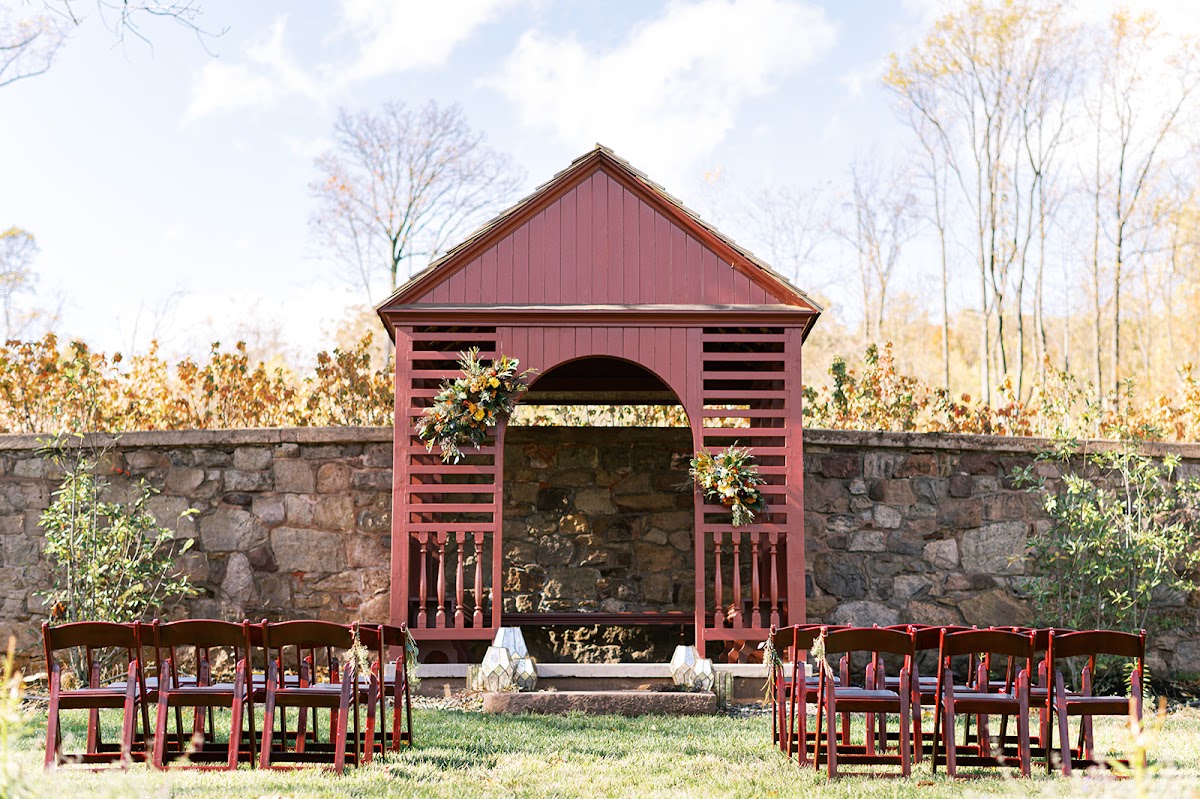
Setting: The Garden Folly is nestled within Coleman Gardens — a historic stone wall with a restored wooden pergola structure that creates an architectural framework for outdoor ceremonies. The stone wall is substantial, built from the same golden-gray fieldstone that appears throughout the property, and the wooden pergola overhead is weathered and beautiful, with vines beginning to climb its posts. The Folly sits on one of the garden’s terraced levels, surrounded by boxwood hedges and seasonal plantings, with views of the bell tower and the estate beyond.
Floral approach: The Garden Folly’s existing architecture is so strong that it requires a light touch. This is not a blank canvas that needs to be constructed from scratch; it is a frame that needs only to be adorned. We recommend a ceremony arbor installation that enhances the pergola without covering it entirely: asymmetrical garlands draped along the wooden beams, with clusters of garden roses (Keira, Quicksand, Ivory Tower), lisianthus, spirea, and jasmine vine at the corners and center. The stone wall base can support low ground arrangements in aged stone or ceramic vessels — lush, overflowing designs with Café au Lait dahlias, garden roses, astilbe, and trailing greenery that spills onto the grass. Aisle arrangements leading to the Folly work beautifully as minimal markers: small vessels placed every few rows, filled with seasonal blooms that echo the garden’s existing palette. The key is integration. Florals here should feel like a natural extension of the garden, not an imported decoration. Let the boxwood, the stone, and the wooden pergola do the structural work, and use florals to add softness, color, and seasonal relevance.
Stiegel-Coleman House Porch & Patio
Capacity: Flexible (typically 40-60 for cocktails)
Setting: The Stiegel-Coleman House is the mid-1700s stone mansion that anchors the property, and its wraparound porch is pure colonial elegance. Federal columns support the porch roof, colonial-style benches line the perimeter, and the views overlook the estate grounds. Adjacent to the porch is a grey stone patio with a built-in firepit, creating a transition space between the mansion and the gardens. This area is most often used for cocktail hour, though it can also host intimate seated dinners or rehearsal gatherings.
Floral approach: The Stiegel-Coleman House porch calls for classic, refined floral design that matches the Federal architecture. We love flanking the porch entrance with a pair of statement urns filled with seasonal florals: white hydrangea, Quicksand and Ivory Tower garden roses, white lisianthus, and eucalyptus in spring and summer; burgundy dahlias, plum ranunculus, privet berries, and bronze foliage in fall. The porch columns can be adorned with minimal garlands — think smilax and eucalyptus with occasional floral clusters — though we often leave them bare to let the architecture shine. The colonial benches can feature small floral accents or remain unadorned depending on the couple’s vision. On the stone patio, cocktail tables benefit from small, elegant arrangements in compotes or bud vases — low designs that don’t interfere with conversation but add color and life to the space. The firepit area is ideal for lanterns surrounded by greenery (eucalyptus, olive branches, ferns) and perhaps a few scattered votives, creating a warm, inviting glow as daylight fades. This is a space where less is often more; the mansion’s architecture provides the elegance, and florals simply punctuate it.
Wedding Flower Ideas for Elizabeth Furnace
Pennsylvania Garden Estate
This concept leans into the English garden aesthetic of Coleman Gardens while grounding it in Pennsylvania’s landscape. The palette is soft and romantic: blush, peach, cream, sage green, and dusty lavender. Florals include Juliet, Keira, and Patience garden roses, white and blush peonies, lavender, scabiosa, astilbe, ranunculus, and lots of textured greenery — eucalyptus, olive, ferns, and trailing jasmine vine. Vessels are aged terracotta, weathered stone compotes, and ceramic urns that echo the garden’s timeless quality. Arrangements are lush and organic, with flowers appearing to spill naturally from their containers. This palette works beautifully throughout the property: ceremony arbor florals at the Garden Folly, lush centerpieces in the Stiegel Stable, and garden-gathered arrangements on the porch of the Stiegel-Coleman House. It is classic without being stuffy, romantic without being overly sweet — the kind of floral design that feels both timeless and fresh.
Woodland Reverie
This concept embraces the Charcoal Barn’s primitive, forested setting and extends it across the property. The palette is earthy and moody: deep burgundy, rust, terracotta, chocolate brown, moss green, and cream. Florals include Café au Lait dahlias, Black Satin and Rip City dahlias, chocolate cosmos, burgundy ranunculus, privet berries, scabiosa pods, and foraged elements like oak branches, magnolia leaves, ferns, and wild grasses. Vessels are natural wood, aged ceramic, and iron urns that feel organic and unpolished. Arrangements are deconstructed and asymmetrical, with a gathered-from-the-forest aesthetic. This palette is stunning in the Charcoal Barn for a woodland ceremony or reception, but it also translates beautifully to the Stiegel Stable’s stone walls and can be softened slightly for Coleman Gardens with the addition of cream and peach tones. It is ideal for fall weddings but works year-round for couples drawn to a darker, more dramatic aesthetic.
Colonial Elegance
This concept honors the property’s 1700s heritage with a refined, historically-inspired palette. The color story is sophisticated and restrained: ivory, champagne, taupe, dusty blue, and deep green. Florals include white peonies, Patience and Ivory Tower garden roses, white hydrangea, white lisianthus, tweedia, dusty miller, eucalyptus, and olive branches. Vessels are formal — silver urns, white ceramic compotes, aged brass candlesticks — with a nod to colonial-era elegance. Arrangements are structured and symmetrical, with a classic garden aesthetic. This palette is ideal for couples using the Coleman Chapel for their ceremony (where white and cream florals complement the Tiffany windows beautifully) or for a formal reception in the Stiegel Stable. It also works perfectly on the Stiegel-Coleman House porch, where the Federal columns and colonial architecture call for refined, traditional design. This is timeless, sophisticated, and quietly luxurious.
Seasonal Considerations
Elizabeth Furnace’s location in Lancaster County means four distinct seasons, each offering unique opportunities and considerations for floral design.
Spring (April–May) arrives with a rush of color in Coleman Gardens. Tulips, daffodils, and hyacinths bloom in the tiered beds, and the boxwood hedges leaf out in bright green. This is an ideal time for garden ceremonies, though Pennsylvania spring weather is notoriously unpredictable — have a rain plan in place (the Charcoal Barn or Stiegel Stable work beautifully as backups). Locally available spring florals include tulips, ranunculus, anemones, hellebores, tweedia, and early garden roses. The temperature can range from the 50s to 70s, so consider guest comfort for outdoor ceremonies. Spring light in Pennsylvania is soft and luminous, perfect for photography.
Summer (June–August) brings warm days, lush greenery, and long daylight hours. Coleman Gardens is at its peak, with hydrangeas, roses, and perennials in full bloom. This is the most popular season for weddings at Elizabeth Furnace, and for good reason — the gardens are spectacular, and the weather is reliably warm. Locally available summer florals include peonies (early June), garden roses, hydrangeas, dahlias, lisianthus, scabiosa, astilbe, and a wide variety of foliage. Be mindful of heat and humidity; delicate blooms like sweet peas may wilt, and guests will appreciate shaded cocktail areas. The Stiegel Stable’s air conditioning is a significant advantage for summer receptions. Evening light in late June and July is golden and long, making for stunning outdoor photography until well after 8 PM.
Fall (September–October) is Pennsylvania at its finest. The surrounding Lancaster County farmland turns gold and amber, the vineyard foliage shifts to crimson, and the air takes on that particular crispness that makes outdoor celebrations feel celebratory rather than sweaty. Coleman Gardens’ seasonal plantings include chrysanthemums, ornamental grasses, and late-blooming perennials. Locally available fall florals include dahlias (at their absolute peak), garden roses, ranunculus, marigolds, celosia, amaranthus, privet berries, and incredible foliage — oak leaves, bittersweet vine, and ornamental grasses. This is the ideal season for the Woodland Reverie palette. Temperatures can range from the 60s to low 70s during the day, dropping into the 50s or lower in the evening — consider providing blankets or pashminas for guests at outdoor ceremonies. Fall light is warm and golden, perfect for late-afternoon ceremonies.
Winter (November–February) shifts celebrations indoors to the Stiegel Stable and Charcoal Barn, though hearty couples can still use Coleman Gardens for photos (the boxwood structure looks beautiful even in dormancy). Winter florals are more limited locally, but greenhouse-grown options include garden roses, ranunculus, anemones, hellebores, amaryllis, evergreens, and winter berries. This is the season to embrace rich, warm color palettes — deep burgundy, plum, evergreen, and cream. The firepit on the stone patio becomes a focal point for cocktail hour, and the Stiegel Stable’s climate control and rustic warmth make it feel cozy and intimate. Winter light is softer and ends earlier, so plan ceremony timing accordingly if using natural light in the Charcoal Barn or Chapel.
Poppy’s Expert Take
The Garden Folly is dramatic enough on its own. We have seen couples over-floralize this structure, covering the beautiful stone and wood with so much greenery and blooms that the architecture disappears entirely. The Folly is the focal point; florals should enhance it, not obscure it. A refined garland along the pergola beams with asymmetrical floral clusters is all you need. Let the stone wall, the boxwood surrounds, and the bell tower in the background do the rest of the work.
The Stiegel Stable’s exposed beams are magnetic. Literally — the venue installed magnetic ceiling beams specifically to allow suspended installations without drilling or damaging the historic structure. This is a rare gift in a historic venue. Take advantage of it with a lush garland installation running the length of the reception space, but work with a florist (like Poppy) who understands the engineering required to make it secure. The last thing you want is a garland dropping onto the head table mid-toast.
Coleman Gardens already has a color palette. The seasonal plantings change throughout the year, but there is always a garden aesthetic in play. Before finalizing your floral palette, ask the venue what will be blooming in the garden beds during your wedding month, and design your ceremony and cocktail florals to complement rather than clash. If the garden has pink roses and purple salvia in bloom, a ceremony arbor in coral and orange will feel disjointed.
The Charcoal Barn’s woodland setting creates logistics most couples don’t anticipate. This space is beautiful, but it is also primitive — uneven floors, limited electrical access, and it sits in a wooded glen which means bugs in warmer months. If you are planning a ceremony or reception here, discuss lighting, sound, and insect control with your venue and planner. For florals, the lack of climate control means delicate blooms may not hold up in summer heat or winter cold. Choose hardy varieties (roses, dahlias, foliage) over fragile options (sweet peas, lily of the valley).
The Coleman Chapel’s Tiffany windows create color everywhere. And we mean everywhere. The colored light from those stained glass windows will tint your florals, your dress, your photographs. This is not a problem if you plan for it — white and cream florals will glow beautifully in the colored light, and photographers who understand how to work with stained glass will capture it gorgeously. But if you choose heavily colored florals (deep red roses, bright yellow sunflowers), they may photograph strangely in the jewel-toned light. Stick to neutrals in this space.
Budget your floral installation across the property strategically. Elizabeth Furnace offers multiple spaces, and couples often want florals everywhere — the Chapel, the Gardens, the Stable, the Porch. This can escalate costs quickly. Prioritize based on where your guests will spend the most time and where photos will be taken. Typically, that means: ceremony site (wherever you choose), cocktail area (likely the Gardens or Porch), and reception (Stiegel Stable). You can add accent florals to other spaces, but concentrate your investment where it will have the most impact.
The golf cart transportation is charming but creates timing considerations. If your ceremony is in Coleman Gardens and your reception is in the Stiegel Stable, there will be a 5-10 minute transition as guests are shuttled between spaces. This is when cocktail hour happens, and it is also when your floral team may need access to flip or adjust ceremony arrangements if you are repurposing them for the reception. Coordinate timing carefully with your florist and day-of coordinator to ensure a seamless transition.
What Poppy Couples Spend on Flowers Here
While Poppy does not yet have completed bookings at Elizabeth