
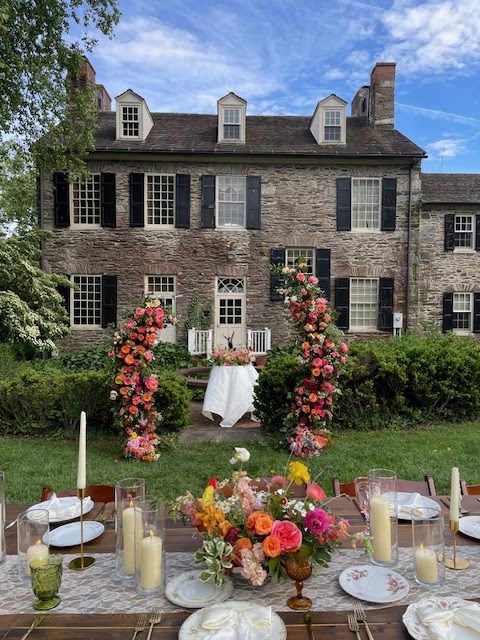
You take Gamber Road west out of Finksburg, past the last gas station and the feed store with its faded red paint, and the landscape opens. The road narrows. Fields stretch out on both sides, bordered by split-rail fences that have weathered to silver. Then the stone pillars appear at the entrance to Cold Saturday Farm, and you turn onto the long drive that winds past horse paddocks and through a grove of century-old sweet gum trees. The Manor House comes into view first — a Colonial stone mansion from 1765, its ivy-covered walls the color of aged honey, its shutters painted forest green. It sits on the National Registry of Historic Places, and you can feel the weight of that history the moment you step onto the property. Beyond the Manor, the land unfolds: rolling hills dotted with granite outcroppings, the hand-built cedar gazebo on The Green, the covered bridge arching over Beaver Run creek, and in the distance, the tented pavilion at The Overlook where the sun sets behind a canopy of sycamores. This is not a venue that has been built recently to look historic. This is 60 acres of actual Maryland farming history, preserved and reimagined into one of the most versatile wedding properties in Carroll County. Poppy has designed Cold Saturday Farm wedding flowers for 4 celebrations here, and each time we make that drive up from Baltimore, we are reminded why couples fall for this place — it is genuine, layered, and utterly beautiful.
About Cold Saturday Farm
Cold Saturday Farm sits on 60 acres of rolling countryside in Finksburg, Maryland, roughly 30 minutes northwest of Baltimore and an hour from Washington, D.C. The property has been in continuous agricultural use since the mid-18th century, and that farming heritage is not decorative window dressing — it is the foundation of everything here. The centerpiece is the Manor House, built in 1765 from local fieldstone with hand-hewn timber beams and original wide-plank floors. While the Manor remains a private residence (you will not be hosting dinner inside), its exterior provides one of the most photographed backdrops in the Mid-Atlantic. The ivy-strewn stone walls, the arched gate with its iron hardware, and the circular brick terrace are all accessible for ceremonies and portraits, and they lend a gravitas that newly constructed “historic-style” venues cannot replicate.
The farm’s event spaces were developed thoughtfully over the past decade, each one repurposing an existing agricultural structure or landscape feature. The Overlook, the property’s most requested venue, is a 4,000-square-foot tented structure positioned on the highest point of the property with panoramic views across horse fields, granite outcroppings, and the covered bridge over Beaver Run. The Courtyard occupies what was once a horse ring, now enclosed by the original fieldstone wall and anchored by four modern glass garage doors that open into a renovated interior with polished concrete floors and white walls. The Orchard Barn, built in 2012 using reclaimed Amish farm cedar, sits on the site of the original orchard and features exposed timber beams, iron chandeliers, and floor-to-ceiling barn doors that frame views of Beaver Run creek. And The Green — a full acre of manicured lawn between the Manor House and the hand-built gazebo — serves as the primary ceremony site, complete with wildflower gardens, market lights strung overhead, and a stone wall that dates back to the property’s earliest days.
Logistically, Cold Saturday Farm is well-positioned for Baltimore-area weddings. The drive from our Poppy studio is straightforward, and the venue provides ample load-in access with vendor entry starting at 9:00 a.m. on event days. The property includes parking for guest vehicles across its 60 acres, and while the rural location means you will not have Uber drivers circling the block, most couples arrange shuttle service from nearby hotels or encourage carpooling. The venue requires licensed and insured caterers (no drop-off service or family-prepared food), but florists are not restricted to an approved list, which gives us the flexibility to design without constraints. Cold Saturday Farm’s events team is communicative and organized, which makes coordination seamless — they understand that floral installations require time and care, and they work with us to ensure we have the access we need when we need up it.
Event Spaces & Floral Opportunities
The Overlook (Tented)
Capacity: 250 seated
Setting: The Overlook is positioned at the highest elevation on the property, offering what are genuinely the best views at Cold Saturday Farm. The 4,000-square-foot tented structure is open-sided during warm months and can be enclosed with clear sidewalls for spring or fall events. The tent’s interior features white fabric ceiling draping, and a brick walkway connects it to the Manor House terrace. From your seat at dinner, you can see across horse paddocks to the covered bridge, out over the rolling hills, and down toward Beaver Run creek winding through the meadow. At sunset, the light filters through the sycamore trees on the western edge of the property and turns everything amber and gold. The tent sits on a raised platform, which means no muddy shoes or uneven ground, and the venue provides sixty-inch white round tables and 250 white padded folding chairs as part of the rental.
Floral approach: The Overlook’s open-air structure and sweeping views call for florals that enhance rather than compete with the natural landscape. We favor low, lush centerpieces — no more than ten inches tall — that allow guests to see across the table and out toward the hills. Think mounded garden roses (Patience, Juliet, and Keira for texture), seasonal dahlias (Cafe au Lait, Peaches and Cream), spray roses (Bombastic, Mimi Eden), and textural foliage like eucalyptus, Italian ruscus, and trailing jasmine vine arranged in aged terracotta compotes or low wooden boxes that echo the farm’s agricultural roots. For the tent poles, we love running smilax garlands with clusters of blooms tucked in at intervals — nothing so dense that it blocks sightlines, but enough to soften the structure and create a sense of enclosure within the open tent. The brick walkway leading from the Manor House to the tent is an ideal spot for a pair of large-scale urns overflowing with seasonal branches (flowering dogwood in spring, oak and maple in fall) and statement blooms. If your reception is at The Overlook, consider a low floral runner down the center of the head table — a continuous installation of roses, ranunculus, and greenery interspersed with candles in varying heights. Cold Saturday Farm wedding flowers in this space should feel organic and abundant, as if they grew up through the floorboards.
The Courtyard
Capacity: 100 seated
Setting: The Courtyard is Cold Saturday Farm’s most architecturally striking space, and also its most versatile. It occupies what was once a horse ring, surrounded by the original fieldstone wall that dates back over a century. Above, a canopy of mature spruce pines provides natural shade, and market lights are strung overhead for evening ambiance. Along one side, four large glass garage doors open into a modern interior with white walls, polished concrete floors, and industrial-chic lighting — a deliberate contrast to the rustic fieldstone exterior. The venue provides brown rectangular farm tables and 100 matching chairs, which lean into the rustic aesthetic rather than fighting it. The result is a space that can swing romantic-rustic or modern-organic depending on how you dress it, and the indoor-outdoor flow means you are not at the mercy of weather.
Floral approach: The Courtyard’s fieldstone wall is the star here, and we treat it as a canvas. For ceremonies held in this space, we love installing a substantial floral piece directly against the stone — either a full asymmetrical arch that follows the natural curve of the wall, or a large-scale ground installation that appears to cascade down from the top of the wall. Use blooms with depth and texture: garden roses in dusty mauve and peach (Quicksand, Toffee, Romantic Antike), hellebores, ranunculus, tweedia, scabiosa, and plenty of trailing elements like Italian ruscus, silver dollar eucalyptus, and jasmine vine. For receptions, the brown farm tables call for organic, low-slung runners rather than traditional centerpieces. Imagine a continuous garland running the length of each table with clusters of roses, dahlias, and foliage punctuated by pillar candles in glass hurricanes. The market lights overhead cast a warm glow that makes peach, cream, and blush tones absolutely glow at twilight. If you are using the modern interior space, consider a stark contrast: clean, architectural arrangements in white ceramic or concrete vessels with monochromatic palettes — white anemones, white ranunculus, white garden roses, and dark green foliage. The glass garage doors can be flanked with tall arrangements on iron stands, creating a visual threshold between the rustic courtyard and the modern interior.
The Orchard Barn
Capacity: 75 seated
Setting: The Orchard Barn is the most intimate of Cold Saturday Farm’s reception spaces, and also the most traditionally rustic. Built in 2012 using reclaimed cedar from an Amish farm, the barn features honey-toned cedar flooring, a soaring gable roof with exposed timber beams, and multiple iron chandeliers that hang from the ceiling like sculpture. The barn sits on elevated ground, and its stacked windows overlook Beaver Run creek and the surrounding fields. Floor-to-ceiling barn doors on both ends of the structure can be thrown open to create cross-breezes in summer or closed for warmth in cooler months. The elevated alleys along the sides of the barn provide built-in display areas for decor, and the overall effect is cozy, warm, and undeniably romantic — especially when those iron chandeliers are glowing at dusk.
Floral approach: The Orchard Barn’s cedar tones and iron chandeliers are best complemented by florals with warmth and richness. We favor palettes that lean toward burnt orange, deep burgundy, rust, and gold, with touches of blush and cream to keep things from feeling too heavy. Think dahlias (Labyrinth, Jowey Winnie, Cornel Bronze), garden roses in toffee and cappuccino tones, chocolate cosmos, hanging amaranthus, and textural foliage like oak leaves, magnolia, and seeded eucalyptus. The iron chandeliers are a natural focal point, and we love suspending floral installations from them — either delicate greenery garlands woven through the ironwork or more dramatic suspended arrangements that hang below the chandelier like a floral chandelier of their own. For ceremonies or cocktail hours in this space, position a low floral installation at the base of the barn doors, framing the view beyond. For seated dinners, use a mix of low compote arrangements and taper candles in brass or bronze holders to create layers of light and texture on the tables. The elevated alleys are ideal for displaying larger installations — consider a series of bud vases in varying heights with single-stem blooms, or a collection of vintage brass vessels filled with seasonal branches and trailing vines.
The Green
Capacity: 250 seated (ceremony configuration)
Setting: The Green is where most Cold Saturday Farm ceremonies take place, and it is easy to see why. This one-acre expanse of manicured lawn sits between the historic Manor House and the hand-built cedar gazebo, flanked by wildflower gardens, a centuries-old ivy-strewn stone wall with an arched gate, and the circular brick terrace that wraps around the Manor’s exterior. Market lights are strung overhead, creating a canopy of light for evening events, and the surrounding landscape includes mature maples, sweet gum trees, hemlock, and seasonal blooms like pink magnolia in spring and ornamental grasses in fall. The gazebo itself is simple and beautifully constructed, with natural cedar that has weathered to a soft silver-gray. Behind it, the wildflower garden shifts with the seasons — Queen Anne’s lace and black-eyed Susans in summer, asters and goldenrod in fall. The view beyond includes rolling pastures, granite outcroppings, and an untainted night sky if your celebration extends past sunset.
Floral approach: The gazebo is the natural focal point here, and we have two schools of thought on how to approach it. The first is to treat it as a frame and keep florals minimal — a pair of low arrangements flanking the base of the structure, or a simple garland swag across the back beam with trailing vines and a few statement blooms. This approach honors the gazebo’s architecture and allows the wildflower garden behind it to do the talking. The second approach is to fully embrace the gazebo as your ceremony altar and build a substantial floral installation around it — an asymmetrical arch that wraps one side of the structure, or a ground-based installation that appears to grow up from the base and spill across the cedar beams. For this approach, use blooms that echo the wildflower garden: garden roses, zinnias, dahlias, Queen Anne’s lace, scabiosa, tweedia, and plenty of organic, untamed foliage. The stone wall with its arched gate is another opportunity — we love installing a floral swag across the top of the arch, or flanking the gate with a pair of large urns overflowing with seasonal branches and blooms. For aisle markers, consider low clusters of florals in galvanized buckets or wooden boxes placed every few rows, or simple shepherd’s hooks with hanging arrangements that sway gently in the breeze. The Manor House’s brick terrace is ideal for cocktail hour arrangements — small bud vases on high-top tables, or a statement urn installation on the terrace steps.
Wedding Flower Ideas for Cold Saturday Farm
Heritage Garden
This palette draws directly from the property’s Colonial history and wildflower gardens, using blooms that would have been grown in 18th-century Maryland farmsteads. Soft peach and blush garden roses (Juliet, Patience, Romantic Antike), ivory spray roses (Mimi Eden), white lisianthus, dusty pink astilbe, and Queen Anne’s lace form the foundation, accented by seasonal wildflowers like scabiosa, tweedia, and sweet peas. Foliage includes silver dollar eucalyptus, seeded eucalyptus, Italian ruscus, and trailing jasmine vine. Vessels are aged terracotta, weathered wooden boxes, and hand-thrown ceramic compotes in cream and soft gray. This palette works beautifully in every space — the organic, garden-style arrangements feel at home against the fieldstone walls of The Courtyard, the cedar tones of the Orchard Barn, and the wildflower backdrop at The Green. It is especially stunning in spring when the property’s pink magnolias are in bloom, creating a cohesive color story across the entire landscape.
Meadow & Stone
A palette inspired by the farm’s natural landscape — the fieldstone walls, the granite outcroppings, the meadows along Beaver Run. We use blooms in tones of rust, burnt orange, amber, and gold, grounded by deep burgundy and accented with soft cream. Dahlias (Labyrinth, Cafe au Lait, Jowey Winnie), garden roses in toffee and cappuccino tones (Toffee, Quicksand, Sahara), chocolate cosmos, ranunculus in burnt orange, hanging amaranthus, and marigolds provide the warmth, while cream lisianthus and white Japanese anemones offer contrast. Foliage includes oak leaves, magnolia branches, seeded eucalyptus, and bear grass for movement. Vessels are bronze compotes, aged brass urns, and natural wood pedestals. This palette is particularly striking in The Overlook at sunset when the amber light echoes the floral tones, and in the Orchard Barn where the cedar and iron chandeliers provide the perfect backdrop. It is also our go-to recommendation for fall weddings when the property’s century-old sweet gum trees turn orange and gold.
Modern Pastoral
For couples drawn to Cold Saturday Farm’s historic bones but with a contemporary aesthetic, this concept balances clean lines with organic abundance. The palette is deliberately restrained — white, cream, soft green, and charcoal — but the arrangements are lush and textural. White garden roses (Patience, Polo), white ranunculus, anemones, hellebores, white lisianthus, and cream spray roses are combined with an abundance of foliage: eucalyptus in multiple varieties (silver dollar, seeded, baby blue), Italian ruscus, olive branches, and trailing jasmine. Vessels are modern and minimal: white ceramic cylinders, concrete compotes, and clear glass in geometric shapes. The result is sophisticated and fresh, with enough organic movement to feel appropriate in a pastoral setting. This palette shines in The Courtyard, particularly in the modern interior space where the white walls and polished concrete provide a gallery-like backdrop. Use it for clean, low centerpieces on the brown farm tables, and let the market lights overhead provide the warmth.
Seasonal Considerations
Cold Saturday Farm’s location in Carroll County, Maryland, means the property experiences four distinct seasons, each with its own character and challenges.
Spring (April–May) arrives tentatively in Finksburg, with temperatures ranging from the 50s to the 70s and the ever-present possibility of rain. The property comes alive with pink magnolia blooms, budding trees, and the first flush of green in the meadows. Early spring flowers like tulips, hyacinths, ranunculus, anemones, and hellebores are abundant and affordable. By May, peonies begin their brief but glorious season, and local flowering branches — dogwood, cherry, and quince — are available for larger installations. The Green is particularly stunning in spring when the wildflower gardens are just beginning to show color. The primary consideration is weather contingency: Cold Saturday Farm has indoor backup options for all outdoor spaces, but if you are planning a ceremony at The Green, discuss timing with your planner and have a clear rain plan. Spring in Maryland can be unpredictable, with warm sunshine one moment and a thunderstorm the next. April and May are ideal for couples who love soft, romantic palettes and do not mind taking a slight weather gamble.
Summer (June–August) brings heat and humidity, with temperatures regularly climbing into the 90s. The property is lush and green, the wildflower gardens are at their peak, and evening light lasts until nearly 9:00 p.m. Summer blooms are abundant and often more affordable: zinnias, sunflowers, dahlias (in their first flush), lisianthus, scabiosa, and Queen Anne’s lace are all available from local growers. The challenge is heat tolerance — both for flowers and for guests. We recommend avoiding delicate blooms like garden roses and ranunculus for outdoor ceremonies or cocktail hours in July and August, as they will wilt quickly in direct sun and high temperatures. Instead, lean into heat-tolerant flowers like dahlias, zinnias, celosia, and lisianthus. For events at The Overlook or The Green, consider scheduling your ceremony for late afternoon when temperatures begin to drop, and ensure there is ample shade (the spruce pines at The Courtyard provide natural cover). Summer is ideal for couples who want a lush, abundant, garden-style wedding and are comfortable with warm weather.
Fall (September–November) is peak wedding season at Cold Saturday Farm, and for good reason. Temperatures are mild (60s to 70s in September, 50s to 60s in October), the humidity drops, and the property’s century-old sweet gum trees turn brilliant shades of orange and yellow. Fall is dahlia season — these blooms are at their absolute peak from September through the first hard frost, offering an astonishing range of colors, shapes, and sizes. Other seasonal favorites include garden roses (which thrive in cooler temperatures), marigolds, chocolate cosmos, hanging amaranthus, and seasonal foliage like oak leaves and maple branches. The natural fall color on the property is so abundant that you may want to scale back on floral installations and let the landscape do the work. September and October are the most requested months, so book early. November can be beautiful but unpredictable — some years it is mild and golden, other years it is cold and rainy. Fall is ideal for couples who love rich, warm color palettes and want the most forgiving weather conditions.
Winter (December–February) is the quietest season at Cold Saturday Farm, and also the most affordable. Temperatures range from the 30s to the 50s, and while snow is possible, it is not guaranteed. The property takes on a stark, elegant beauty in winter — bare branches, dormant fields, and that particular quality of gray light that makes everything feel contemplative. Winter blooms are more limited and often more expensive: amaryllis, anemones, ranunculus, hellebores, tulips (imported), evergreens, and seasonal branches like magnolia, holly, and pine. We recommend leaning into the season rather than fighting it — think evergreen garlands, white and cream blooms, candlelight, and rich jewel tones like burgundy, navy, and forest green. The Orchard Barn and The Courtyard (with its indoor option) are ideal for winter weddings, as they provide warmth and shelter while still offering views of the landscape. Winter is perfect for couples who want an intimate, cozy celebration and are comfortable with cooler temperatures.
Poppy’s Expert Take
The gazebo does not need an arch. The cedar gazebo at The Green is beautifully constructed and already functions as an architectural frame for your ceremony. Adding a separate floral arch in front of it often creates visual competition and blocks the structure you are paying to use. Instead, consider a ground-based installation at the base of the gazebo that appears to grow organically from the earth, or a simple garland swag across the back beam with trailing vines. If you absolutely want an arch, place it several feet in front of the gazebo so the two structures are visually distinct, or skip the gazebo entirely and position your arch elsewhere on The Green with the Manor House as your backdrop.
The Courtyard’s market lights are magic after 7:00 p.m. If you are hosting cocktail hour or dinner in The Courtyard, time your event to take advantage of the market lights at twilight. The warm glow they cast transforms the space and makes peach, blush, and cream florals absolutely luminous. We have seen couples schedule their ceremony at The Green for 5:30 p.m., move guests to The Courtyard for cocktails at 6:30 p.m., and by 7:30 p.m. when dinner begins, the lights have worked their magic. The fieldstone walls also reflect candlelight beautifully, so do not skimp on candles — lots of pillar candles in glass hurricanes on the tables and along the stone wall will amplify the glow.
Tables and chairs cannot be swapped between venues. Cold Saturday Farm provides sixty-inch white round tables and white padded folding chairs for The Overlook, and brown rectangular farm tables with matching brown chairs for The Courtyard. These sets are venue-specific and cannot be mixed or moved. If you want a different look — say, mahogany Chiavari chairs or long farm tables at The Overlook — you will need to rent them separately. This matters for floral design because the table shape and color influence our vessel and arrangement choices. Round tables look best with centered arrangements in round or square vessels; long farm tables are ideal for runners or a series of small arrangements down the center.
Load-in at The Overlook requires coordination. The Overlook sits at the highest point on the property, accessed by a brick walkway from the Manor House. While there is vehicle access for setup, the pathway is narrow and shared with other vendors (caterers, rental companies, lighting). We typically arrive early on the day of the event to claim our load-in window and stage our materials before the walkway becomes congested. If you are having a complex floral installation at The Overlook — say, a head table runner and twenty centerpieces — build in extra setup time and communicate with your planner about vendor scheduling. The last thing you want is for your florist to be stuck waiting while the rental company unloads chairs.
Repurpose ceremony florals strategically. Because The Green is the primary ceremony site and most receptions are held at The Overlook or The Courtyard (both a short walk away), repurposing ceremony florals for the reception is logistically straightforward. Urns flanking the gazebo can be moved to the entrance of your reception tent. Low arrangements on the Manor House terrace can be redistributed to cocktail tables. However, timing is key — the transition typically happens during cocktail hour, which means your florist or a designated helper needs to be available to move pieces. If you are using a ground-based installation or an arch at the gazebo, those are not easily moved, so plan accordingly.
Work with the wildflower gardens, not against them. The wildflower gardens at The Green shift with the seasons, and their colors will influence how your florals read in photographs. In summer, you will have yellows, whites, and purples from Queen Anne’s lace, black-eyed Susans, and wild asters. In fall, goldenrod and ornamental grasses add golds and taupes. If your floral palette is soft pink and cream, it will provide a beautiful contrast to the yellow and purple wildflowers. If you are using yellow or gold florals, they will blend into the background. Walk the property (or review recent photos) before finalizing your palette to understand what the natural landscape will contribute.
The covered bridge is underutilized. Most couples focus their floral budget on ceremony and reception spaces, but the covered bridge over Beaver Run is one of the most photographed features on the property and it is visible from The Overlook. Consider placing a pair of arrangements at the bridge entrance, or draping a simple greenery garland along the railings. It is a small touch that makes a big impact in guest photos and creates a sense of floral continuity across the property.
What Poppy Couples Spend on Flowers Here
Based on our experience with Cold Saturday Farm wedding flowers, couples typically invest around $1,747, though budgets vary widely depending on guest count, event scope, and design complexity. Here is how that breaks down across three tiers:
$1,200–$2,000 | Ceremony & Personal Flowers
This tier covers the essentials for a beautiful, intimate wedding. You will have personal flowers for the wedding party (bridal bouquet, 2–4 bridesmaid bouquets, 3–6 boutonnieres), plus a focused ceremony installation. At The Green, this might be a pair of medium-sized urns flanking the gazebo with seasonal blooms and greenery, or a low ground-based installation at the gazebo’s base with garden roses, ranunculus, and trailing foliage. If you are using The Courtyard for your ceremony, this budget allows for a substantial floral piece against the fieldstone wall — an asymmetrical arrangement with roses, dahlias, and greenery that serves as your ceremony backdrop. This tier is ideal for micro-weddings (under 50 guests) or couples who are DIY-ing their reception florals and want professional help only with the ceremony and personal pieces.
$2,000–$3,500 | Full Ceremony & Reception Coverage
This is the sweet spot for most Cold Saturday Farm weddings. Your budget includes personal flowers for a full wedding party, a complete ceremony installation, and centerpieces for all guest tables at your reception. For a 100-guest reception at The Courtyard, you would have low, organic runners down the length of each brown farm table — continuous installations of garden roses, spray roses, seasonal dahlias, and foliage with pillar candles interspersed. For the ceremony at The Green, you would have either a substantial ground-based installation at the gazebo or a pair of large urns plus aisle markers (every third row). Add a few statement pieces