
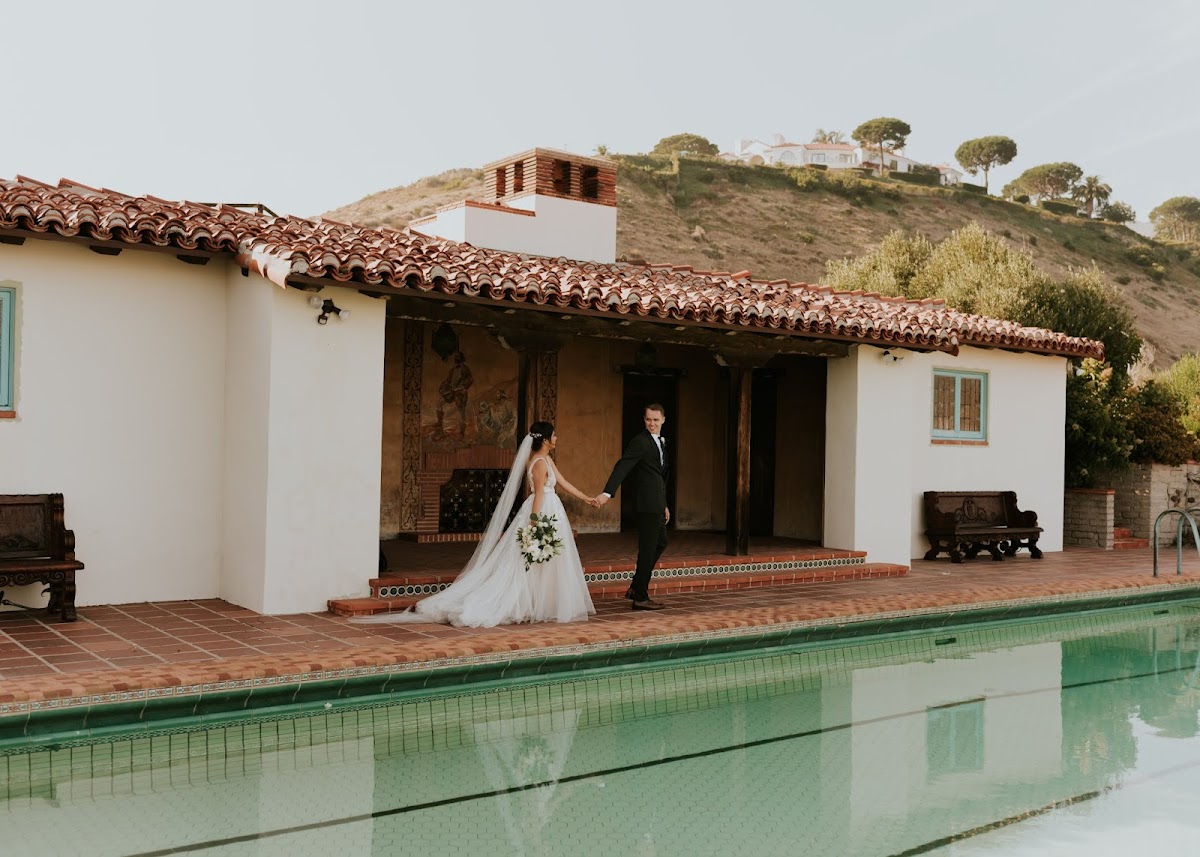
Designing flowers for the Adamson House Museum requires a balance between the venue’s dominant natural features and its whimsical architectural surprises. The presence of cascading waterfalls and mature oak canopies means your floral palette should either lean into the lush, woodland environment or provide a sharp, modern contrast to the rustic stone.
The Spaces
Waterfall Deck
This is the venue’s most dramatic ceremony spot, where a stone waterfall provides a constant rhythmic backdrop. The space is anchored by a wooden pergola that acts as a natural frame for the exchange of vows.
- What works: Asymmetrical floral growth climbing the pergola pillars or a full hanging installation to draw the eye upward. Flanking ground-level “nests” work well to frame the couple without blocking the waterfall.
- Skip: Heavy, solid floral walls that obscure the texture of the natural stone and the movement of the water.
- Watch out: The mist from the waterfall can create a high-humidity microclimate; ensure your florist uses water-resistant tape and mechanics for any installations near the base.
- Budget hero move: Focus all ceremony funds on the pergola. A lush, overhead floral “cloud” creates a high-impact focal point that requires fewer stems than a ground-to-ceiling installation.
The Pavilion
A nature-centered space nestled beneath a massive California Oak. This area feels like a private forest clearing, complete with the sound of a multi-level pond nearby.
- What works: Organic, garden-style arrangements that look like they grew out of the landscape. Use the low-hanging branches of the oak for hanging glass orbs or delicate floral accents.
- Skip: Overly structured, geometric centerpieces that feel out of place in such a wild, natural setting.
- Watch out: The canopy provides significant shade, which is great for flower longevity but can make dark floral colors (like deep burgundy) disappear in photos.
- Budget hero move: Use the existing oak tree as your “structure” instead of renting a heavy arch. A few well-placed floral clusters on the trunk or low branches can be just as effective.
The Oak Room
This space bridges the gap between rustic charm and upscale sophistication, featuring exposed wood beams and a sweeping deck that catches the Malibu sunset.
- What works: Long, low greenery runners for the indoor wooden beams and statement mantle pieces for the flagstone fireplace.
- Skip: Tall, spindly centerpieces that compete with the low-slung rustic ceilings.
- Watch out: The transition from the bright outdoor deck to the darker indoor space requires a floral palette that looks consistent in both lighting conditions.
The Grounds
The grounds are expansive and feature unique elements like a carousel and a Ferris wheel, creating a whimsical, carnival-like atmosphere.
- What works: Whimsical, airy floral “meadows” placed at the base of the vintage structures. Bright, punchy colors work well here to match the playful energy.
- Skip: Formal, tight rose spheres or anything too “stiff.”
- Watch out: This is an open-sky environment with zero shade; flowers must be hardy varieties like carnations, orchids, or thick-petaled roses to survive the Malibu sun.
What Works at Adamson House Museum
- Moisture-resistant mechanics. Given the proximity to waterfalls and the potential for canyon mist, use floral cages and foam only where necessary, and prioritize hardy stems for ground-level work.
- Verticality on the decks. The pergolas are the strongest architectural assets; use them to create height and drama without taking up valuable floor space on the decks.
- Textural greenery. Incorporating ferns, smilax, and eucalyptus mirrors the surrounding Malibu Canyon vegetation and helps the arrangements feel integrated rather than “placed.”
- Narrow-profile aisle markers. The garden paths can be relatively narrow; keep aisle florals tight to the chairs to ensure guest flow isn’t obstructed.
- Neutral stone palettes. White, cream, and sage green look exceptionally sophisticated against the venue’s pervasive flagstone and wood textures.
Budget Guide
| Tier | Estimate | Floral Scope |
|---|---|---|
| Essentials | $1,750 - $4,000 | Personal flowers (bouquets/boutonnieres) and high-impact ceremony focal points on the Waterfall Deck pergola. |
| Sweet Spot | $4,000 - $8,000 | Adds table centerpieces for the Pavilion or Oak Room and small accents for the stone fireplaces. |
| Full Experience | $8,000 - $15,000 | Includes hanging installations on the pergolas, lush aisle meadows, and floral enhancements for the Ferris wheel or carousel. |
| Statement | $15,000+ | Full-scale transformation including greenery crawls on all indoor beams, overhead floral clouds, and immersive garden-path installations. |
The natural beauty of the Malibu Canyon setting means you are never starting from zero; your budget should be spent on enhancing the existing anchors rather than trying to hide the venue’s character.
Tips
- Design for the mist. If you are using ground-level florals on the Waterfall Deck, ensure the containers are weighted and the mechanics can handle a constant light spray.
- Repurpose with purpose. The ceremony arrangements from the Waterfall Deck pergola can often be moved to frame the sweetheart table or the indoor fireplace for the reception.
- Scale for the Oaks. Don’t let your centerpieces get lost under the massive tree canopies; use a mix of heights to fill the visual volume.
- Lighting is a floral’s best friend. The venue’s evening ambiance is heavily dependent on artificial light; ask your florist to tuck battery-operated LEDs or fairy lights into larger installations.
- Respect the path. Keep ground installations on the garden paths under 18 inches wide to allow for comfortable guest movement and dress clearance.