
You drive Port Sheldon Street past farmland and stands of hardwoods, past the kind of modest homes that have housed the same families for generations, and then the red schoolhouse appears on your right — not announcing itself with signage or fanfare, but simply standing there the way it has since 1908, solid and purposeful. The bell tower rises from the roofline, still capped with its original weathervane. Park in the gravel lot and walk toward the entrance, and you will notice the details that survived renovation: the brick foundation, the white-trimmed windows, the way the building seems to have grown out of the Michigan soil rather than been placed on top of it. Step inside and the scent of old wood floors hits first, followed by the visual surprise of those vintage tin ceilings catching the light, and the authentic chalkboards still mounted on the walls where children once conjugated verbs and calculated fractions. Beyond the main hall, two manicured garden areas stretch beneath towering oaks and maples, their canopies so dense in summer that the dappled light creates natural spotlighting. This is not a venue pretending to be historic — it is historic, renovated with reverence, and utterly charming in the way only a century-old schoolhouse in rural Michigan can be. Poppy has received 5 inquiries for District 5 Schoolhouse wedding flowers, and while we have not yet designed a celebration here, we understand the assignment: honor the past, celebrate the present, and let the architecture speak as loudly as the blooms.
About District 5 Schoolhouse
District 5 Schoolhouse sits on Port Sheldon Street in Borculo, a blink-and-you-miss-it community in Ottawa County just north of Zeeland proper. This is the kind of rural Michigan setting where the landscape is agricultural, the roads are two-lane, and the nearest city — Grand Rapids — feels comfortably distant at 25 minutes away. Lake Michigan is ten minutes west. Downtown Holland is fifteen minutes south. The location offers the rare combination of genuine countryside seclusion with metropolitan accessibility, which means your guests from Detroit or Chicago will not feel like they have driven to the edge of the earth, but they will absolutely feel like they have left the suburbs behind.
The building itself dates to 1908, constructed as an actual one-room schoolhouse to serve the farming families of District 5. It functioned as a school for decades before being decommissioned, and in 2015, it was purchased and painstakingly renovated into a wedding and events venue. The renovation preserved the elements that mattered — those original wooden floors, worn smooth by generations of children’s feet; the pressed tin ceilings with their intricate floral patterns; the chalkboards that still bear faint traces of lessons taught a century ago; and the bell tower, which remains accessible for adventurous couples willing to make the climb for photos. Modern amenities were added thoughtfully: climate control, updated restrooms, a commercial kitchen prep area, and private getting-ready suites for both the bride and groom. The result is a venue that feels authentically historic without the mustiness or limitations that often plague old buildings.
The property encompasses not just the schoolhouse itself but also the surrounding grounds, which include two large ceremony garden areas, two outdoor decks for cocktails or lounge seating, and a bonfire pit area with lawn games. The landscaping is manicured but not fussy — think Michigan cottage garden rather than formal estate. Mature trees provide natural shade and a verdant backdrop, and the gardens are planted with perennials that bloom in succession from late spring through early fall.
One of the venue’s most practical offerings is the “Pay It Forward Decoration Closet” — an extensive collection of donated wedding décor that couples can borrow at no charge. This includes everything from vintage bottles and candle holders to fabric draping and signage. For florists, this means couples often arrive with a base layer of décor already planned, and our job is to elevate that foundation with fresh, organic elements that cannot be borrowed or stored: the peonies, the garden roses, the foraged branches, the living greenery that makes a space feel abundant and current.
Logistically, District 5 Schoolhouse offers florists the kind of access we appreciate. There is ample parking for vendor load-in, a walk-in cooler on-site for storing arrangements, and an on-site coordinator who manages the timeline and vendor flow. The venue provides exclusive use for the entire day, which means no rushed setups or overlapping events. Setup typically begins mid-morning, and we have the run of the space until the couple’s contracted end time. The drive from Poppy’s Grand Rapids studio takes about 30 minutes via I-196 and US-31, a straightforward route that allows us to transport even large installations without concern.
Event Spaces & Floral Opportunities
Main Reception Hall
Capacity: 200 seated
Setting: The Main Reception Hall is where the schoolhouse reveals its full historic character. The original wooden floors — wide planks of honey-toned oak, beautifully aged and refinished — stretch the length of the room. Above, the vintage tin ceilings display their embossed floral patterns, painted in soft white that reflects the string lights draped across them in crisscrossing lines. The chalkboards are mounted on two walls, and couples often use them for seating charts, timelines, or hand-lettered vows. The room is rectangular, with windows on three sides that let in generous natural light during daytime events. Tables, chairs, and linens are included in the venue rental, and the neutral cream linens provide a clean canvas for any color palette. The space is climate-controlled, which means it functions equally well for a January wedding or an August reception.
Floral approach: This is a room that rewards restraint as much as abundance. The tin ceilings are already a decorative element — adding too much overhead installation risks visual clutter. Instead, consider a single dramatic suspended piece above the head table or dance floor: a cloud-like installation of smilax, Italian ruscus, and plumosa fern punctuated with Quicksand and Sahara garden roses, trailing jasmine vine, and clusters of white ranunculus. For guest tables, low centerpieces work best to maintain conversation flow and sightlines. We favor compote-style arrangements in aged brass or matte ceramic vessels — think Café au Lait dahlias, Juliet garden roses, white lisianthus, blush astilbe, and silver dollar eucalyptus mounded just eight to ten inches high. The chalkboards present a unique opportunity: frame them with garlands of seeded eucalyptus and dusty miller, or place small bud vases with single stems (hellebores, anemones, or scabiosa) along the chalk ledges. The wood floors are beautiful enough to go bare, but if the couple desires an aisle runner for the indoor ceremony option, flank it with hurricane lanterns and loose petals rather than standing arrangements. The goal is to let the architecture be the star and use flowers as punctuation rather than paragraphs.
Outdoor Ceremony Area
Capacity: 200 seated
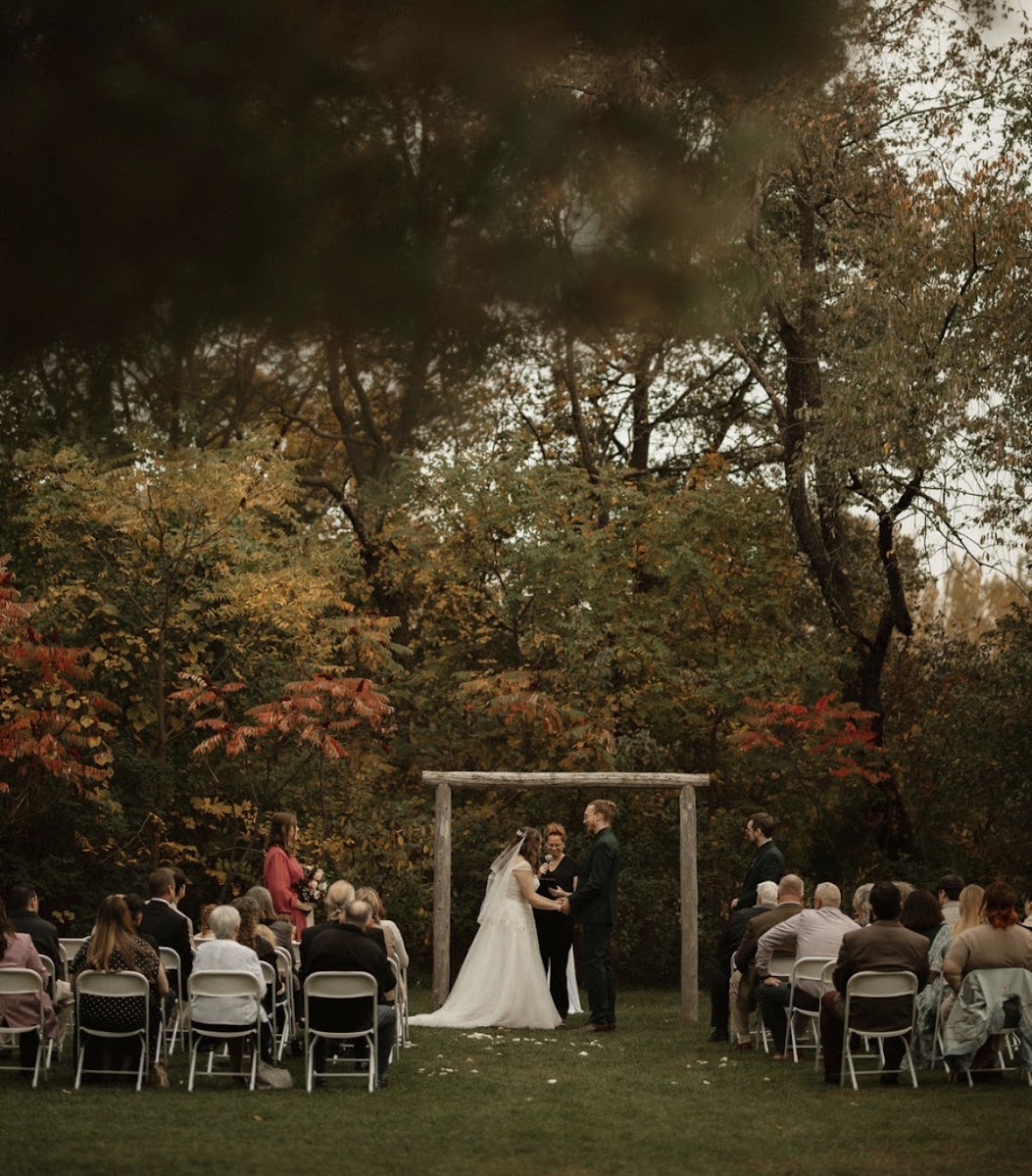
Setting: District 5 Schoolhouse offers two distinct outdoor garden areas for ceremonies, both framed by mature trees and lush perennial borders. The primary ceremony site features a venue-provided wooden arbor that serves as the focal point, positioned against a backdrop of towering oaks and maples. The lawn is level and well-maintained, with seating arranged in rows facing the arbor. The second garden area offers a slightly more intimate feel with additional shade, making it ideal for summer ceremonies when heat is a concern. Both spaces are surrounded by the kind of naturalistic plantings that feel cottage-garden inspired — daylilies, hostas, hydrangea bushes, ornamental grasses — which means the built-in greenery is already substantial.
Floral approach: The venue’s wooden arbor is the obvious canvas for floral design, but the approach should complement rather than obscure the natural surroundings. We recommend asymmetrical garland-style installations that follow the arbor’s lines — starting lush on one side with a cluster of blooms and trailing down the opposite side with greenery and smaller accent flowers. For a late summer wedding, imagine a base of Italian ruscus and seeded eucalyptus draped across the top beam, with a dense corner installation of Café au Lait and Penhill dahlias, peach-toned Juliet and Keira garden roses, white lisianthus, and apricot stock, tapering into wispy ferns and jasmine vine. For spring ceremonies, substitute peonies (Sarah Bernhardt, Shirley Temple), white tulips, hellebores, and flowering branches (dogwood, cherry, or crabapple). Aisle markers can be simple — shepherd’s hooks with hanging lanterns and greenery cuffs, or low arrangements in vintage metal buckets placed every third row. The goal is to create a ceremony focal point that honors the garden setting without competing with those magnificent trees. Avoid overly formal, symmetrical designs — this venue calls for organic, slightly wild installations that look like they could have grown there.
Bridal Lounge
Setting: The Bridal Lounge is a private suite within the schoolhouse designated for the bride and bridal party to get ready. It includes styling stations, mirrors, seating, and space for hair and makeup artists to work comfortably. The décor is simple and feminine, with good natural light from windows. After the ceremony begins, this space converts to additional mingling or lounge space for guests.
Floral approach: While this is primarily a functional getting-ready space, a small floral installation makes a significant difference in both ambiance and photography. Place a low, lush arrangement on the central styling table — something the bride will see in her getting-ready photos. Use a vintage ceramic or milk glass vessel filled with soft, romantic blooms: blush Keira roses, white ranunculus, dusty pink sweet peas, and trailing jasmine or passion vine. Keep it low (under ten inches) so it does not interfere with makeup application or champagne toasts, but full enough to feel abundant. A secondary option is to create a small installation near the mirror or window where detail shots (dress, shoes, jewelry) will be photographed — a bud vase trio with single stems or a small wreath of eucalyptus and spray roses hung on the mirror. This is not the place for a major floral investment, but a $75–$150 arrangement here elevates the entire getting-ready experience and provides beautiful photo content.
Grooms Lounge
Setting: The Grooms Lounge is the masculine counterpart to the Bridal Lounge, offering the groom and groomsmen a private space to prepare. It includes seating, games, and activities, with a more casual, laid-back vibe. Like the Bridal Lounge, this space converts to additional guest space after the ceremony.
Floral approach: Florals in the Grooms Lounge should feel intentional but understated. A single arrangement on the bar or central table is sufficient — consider a low vessel (dark ceramic, aged bronze, or even a vintage toolbox) filled with textural, architectural elements rather than soft romantic blooms. Think scabiosa pods, eryngium, burgundy hypericum berries, deep plum carnations (yes, carnations, the modern varieties are excellent), and dark foliage like leather leaf or eucalyptus in charcoal tones. Alternatively, skip flowers entirely and opt for a potted succulent arrangement or a cluster of pillar candles surrounded by loose eucalyptus. The goal is subtle sophistication that does not read as traditionally “wedding flowers” but still provides a finished, considered look for photos.
Two Outdoor Decks
Setting: The schoolhouse features two outdoor deck areas extending from the main building, furnished with seating and tables. These spaces are ideal for cocktail hour, lounge areas, or simply providing guests with an outdoor option for mingling and enjoying the countryside air. The decks overlook the gardens and bonfire area.
Floral approach: Deck spaces benefit from floral accents that feel casual and organic. Garland installations along the railings — smilax, seeded eucalyptus, or Italian ruscus interspersed with seasonal blooms — create visual connection between the indoor and outdoor spaces. For cocktail tables, consider small potted arrangements (lavender plants, rosemary topiaries, or potted succulents that guests can take home as favors) rather than cut arrangements, which can wilt quickly in Michigan summer heat. If the decks are used for cocktail hour, place one larger arrangement on the bar — something tall enough to be visible from across the deck, in a substantial urn or galvanized bucket. The aesthetic here should feel relaxed and garden-party inspired, not formal.
Bonfire Area with Outdoor Games
Setting: A dedicated bonfire pit surrounded by lawn games and casual seating provides evening entertainment and a rustic, informal gathering spot. This area is separate from the main building and ceremony gardens, offering a campfire-style experience for late-night s’mores and conversation.
Floral approach: Minimal to none. The bonfire area is intentionally casual, and florals would feel out of place. If the couple wants to add visual interest, suggest lanterns, potted ferns, or galvanized buckets filled with birch branches rather than cut flowers. This is a space where the fire, the stars, and the Michigan night air do the work.
Wedding Flower Ideas for District 5 Schoolhouse
Schoolhouse Garden Romance
This concept honors both the historic architecture and the lush garden setting with a palette that feels soft, nostalgic, and abundantly romantic. Imagine the kind of flowers a 1908 schoolteacher might have gathered from her own garden: old-fashioned garden roses in blush and peach (Juliet, Keira, Patience), peonies in shades of pale pink and cream (Sarah Bernhardt, Duchesse de Nemours), delicate sweet peas in lavender and white, white lisianthus, blush ranunculus, and astilbe in soft pink. Foliage includes seeded eucalyptus, dusty miller, silver dollar eucalyptus, and jasmine vine for trailing texture. Vessels are vintage-inspired: milk glass compotes, weathered ceramic crocks, antique brass candlesticks repurposed as bud vases, and galvanized watering cans for larger installations. This palette works beautifully in the Main Reception Hall, where the soft colors complement the warm wood and white tin ceilings, and in the Outdoor Ceremony Area, where the romantic blooms echo the cottage-garden plantings. The overall effect is timeless, feminine, and effortlessly elegant — the kind of flowers that feel like they have always belonged in this space.
Harvest Homecoming
Lean into the rural Michigan setting and the schoolhouse’s agricultural roots with a palette inspired by autumn harvest and farmland abundance. Deep, saturated colors dominate: burnt orange dahlias (Labyrinth, Karma Fuchsiana), burgundy calla lilies, plum-toned scabiosa, golden yellow sunflowers (the smaller, multi-headed varieties like Sunrich Gold), rust-colored chrysanthemums, and burgundy amaranthus for trailing texture. Foliage includes seeded eucalyptus, oak leaves, wheat stalks, and millet. Accent elements like mini pumpkins, gourds, and crabapples can be incorporated into larger arrangements. Vessels are rustic and substantial: wooden crates, galvanized buckets, vintage enamelware, and woven baskets lined with plastic. This concept is ideal for September and October weddings and works particularly well on the Outdoor Decks and in the Bonfire Area, where the rustic aesthetic feels contextually perfect. The arbor installation for an outdoor ceremony could incorporate dried corn husks, wheat bundles, and clusters of harvest blooms for a statement piece that celebrates Michigan’s agricultural heritage. This is not a subtle palette — it is bold, warm, and unapologetically seasonal.
Modern Schoolhouse
This concept reinterprets the historic setting through a contemporary lens, using unexpected color combinations and clean-lined arrangements that contrast with the vintage architecture. The palette is sophisticated and slightly edgy: deep eggplant calla lilies, charcoal-toned scabiosa pods, white anemones with black centers, dusty mauve Quicksand roses, silver brunia, and touches of unexpected blue from tweedia or delphinium. Foliage is architectural: eucalyptus in silver and gray-green tones, ruscus, and bear grass for linear accents. Vessels are modern and minimal: matte black ceramic cylinders, geometric concrete planters, clear glass cubes, and brushed brass stands. This approach works particularly well for couples who love the schoolhouse venue but do not want an overtly rustic or romantic aesthetic. The chalkboards become an opportunity for modern calligraphy or graphic design elements, framed with minimalist greenery installations. Guest table centerpieces are low and structured rather than loose and organic. The overall effect is sophisticated, design-forward, and proof that historic venues can support contemporary aesthetics when the floral design is intentional and confident.
Seasonal Considerations
Spring (April–June)
Michigan springs are notoriously unpredictable — warm and sunny one weekend, frosty and gray the next. April weddings risk temperatures in the 40s and 50s, though May and June are generally reliable. The outdoor ceremony gardens come alive in late May and early June when the venue’s perennial plantings hit peak bloom. Spring offers the best selection of locally available tulips, daffodils, hyacinths, and flowering branches (dogwood, cherry, crabapple, quince). Peonies arrive in late May and are spectacularly abundant in June. For spring ceremonies, keep backup plans flexible — the outdoor gardens are beautiful, but the Main Reception Hall can accommodate an indoor ceremony if weather turns. Spring palettes should lean into the season’s freshness: pastel pinks, soft yellows, creamy whites, and the pale greens of new growth. Avoid flowers that wilt quickly in cooler temperatures; ranunculus and anemones are more cold-tolerant than roses or dahlias.
Summer (July–August)
Michigan summers are warm and humid, with July and August temperatures regularly reaching the 80s and 90s. The outdoor ceremony gardens are lush and fully leafed-out, providing excellent natural shade beneath the mature trees. This is peak wedding season at District 5 Schoolhouse, and the venue’s climate-controlled interior is a major asset for keeping florals fresh. Summer offers the widest selection of locally grown flowers: dahlias begin their season in mid-July and are spectacular through September; zinnias, cosmos, sunflowers, and celosia are abundant; and garden roses perform beautifully in the heat. For outdoor ceremonies, time them for late afternoon or early evening to avoid peak heat. Summer palettes can go bold and saturated — coral, fuchsia, golden yellow, deep purple — or stay soft and romantic with whites, blushes, and peaches. Hydrate all florals thoroughly before transport, and use the venue’s walk-in cooler generously.
Fall (September–November)
Fall is arguably the most beautiful season at District 5 Schoolhouse. The surrounding trees turn brilliant shades of red, orange, and gold, and the September and October weather is reliably gorgeous — warm days, cool nights, and that crystalline Michigan light that makes everything look better. Dahlias are at their absolute peak in September and early October. Chrysanthemums, asters, and ornamental kale become available. Fall foliage — oak leaves, maple branches, bittersweet vine — is abundant and stunning. November weddings risk colder temperatures and the possibility of early snow, though the indoor spaces are fully heated. Fall palettes should embrace the season: burnt orange, deep burgundy, mustard yellow, plum, and chocolate brown. Incorporate seasonal elements like mini pumpkins, crabapples, and wheat stalks. This is the time to go full harvest abundance.
Winter (December–March)
Winter weddings at District 5 Schoolhouse are rare but magical. The venue’s climate control and cozy interior spaces make winter celebrations entirely feasible, and the snow-covered grounds provide a picturesque backdrop for photos. Winter flower availability shifts heavily toward imported blooms: amaryllis, anemones, ranunculus, tulips (imported from the Netherlands), and evergreens. Hellebores — one of the most exquisite winter flowers — are available December through February. Winter palettes can go two directions: rich jewel tones (emerald green, ruby red, deep plum) for a holiday feel, or icy sophistication (white, silver, pale blue, champagne) for a winter wonderland aesthetic. Incorporate evergreen boughs (pine, cedar, fir), pinecones, and branches for textural interest. Candles become essential design elements, adding warmth and ambiance to shorter daylight hours.
Poppy’s Expert Take
Embrace the Pay It Forward Closet, then elevate it. District 5 Schoolhouse’s decoration closet is genuinely impressive — couples have access to lanterns, vintage bottles, fabric draping, and an array of decorative odds and ends at no charge. As a florist, see this as an advantage rather than competition. The borrowed décor provides a foundation, and our job is to add the living, organic layer that cannot be stored or borrowed. Use fresh greenery to soften the borrowed lanterns. Add low floral arrangements to complement the vintage bottles. Weave smilax garland through the fabric draping. The combination of borrowed hardgoods and fresh florals creates a layered, collected look that feels both budget-conscious and beautiful.
The chalkboards are your wildcard. Every couple wants to do something with those chalkboards — seating charts, timelines, welcome messages, hand-lettered quotes. Work with your couple’s stationer or calligrapher to coordinate the chalkboard designs, then frame them with florals that enhance rather than compete. A simple garland of seeded eucalyptus and dusty miller along the top edge of the chalkboard draws the eye without obscuring the lettering. Small bud vases placed along the chalk ledge with single stems (hellebores, anemones, scabiosa) add a three-dimensional element. Avoid placing large arrangements directly in front of chalkboards — guests need to be able to read them.
The outdoor ceremony arbor is not negotiable, so make it your centerpiece. The venue provides a wooden arbor for outdoor ceremonies, and couples are expected to use it. Do not fight it — lean into it. This arbor becomes the single most important floral installation of the ceremony, so allocate budget accordingly. An asymmetrical garland installation with a dense corner cluster and trailing greenery creates the most organic, garden-appropriate look. Symmetrical arrangements on either side of the arbor feel too formal for this venue’s casual elegance. The arbor should feel lush and abundant, as if the garden grew up around it overnight.
Plan for the walk-in cooler, but do not rely on it entirely. The venue has a walk-in cooler on-site, which is a significant asset for keeping arrangements fresh during setup and throughout the event. However, cooler space is shared with catering, beverages, and other vendors, so it fills up quickly. Arrive early for setup to secure cooler space for your most delicate blooms (peonies, garden roses, ranunculus). Hardier flowers (eucalyptus, carnations, chrysanthemums) can sit out longer. Communicate with the venue coordinator about cooler access and timing.
The tin ceilings are already doing the work overhead — do not overdo it. Those vintage tin ceilings are beautiful architectural details, and the strung lights that crisscross them create a romantic ambiance on their own. Resist the urge to add too much overhead floral installation. One statement piece above the head table or dance floor is sufficient; more than that risks visual clutter. The room’s charm comes from its authentic historic details, not from floral excess. Keep the focus at eye level and tabletop level, where guests will actually experience the flowers up close.
Logistics are straightforward, but build in buffer time. Load-in access is easy, parking is plentiful, and the venue coordinator manages vendor flow well. However, the drive from Grand Rapids or surrounding areas can add time, and the rural location means you cannot run back to the studio for forgotten items. Pack your van methodfully, bring backup mechanics (zip ties, floral wire, waterproof tape), and arrive 30 minutes earlier than you think you need to. The venue’s exclusivity means you will have the space to yourself all day, so there is no rush once you arrive — but getting there with everything you need is crucial.
Sell the seasonal Michigan aesthetic hard. District 5 Schoolhouse is located in the heart of Michigan farm country, surrounded by agricultural land and towering hardwoods. Couples who choose this venue are, consciously or not, buying into a Michigan identity. Steer them toward designs that honor that — locally grown dahlias in summer and fall, flowering branches in spring, and evergreens in winter. Avoid tropicals (orchids, anthuriums, protea) unless they are part of a very intentional modern concept. The venue’s beauty comes from its rootedness in place, and the florals should reflect that.
What Poppy Couples Spend on Flowers Here
Since Poppy has not yet completed a wedding at District 5 Schoolhouse, we are basing these estimates on our experience with similar-sized venues in the Grand Rapids market and the specific floral needs of this property. Most couples working with Poppy for a 150–200 guest celebration at a venue of this style invest between $3,800 and $8,500 on wedding flowers, depending on the level of coverage and installation complexity they desire.
$2,800 – $4,200 | The Essentials
This tier covers the foundational floral needs for a District 5 Schoolhouse wedding: bridal bouquet, four bridesmaid bouquets, five boutonnieres, two mother/grandmother corsages, and 20 guest table centerpieces in the Main Reception Hall. The outdoor ceremony arbor receives a moderate garland installation — approximately 12 feet of greenery-based garland (smilax, seeded eucalyptus, Italian ruscus) with clustered blooms at one corner (garden roses, lisianthus, spray roses, and seasonal filler). Guest table centerpieces are low and lush in compote-style vessels, using a mix of focal flowers (roses or dahlias), secondary blooms (lisianthus or stock), and textured greenery. This budget does not include installations in the getting-ready suites, deck garlands, or additional ceremony aisle markers, but it provides a beautiful foundation that covers the primary visual touchpoints. Couples in this range often supplement with décor items from the venue’s Pay It Forward Closet — lanterns, candles, and vintage bottles — to create a fuller look without additional floral expense.
$4,500 – $6,800 | The Full Picture
This mid-tier investment expands coverage to include more detailed ceremony installations and additional accent pieces throughout the venue. The outdoor ceremony arbor receives a more substantial installation — 18–20 feet of garland with two corner clusters of blooms, creating a more dramatic focal point. Ceremony aisle markers are added — shepherd’s hooks with hanging arrangements or low arrangements in vintage buckets placed every third row. Inside the Main Reception Hall, guest table centerpieces are more varied and abundant, with a mix of heights (some low compotes, some elevated arrangements on clear glass risers) to create visual interest. A head table installation is added — either a long, low garland runner with clustered blooms and trailing greenery, or elevated arrangements flanking the couple’s seats. The Bridal Lounge receives a styled arrangement for getting-ready photos. The outdoor decks get garland installations along railings or small potted arrangements for cocktail tables. This tier provides full floral coverage of the primary spaces and creates multiple wow moments throughout the celebration.
$7,000+ | The Full Experience
Couples investing at this level are commissioning a fully designed floral experience that transforms every space at District 5 Schoolhouse. The outdoor ceremony arbor becomes a showstopping installation — a fully asymmetrical design with cascading greenery, abundant blooms in multiple varieties and textures, and trailing elements (jasmine vine, passion vine) that create movement. Ceremony aisle markers are elevated — larger arrangements in substantial vessels placed at every row, or a continuous garland runner down one or both sides of the aisle. Inside the Main Reception Hall, every surface receives floral attention: guest tables feature varied centerpieces in multiple heights and styles; the head table gets a dramatic garland installation running its full length; and a suspended installation hangs above the dance floor. The chalkboards are framed with custom garland installations. Both getting-ready suites receive styled arrangements. The outdoor decks get full garland coverage along railings plus substantial arrangements on cocktail tables and the bar. Additional accent pieces — floral wreaths on doors, arrangements flanking the entrance, small installations in restrooms — complete the look. At this investment level, Poppy is not just providing flowers; we are creating an immersive floral environment that makes District 5 Schoolhouse feel entirely transformed while still honoring its historic character.