
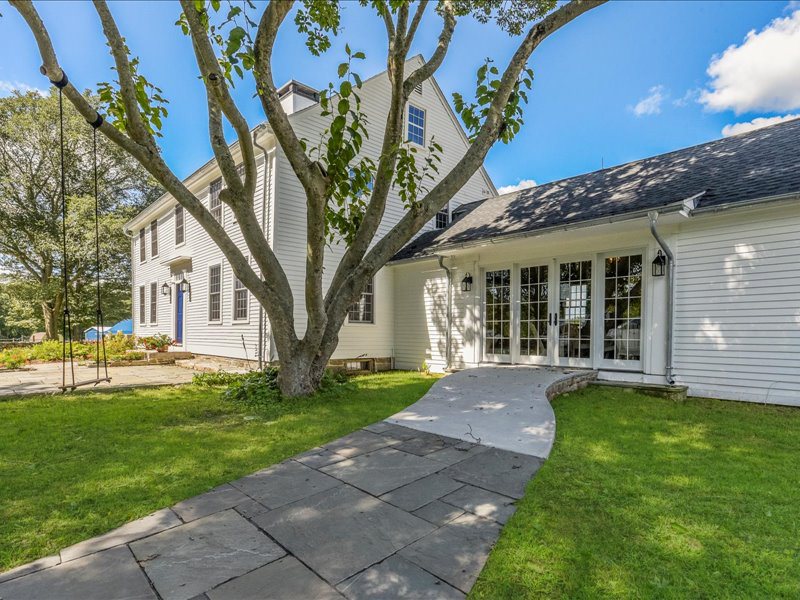
Designing flowers for Deans Mill Farm requires an appreciation for the “ground-up” aesthetic. This is not a venue for synthetic perfection; it is a place for organic textures, sprawling vines, and arrangements that feel as though they were gathered from the surrounding Stonington meadows. We know this venue well from our work here, and we find that the most successful designs lean into the historic masonry and the expansive, open-sky atmosphere.
The property is a masterclass in New England charm, balancing the ruggedness of weathered stone with the elegance of a white farmhouse. Because the majority of the event takes place outdoors or under a tent, the floral strategy must account for natural light shifts and the physical scale of the landscape. Small, dainty arrangements will get lost here. You need intentionality in your focal points to ground the celebration within the wide-open spaces.
The Spaces
The Stone Ruins and Grounds
This is the architectural heart of the property. The ruins provide a sense of permanence and history that serves as a profound backdrop for a ceremony. The textures of the stone are varied—cool greys, deep charcoals, and mossy greens—which means your floral palette has a built-in neutral base.
- What works: “Growing” ground installations. Use heavy-based arrangements that appear to sprout from the base of the stone walls. This creates a seamless transition between the built environment and your decor. Freestanding arches also work well here, provided they are anchored for the coastal breeze.
- Skip: Tall, narrow pedestals. They look precarious and disconnected on the uneven grass and against the heavy horizontal lines of the stone walls.
- Watch out: Wind exposure. This is an open site. Any structure, from a chuppah to a simple floral pillar, must be weighted significantly.
- Budget hero move: Focus your entire ceremony budget on a single, lush semi-circle of flowers at the altar. The stone walls do the rest of the work for the aisle.
The Tent Area
The reception typically moves to a large fabric tent, which acts as a blank, airy canvas. The presence of farm tables here is a design directive in itself. These long, wooden surfaces demand a linear approach to floral placement rather than the isolated clusters used on round tables.
- What works: Low, lush troughs or “bud vase crawls” that span the length of the farm tables. If the budget allows, greenery installations climbing the tent poles can draw the eye upward and soften the industrial feel of the tent structure.
- Skip: Traditional tall glass trumpets. They feel corporate and out of place in a rustic farm setting. They also tend to wobble on grass-based flooring.
- Watch out: Flooring. If the tent is on grass, the moisture level can affect how flowers hold up. Ensure all containers are leak-proof to protect the venue’s farm tables.
- Budget hero move: Greenery smilax or ruscus wrapped around the center tent poles. It provides a massive visual impact for a fraction of the cost of a hanging floral chandelier.
The Farmhouse Lawn
Often used for cocktail hour or as a secondary photo site, the lawn surrounding the white farmhouse is all about clean lines and high contrast. The crisp white siding of the house makes every petal color more vibrant.
- What works: Flanking arrangements at the entrance of the house or the porch. Large-scale urns with sprawling, asymmetrical branches create a sophisticated “manor house” vibe that complements the B&B’s aesthetic.
- Skip: Overly manicured, tight floral balls. This venue calls for movement and airiness.
- Watch out: Foot traffic. The gravel pathways are charming but can be narrow. Ensure cocktail arrangements are kept on stable surfaces where they won’t be bumped.
- Budget hero move: Repurpose your ceremony ground nests to the base of the farmhouse steps for the second half of the day.
What Works at Deans Mill Farm
Incorporate the masonry. The stone walls are the venue’s most distinct feature. Designing flowers that “nest” into the nooks of the ruins or spill over the top of a wall creates a high-end, custom look that feels integrated rather than placed.
Leverage the white farmhouse backdrop. Use the clean white exterior for your most important portraits. If you are using a soft, neutral palette, the house provides the necessary contrast. If you are using bold colors like burgundy or ochre, the white background makes them sing.
Linear table logic. Since farm tables are the standard here, think in lines, not circles. Long garlands, repeated bud vases, or a series of small, low compotes are the only way to ensure every guest has a view of the design without obstructing conversation.
Scale for the sky. In an open-air venue, the “ceiling” is the sky. Petite arrangements will look like an afterthought. You need to create height through the use of tall branches (like quince or forsythia) or by using the tent’s structural poles to create vertical floral moments.
Embrace the “Stonington Wild.” The most successful palettes here pull from the local landscape. Think dusty blues, sage greens, toasted tawnies, and cream. Avoid anything that looks too “hot house” or tropical, as it will clash with the historic New England farm vibe.
Budget Guide
| Tier | Investment | Floral Strategy |
|---|---|---|
| Essentials | $1,750 - $3,200 | Focus on personals and a high-impact ceremony focal point. Use the stone walls as your primary decor and keep reception tables simple with curated bud vases. |
| Sweet Spot | $3,500 - $5,500 | Adds lushness to the reception. Includes full compote arrangements for farm tables and a more substantial ceremony installation. Some greenery accents for the tent poles. |
| Full Experience | $6,000 - $8,500 | Allows for a large-scale “growing” installation at the ruins and significant floral work in the tent. Think overhead greenery or a floral-heavy entrance to the farmhouse. |
| Statement | $9,000+ | Full-scale transformation. Includes custom builds for the ruins, overhead floral installations in the tent, and lush, layered designs for every surface from the porch to the bar. |
The character of Deans Mill Farm is rooted in its quiet, historic elegance; your floral budget should prioritize quality and texture over sheer volume.
Tips
Plan for the Stonington breeze. Weighted bases are non-negotiable for any freestanding structure on the grounds to prevent toppling.
Navigate the gravel with care. The pathways are beautiful but challenging for rolling equipment; ensure your floral team is prepared for a “carry-in” setup.
Repurpose with intention. Ceremony flowers from the ruins can easily be moved to the base of the sweetheart table or the tent entrance, but they must be designed in heavy, water-holding vessels to survive the transition.
Check the tent rigging rules. While the tent allows for hanging designs, always confirm the weight limits with the tent company before dreaming up a heavy floral ceiling.
Design for the golden hour. The light hits the farmhouse and the ruins beautifully in the late afternoon; choose flower finishes (like silkier petals or iridescent berries) that catch the low sun.---