
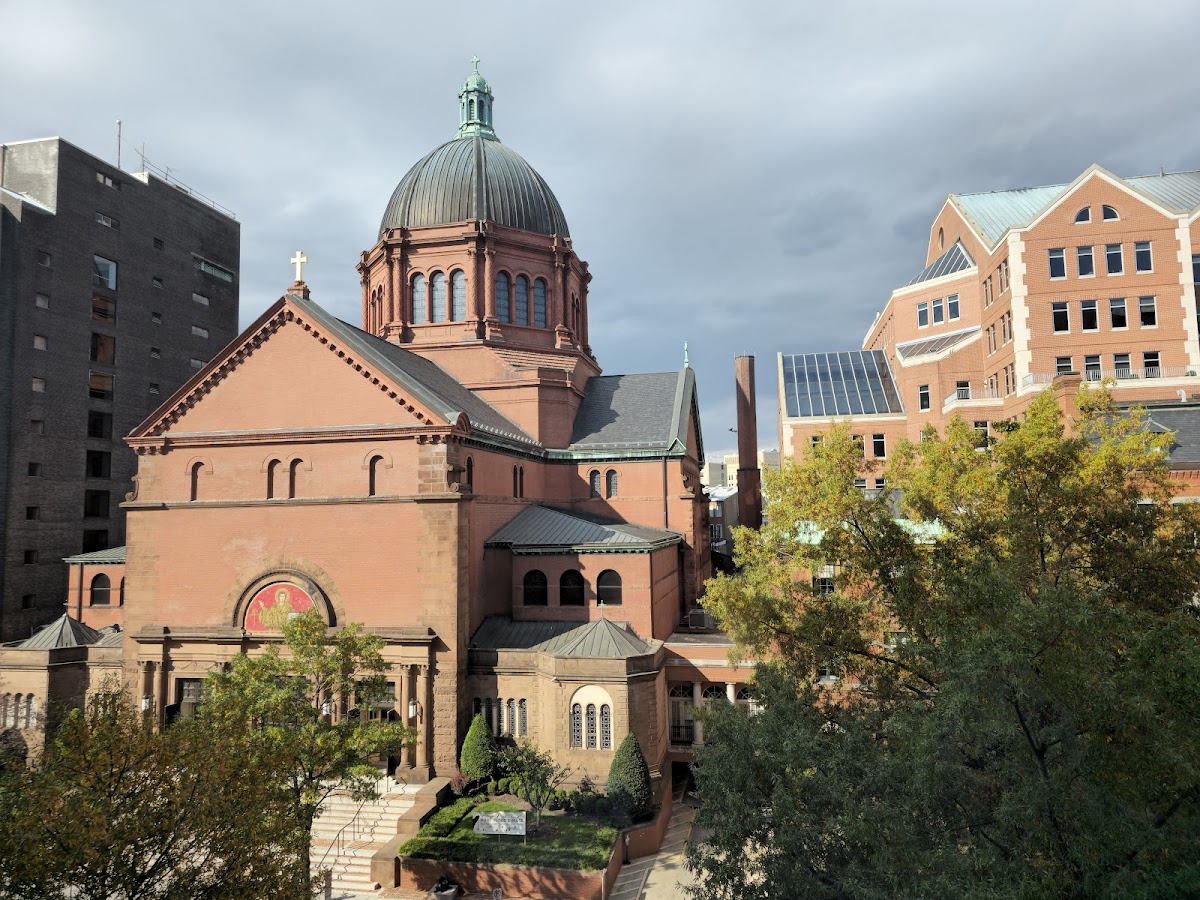
You approach from Rhode Island Avenue, and at first the Cathedral of St. Matthew the Apostle announces itself quietly — a red brick edifice trimmed in sandstone and terra cotta, dignified but not showy among the embassies and office buildings of Dupont Circle. Then you step through the bronze doors, and the space opens like a held breath released. The octagonal dome soars 190 feet above you, light streaming through clerestory windows and pooling on marble floors that have witnessed presidential funerals, papal visits, and countless wedding processions. The walls shimmer with mosaics — not subtle, not pastel, but vibrant with semiprecious stones in cobalt, gold, crimson, and emerald green. Behind the altar, a 35-foot mosaic of St. Matthew commands attention, his robes rendered in thousands of tiny tiles that catch the light and seem almost to move. And then there is the aisle: 155 feet of polished marble stretching from entrance to sanctuary, the longest processional in Washington, DC. This is not a venue that whispers. It proclaims. Poppy has designed Cathedral of St. Matthew the Apostle wedding flowers for 2 ceremonies here, and each time we set foot in this space, we are reminded that our job is not to decorate a cathedral — it is to honor one.
About Cathedral of St. Matthew the Apostle
The Cathedral of St. Matthew the Apostle serves as the mother church of the Roman Catholic Archdiocese of Washington, a designation that speaks to both its ecclesiastical importance and its architectural ambition. Construction began in 1893 under the direction of architect C. Grant La Farge, who drew heavily from Renaissance Revival and Romanesque Revival traditions with Byzantine flourishes throughout. The building was completed in 1913, and the result is a cathedral that feels at once European in its grandeur and distinctly American in its confidence. The exterior is relatively restrained — red brick with sandstone and terra cotta trim — but the interior is an exercise in maximalism executed with exquisite taste. Marble columns, pendentives depicting the four evangelists, a 5,045-pipe Möller organ, and mosaics that cover nearly every vertical surface in jewel tones and gold leaf. The dome, restored between 2000 and 2003, rises to a total height of 200 feet and serves as the visual anchor for the entire space, visible from nearly every vantage point within the sanctuary.
The cathedral’s historical significance extends beyond architecture. On November 25, 1963, it hosted the funeral mass for President John F. Kennedy, an event attended by heads of state from around the world. A floor inscription still marks the spot where his flag-draped casket rested. This history lends a weight to every ceremony held here — a sense that you are participating not just in your own story, but in a continuum of national and spiritual life that stretches back generations.
Logistically, the cathedral sits at 1725 Rhode Island Avenue NW, directly in the heart of downtown Washington, DC, within walking distance of Dupont Circle and Farragut North Metro stations. For couples and guests traveling from Maryland or Virginia suburbs, access is straightforward via Red Line Metro or by car, though parking in this area is limited to nearby garages such as Penn Parking. The urban location means this is not a venue with sprawling grounds or bucolic photo opportunities, but the cathedral’s proximity to Embassy Row, the National Mall, and historic Georgetown provides ample options for post-ceremony portraits. For Poppy’s delivery teams, load-in requires coordination with the cathedral staff — there is no dedicated loading dock, and all vendor access must be arranged through the rectory at 202-347-3215. We typically schedule deliveries for early morning to avoid street traffic and ensure adequate setup time before guests arrive.
Couples booking a wedding at St. Matthew’s must work directly with the cathedral clergy. This is an active parish with daily masses and a full liturgical calendar, so availability can be limited, particularly during Lent and Advent. Pre-Cana classes and paperwork are required, and all ceremonies must adhere to Catholic liturgical guidelines, which include restrictions on music, readings, and the structure of the service. For florists, this means working within a framework that respects the sacred nature of the space — no adhesives on marble, no obstructing the altar or tabernacle, and designs that enhance rather than overshadow the liturgy.
Event Spaces & Floral Opportunities
Main Cathedral
Capacity: 1,200 seated
Setting: The Main Cathedral is the principal worship space and the venue for wedding ceremonies, a Latin cross floor plan measuring 155 feet in length and 136 feet in width. The octagonal dome rises from the crossing, creating a vertical focal point that draws the eye upward and floods the sanctuary with natural light. The nave is flanked by two side aisles, each lined with columns in richly veined marble, and the apse behind the altar features the Edwin Blashfield mosaic of St. Matthew, a massive work in vibrant blues, golds, and reds that serves as the visual terminus for anyone standing at the entrance. The marble floors are inlaid with geometric patterns, and the pews are carved dark wood with cushioned kneelers. Pendentives beneath the dome depict the four evangelists in mosaic, their figures surrounded by gilded halos and wings. This is a space that was designed to inspire awe, and it succeeds.
Floral approach: The sheer scale of the Main Cathedral demands restraint and precision. A scattering of small arrangements will disappear entirely, swallowed by the volume of the space, while overly elaborate florals risk competing with the mosaics and marble. We favor a strategy of focal anchors: two large-scale altar arrangements flanking the sanctuary steps, symmetrical in form and generous in scale. Think tall urn arrangements filled with white French tulips, ivory Patience garden roses, Majolica spray roses, white lisianthus, and cascading trails of Italian ruscus and smilax, standing 4 to 5 feet tall on bronze or marble pedestals. These arrangements should be lush enough to register from the back of the nave but composed of flowers with enough depth and texture to reward close inspection during the ceremony. The 35-foot St. Matthew mosaic behind the altar is awash in warm tones — gold, rust, deep blue, crimson — so florals here benefit from either a monochromatic white palette (which provides elegant contrast) or jewel tones that echo the mosaic (burgundy dahlias, marigold-hued roses, deep purple lisianthus). For the 155-foot main aisle, pew markers are the traditional approach: simple clusters of roses, stock, and greenery tied with silk ribbon and hung from every third or fourth pew. Alternatively, consider a more dramatic installation with tall brass candlestick holders placed at intervals along the aisle, each topped with a compact dome of white hydrangea and garden roses. Avoid anything that blocks the aisle or disrupts the procession — this is sacred choreography, and the flowers are there to frame it, not interrupt it. If the couple desires additional floral elements, a garland wrapping the base of the altar steps or discreet arrangements in the side chapels can add layers of beauty without overwhelming the sanctuary. Above all, remember that the cathedral’s architecture is the primary design element here. Cathedral of St. Matthew the Apostle wedding flowers should feel like a natural extension of the mosaics and marble, not an imposition upon them.
Wedding Chapel
Capacity: Approximately 75 seated
Setting: Tucked along the right side of the main cathedral, the Wedding Chapel is a separate, more intimate space designed specifically for smaller ceremonies. Restored between 2000 and 2003, the chapel features updated marble flooring, freshly restored ceiling frescoes, and a quieter, more contemplative atmosphere than the grand sanctuary. The altar is simpler here, with a carved reredos and flanking candlesticks, and the pews are arranged in tight rows that create an almost domestic sense of closeness. Natural light filters in through stained glass windows depicting scenes from the life of Christ, casting soft jewel tones across the floor. This is the space for couples who want the gravitas of a cathedral wedding without the overwhelming scale of the main sanctuary.
Floral approach: The Wedding Chapel allows for a more personal, detailed floral approach. Because the space is smaller and guests are seated closer to the altar, arrangements can be more intricate without losing impact. Consider a pair of medium-sized arrangements in aged brass compotes, filled with white O’Hara garden roses, blush ranunculus, ivory stock, and dusty miller foliage, placed on pedestals at either side of the altar. The smaller scale permits the use of more delicate flowers — hellebores, sweet peas, anemones — that would be lost in the main cathedral. Pew markers can be petite and refined: single stems of white spray roses tied with velvet ribbon, or small tussie-mussies of lily of the valley and stephanotis. If the couple is using the chapel for a full ceremony, a small floral arrangement on the altar itself (subject to clergy approval) can add warmth without blocking sightlines. The Wedding Chapel is also an excellent option for couples on a tighter floral budget, as the smaller space requires fewer elements to feel fully dressed.
Blessed Sacrament Chapel
Capacity: Small devotional space, not typically used for ceremonies
Setting: The Blessed Sacrament Chapel is a sacred side chapel reserved primarily for private prayer and Eucharistic adoration. With its restored marble and quiet, contemplative atmosphere, this space is not a wedding venue per se, but it may be open and visible during ceremonies held in the main cathedral or Wedding Chapel.
Floral approach: Any floral work in the Blessed Sacrament Chapel must be minimal and deeply respectful of its devotional purpose. A single arrangement of white lilies or roses in a simple glass vase, placed near the altar or in a niche, is appropriate. Avoid anything large, fragrant, or attention-grabbing. The chapel’s purpose is prayer, not celebration, and flowers here should reflect that solemnity.
Angels’ Chapel
Capacity: Small devotional space, not typically used for ceremonies
Setting: Another side chapel within the cathedral, the Angels’ Chapel features restored marble and ceiling work and serves as a quiet devotional space similar to the Blessed Sacrament Chapel.
Floral approach: As with the Blessed Sacrament Chapel, florals here should be minimal and respectful. A small tribute of white flowers — perhaps a low arrangement of white hydrangea and ivy in a stone bowl — can add beauty without disrupting the chapel’s intended use. Always consult with the cathedral staff before placing any florals in side chapels, as some may have specific restrictions.
Wedding Flower Ideas for Cathedral of St. Matthew the Apostle
Byzantine Splendor
This concept takes its cues directly from the cathedral’s mosaics, embracing the jewel tones and gilded accents that define the interior. The palette is rich: deep burgundy dahlias (Rip City, Arabian Night), burnt orange roses (Free Spirit, Voodoo), marigold-hued spray roses, and crimson ranunculus, all punctuated by gold-tipped eucalyptus, bronze calla lilies, and accents of deep plum hellebores. Vessels are aged brass or bronze urns with verdigris patina, echoing the metalwork throughout the cathedral. Arrangements are lush and slightly wild — not overly structured, but abundant in the manner of an Old Master still life. This palette works beautifully against the warm tones of the St. Matthew mosaic and feels opulent without tipping into garishness. For altar arrangements, imagine towering urns overflowing with these rich blooms, with trailing amaranthus and Italian ruscus cascading down the pedestals. For pew markers, clusters of burgundy and orange roses tied with gold silk ribbon. This is a design for couples who want their florals to engage with the cathedral’s visual language rather than stand apart from it.
Seraphic White
A study in restraint and luminosity, Seraphic White is an all-white palette elevated by texture and scale. The foundation is white garden roses (Patience, Vitality, Playa Blanca), ivory French tulips (in season), white phalaenopsis orchids, white lisianthus, and soft cream Majolica spray roses. Textural elements include white veronica, white astilbe for softness, and silvered foliage — dusty miller, eucalyptus, Italian ruscus. Vessels are white marble urns or carved stone compotes that echo the cathedral’s architectural materials. The effect is angelic, ethereal, and deeply classical — florals that feel as if they have always been part of the cathedral rather than added for a single day. This palette provides elegant contrast to the vivid mosaics without competing for attention, and it photographs beautifully against the warm marble and gold accents. For altar arrangements, think tall, symmetrical designs in marble urns, dense with white blooms and trailing greenery. For the aisle, brass candlesticks topped with tight domes of white hydrangea and roses. This is the choice for couples who want timeless, iconic wedding imagery.
Romantic Mauve & Ivory
A softer, more romantic take that bridges classic and modern sensibilities. The palette centers on blush and mauve tones: Quicksand roses, Cappuccino roses, mauve lisianthus, blush ranunculus, ivory spray roses, and soft pink astilbe. Accents include white garden roses for brightness, touches of lavender sweet peas (in season), and silver-green foliage such as eucalyptus and olive branches. Vessels are a mix of aged silver compotes and blush ceramic urns. This palette feels warm, approachable, and romantic without veering into saccharine territory — the mauve tones have enough gray in them to maintain sophistication. It complements the cathedral’s architecture without directly referencing the mosaics, creating a softer visual dialogue. For altar arrangements, consider medium-height designs in silver compotes, lush and slightly asymmetrical, with roses and ranunculus clustered in the center and trailing greenery softening the edges. For pew markers, small bouquets of blush roses and lavender sweet peas tied with silk ribbon. This palette works particularly well for spring and summer weddings when the soft, diffused light through the cathedral’s windows enhances the gentle color story.
Seasonal Considerations
Washington, DC’s four-season climate offers distinct opportunities and challenges for Cathedral of St. Matthew the Apostle wedding flowers, with each season bringing its own palette of locally available blooms and weather considerations.
Spring (March-May): Spring in DC is glorious but unpredictable. Cherry blossoms bloom along the Tidal Basin in late March and early April, tulips and daffodils flood the markets in April, and by May the city is lush with peonies, ranunculus, sweet peas, and lilac. For cathedral weddings, spring is ideal for soft, romantic palettes featuring blush peonies, ivory garden roses, lavender sweet peas, and French tulips in white and cream. The weather ranges from chilly and damp in March to warm and humid by late May, so flower longevity is generally good. One logistical note: spring is peak tourist season in DC, so traffic around the cathedral can be heavy, particularly on weekends when the Smithsonians and monuments are crowded. Plan load-in times accordingly. The most popular wedding months at St. Matthew’s are April and May, when the city is at its most beautiful and outdoor reception venues are starting to become viable options.
Summer (June-August): DC summers are notoriously hot and humid, with temperatures regularly climbing into the 90s and occasional thunderstorms rolling through in the late afternoon. The good news: the cathedral’s thick stone walls and elevated ceilings keep the interior relatively cool, and air conditioning helps during peak heat. The challenge: transporting flowers from our studio to the cathedral during July and August heat requires careful climate control to prevent wilting. We favor heat-tolerant blooms during these months — hydrangeas (kept well-hydrated), garden roses, lisianthus, and orchids all perform well. Avoid delicate flowers like sweet peas, tulips, or anemones, which struggle in humidity. Summer also brings the full glory of American-grown flowers: zinnias, dahlias, sunflowers, and cosmos from local farms. For couples seeking a more relaxed, garden-party aesthetic, summer florals can incorporate these seasonal favorites alongside traditional wedding flowers. One advantage of summer weddings at St. Matthew’s: the long daylight hours mean natural light floods the cathedral well into the evening, making for stunning photography.
Autumn (September-November): Fall is peak wedding season in DC, and for good reason. Temperatures cool to a comfortable range, humidity drops, and the city’s trees begin their slow transition to gold, orange, and crimson. The cathedral’s warm-toned mosaics and marble seem to glow in the slanting autumn light, and the jewel-toned palette possibilities are endless. This is the season for dahlias (Café au Lait, Rip City, Arabian Night), garden roses in burnt orange and deep burgundy, marigolds, chocolate cosmos, and branching elements like oak leaves and crabapple. Autumn also brings the harvest — consider incorporating ornamental kale, clusters of lady apples, or heirloom pumpkins into altar arrangements for couples seeking a seasonal, organic aesthetic. The weather is generally cooperative, though November can bring early cold snaps, so be prepared with contingency plans for any outdoor elements (such as post-ceremony photos on the cathedral steps). September and October are heavily booked months, so couples should secure their wedding date well in advance.
Winter (December-February): Winter weddings at the Cathedral of St. Matthew are rare but magical. The city quiets down as tourists depart, and the cathedral’s grand interior takes on an even more contemplative, hushed quality. The floral palette shifts to evergreens, white amaryllis, white roses, paperwhites, and branches of holly or pine. Poinsettias are sometimes available for December weddings, though we generally prefer more subtle holiday accents — sprigs of rosemary, eucalyptus berries, white hellebores. The challenge: many flowers are imported during winter months, which can drive costs up and limit availability, particularly around Christmas and New Year’s. Avoid delicate blooms that suffer in cold transport, and favor hardy flowers like roses, orchids, and lilies. On the logistical side, winter weather can bring snow and ice, so delivery schedules must remain flexible. One advantage: the cathedral’s interior is beautifully heated, so once flowers are installed, they remain comfortable and fresh throughout the ceremony. Winter weddings also benefit from lower venue competition — if you want a Saturday in January or February, you are far more likely to secure it than a Saturday in October.
Poppy’s Expert Take
The aisle is 155 feet long — embrace it. Many florists underestimate the visual impact needed to register in such a long, grand space. Sparse pew markers placed every six rows will look lost. Either commit to robust pew arrangements every third or fourth row, or elevate the design with tall brass candlesticks topped with flowers placed at intervals down the aisle. The length is the cathedral’s signature feature for weddings; lean into it rather than treating it like an ordinary aisle.
The mosaic is your color consultant. The 35-foot St. Matthew mosaic behind the altar is rendered in golds, deep blues, crimson, and rust — a Byzantine palette that can either be your inspiration or your contrast point. If you choose jewel-toned florals, echo the mosaic’s warmth. If you choose white, the contrast will be striking and elegant. What you should avoid: pastel pinks, baby blues, or any washed-out palette that neither complements nor contrasts with the richness of the interior. The cathedral demands commitment.
Catholic ceremony restrictions are real and non-negotiable. This is an active parish with specific liturgical rules. Aisle runners are often discouraged or prohibited. Unity candles or sand ceremonies may not be permitted. And most importantly, nothing can obstruct the altar, tabernacle, or celebrant’s movement during the Mass. When Poppy designs florals for St. Matthew’s, we coordinate directly with the cathedral staff to ensure compliance. Any adhesive, nails, or tape on marble surfaces is strictly forbidden — all arrangements must be freestanding or placed in approved locations. Plan your designs with these restrictions in mind from the beginning, not as an afterthought.
This is a ceremony-only venue — plan your floral budget accordingly. Unlike ballroom venues where florals transition from ceremony to reception, the Cathedral of St. Matthew hosts only the ceremony. Reception flowers are a separate line item, designed for a different venue. This actually works in a couple’s favor budget-wise: you can invest more heavily in dramatic altar arrangements and aisle decor for the ceremony, knowing that these pieces will be the primary floral moment of the day. Alternatively, if you are hosting a reception at a separate venue, you can repurpose the altar arrangements as reception focal points — Poppy handles this logistics coordination frequently, transporting arrangements from the cathedral to the reception site for couples who want to maximize their floral investment.
Load-in requires coordination and patience. There is no loading dock at the cathedral, and Rhode Island Avenue NW is a busy urban street. Poppy typically coordinates delivery for early morning — ideally 7:00 or 8:00 AM for a noon ceremony — to avoid traffic and ensure ample setup time. We park temporarily in front of the main entrance, unload quickly, and move vehicles to nearby garages. The cathedral staff is accustomed to vendor coordination, but everything runs more smoothly when delivery is scheduled in advance through the rectory. Allow extra time for setup; the scale of the space means that even simple arrangements require ladders, careful placement, and adjustments once you see how they read from the back of the nave.
Lighting matters more than you think. The cathedral’s lighting is a mix of natural light from the clerestory windows and ambient lighting from chandeliers and sconces. The dome floods the crossing with sunlight during midday, but the side aisles and chapels can be quite dim. When planning altar arrangements, remember that they will be backlit by the mosaic and overhead lighting, which can either make white flowers luminous or turn dark flowers into silhouettes. If you are working with deep burgundy or plum florals, ensure they have enough tonal variation (lighter accents, silvered foliage) to remain visible from a distance. Conversely, white and cream flowers will glow in the cathedral’s light, especially during afternoon ceremonies when the sun is high.
Photography coordination is essential. The cathedral allows wedding photography, but flash may be restricted during the ceremony itself, and certain areas (such as the sanctuary during Mass) may be off-limits for posed shots. Work with your photographer to scout the cathedral in advance and identify the best angles for capturing both the architecture and your florals. The view from the rear of the nave looking toward the dome and altar is iconic and should be part of your shot list. For post-ceremony portraits, the front steps and the surrounding Dupont Circle neighborhood offer excellent urban backdrops, though be prepared for pedestrian traffic and parked cars in the frame.
What Poppy Couples Spend on Flowers Here
Based on our experience with weddings at the Cathedral of St. Matthew the Apostle, couples invest an average of $4,609 on their ceremony florals — a figure that reflects both the scale of the space and the significance of the occasion. This is not a venue where minimalism reads well. The architecture demands presence, and florals that register in a 1,200-seat cathedral are necessarily substantial in scale and scope. Here is how that investment typically breaks down across three budget tiers, with specific recommendations for each.
$2,500 - $4,000 | The Ceremony Essentials At this level, the focus is on the most impactful areas: personal flowers and altar arrangements. The couple carries a lush bridal bouquet and the groom wears a boutonniere. Bridesmaids carry smaller bouquets in a complementary palette, and groomsmen wear matching boutonnieres. The real investment goes toward two large altar arrangements flanking the sanctuary — tall pedestal urns filled with white garden roses, lisianthus, hydrangea, and cascading greenery. These arrangements stand 4 feet tall and are symmetrical, classical, and photographed from every angle. For the main aisle, consider either pew markers on every fourth row (clusters of roses and stock tied with ribbon) or a dozen brass candlesticks topped with low domes of white hydrangea, spaced evenly down the 155-foot processional. This tier creates a dignified, elegant ceremony that honors the cathedral’s architecture without attempting to fill every corner. It is ideal for couples who are investing more heavily in their reception florals at a separate venue and want the cathedral ceremony to feel complete but not overwhelming.
$4,000 - $6,500 | The Complete Ceremony This mid-tier budget allows for more layered, detailed floral design. Personal flowers expand to include corsages for mothers and grandmothers, and bouquets for additional attendants. Altar arrangements become more elaborate — either larger urns (5+ feet tall) or two sets of arrangements (one pair flanking the altar, another pair framing the entrance to the sanctuary). The main aisle gets fuller treatment: pew markers on every third row, or a combination of candlesticks and low floral clusters. At this level, you can also add small arrangements in the Wedding Chapel or side areas visible during the ceremony, creating visual continuity throughout the space. Consider a garland installation wrapping the base of the altar steps, or a lush swag decorating the entrance doors that guests pass through upon arrival. This tier allows you to create a ceremony that feels abundant and intentional, with florals that register from the back of the nave while still maintaining detail and texture up close. It is the sweet spot for couples who want a fully designed ceremony space without venturing into installation territory.
$6,500+ | The Cathedral Masterwork At this level, the floral design becomes an integral part of the ceremony experience, a visual narrative that unfolds as guests enter and progress through the space. Personal flowers are extensive: oversized bridal bouquet trailing with jasmine vine and silk ribbon, boutonnieres with textured elements like scabiosa pods or hypericum berries, and corsages designed as miniature bouquets rather than simple clusters. Altar arrangements are monumental — 6-foot urns overflowing with hundreds of blooms, or custom-designed installations that incorporate branching elements (curly willow, flowering cherry, manzanita) for architectural drama. The main aisle becomes a floral processional: brass candlesticks at every other row, each topped with a lush arrangement, or a continuous low hedge of florals lining the aisle on both sides. Add a dramatic garland installation above the entrance to the sanctuary, suspended floral elements beneath the dome (where structurally feasible and approved by cathedral staff), and full floral dressing in the Wedding Chapel for pre-ceremony family photos. This tier also typically includes floral repurposing: Poppy transports the altar arrangements to the reception venue after the ceremony, where they are reinstalled as head table backdrops or entryway focal points, maximizing the couple’s investment. This is the budget for couples who view their cathedral ceremony as the centerpiece of their wedding day and want every element — from the first glimpse inside the doors to the final moment at the altar — to be florally breathtaking.