
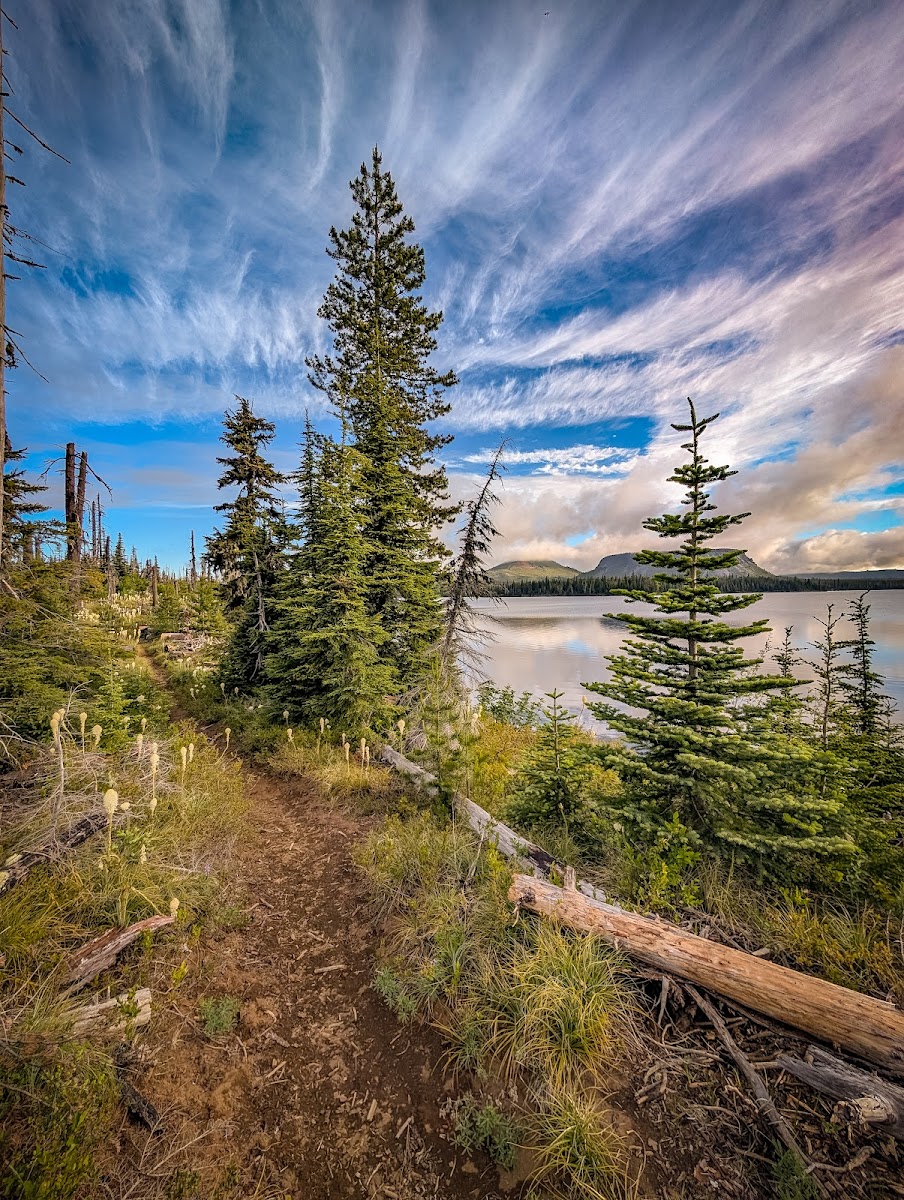
Designing for Big Lake is an exercise in scale and stamina. This is not a venue for delicate, fragile blooms or fussy, intricate details that require a climate-controlled environment. Here, the landscape is the protagonist, and your floral design serves as the frame. Success at this Sisters, Oregon landmark depends on your ability to compete with the sheer magnitude of the Willamette National Forest without clashing with its rugged, unrefined beauty.
We know this venue well from our work here, and the primary challenge is always the environment. Between the high-altitude sun that saps moisture from petals and the afternoon gusts coming off the lake, your floral choices must be as resilient as the volcanic rock that defines the region.
The Spaces
Outdoor Ceremony Space
This is the crown jewel of the property, offering a panoramic view of Mt. Washington. The scale here is deceptive; what looks like a large floral arch in a studio will look like a toothpick against the Cascade Range. You need volume and height to make an impact.
- What works: Heavy-timber arbors dressed in asymmetrical floral sprays or massive ground-level “meadow” installations that look as though they emerged from the forest floor. Use bold, face-heavy flowers like protea, large roses, or dahlias that can be seen from the back row.
- Skip: Thin, circular metal hoops or light-colored, airy pampas grass that will get lost against the bright sky and grey rock.
- Watch out: The wind. Any structure here must be staked into the ground or weighted with at least 50 pounds of sandbags at the base.
- Budget hero move: Focus your entire ceremony budget on two massive ground-level installations at the altar. These can be moved to the reception entrance or the head table later, providing twice the visual impact for the same cost.
Big Lake Waterfront
The waterfront offers a more intimate but equally exposed setting. The blue of the lake is intense, providing a natural color palette that favors whites, creams, and deep forest greens.
- What works: Low-profile floral nests that wrap around the base of the dock or the seating area. These stay below the wind line and don’t block the reflection of the mountains on the water.
- Skip: Tall pedestals or top-heavy arrangements. The risk of them blowing over into the lake is high.
- Watch out: Access. The path to the waterfront can be uneven. Ensure your floral team has heavy-duty carts with all-terrain wheels for transport.
The Meadow
Often used for larger gatherings or tented receptions, the meadow is a blank slate of green and gold.
- What works: Long, continuous floral runners for banquet tables that mimic the horizon line. Incorporating local textures like manzanita branches or dried grasses helps the designs feel grounded in the Pacific Northwest.
- Skip: Formal, tight spheres of flowers. They feel too suburban for such a wild setting.
- Watch out: Direct sun. If the reception is not tented, flowers will need to be set up as late as possible to prevent wilting.
What Works at Big Lake
Embrace the “Wild” in Wildflower. Refined, ballroom-style arrangements look out of place here. Instead, opt for organic shapes, varied heights, and “growing” designs. Use greenery that mimics the local flora—think silver-toned eucalyptus, ferns, and pine branches—to create a seamless transition from the venue to your decor.
Prioritize Saturated Colors. The high-altitude light at Big Lake is incredibly bright, which can wash out pale pastels in photographs. To ensure your flowers pop against the blue sky and green pines, lean into saturated tones. Deep burgundies, vibrant ochres, or even a crisp, high-contrast white will hold their own against the landscape.
Mechanical Integrity is Non-Negotiable. This is a “mechanics first” venue. Every arch must be anchored, every vase must be heavy-bottomed, and every stem must be deeply hydrated. We recommend using floral foam alternatives like Oshun pouches or chicken wire cages heavily weighted with rocks to ensure nothing shifts during the ceremony.
Scale Up, Not Out. Because the venue is so expansive, a high volume of small arrangements will look like clutter. It is better to have three massive, high-impact floral moments than twenty small ones. Think in terms of “floral installations” rather than “bouquets in vases.”
Texture Over Perfection. The beauty of Sisters, Oregon is in its ruggedness. Floral designs that incorporate architectural branches, berries, and textural foliage feel more sophisticated in this context than a bouquet of perfectly uniform roses. Let the stems have movement and “air” to them.
Budget Guide
| Tier | Investment | Floral Strategy |
|---|---|---|
| Essentials | $1,750 - $3,500 | High-impact personal flowers (bouquets/boutonnieres) and a single, substantial ceremony focal point. |
| Sweet Spot | $3,500 - $6,500 | Full ceremony arch or meadow, aisle markers that transition to the reception, and textural centerpieces for 10-15 tables. |
| Full Experience | $6,500 - $10,000 | A lush, 360-degree ceremony installation, elevated reception florals, and additional “moment” pieces for the bar and entrance. |
| Statement | $10,000+ | Large-scale custom builds, such as a floral-covered entrance into the meadow, overhead greenery in a tent, and a fully immersive head table design. |
Big Lake is a venue that demands respect for the elements; your budget should prioritize structural stability and flower varieties that can endure the Oregon sun.
Tips
Secure the base with more than you think you need. Use sandbags, water weights, or literal boulders found on-site to keep arches upright against lake winds.
Hydration is the silent killer at high altitudes. Ensure all flowers are delivered in water and stay in the shade until the absolute last moment before the ceremony begins.
Design for 360-degree viewing. In open outdoor spaces, guests will see arrangements from every angle; there is no “back” to a ceremony arch here.
Repurpose with a logistical plan. Moving large installations across dirt paths and uneven grass takes time and muscle; ensure your floral team has the staff to execute this quickly.
Work with the season. Early summer brings bright greens, while late August and September offer a more golden, dried aesthetic that pairs beautifully with autumnal floral tones.