
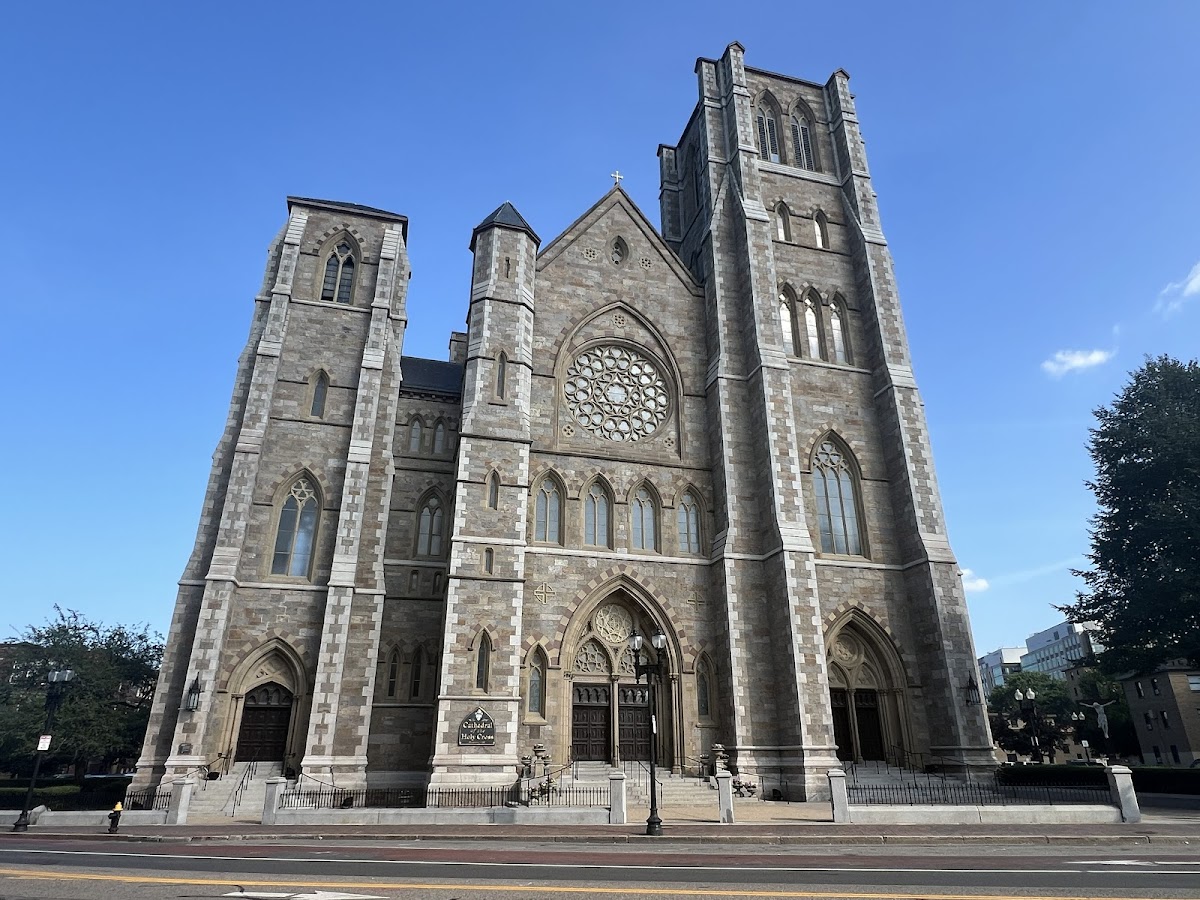
You take the T to Back Bay, or you drive down Tremont past rows of brick bow-fronts, and then Washington Street delivers you to something wholly unexpected in the middle of Boston’s urban grid. The Cathedral of the Holy Cross rises 120 feet into the New England sky, all Roxbury puddingstone and limestone, its tower visible for blocks before you arrive. This is not a church. This is a cathedral — the seat of the Archdiocese of Boston, the largest Catholic church in New England, and the kind of sacred space that makes even secular guests catch their breath when they step inside. The doors open onto a nave that stretches 364 feet long and 90 feet wide, with soaring Gothic arches, a ceiling that seems to scrape heaven, and stained glass windows restored to jewel-box brilliance in 2019. Light pours through those windows in shafts of ruby, sapphire, and gold, painting the stone floors in color. The 1875 Hook & Hastings pipe organ — the largest surviving instrument built by that storied firm — fills the space with sound so resonant you feel it in your sternum. This is architecture as prayer, stone and glass arranged to lift the spirit upward. Poppy has received inquiries from 5 couples planning Cathedral of the Holy Cross weddings, and each time we walk through those doors to consult on ceremony florals, we are reminded that some spaces demand humility from a florist. The Cathedral does not need us to make it beautiful. It needs us to honor what is already there.
About Cathedral of the Holy Cross
The Cathedral of the Holy Cross was consecrated in 1875, designed by the renowned architect Patrick Keely, whose fingerprints are on dozens of Catholic churches across America but whose masterwork is arguably this one. Built in the Gothic Revival style that was sweeping through ecclesiastical architecture at the time, the Cathedral was constructed using local Roxbury puddingstone — a distinctive conglomerate rock embedded with colorful pebbles — combined with limestone trim that provides sharp contrast against the darker stone. The result is a building that feels both rooted in New England geology and reminiscent of the great European cathedrals. At 364 feet long, 90 feet wide across the transepts, and with a ceiling height of 120 feet at the ridgepole, the Cathedral can seat between 1,700 and 2,000 guests, making it one of the largest worship spaces in the region. This is not a venue where intimacy comes easily. The scale is monumental, designed to inspire awe and elevate the liturgy.
The interior underwent a significant restoration between 2018 and 2019, during which the walls were brightened, the stained glass windows were meticulously restored to their original vibrancy, and modern climate control and acoustics were installed without compromising the historic character. The stained glass is particularly noteworthy — each window depicts scenes from scripture or portraits of saints, and when backlit by afternoon sun or illuminated from within at evening ceremonies, they glow with an intensity that no floral arrangement can match. The main altar, designed by Keely himself, features a gilded ceiling in the chancel adorned with intricate geometric patterns in gold leaf. The stone floors, also restored, provide a durable and beautiful foundation that photographs beautifully and provides excellent acoustics for the pipe organ.
The Cathedral sits in Boston’s South End, a neighborhood that has undergone dramatic transformation over the past few decades. Once a working-class area, the South End is now one of the city’s most desirable addresses, known for its Victorian brownstones, tree-lined streets, pocket parks, and thriving restaurant scene. The area is home to a diverse population — young professionals, families, artists, and Boston’s vibrant LGBTQ+ community. Within a ten-minute walk of the Cathedral, you will find some of the city’s best dining (MIDA, The Beehive, Kaia), independent boutiques, contemporary art galleries, and experimental theaters. For guests traveling from outside Boston, the Cathedral is easily accessible via the MBTA Orange Line, and it sits just minutes from downtown Boston and Back Bay. Parking is available through metered street parking (free on Sundays) and several nearby lots on Albany Street, about a ten-minute walk from the Cathedral.
For Poppy’s team, load-in at the Cathedral is straightforward but requires coordination. The main entrance is at 1400 Washington Street, with a handicap-accessible entrance at 74 Union Park Street that also serves as a practical drop-off point for vendors. Because this is an active parish with regular services, weddings are typically scheduled on Saturdays, and the Lower Church hosts confessions from 3:15 to 4:15 PM, which means vendor setup must be completed efficiently and respectfully. The Cathedral staff is professional and experienced with wedding logistics, though couples should confirm specific vendor requirements — including certificate of insurance details — directly with the parish office at 617-542-5682. One critical note for florists: the Cathedral’s grandeur means that floral installations must be proportional to the space. What would be considered a large arrangement in a typical church will read as modest here. Scale matters.
Event Spaces & Floral Opportunities
Main Cathedral Sanctuary
Capacity: 1,700-2,000 seated
Setting: The Main Cathedral Sanctuary is where the drama unfolds. You enter through massive wooden doors into a nave that feels less like a room and more like a canyon carved from stone and light. The Gothic arches rise in parallel lines toward the distant altar, creating a visual path that draws the eye forward. Stained glass windows line both sides of the nave, each one a masterpiece of color and narrative — saints and angels, parables and miracles, all rendered in glass that glows when light passes through it. The ceiling vaults overhead at 120 feet, supported by stone pillars that seem to grow organically from the floor. The main altar sits beneath a gilded chancel ceiling, intricate and luminous, with the 1875 Hook & Hastings pipe organ rising behind it like a wall of polished wood and brass pipes. The stone floors, recently restored, amplify sound beautifully — every footstep, every note of music, every whispered prayer carries through the space. This is a setting designed for transcendence, and it achieves that goal without requiring a single additional element. The 2019 restoration brightened the walls and enhanced the acoustics, so the space now feels both historic and remarkably well-maintained.
Floral approach: The fundamental principle for Cathedral of the Holy Cross wedding flowers in the Main Sanctuary is restraint paired with scale. This is not a space where you scatter arrangements liberally. This is a space where you choose three or four key moments and execute them with authority. Start with the altar. The gilded chancel and the pipe organ provide such a powerful backdrop that any altar arrangement must be substantial enough to register from the back pews without overwhelming the architecture. We recommend a pair of tall, symmetrical arrangements in classical urns — think 48 to 60 inches tall, positioned on either side of the altar steps. Use long-stemmed white flowers with architectural presence: Casa Blanca lilies, white hydrangea, Playa Blanca roses, white delphinium, and white gladiolus, supplemented with Italian ruscus and eucalyptus for structure. The palette should be monochromatic or very close to it, because the stained glass windows will introduce color into the composition regardless of your choices. If you introduce coral, blush, or jewel tones into your altar arrangements, they will compete with the ruby, sapphire, and emerald light filtering through the windows. Ivory and white allow the architecture and glass to dominate while providing enough visual weight to anchor the altar.
The processional aisle is 364 feet long, which presents both an opportunity and a budget challenge. Full pew decorations on every row would require an enormous quantity of florals and would likely go unnoticed given the scale of the space. Instead, we recommend marking every third or fourth pew with substantial arrangements — either floral clusters tied with wide silk ribbon or arrangements in small brass or stone urns secured to the pew ends. Use white spray roses, white lisianthus, seeded eucalyptus, and trailing jasmine vine to create pieces that read as elegant and abundant without requiring the quantity of premium flowers that full pew coverage would demand. Another approach is to line the aisle with tall brass candelabras — seven to nine feet tall — with floral garlands woven around the base and trailing down. This creates vertical drama that registers in the vast space and provides a sense of ceremony without cluttering the floor. If your couple is incorporating Catholic traditions such as offering the bridal bouquet to the statue of Mary in Our Lady’s Chapel, coordinate that moment with your photographer, as it provides a beautiful intimate counterpoint to the grandeur of the main ceremony.
One often-overlooked opportunity in the Main Sanctuary is the entrance. Guests will gather outside before the ceremony begins, and when those massive wooden doors open to reveal the bride, the view should be breathtaking. Consider a large installation flanking the interior doors — either two substantial urns overflowing with white florals and greenery, or a garland draped above the doorway. This frames the bride’s entrance and provides a visual moment that signals the transition from the everyday world into sacred space. Finally, if your budget allows and the Cathedral permits it, consider a hanging installation — perhaps a simple garland of smilax and white roses suspended above the altar or along a section of the nave. The high ceilings can accommodate vertical elements that would overwhelm a smaller church, and a suspended installation plays beautifully with the Gothic architecture’s emphasis on upward movement.
Lower Church
Capacity: Varies depending on configuration
Setting: The Lower Church occupies the ground level of the Cathedral, a more intimate worship space used for daily masses and services when the main sanctuary is hosting events. The aesthetic here is quieter, more subdued — lower ceilings, simpler architectural details, and a warmth that contrasts with the soaring grandeur upstairs. The Blessed Sacrament Chapel, also located on this level, is a small devotional space where the Eucharist is reserved. During Saturday weddings, the Lower Church hosts confessions from 3:15 to 4:15 PM, which means this space remains active even while the main sanctuary is being used for ceremonies. For couples planning smaller, more intimate weddings, the Lower Church can serve as the primary ceremony location, offering a sense of enclosure and warmth that some couples prefer to the cathedral-scale of the main sanctuary.
Floral approach: Floral design in the Lower Church should embrace the space’s intimacy rather than attempting to replicate the grandeur of the main sanctuary. If the Lower Church is being used for a small ceremony, consider a single focal arrangement on or near the altar — a low, lush composition in a brass or ceramic vessel, filled with garden roses (Patience, Keira, Juliet), white ranunculus, hellebores, and textured foliage like dusty miller and eucalyptus. The lower ceilings mean that tall arrangements will feel out of proportion; instead, focus on creating abundance at eye level. Candlelight works beautifully here, as the smaller scale allows the glow to have real impact. Consider flanking the altar with pillar candles in glass hurricanes, surrounded by wreaths of greenery and white blooms. If the Lower Church is being used for a pre-ceremony gathering space — perhaps for immediate family or the bridal party — a few small arrangements on side tables or a simple garland along the entrance will suffice. The key is to treat this as a supporting space, not a competing one.
Our Lady’s Chapel
Capacity: Small, intimate gatherings
Setting: Our Lady’s Chapel is a side chapel within the main Cathedral, used for Latin Rite Mass and other liturgical celebrations. It is also the traditional location for a Catholic wedding custom in which the bride offers her bouquet to the statue of the Virgin Mary, either before or after the ceremony. The chapel is intimate, with room for perhaps a dozen people at most, and its scale is human rather than monumental. The statue of Mary is the focal point, and the space is designed for quiet devotion rather than public ceremony.
Floral approach: Floral design in Our Lady’s Chapel should be minimal and reverent. If your couple is observing the tradition of offering the bridal bouquet to Mary, that bouquet will become the primary floral element in the chapel, and no additional arrangements are needed. If you are designing a separate installation for the chapel, consider a single low arrangement at the base of the statue — white roses, white lisianthus, and ivy in a simple stone or ceramic container. The palette should be white or cream to maintain the sense of purity and devotion associated with Marian imagery. Avoid anything overly elaborate or colorful; the chapel’s intimacy calls for simplicity. This is a moment for restraint, for allowing the sacred context to guide the design rather than attempting to impose a floral statement onto the space.
Wedding Flower Ideas for Cathedral of the Holy Cross
Altar of Light
This concept works within the Cathedral’s Gothic architecture by treating the altar florals as an extension of the stained glass windows’ luminosity. The palette is pure white and ivory — Casa Blanca lilies, white hydrangea, Playa Blanca roses, white delphinium, white gladiolus, and white tulips (in spring) — combined with silvery foliage like dusty miller, eucalyptus, and Italian ruscus. Arrangements sit in tall classical urns in antique brass or aged stone, positioned symmetrically on either side of the altar to frame the ceremony without blocking the view of the gilded chancel. The effect is ethereal and formal, allowing the colored light from the stained glass to wash over the white florals and create subtle shifts in tone as the sun moves across the sky. This design works year-round and photographs beautifully, as the white blooms reflect light rather than absorbing it. For the processional aisle, mark every fourth pew with clusters of white roses and eucalyptus tied with ivory silk ribbon. This palette is particularly stunning for morning or midday ceremonies when natural light pours through the windows at full strength.
Gothic Romance
For couples drawn to the Cathedral’s historic European character, this concept leans into a richer, more romantic palette inspired by medieval illuminated manuscripts and Renaissance religious paintings. The foundation is ivory and blush — Quicksand roses, Keira garden roses, Patience garden roses, blush ranunculus, white majolica spray roses — accented with deeper tones of mauve, taupe, and dusty rose. Add textural elements like scabiosa pods, astilbe, hellebores, and trailing amaranthus for movement and depth. Arrangements in aged brass urns or dark bronze vessels sit on the altar, substantial and lush but not overly bright, allowing the stained glass to remain the primary source of color in the space. For the aisle, consider tall brass candelabras with floral garlands woven around the base — smilax, jasmine vine, blush spray roses, and seeded eucalyptus trailing down toward the floor. This design works beautifully for late afternoon or evening ceremonies when the light softens and the Cathedral’s interior takes on a warmer, more intimate glow. It is particularly effective in autumn and winter when the lower sun angle creates longer shadows and richer color saturation in the stained glass.
Gilded Elegance
This concept takes its cue from the gilded chancel ceiling and the brass pipes of the historic organ, incorporating gold and bronze tones into a palette of cream, champagne, and pale yellow. Use cream roses (Patience, Quicksand), champagne roses (Cappuccino, Sahara), pale yellow garden roses, cream ranunculus, and white hydrangea, accented with gold-painted eucalyptus, bronze amaranthus, and touches of gold-dipped foliage. Arrangements sit in antique gold urns or bronze vessels, echoing the metallic accents already present in the Cathedral’s architecture. This palette feels opulent without being overly colorful, and it photographs exceptionally well, especially in late afternoon light when the gold tones warm up even further. For the aisle, use gold silk ribbon to tie small clusters of cream roses and gold-painted eucalyptus to every third pew. If your budget allows, incorporate gold pillar candles in brass candlesticks along the altar steps to amplify the sense of warmth and richness. This design is ideal for couples who want their florals to feel luxurious and elevated while still respecting the Cathedral’s sacred context.
Seasonal Considerations
Boston’s four distinct seasons each bring unique opportunities and challenges for Cathedral of the Holy Cross wedding flowers, shaped by New England’s coastal climate and the city’s urban microclimate.
Spring (April-June): Spring in Boston is a season of anticipation and unpredictability. April can still bring frost, while May and June warm rapidly, with daytime temperatures ranging from the 50s to the 70s. This is when the city’s parks and gardens explode with color — magnolias, cherry blossoms, tulips, and daffodils — and that same energy translates well to wedding florals. Spring offers an abundance of locally available blooms: tulips in every conceivable color, Dutch hyacinths, daffodils, ranunculus, anemones, and (by late May) peonies. For Cathedral weddings, spring is an opportunity to work with softer palettes — blush, ivory, pale yellow, lavender — that feel fresh without competing with the stained glass. Tulips are particularly well-suited to the Cathedral’s scale, as their long stems and architectural form read well from a distance. Consider tall arrangements of French tulips (especially white or pale pink varieties) mixed with white lilac and eucalyptus for a design that feels both abundant and structured. Peonies, available from mid-May through June, are always a favorite, though they are temperature-sensitive and should be kept cool until the last possible moment. Spring brides should also consider the Cathedral’s lack of climate control during setup; if it is a warm day, ensure your florist uses water tubes and keeps arrangements hydrated. The best months for spring weddings at the Cathedral are May and early June, when the weather is reliably mild and the flower market is at its peak.
Summer (July-September): Summer in Boston means heat, humidity, and occasional thunderstorms. July and August can see temperatures climb into the 90s, and while the Cathedral’s 2019 renovation included improved climate control, the stone interior can still retain warmth, especially during afternoon ceremonies. Summer florals must be chosen with heat tolerance in mind. Roses, hydrangeas, and lilies are all excellent summer choices, as they hold up well in warm conditions. Avoid delicate blooms like sweet peas, anemones, and peonies (which are largely out of season by July anyway), as they will wilt quickly. Hydrangeas are abundant and affordable in summer, and their large blooms provide significant visual impact for the investment. Consider using white or cream hydrangeas as the foundation of your altar arrangements, supplemented with Playa Blanca roses, white lisianthus, and eucalyptus. For the aisle, hydrangea-based pew arrangements are both cost-effective and heat-tolerant. Summer is also an opportunity to incorporate seasonal accents like Queen Anne’s lace, grown locally in Massachusetts, which adds an organic, meadow-like quality to arrangements. The Cathedral’s stained glass is particularly vibrant in summer when the sun is high and strong, so keep your floral palette neutral to allow the colored light to dominate. September, technically still summer by the calendar, begins to feel like early fall in Boston, with cooler temperatures and the first hints of autumn color. September weddings benefit from comfortable weather and the availability of both summer and early fall blooms.
Fall (October-November): Fall is wedding season in New England, and for good reason. The weather is crisp and comfortable, the foliage turns brilliant shades of red, orange, and gold, and the light takes on a golden quality that photographers dream about. For Cathedral of the Holy Cross weddings, fall offers a rich palette of seasonal blooms: dahlias (Café au Lait, Peaches and Cream, burgundy varieties), garden roses, chrysanthemums, marigolds, and late-season hydrangeas. The Cathedral’s warm stone tones and the amber light filtering through the stained glass windows make this an ideal season for richer, deeper color palettes — burgundy, rust, burnt orange, deep plum. A fall altar arrangement might include Café au Lait dahlias, Quicksand roses, burgundy dahlias, bronze chrysanthemums, and rust-colored amaranthus in aged bronze urns. For the aisle, consider clusters of burgundy and rust dahlias tied with velvet ribbon in deep wine tones. Fall also brings shorter days, so late afternoon ceremonies will benefit from candlelight; consider lining the altar steps with pillar candles in amber glass hurricanes to amplify the warm glow. October is the peak month for fall weddings, with consistently beautiful weather and maximum foliage color. November can be unpredictable — early November often extends the fall beauty, while late November edges into winter with colder temperatures and bare trees.
Winter (December-March): Winter weddings at the Cathedral are less common but offer a unique beauty. The stone interior feels even more sheltering when the weather outside is harsh, and the Cathedral’s scale lends itself to a sense of ceremony and gravitas that pairs well with winter’s solemnity. December brings the holiday season, when the Cathedral may already have seasonal decorations in place (confirm with the parish office). Winter florals must be hardy and able to withstand cold temperatures during transport. Amaryllis, white roses, white lilies, evergreens, and holly are all excellent winter choices. For a winter Cathedral wedding, consider a palette of white, cream, and evergreen — white amaryllis, white roses, white ranunculus, white pine, cedar, and magnolia foliage. Add touches of silver or gold (gold-painted eucalyptus, silver brunia berries) to create a sense of celebration without introducing bright colors that would compete with the stained glass. Winter is also an opportunity for dramatic installations — consider a garland of mixed evergreens (white pine, cedar, noble fir) interwoven with white roses and eucalyptus, draped along the altar or above the entrance doors. Candlelight is essential in winter, as the shorter days mean many ceremonies will take place in dim light; line the processional aisle with white pillar candles in glass hurricanes for both illumination and atmosphere. January and February are the quietest months for weddings, but they offer budget-conscious couples an opportunity to secure prime dates and take advantage of lower vendor pricing. March begins the transition into spring, with unpredictable weather but also the first signs of renewal.
Poppy’s Expert Take
Respect the scale. The single most common mistake we see with Cathedral florals is underestimating the scale of the space. What looks substantial in your florist’s studio will appear modest in a room with 120-foot ceilings and a 364-foot nave. Altar arrangements should be a minimum of 48 inches tall, and even at that height, they will read as modest from the back pews. If your budget is limited, it is better to invest in two large, dramatic altar arrangements and minimal aisle decoration than to spread your budget across many small arrangements that will not register in the space. The Cathedral does not need fussy details. It needs bold gestures executed with confidence.
Let the stained glass lead your palette. The Cathedral’s stained glass windows, restored in 2019, are vibrant and saturated with color. When sunlight passes through them, the entire nave is washed in colored light — ruby, sapphire, emerald, amber. If you introduce bright florals in competing hues (hot pink, coral, bright yellow), your arrangements will clash with the light. White, ivory, cream, and soft blush are the safest and most elegant choices, as they allow the stained glass to dominate while providing enough visual weight to anchor the ceremony. If you want to introduce deeper tones, choose colors that harmonize with the windows’ palette: burgundy, plum, deep mauve, and gold all work well because they echo the jewel tones in the glass.
Coordinate load-in timing carefully. The Cathedral is an active parish with regular services, and Saturday confessions take place in the Lower Church from 3:15 to 4:15 PM. This means floral load-in must be completed earlier in the day, and your florist will need to coordinate with the Cathedral staff to ensure access. If your ceremony is at 5:00 PM, your florist should plan to arrive no later than 1:00 PM to allow sufficient time for setup. Communicate your vendor schedule to the parish office at least two weeks in advance, and confirm access points — the main entrance at 1400 Washington Street or the handicap entrance at 74 Union Park Street. Also confirm whether you will need a certificate of insurance; some religious venues require this for all vendors.
Consider the acoustics for your photographer. The Cathedral’s stone floors and high ceilings create exceptional acoustics, which is wonderful for the pipe organ and choir but means that every footstep, whispered conversation, and camera shutter echoes through the space. Remind your photographer to use silent shutter mode if their camera allows it, and consider designating specific locations where photographers can stand during key moments (processional, vows, recessional) to minimize disruption. The Cathedral’s grandeur photographs beautifully, but the best shots often come from elevated perspectives — ask your photographer about access to the balcony or upper levels for dramatic overhead views of the ceremony.
Budget for transportation if florals are moving to a reception. The Cathedral is a ceremony-only venue, so your reception will take place elsewhere. If you are planning to repurpose ceremony florals at your reception, factor in transportation time and logistics. The altar arrangements can typically be moved, as can pew decorations and entrance pieces, but the process requires additional labor and coordination. Work with your florist to determine which pieces are worth transporting (large, expensive installations) and which are better left as ceremony-only décor (small pew decorations, aisle markers). Also confirm with your reception venue how much time you will have for setup between the end of the ceremony and the start of cocktail hour; if the timeline is tight, repurposing florals may not be feasible.
Embrace Catholic traditions in your design. Many Catholic brides observe the tradition of offering their bouquet to the statue of Mary in Our Lady’s Chapel, either before or after the ceremony. This is a beautiful, intimate moment that makes for stunning photographs. If your bride is planning this tradition, design her bouquet with longevity in mind — use hardy flowers like roses, ranunculus, and hydrangea that will hold up through the ceremony and the offering. Also coordinate with your photographer to capture this moment, as it often gets overlooked in the rush of the day. Another Catholic tradition is the unity candle; if your couple is incorporating this element, consider flanking the candle with small floral arrangements or a garland of greenery and blooms to integrate it visually into the ceremony design.
Plan for natural light shifts. The Cathedral’s stained glass windows create dramatically different effects depending on the time of day and the quality of light outside. Morning and midday ceremonies benefit from strong, direct sunlight that makes the windows glow with saturated color. Late afternoon and evening ceremonies have softer, warmer light that creates longer shadows and a more intimate atmosphere. If your ceremony is in the late afternoon or evening, consider adding candlelight to your design — pillar candles along the altar steps, candelabras lining the aisle, or votive candles clustered at the entrance. The interplay of candlelight and stained glass creates a magical effect that no amount of floral decoration can replicate. Confirm with the Cathedral whether open-flame candles are permitted, or whether you will need to use LED alternatives.
What Poppy Couples Spend on Flowers Here
Because the Cathedral of the Holy Cross is a ceremony-only venue, floral budgets here are typically focused exclusively on the ceremony space, without the need to also design for a reception. That said, the Cathedral’s monumental scale means that even ceremony-only florals require significant investment to achieve visual impact. Based on Poppy’s experience with Boston-area weddings and the specific requirements of this space, here is how couples typically allocate their floral budget.
$3,000 - $5,000 | The Essentials
At this level, you are working with a focused approach: two large altar arrangements and minimal aisle decoration. The altar arrangements — 48 to 60 inches tall in classical urns — will feature long-stemmed white blooms like Casa Blanca lilies, white hydrangea, white roses, and white delphinium, with eucalyptus and Italian ruscus for structure. These two pieces alone will account for roughly $2,000 to $2,800 of your budget, as the quantity of premium flowers required to fill large urns at that scale is substantial. For the aisle, mark every fourth or fifth pew with small clusters of white roses, eucalyptus, and ivory ribbon (budget $30 to $50 per pew cluster, so roughly $600 to $800 for 16 to 20 clusters). Use your remaining budget for the bridal bouquet and boutonnieres. At this investment level, you will not have budget for elaborate entrance pieces, garlands, or candlelight installations, but the two altar arrangements will provide the necessary visual anchor for the ceremony, and the pew markers will define the processional aisle. This tier works best for couples prioritizing a classic, understated look that respects the Cathedral’s existing beauty without attempting to compete with it.
$5,000 - $8,000 | The Full Picture
This tier allows for more comprehensive coverage of the Cathedral’s key moments. Start with the same large altar arrangements described above ($2,000 to $2,800), then add aisle coverage — mark every third pew instead of every